Shiny Happy Knightly People

20140614-145234-53554609.jpg

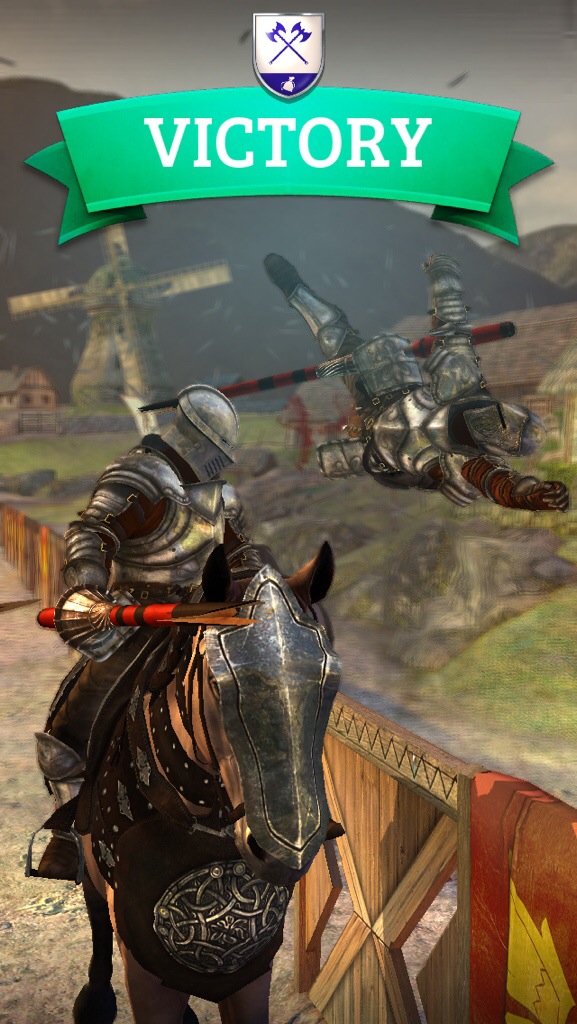
What does it take to make a game? Not all that much, it seems. Take a rhythm action section, consisting of eight taps on a screen, then add a few seconds of drag-to-target and voila! You have new free-to-play offering Rival Knights (Gameloft, iOS and Android).

Oh, all right, there’s a bit more to it than that. This game of jousting knights is deepened by an item (mail, helm, lance and steed) collecting element that improves your abilities, and it’s polished by some fine design, graphics, audio and physics. The latter element is particularly satisfying, as a successful strike sends your opponent ragdolling through the air.

Still, the core of the gameplay comes down to the joust itself, and given that each joust lasts around ten seconds or so and will be repeated many, many times by a player seeking to advance through the single- or multiplayer modes, it has to be refined to a high degree. Luckily, it is. While the mechanics can be made more difficult by the wrong equipment, they provide satisfying rewards for increasing expertise.

That equipment affects the three measures that decide who wins a joust. Armour is largely decided by mail and helm, though it, along with the other measures, can be boosted by a critical hit. Speed is based on your horse and modified through the rhythm-action segment. Attack Strength is based on your horse and modified by your accuracy in the targeting segment. Win two out of three and you win the lot.

Being a free-to-play game, players can spend some money to purchase in-game cash or the game’s premium currency: gems. Gems allow you to buy special equipment to get a head start in both game modes, though you can play with the standard items without feeling short-changed. You can also use gems to reset the timers that control how often you can play, though they fill quickly enough on their own. If you’re trying to hit the top of the daily leaderboards in the multiplayer mode, though, spending gems gained either in-game or through purchases might sound appealing.

So we have some simple, yet rewarding, game mechanics at play and a relatively nonintrusive payment system. What really sets Rival Knights apart is the amount of detail and polish Gameloft has lavished on it. The graphics are top-notch, and though there’s only one jousting field, differing times of day and weather conditions (none of which have any effect on the gameplay) boost variety.

Even more variety comes through the equally attractive equipment you can collect, which extends to designing your knight’s coat of arms. I’m getting into the third of five tiers of the single-player game and there are still plenty of opportunities to mix and match equipment to find a successful blend of armour, speed and attack strength. Even lower-tier equipment remains useful in the multiplayer mode.

Still, it’s not a terribly deep game, just a fun one. The multiplayer mode relies mostly on daily leaderboard challenges, with an asynchronous knock-out competition offering some secondary fun. It’s a bit loose and while it offers rewards to dedicated players, it’s not as big a draw as the single-player mode yet. Worse, the networking behind the multiplayer is pretty flaky at the moment. While this will probably be smoothed out soon, it’s annoying right now.

The only real worry I have with regard to the game is the impact of all that shiny graphical wonder on my iPhone’s battery. Sure, it looks beautiful on an iPhone 5S, but the way the phone heats up proves just how hard its graphics chip is being pushed. As a result, playing regularly through the day is going to burn through your charge. So while you might enjoy the life of a knight on the tourney circuit, it’s best not to stray too far from a plug socket while you do so.

Commit to the Insanity

No sign of Varney ... yet.
Back when something dreadful genuinely cost only a penny…

It’s been a surprisingly good year for mainstream cinema so far. We’ve had the best Disney animated movie in years (Frozen), a monster movie that knew it was a monster movie and played to its strengths while referencing 2001: A Space Odyssey and getting away with it (Godzilla), a superhero movie that managed to be way smarter than it had any right to be (X-Men: Days of Future Past) and another two that were way more fun than they were intelligent (Captain America: The Winter Soldier and Edge of Tomorrow), and even an arthouse biblical movie that was one of the weirdest mainstream releases in years (Noah).

Sure, there have been clunkers (Transcendence), overrated local offerings (Calvary) and blitheringly stupid drivel (The Amazing Spider-Man 2), but largely, things have been good. The film that I’m looking forward to the most, though, is Guardians of the Galaxy, not due until August. Why? Well, there’s a great sense of fun about the trailers, but beyond anything else, it looks completely bonkers.

Marvel’s movies have eased cinema audiences into the superhero mindset: from the vaguely realistic Iron Man to the space gods of Thor, the weird science and period setting of Captain America, and the alien invasion of Avengers. GotG, though, has a talking racoon with a really big gun and an ambulatory tree with violent tendencies. It’s Narnia and Lord of the Rings meets Star Wars, and if it’s a success it’ll be the biggest vindication of Marvel’s strategy to date.

My anticipation of the sheer insanity of all of this is something I’ve noted cropping up all over the place lately. While I enjoy straight drama as much as anyone, there’s something invigorating about entertainment that recognises its limits and takes a big hairy step beyond them. The kind of TV or film that can genuinely take you by surprise with its refusal to hew to well-worn plots and character archetypes.

It can be a tough approach to take though. The slightest hint that the writers or cast are winking at the audience and the whole thing can become uncomfortably camp. Take as an example the movie League of Extraordinary Gentlemen. Based on an Alan Moore comic series that was itself a perfect example of storytelling beyond the bounds of reason (Victorian fiction’s finest team up to take on Professor Moriarty, Fu Manchu and Martians), it was turned into a movie that missed the mark all over the place. Most notably Sean Connery’s starring role as a character who clearly knew he was the star.

All the stranger, then, that where the LoEG movie failed so badly, there’s currently a TV series treading the same ground (filmed in Dublin no less) that gets a whole lot right. In Penny Dreadful, there are vampires, werewolves, Frankenstein (both doctor and monster), Jack the Ripper, big-game hunters, Egyptian deities and consumptive prostitutes, all thrown together in an over-the-top stew. It succeeds for a few different reasons: a consistent tone of darkness (slathered with gore), characters who are buried neck-deep in their own failings and committed anchoring performances from Timothy Dalton (who seems to be enjoying the latter part of his career far more than the early part) and especially Eva Green.

I had previously watched and enjoyed Dracula, a similarly bonkers TV series that mixed the Prince of Darkness with Thomas Edison and Nikolai Tesla and threw in Freemasons and Buffy the Vampire Slayer, yet never quite managed to make it all gel. Penny Dreadful is working a lot better so far, despite its tendency to have every one of its characters get emotionally or physically involved with as many of the others as possible.

It’s not the greatest TV show ever made, and it’s not going to threaten Game of Thrones or Person of Interest atop my to-view pile, but there are plenty of reasons to catch an episode. In fact, I can only think of one real reason not to, and it isn’t the buckets of gore thrown all over the place. It’s poor old Billie Piper, as the aforementioned consumptive prostitute (a role she really doesn’t want to get typecast in), who is saddled with one of the worst Belfast accents I’ve ever heard. One can only hope it’s less painful to those of you who didn’t grow up in Northern Ireland…