Category Archives: Reviews

Pluribus: Anhedonia and the Hive Mind

What does it mean to be happy? Is it being free of cares, or does that merely grant calm and contentment? Is it losing yourself in the moment, enraptured by music or art, or is that mere euphoria? Or is true happiness only found in the love we bear for others, whether family, friends, or partners?

Vince Gilligan’s new series, Pluribus, seems to be digging into this question, among many others, and I’ll admit that I’m fascinated. Both on a personal level, as someone who finds happiness hard to define and achieve, and as a writer who enjoys fiction that engages with knotty questions about human nature.

(Naturally, there will be spoilers below the cut. Pluribus, though not quite finished with its first season, is well worth knowing as little as possible about before tackling.)

Continue reading Pluribus: Anhedonia and the Hive Mind

July 2025 Reviews

I’m going to start trying to write again, so a regular blogging habit might help with that. Reviews won’t be all of it, but I’m fond of my old three-sentence review format. Let’s see if we can get some more mileage out of that.

The Surfer (2024 film, Lorcan Finnegan)

The Surfer is an Irish-Australian production from director Lorcan Finnegan that provides a vehicle for Nicolas Cage as a man who views buying his childhood home as a potential solution to a life falling apart at the seams, only to face hostility to an absurd degree from the locals. That’s an incomplete, if not to say entirely misleading, description of a film that has clever and interesting things to say about the pressures that men face and the maladapted ways that many choose to cope with them. However, for me at least, the film gets off to the wrong start by making Cage’s character completely unlikeable, rendering the first two thirds of the movie a depressing slog, no matter how well thought out it is.

Ithaya: Magic Studies (2025 PC game, Blue Turtle)

Ithaya: Magic Studies is less a game than it is a study or work aid, but it’s so well put together by blueturtle that it’s both entirely enchanting and well able to perform its chosen task. The “narrative” sees you, as Ithaya, arriving at an ancient city to study magic, and the systems of the game slowly unlock the world surrounding the city as you devote tasks and time to the underlying organiser. The lack of pressure from the mechanics and the appealing nature of the art and audio means that there’s plenty to appreciate and explore, and I’ve already devoted more work to it than I’ve managed in multiple months beforehand.

Andor (2025 TV show, Disney+)

Of the various spin-offs of Star Wars that have appeared in recent years, none have received the same acclaim as Andor, a two-series show from Tony Gilroy, which serves both as a prequel to his film Rogue One and as a deep dive into the mindset of people making the decision to resist an authoritarian state (hmm, wonder why that feels relevant). As someone who wasn’t a huge fan of Rogue One, I’ve enjoyed Andor to a much greater degree, with its longer format providing the chance to dig into its characters, their troubles, and the inevitable costs that raising a rebellion incurs. There can be few countries around the world that don’t have some revolutionary history of their own to speak of, and for all that it feels distant from the mainline Star Wars offerings, Andor speaks to a broader human experience and may well endure all the better for it.

Blue Prince (2025 PC game, Dogubomb)

I gave up on Blue Prince not long after starting it: Dogubomb’s puzzle game is structured in such a way that it requires an investment of effort and thought to get over the initial hurdle of bafflement. As someone who tends to solve puzzles by brute force (or ignoring them for extended periods of time), this isn’t a puzzle game exactly suited to me, no matter how much I might enjoy taking notes as I progress through an ever-changing mansion of rooms with multiple meanings, hidden treasures, and unguessed-at secrets. I don’t want to spoil too much, as this is one of the deepest games and the most carefully crafted titles that I’ve come across in many years, but if you have the patience (and an ability to think laterally), you might just have a lot of fun digging into the foundations of this mansion of madness.

A City on Mars (2023 book, Kelly & Zach Weinersmith)

Fans of Zach Weinersmith’s webcomic Saturday Morning Breakfast Cereal will already know of his deep interest in science of various flavours, and A City on Mars stands as an excellent follow-up to his and his wife’s Soon-ish, a review of the reality or unreality of various upcoming technologies. In A City on Mars, the Weinersmiths pick apart the various arguments in favour of settling Mars (or space in general) and try to get to the reality of the new life that often gets hyped up by over-promising tech bros. The result is a highly entertaining and gently chastening book for anyone with the vaguest interest in space or the future of humanity, at the same time offering solid proof that humorous is not the opposite of serious.

Thunderbolts*—Punch the Dark Away

It’s been a while since I came out of a Marvel movie with anything more than a feeling of having been adequately amused. Like a lot of other nerds and comics fans, I got caught up in the initial rush of not only comic book movies done right, but a comic book universe splashed across the big screen in release after release. We had a roller coaster ride for ten years, with the payoff of Avengers: Endgame to complete it all, and then… it kept going.

(Spoilers for Thunderbolts* below.)

That it kept going wasn’t in itself the problem. The problem was that there didn’t seem to be a solid reason for it to keep going. The success of telling an increasingly coherent story over the first three “phases” of the “Marvel Cinematic Universe” necessitated some sort of structure to what came next, but the MCU as such had started with only the vaguest hints of an endgame, whereas the next saga was instantly anticipated but largely left hanging in the movies and television shows, outside of a nebulous concern with the multiverse, a concept broad enough to cover any potential stories but hardly one to stir audience interest.

With a mix of tentative new stars and second-stringers stepping up to prime time, the MCU went on struggling to fill its sizeable shoes, usually managing to deliver that adequate entertainment but increasingly losing the buzz it once had. In this growth-obsessed world, holding steady (or worse, slight declines) don’t cut it. To audiences and studio bosses, the MCU was starting to look a little shabby.

This is the ground that Thunderbolts* steps into. Presenting a collection of Marvel’s broken toys in a story of betrayal and despair, it’s a surprisingly bleak little offering. Yet in contrast to what I’ve heard of the preceding MCU movie (Captain America: Brave New World) it does seem that Thunderbolts* at least knows what it’s about and how to stick to its guns. Because I came out of a showing last weekend not only adequately amused but wholly charmed.

Much of this, of course, is down to Florence Pugh. Playing Yelena Belova, the grieving, self-loathing sister of Scarlet Johansson’s Black Widow, she’s rightly kept at the core of the film, her path towards acceptance and her growing awareness of the suffering of others as important as the occasional beatdowns she inflicts on anyone unlucky enough to get in her way. She’s a magnetic presence, nakedly emotional against the Marvel tendency to be ironically cool.

Along the way, Pugh gets to pinball off (both literally and figuratively) some of those aforementioned broken toys: Wyatt Russell’s U.S. Agent, a similarly self-loathing replacement for Captain America; Sebastian Stan’s Bucky Barnes, stuck in a job he can’t stand and desperate to punch someone; Hannah John-Kamen’s Ghost, a mercenary with phasing powers (and the one character underserved by the story); and especially David Harbour’s Red Guardian, Yelena’s bombastic but failure-addled super soldier father.

And then there’s Bob. Now, I have to admit some bias here. Bob Reynolds, aka the Sentry, is one of the more divisive Marvel characters among fans. Created as a Marvel mirror image of Superman and often used to explore the terror of godlike powers in the hands of an unstable personality, the Sentry rubs some people up the wrong way, especially as his origin retconned him into decades of Marvel continuity. Here, that isn’t a problem, but I have a lingering affection for a character I’ve followed since his creation, and I was fascinated to see how the MCU would treat him.

As it turns out, Thunderbolts*, in the hands of director Jake Schreier and writers Eric Pearson and Joanna Calo, very much knows what it’s about with Bob and his terrifying alter ego. From the very first moments, when he appears amnesiac and confused in the middle of a fight to the death between Yelena and some of the other broken toys, to Yelena’s quickness to ascertain that things aren’t quite right with him and her first instinct being to help, we’re clued into the notion that Bob is important, not just for what he is, but simply for who he is.

So when we get to the grand confrontation with the villain and ensuing punch up that normally marks the denouement of a Marvel movie, Thunderbolts* is ready to start twisting the script. First of all, it’s not much of a fight. The broken toys are hopelessly, hideously outclassed by the Sentry, who even saves their lives during the fight when he might have accidentally killed them instead. Bob, it seems, doesn’t want to kill people he knows, even if the only way some of them know to get through to him is punching.

There’s an oft-quoted Terry Pratchett line that I’m going to mangle here: “Sin, young man, is when you treat people like things.” That theme seems to run through the background of the movie—I can’t imagine that at least one of the writers didn’t know that line. The broken toys are treated as things to be discarded by Julia Louis-Dreyfus’ Valentina, then Bob is treated as a prize to be used (to save her ass) and then discarded when he turns dangerous. It’s treatment that causes only hurt and makes the world worse, and it unleashes the dark flip side of the Sentry, the Void.

This kind of broad-strokes storytelling of the light and dark side of a personality can fall very flat if not handled right, but the movie stays on target. As the Thunderbolts were outmatched before, so they are now. All they can do is try to save people from the Void’s wrathful self hatred (did we forget that the fantasy of the super hero is that someone is coming to save us?), and ultimately try to save Bob from himself.

There is only a little punching at the end of Thunderbolts*, and it’s a terrible thing. The victory of the climax is that we get to a point where punching isn’t necessary. Where the characters realise that it doesn’t help, and that what they are there for is to help. It’s a surprisingly uplifting, lighthearted turn for a movie that spends so long looking at self loathing and despair, but it’s all the more earned for that.

I’m not saying it’s a perfect movie. There’s more than a bit of clunky exposition, certainly more than I was comfortable with, and one or two characters were poorly served by the script, but overall this is one of the bigger Marvel successes in a while. The series as a whole may yet get sucked back down into the maw of chasing those post-Endgame highs, but for now it’s shown that it can still make good use of its broken toys.

Long Walks on Strange Planets

I don’t know where I am. This is a strange world to me, and unkind. I have no memory of how I came to be here, but in exchange for this amnesia, I have been given technology that shields me from the harsh surroundings. It is greedy for fuel, but it suffices. I can explore.

Way back in the long ago of 2016, a game called No Man’s Sky was released. Its launch was accompanied with a huge amount of hype and an equal amount of disappointment. The promise of multiple galaxies worth of exploration was undermined by a lack of things to do and procedurally generated worlds that were unique in their details but repetitive in sum. Add to that a lack of functioning multiplayer gameplay and No Man’s Sky was, at launch, a vast expanse of loneliness.

Near where I came to consciousness, I found a crashed ship. Half wrecked and unfit for the skies, it seemed an omen of a past better forgotten. I chose to leave it behind and struck out instead in search of habitation. From local plants and rocks I can keep the technology that preserves me fuelled. This world is severe, but it sustains me.

Over the next few years, Hello Games, the developer of No Man’s Sky, released a stream of patches and updates for the game that expanded the things a player could do and added variety to the countless worlds. (Thus making No Man’s Sky one of the few things on this benighted planet to have improved continuously since 2016.) And somewhere along the way, I jumped on board. I woke on a strange planet and set out to explore the worlds beyond.

This world is not untouched. I came across an abandoned facility, built who knows how many years ago. Buried in its technology, I came across a signal. Somewhere across the hills and valleys of this world, a distress signal still calls out. My existence has been graced with a direction.

Since then, it’s become one of my more-played games. I’ve explored through many updates, constructing an array of bases across many worlds, and managing a fleet of fully upgraded ships from my capital ship. I have, in other words, done pretty much everything the game has to offer. For the past year or so, I was only dipping back in whenever something new was released.

There are techniques for survival that this world has taught me. Carbon and Sodium will serve to maintain life support and power, but it is more efficient to craft fuel cells and life pods for these purposes. To do so requires delving into caves in search of rarer minerals, which also offers the benefit of temporary protection from the harsh environment of the surface. However, the caves extend for many miles and not all paths lead back to the harsh light of day.

This is the problem of procedurally generated content. After a while, you’re just going to be seeing variations on what you’ve seen before. A new gameplay loop, such as the corrupted sentinels and sentinel ships introduced in the last update, “Interceptor,” can be woven into the setting, but any narrative essentially sits on top of the game world. My bases and ships may be all my own work, but the story I’ve experienced is the same as anyone else’s.

My efforts to survive on this world are not unopposed. There are sentinels here that object violently to my plundering; robotic guardians that float in peace across the surface but gather in wrath when I transgress. I have learned to avoid their gaze and so endure. The few other aliens I have encountered have been isolated traders or scientists. I lack a language they would understand, but I have been able to trade with them for credits and equipment that might serve me later.

An answer to this dilemma recently presented itself. Watching a YouTuber’s public play session, I saw a new option for a new game: ignore the starter ship. Rather than accept the nearby crashed ship that the game directs you towards, head out into the wilderness and look for other options: follow a distress signal to a crashed ship, come across a crashed ship by chance, or find a trading post and buy one of the ships that lands there.

The distress signal that I follow is far distant, but my journey grows swifter. Scavenged technology has improved both my survival suit and my mining tool. My jet pack now carries me across narrow valleys and cushions my descent from great heights. My scanner can now detect buildings at a greater distance. Still, I must not be careless. Even with these improvements, I could easily die from a fall or neglecting my protection or sustenance.

The first time I tried this, I got lucky. A distress signal pointed me to a crashed ship only an hour’s travel away. Quite quickly, I was spacebound, trading in my scavenged ship for a pristine model and prospering across several systems. However, the sense of immersion in the world for that first few hours was so impressive, that I decided to up the difficulty. I started again in Survival mode (in which several basic technologies are unavailable at the start) and Iron Man (one life only, with the save game deleted on death). The result was interesting…

I wish I could convey to you the feeling of skimming millimetres over a ridge line, then landing soft-footed on the next peak. To clamber to the top of a mesa in order to survey the land for miles around, then cast yourself to the winds and direct your fall wherever you wish to go. To play hide and seek with implacable robotic guardians, like some scavenging imp. This world is harsh, yes, but there is joy here. Still, I have travelled for many hours and my quarry feels as far distant as ever.

This time, I started on a desert world. I quickly located another distress signal … 18 hours travel away. No problem, I figured, I’ll head that way and find another signal or a crashed ship along the way. Several game sessions later, and every distress signal pointed the same way. I’d enhanced my suit and mining tool with the technology I’d found along the way, but it looked like I was in this for the long haul.

In the shadow of a wrecked freighter, I came across a trading post. I’d gathered credits and hoped to bargain for one of the ships that landed there, but it seemed that what I owned was insufficient. Until I remembered one other thing I possessed: knowledge of the location of the ship I had abandoned. A trader in a small scientific vessel was willing to accept the prospect of salvage in addition to everything else I offered. I was no longer bound to the surface of this world.

About halfway through my trek, I picked up the signal of a crashed freighter. It was a bit of a detour but not too far away. So I ventured that way and picked over the gigantic ruin. On the way back to my route, I stumbled across a trading post. In No Man’s Sky, this is one of two kinds of places (the other being the space port that most systems have) where you can be guaranteed to encounter landing ships. I initially scavenged in the area for valuable goods to increase my credit count, but when I realised the trade-in value of the starter ship, the skies belonged to me.

I do not know where I will go now. I do not know if I have a past to discover. I do not know how far this universe I inhabit extends. But I will never forget the world on which this life of mine began.

Ultimately, once you’ve made it into space, the game’s story reintegrates with the rest of the NMS experience as crafted by Hello Games. But that first world? The struggle to survive and find a way off the surface forced me to actually engage with the starter world, to write a little story of perseverance in my own head. And that story is unique and solely mine. It’s opened my eyes, and the next time I go back to a game I feel I’ve played out, I’ll first ask myself how changing just one rule might change the narrative.

Celluloid Cubes

Way back in the distant past of 2000, there was a movie called Dungeons & Dragons. It was a pretty big deal at the time, with a substantial budget, plenty of flashy CGI, and a cast that included Jeremy Irons and a then-hot Thora Birch (hot in the sense of fame, for clarity’s sake). It was also, unfortunately but deservedly, a rather massive flop

Treating the fantasy trappings of the game it took its name from as an embarrassing necessity, its mix of overwrought portentousness and slacker humour didn’t work at all. D&D crashed and burned, failing to make back its original budget (not even accounting for what I remember as a substantial marketing campaign). It was enough of a flop that it could have killed off fantasy movies as a genre for a decade, were it not for the small matter of The Lord of the Rings: Fellowship of the Ring coming out the next year. As it was, the D&D film series limped on with a couple of direct to DVD sequels before being put out of its misery.

Well, now we have a new D&D movie, in the form of Dungeons & Dragons: Honor Among Thieves, and it’s coming out into a very different landscape. Not only is fantasy as a genre both more diverse and more respectable, but D&D and roleplaying are actually kind of cool at the moment, courtesy of cameos in Stranger Things and real-play series like Critical Role. And, wonder of wonders, HAT (they might have thought a little harder about that acronym) isn’t just a good movie, it’s also a riotously fun one.

Spoilers below the jump…


Sure, the film is stuffed with CGI, but that CGI is actually used to recreate elements of the Forgotten Realms setting from D&D that players would recognise, and those elements are used as functional parts of the narrative, not as embarrassing set dressing. (The beholder from the original movie can make me cringe at a distance of two decades.) As the action hops from location to location, each one is colourfully depicted and the various fantastic beasts that show up all have a good amount of heft to them.

Cleverly, the writers of the movie have hung the story on a familiar movie form: the heist. The main characters have to run a scam on a former friend and in order to do so they have to gather a team, case the joint, make a plan, deal with setbacks, collect necessary equipment, etc. Any halfway ciné-literate viewer will catch on to how things are supposed to work, and that allows them to just sit back and enjoy the ride. A ride that takes them on a whistle-stop tour of the Forgotten Realms, complete with encounters with the undead, dragons, and Red Wizards, not all of which are hindrances to our heroes’ quest.

The lead heroes in question are Chris Pine as bard and spy Edgin, who is only marginally handy in a fight and slightly better at making plans, and Michelle Rodriguez as barbarian warrior Holga, absolutely the combat specialist of the two and devoted friend to Edgin and surrogate mother to his daughter. That shared devotion provides the emotional hook for the plot, driving the heroes into and through their heist and counterpointing a personal motive against the more traditionally grandiose plans of the villains. In fact, the conflicting web of motivations is one of the strongest points of the movie: everyone’s reasons for what they’re doing are kept clear and consistent, right up to the inevitable but satisfying conclusion.

For D&D fans, there’s plenty of fun in spotting the many and varied call-outs to elements of the game’s lore, both Forgotten Realms-specific and otherwise, but what really makes the movie sing is how it uses now-recognisable elements of the roleplaying experience to enliven the action. The heist itself, with its many setbacks and impromptu plans, resembles closely many roleplaying sessions of my own experience, in which players came up with outlandish plans that got themselves into trouble (with or without the help of the dice), which they then got themselves out of via even more implausible plans. There were times in the action when you could feel the fumbles and criticals being rolled.

Special mention needs to be given to Regé-Jean Page’s extended cameo as the paladin Xenk Yendar. The “lawful-good” alignment in D&D is often jokingly referred to as “awful good” and paladins portrayed as dour enforcers of divine will, but Page brings a warmth and humour to his portrayal while still being the perfect paladin. It’s an impressive achievement and one I want to catch again on a rewatch. For many, I suspect Page will be the highlight of the movie.

All the above is only a very quick and incomplete stroll across the highlights of the movie. D&D: HAT is a surprising riot of a film, and it’s one that should manage to entertain both fans of the original game and people who don’t have the first notion of what a displacer beast is. Go see it, relax into it, and enjoy the ride.

Wandavision—Absolution, Forgiveness, and Redemption

If the global virus of the past year has been good for anything (other than billionaires), then it’s been good for the Marvel division of Disney’s entertainment megaplex. Not long after their ten-year story hit its climactic peak with Avengers: Endgame, the world got dropped into an enforced hiatus. As a result, instead of risking saturation of the market, Marvel got to take a break that Disney would never have allowed and instead begin its new era with smaller-scale TV offerings.

Moreover, those TV series themselves got rearranged in favour of those that could be filmed on closed sets, so instead of leading with the more traditional action offering of The Falcon and the Winter Soldier, Marvel kicked off phase four with the much stranger, much more personal Wandavision. Which, as its nine-week run unfolded, proved to be a tale of trauma and the harm that can spill out from it.

In an era when binge-watching has faded from prominence, but in which people are as eager as they’ve ever been for new media to consume, Wandavision was discussed and dissected endlessly online across its run, not just among Marvel fans but among more casual viewers. It’s mostly great in my opinion, so if you haven’t watched it, don’t read any further, as I’m mostly going to be talking about the ending.

Continue reading Wandavision—Absolution, Forgiveness, and Redemption

Freshly Baked Reviews — January 2021

A few years back, I was in the habit of writing regular reviews on this blog. Covering games, books, and movies, the poorly explained schtick of the reviews was that I limited them to three sentences each. This both leaned into the fact that this was more or less my job for over a decade (compressing information into tiny packages, not writing reviews) and was a fun writing exercise, even if it did occasionally lead to long run-on sentences.

Anyway, after a 2020 that proved very hard for writing, I figure it’s worth my while to develop a better writing habit, and returning to something that was once fun seems like a good start. So expect a few more of these review bundles in the months to come, but in the meantime, here’s what I thought of four movies that I managed to catch over the Christmas break.


Soul (Pete Docter)

Pixar’s latest musing on the nature of life, the universe, and everything may not have been the biggest movie to be released online-only at the end of the plague year, but it wasn’t far off the top of pile. Telling the story of a teacher and aspiring jazz pianist who finds himself hovering between life and death just as he gets his big break, it sets its characters to explore the question of what life is for: a single grand purpose or the simple joys of existing day to day. It shouldn’t come as a surprise that Docter, who also directed Up and Inside Out for Pixar, lands on the latter option as the best one, and while Soul’s message might prove a little straightforward if you’ve already spent part of your life considering it, Soul tells its tale with warmth and humour and is definitely worth checking out.

Wonder Woman 1984 (Patty Jenkins)

Okay, so this movie was the biggest online-only release of the festive period, made all the more notable by Warner Bros’ decision to shift its entire slate online in 2021, and it’s just a shame that WW1984 turned out to be a colourful mess of a film. The first Wonder Woman cannily cast Gal Gadot as a fish out of water hero, but despite the sequel being set some seventy years later, there isn’t any character growth to be seen, and Gadot and her talented supporting cast find themselves tumbling through a series of set pieces that are barely connected by the central conceit of granting wishes with dark costs. WW84 has clearly suffered from its many delays and the chaos surrounding the DC cinematic universe, and the result is a colourful and occasionally exciting shambles that doesn’t build on the success of its predecessor.

Tenet (Christopher Nolan)

If the pandemic year had a tentpole film, it was Christopher Nolan’s time-twisting Tenet, which Nolan fought to get into cinemas and which proved to be divisive on its release. Nolan’s success over the years has seen him lean increasingly towards structural complexity, as seen in Inception and Dunkirk, and Tenet pushes that habit further still, to the point where the structural games overwhelm character development and even plot clarity. Tenet is certainly a spectacle, but its drabness is only really alleviated by Robert Pattinson’s louche secret agent, and while repeated viewings might provide insight into its depths, there might not be much impetus to watch it again if it fails to engage and inspire on first viewing.

Wolfwalkers (Tomm Moore & Ross Stewart)

Arriving just as the year was ending, in a small scattering of cinemas and on Apple TV+, Wolfwalkers is a spellbinding animated tour-de-force, set in a myth-soaked vision of the Irish past. Cartoon Saloon’s film tells the story of two girls—a hunter and a “wolf walker”—who connect amid the turmoil of Cromwell’s occupation of Kilkenny, with animation that sweeps and shifts in stunning hand-drawn fashion as the characters shift from human to wolf and back. Undoubtedly the artistic high point of all the films I’ve seen in the past month, Wolfwalkers benefits further from heartfelt performances from its voice actors and a story that invests viewers in the survival of the wolves and wolfwalkers as a vision of a threatened, romantic land.

The Matter With Britain

These are dark days for Britain. As chaos engulfs the land, a venal and vicious ruler has risen up, interested only in seizing power by whatever means are at hand. Some have sunk into despair while others have abandoned their morals and thrown in with their twisted rulers. Amidst collapse, disease, and the dying throes of a nation turning in upon itself, you must gather your courage and your friends and make your way to the Field of Camlann, where King Arthur awaits your aid.

Wait, what did you think I was talking about?

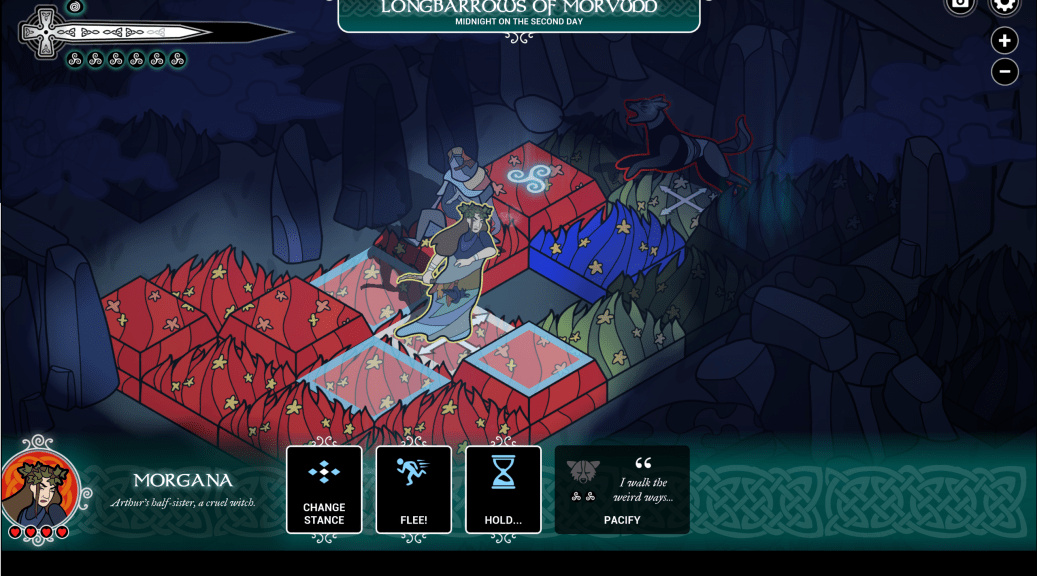
Inkle Studios’ newest game, Pendragon, arrives at a fortuitously relevant time (for it). Its themes of loneliness, loss, and struggle in the midst of desperate times might cut a little close to the bone for some players, but that struggle also heightens the rewards of connections both new and renewed and reminders that hope is never entirely lost.

Inkle has a strong heritage in narrative games, with both the wonderful 80 Days (if you’ve never played it, seek it out—on almost any platform at this stage) and the more recent Heaven’s Vault, an archaeology-themed translate-‘em-up that’s only available on PC but is highly rewarding for those willing to delve into its science fiction worlds. Pendragon is a game on a smaller scale than Heaven’s Vault but it’s just as creative and rewarding.

The core gameplay of Pendragon consists of a series of chess-like encounters between Arthur’s followers, friends, and family as they crisscross Britain in their quest to reach Camlann before the once-and-future king’s final encounter with his bastard son, Mordred. A single play through of the game takes less than an hour in most cases, but with the opportunity to tackle different difficulty levels, unlock a variety of starting characters, and experience the twists and turns of the game’s narrative engine, there’s ample encouragement for replay.

The chess-like gameplay strikes a careful balance between being too intimidating and too simple. The basic concepts of threat and territory control are easy to figure out and amply signposted by the interface, with the special skills of certain characters suggesting particular strategies. Each encounter takes place on a limited battlefield, and though it can become crowded with enemies, their abilities and preferred tactics are likewise clearly signposted. Every battle provides the information that the player needs to win it, though victory isn’t always possible, and sometimes necessity or failing morale will see you fleeing the field.

In fact, victory is rarely a simple matter. Learning Pendragon takes the player along a specific path: First, learn the basics and simple strategies. Then learn to think a few moves ahead so that you don’t end up in a trap. Then learn how enemies act and where their weaknesses are. Then learn how to lure them into traps and dispose of them safely. Then … well, that’s as far as I’ve gotten so far. I’ve yet to even hit the middling difficulty levels.

Amid all of this tactical back and forth, Pendragon’s story engine does its best to weave a compelling tale. Each starting character has their own reasons for seeking out Arthur. You begin with the disgraced knight Lancelot and his lover Guinevere, both freighted with guilt, but other collectible characters who join on the journey do so out of a love of battle, a need to make amends, or sheer vicious spite. In addition to these main characters, there are others who may become your allies, their motivations created randomly and shifting in response to the choices you make.

These characters join you both on the battlefield, where their own skills open up new tactics, and around the campfire, where tales can be shared each evening of knights, faeries, and other Arthuriana. One of the game’s greatest strengths is how well it nails the feeling of the Arthur stories. The ultimately doomed nature of the best intentions in the face of time and dissolution is a recurring theme within both the original stories and Pendragon’s Britain. The world is unkind, and it only takes one person with bad intentions to make it far worse. Only through trust and determination can something better endure.

Mechanically, Pendragon has clearly been honed through multiple iterations. The short duration of each attempt at the game is a priority, with the constantly depleting morale counter pushing the player ever onwards. Characters can sacrifice themselves on the battlefield, to be rescued when the day is won, but this is a trick that can only be repeated so many times, with the food that extends its use always being in short supply.

In short, even on the lower difficulty levels, Pendragon instils in the player the sense that they’re racing against time. Both within battles, due to that falling morale, and on the longer journey as food runs out. Even once Camlann is reached, the pressure of time remains as you face Mordred, who grows stronger as the final battle proceeds, regardless of who faces him.

Mordred is, perhaps, the game’s biggest weakness. Depending on your character’s talents and the randomly generated battlefield you face him on, it’s possible for the final battle to feel unwinnable (in some cases it can even be unwinnable). This is exacerbated by the decision in this confrontation to remove the need to confirm moves, which is present all through the rest of the game. Changing the gameplay in such a way seems an oddly artificial way to up the stakes, and all it achieved was to annoy me when I lost twice to Mordred as a result of misplaced clicks. To have a quest end in such an anticlimax undercuts all the hard work done by the game’s narrative.

In a year like 2020, Pendragon will either match your mindset or undercut it. With its themes of learning how to cope with adversity, of maintaining the struggle even when things seem bleakest, it might feel a little too downbeat for some. For me though, the atmospheric narrative and gorgeous stained-glass art style kept me going through the initial stumbles of plumbing its gameplay depths. This is a tale of camaraderie and persistence in the face of a crumbling world. We could all do with a little of that.

For the moment, Pendragon is only available on PC and Mac, but it’s not an expensive purchase. Moreover, I wouldn’t be surprised to see it follow 80 Days onto a range of other platforms. If it drops onto one that you frequent, do take a look.


Cancer Update

I’m not as good at keeping this blog up to date as I was in the LiveJournal days. Sorry about that. The good news to report is that as of the most recent doctor’s visit, everything seems to be holding steady. I am a little worried about my medicine-induced low heart rate and the encroaching winter combining to turn me into a hibernating blob, but my workplace’s decision to run a “Walktober” event is at least encouraging my more active habits. We’ll see how well that lasts when the weather turns nasty.

There is also the issue of the ongoing global bastard (as one of my favoured YouTube channels calls it). Numbers are spiking in Ireland, especially in the North, which means that I may become even more housebound than I have been in recent months. My immune system is okay, but avoiding any trouble for my lungs seems sensible. I hope you’re keeping safe too, wherever you are. If we’ve ever met or talked, rest assured that you’ve been in my thoughts at some point during all of this.

Wage Epic War

Apple Inc. is, by some measures, the biggest company in the world. From a near-bankrupt state in 1997, it has turned itself into a globe-spanning colossus, worth somewhere in the region of a trillion dollars. In an age of corporate technology titans, it’s been at or near the head of the pack for years.

And this week Epic Games declared war on it.

Not just on Apple either. On Google too, which along with Facebook and Amazon, forms a modern tetrarchy of technology. It’s a war that’s being fought on legal and public fronts, but exactly how does Epic plan to win? And how did these corporate David and Goliaths come to be at odds?

Founded in 1991, Epic Games started as a video game developer before segueing into developing the tools that others use to make video games, most notably its Unreal Engine game engine. Just as sellers of shovels made more money during Gold Rushes than most miners, so Epic did pretty well out of that move. Then, a few years ago, it released Fortnite.

You’ve probably heard of Fortnite. Even if you don’t play it, you know kids who do, or maybe just kids who watch video streamers who do. A free-to-play game with battle royale, creative, and cooperative elements, its in-game purchases have proved a massive cash cow for Epic, pushing the company’s valuation into the tens of billions.

With all that cash weighing it down, Epic decided to throw its weight around. Casting itself as Robin Hood, it first took on Steam, the dominant storefront for PC games, promising players cheaper games and developers a bigger cut of the revenue. The verdict on this ongoing war remains open, as while the Epic Games Store continues to host exclusive titles and offer free games to tempt new customers, many PC gamers are heavily invested in Steam. However, it’s now clear that this was just a warm up for Epic’s biggest fight.

Apple has faced years of criticism for its “walled garden” approach to releasing software on its iPhone and iPad devices. In short, if you want your software to run on an iDevice, you follow Apple’s rules and give Apple its 30% cut. While the ecosystem for Android devices is more open, the Google Play store, which has adopted similar rules and a similar revenue cut, is the quickest and easiest way to find and install new software. Hence, most users will use it.

This week, Epic said “nuts to that” and implemented a new feature in Fortnite, whereby users could make in-game transactions directly from Epic without giving a cut to Apple or Google. Apple swiftly removed Fortnite from its App Store: if you already have it, you can continue to play, but there’ll be no new users and no updates. Google followed suit not long after, delisting Fortnite from the Google Play store.

For players, the immediate impact is minimal. The difference will only really start to show when Fortnite’s new season begins. Unable to update, iOS and Google Play users will miss out on the new content. But Epic didn’t wait to let them know about it. Not only did they slap Apple and Google with a lawsuit accusing them of monopolistic practices, but they also hosted an in-game video that mocked Apple’s famous “1984” advert, arguing that Apple now held the same position as the corporate behemoths it once opposed.

It’s a fair comment. Apple is “the man” now, just as Google has long since ceased being a scrappy garage startup. Both companies have their share of questionable practices and wield ludicrous economic and social power. Yet the fact that Apple got a video whereas Google didn’t suggests that Epic is relying on public opinion being on its side in this fight. Specifically the public opinion of millions of young Fortnite gamers who might end up missing out due to this corporate spat over revenue sharing.

Apple’s argument is the same two-pronged one that it’s used to fend off anti-competitive arguments in the past. First, it built the App Store, and the host devices, and their operating systems. If Epic uploads a free-to-play game and makes billions through in-app purchases, it’s effectively freeloading if Apple doesn’t get a cut. To which Epic might respond, well, isn’t 30% a bit much? In their turn, Apple can say that the same rules apply to everyone, no matter their size. Epic might then point to Steam, which responded to the competition posed by Epic by implementing lower by altering its terms for revenue sharing. It’s a back-and-forth argument but not Epic’s strongest suit.

Apple’s second argument sees it on shakier ground: it controls its walled garden by checking the content it hosts. This has kept Apple’s App Store largely free from the knockoff apps and rubbish that plagued Android in the past, but it also means that the everything on the App Store has to be Apple-approved. With Apple having recently banned Microsoft and Facebook from hosting their own game-streaming services on iPad and iPhone, this is an opportune moment for Epic to draw attention to how Apple’s corporate culture defines what its users get to experience.

The stakes are high. Apple makes a good chunk of its earnings from hardware sales, and losing Fortnite could see it lose a chunk of those (it’s already facing threats to its Chinese market from Trumpian “diplomacy” to add to its vulnerability). On the other hand, Apple has more cash-in-hand than most countries and can weather the storm, whereas Epic is for the first time putting its cash cow at risk.

On the other hand, if Epic can’t quickly find acceptable terms with Apple and Google, some of its players and streamers might just move on. No game lasts forever as “the big thing,” and my own nieces and nephews are pretty happy with Roblox. Epic is not lacking in competitors who would be more than happy to carve off slices of the Fortnite billions.

Of course, Epic has its own war chest to fight this war, and the lawsuit against Apple and Google may prove to be nothing more than a negotiating tactic. After all, implementing changes to the law does require the presence of a justice system with the will to do so, and the U.S. has its own issues at the moment. Europe would be a more friendly venue in which to argue the merits of the tech giants’ market power, but that’s not where the lawsuit was served (as far as I can tell).

Which is where Epic’s social media strategy comes in. The video mocking Apple was a call to arms for Fortnite players to rally to the game rather than the platform. To think about a world where Apple doesn’t take a 30% cut of Epic’s earnings. Which, given that the game deliberately targets younger players with its marketing and in-game purchases, comes across as just a little bit skeezy.

Ultimately, this is a fight between companies worth billions about who gets how much money. Just because it’s the little guy doesn’t make Epic virtuous. As shown in its conflict with Steam, it’s quite happy to leverage its riches and fight dirty. Similarly, just because Google began in a garage and had a motto of “Don’t be evil” for years doesn’t make it the good guy either. And though I’ve been an Apple user for most of my life, I’m more than happy to see people calling it out when it’s getting things wrong.

This is particularly true in the area of games. It’s something that Apple has never quite got to grips with; a legacy of the Steve Jobs era. Now offering its own subscription-based games service, Apple Arcade, it looked dodgy in throwing roadblocks in front of Microsoft and Facebook. It’s a sore point that Epic has targeted, and it’s one in which Apple could do with reviewing its practices.

I’m just not convinced that there’s much more to this fight than money. There’s a possibility of a more even playing field that delivers benefits for consumers emerging from this spat, but believing in that takes optimism that’s in short supply in 2020. Epic wants more money, and it believes that it can force Apple and Google to the table. Time will tell if it’s calculated correctly, and in the meantime Fortnite users will be the ones to pick up the tab.

Fictionally Humane

The gameplay of Ion Storm’s Deus Ex, released twenty years ago, begins with a choice. Preparing to deal with a group of terrorists, the player chooses one of three extra weapons: a rocket launcher, a sniper rifle, and a mini-crossbow loaded with tranquilliser darts. Unusually for a game of that era, Deus Ex announced from the start that the player’s choices mattered.

On my first full playthrough of the game, I selected the mini-crossbow. I had already been an active player of roleplaying games for years at that point, and I was happy to play into the fiction of the game that those trying to kill you might have valid reasons for doing so. (The sniper rifle is the choice for players unconcerned with lethality, whereas the rocket launcher is best suited to taking out robots and inconveniently locked doors.) This fiction is carried through the game’s plot, in which the initial truths you’re presented with are undermined and other characters react to whether or not the player is happy to shed blood through the course of the game.

Although a seminal game in showing how player choice and morality could be integrated into games, Deus Ex proved a hard act to follow. It received only one sequel, and its 2011 prequel, Deus Ex: Human Revolution, received notable criticism for forcing players into unavoidably lethal boss fights.

One year later, in 2012, a spiritual successor appeared in the form of Arkane’s Dishonored. In this title, the player adopts the role of a vengeance-seeking assassin but the developers leaned into stealth as a mechanic and decided to provide the player with the opportunity to find non-lethal resolutions to all of their goals. Not that these are any less dark in some cases: one “fate worse than death” sees a society hostess and supporter of the corrupt regime delivered to an obsessed stalker as an alternative to being murdered.

The ten year gap between these very similar games presents a degree of progression. Deus Ex asked players to think about how they solve problems and whether casual murder can be justified within the fiction of the game. Dishonored asked that question again, and reinforced it by pointing out that just avoiding murder wasn’t enough to make you a good person. Vengeance takes you to dark places.

At this stage, I ought to point out that both Deus Ex and Dishonored are first-person action games. The player literally sees out of the eyes of the protagonist, so opportunities to distance themselves from the morality of what they’re doing are limited. Action-oriented first-person shooters, such as Halo or Doom, tend to either present inhuman enemies like aliens, demons, or zombies as cannon-fodder or lean towards the multiplayer experience, where the targets are usually other players and an immersive narrative is tossed out in favour of an arena atmosphere: you get shot, you respawn, it doesn’t really matter.

The multiplayer-focused Call of Duty series does engage with this issue but in a fashion that passes over player choice. A mission in Call of Duty: Modern Warfare 2’s single-player narrative sees the player participate in a mass shooting. The mission is flagged for “disturbing content” and players can choose how to interact, but the massacre happens regardless. The narrative requires the deaths to happen, regardless of player choice. They’re a necessity of the narrative, just as the mission itself is seen as a necessity on the part of the player character. No moral choice is made.

Step forward another decade or so and we come to 2020’s The Last of Us Part II.* Once again the protagonist is hell-bent on what initially seems to be justified vengeance. As with Modern Warfare 2, the player has no choice but to deal with the deaths they cause. Worse still (from the perspective of the player character), an in-game switch in narrative perspective does its best to rob them of any belief that their vengeance was just in the first place.

Admittedly, The Last of Us is not the same type of game as Deus Ex and Dishonored. It’s played from a third-person perspective and is less a playground for player creativity than a canvas for the creators to tell a story. It’s also unrelentingly grim in tone, and its apparent theme of just how much choosing to kill costs is one that many players seem to have resented confronting. Even so, it’s another step on the same spectrum: engaging in a work of fiction requires emotional investment, and regret, shame, and horror are all valid emotions to feel around making the choice to kill.

Narrative is one of the strongest tools that artists have to generate feelings in consumers of their art. We have literally centuries of practice when it comes to affecting emotions through stories and of making listeners, readers, and viewers reconsider their preconceptions. Video games, as an interactive art form, are much newer on the block, and it’s hardly surprising that they’re going to crib from what came before. The first few decades of film, after all, copied heavily from theatre until the new art form developed its own language.

Yet the linear narratives that other art forms have developed sit uneasily within video games. The Last of Us hews closely to linearity and while it clearly knows the story it wants to tell, it gives players little real moral choice. Even Dishonored, where the player has the freedom to devise their own solutions to problems, has a linear narrative to follow and an external marker of morality: the more murderous the player is, the more the city they inhabit falls into chaos around them.

Deus Ex had things easy, after a fashion. Technology wasn’t advanced enough to create realistically human opponents, so the moral choices facing a player had a level of abstraction. Ten years later, Dishonored provided a more sophisticated world with more sophisticated inhabitants, but it was still a playground of sorts. That twinge of discomfort when handing over Lady Boyle is one of the strongest memories for players of that game because they were forced to reflect on their choices. In that moment, they were reminded that whatever the narrative might tell them, they might not be wholly the good guy.

A decade further on and The Last of Us Part II is even more sophisticated in its world building and character portrayals, but its directed narrative might be a dead end. By all accounts it is an amazing achievement and perhaps a pinnacle for current-generation technology, but if the player has no agency in the choices the narrative makes, how powerful can the moment be when the game forces them to reflect on the morality of those choices?

This problem of ludonarrative dissonance is hardly new, and people within the games industry have been hacking away at it for years.** In these few examples, I wanted to take a look at how some games flag the choice to be a killer and how they can either lead or force the player to reflect on that. The technological capacity for doing so has definitely advanced over the years, and narrative sophistication has likewise grown, but it doesn’t feel like the two have come together yet. I wonder if and when they will.


*Having never been a person of the PlayStation persuasion, I haven’t played The Last of Us, but I have watched Noah Caldwell Gervais’s deep dive into the two The Last of Us games, which I heartily recommend.

** I specifically limited myself to a few examples to restrict the length of this piece. The Mass Effect series is one that deals heavily with morality within the narrative, though less so with the morality of killing.


Cancer Update

Yes, it’s been a while, I know. For what I hope are understandable reasons, my enthusiasm for writing anything here was at a low ebb for a while. Restoring my mental momentum took a while, and there was a recent recurrence of the whole coughing-up-blood thing that distracted me a bit too.

As a general overview though, I’m doing fine. A round of scans and another bronchoscopy found nothing too egregious (well, nothing that they didn’t already know was there) and I’m back on track, taking my medication and doing my best to dodge Covid by the simple expedients of wearing a mask, limiting the number of people I meet, and washing my hands (not all at the same time, admittedly).

My biggest worry for the moment is becoming a couch potato, which is all too easy when the couch in question is only two feet away from your work chair. Still, I have an isolation break to look forward to shortly, and in the face of Ireland’s fitful summer, it’s not so bad to be indoors. I’ll try to keep up with the posting in future, though no promises. In the meantime, I hope you’re all keeping well and safe.