Category Archives: Reviews

A Life in Comics

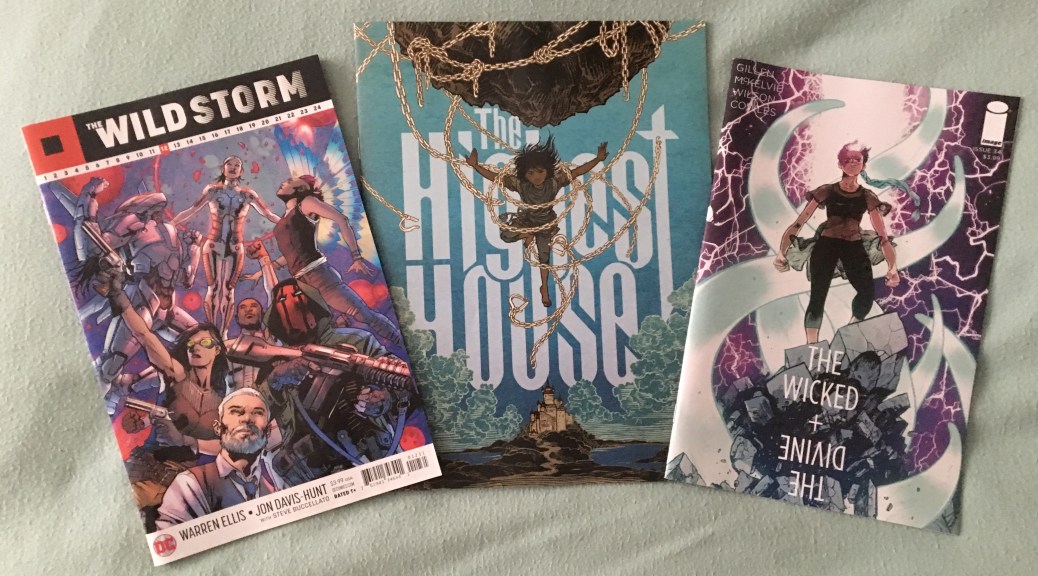
I started reading comics far enough back that I’m not sure of the exact age when I began. There have been ups and downs in the decades since then, but I still pop into a comic store every Wednesday to see if there’s something new worth reading. With the western comics industry looking as diverse and healthy as it has ever been, I thought it might be nice exercise to review some of the comics that have stood out for me over the years.

There are loads of comics missed out from the list below, of course, but these are the ones that spring to mind when I try to remember what had the greatest impact on me as a reader and writer. Most of them are still accessible in trade paperback form too, so if you’re looking for something to read, you could do worse.

Continue reading A Life in Comics

Spider-Diversity

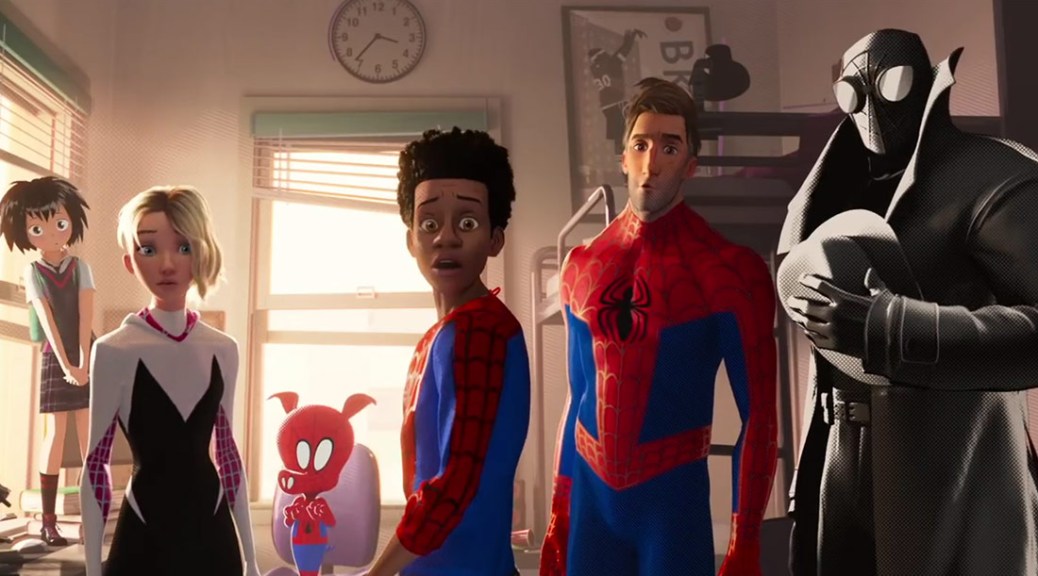
Anyone can be Spider-Man. It’s an unusual theme for a superhero movie, where the exceptional nature of the central character is usually the central point. However, Spider-Man: Into the Spider-Verse is an unusual superhero movie. Animated at a time when live-action superheroes rule at the box office, it’s currently struggling against the live-action Aquaman, but if there’s any justice, it will find success in the long term, because Into the Spider-Verse is a far more interesting movie and a fitting bookend for a superhero year that started with Black Panther.

Spoilers for the movie (which you really ought to go and see) below.

Continue reading Spider-Diversity

Aquaman—An Overstuffed Fish Taco

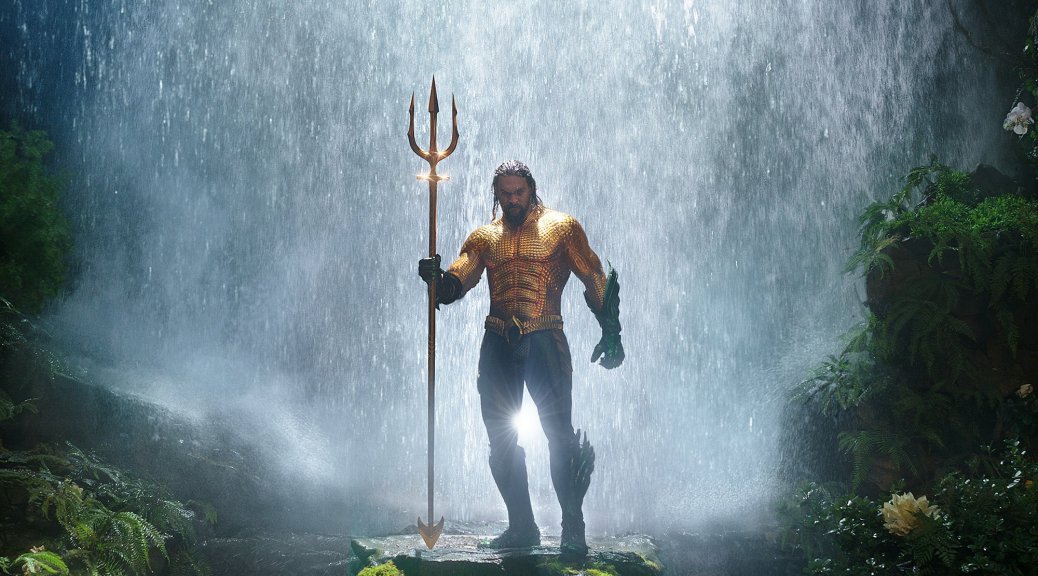
DC/Warner Bros.’s latest superhero movie, Aquaman, manages the impressive trick of being both too long and too short. Before you get to the end of it, you’ll have the feeling that you’ve been tricked into starting an epic series of novels, yet there’s also an ongoing feeling that the amount of story it’s trying to fit in exceeds the amount of minutes it’s prepared to devote to it.

(Spoilers beyond this point, but not too many.)

Continue reading Aquaman—An Overstuffed Fish Taco

A Month with the apple watch

I’m one of those terrible people who opt for Mac instead of Windows, iPhone instead of Android. I have an excuse—I’ve been using Apple devices since the Mac Plus, back in the 1980s—and I’ll argue the advantages, but I know the costs too. As much as Apple devices tend to be reliable and enjoyable to use, they’re not cheap. So if I’m going to add to my collection, I don’t do it without a lot of thought.

I’ve been eyeing the Apple Watch for years now. Partly because I like having new shiny technology to play with, and partly because of my mini-ecosystem of Apple devices that it can interact with. However, the earlier versions suffered the limitations of new technology in such a small form factor, and I had cheaper options available to me. It was only with the release of the Apple Watch Series 4 a while ago that I decided the time had come. I broke open my piggy bank and availed myself of some new wrist decoration.

My resulting purchase is the 44mm Apple Watch Series 4 with a Space Grey Aluminium Case and a black Sports Loop wristband. The Series 4 represents a step up in screen quality and device speed over previous iterations, but the basic functions are essentially the same: it’s a combination of fitness tracker, mobile phone adjunct, and, well, watch.

All of these things my previous smartwatch, the late, lamented Pebble Time, also did to some degree, and its colour e-ink screen provided allowed around five days of battery life, at the cost of much slower responsiveness. However, Fitbit’s buyout of Pebble has finally led to support being cut off. Given that the Pebble Time no longer works with my favoured fitness app, Runkeeper, moving to the new platform was an idea whose time had come.

Initial impressions of the Apple Watch were as favourable as they usually are for Apple Products. Out of the box, it paired with my phone and set about downloading watch apps to match those on my phone. The build quality is good too—a month in, and there are no signs of any scratches or damage, which is something that the plastic-bodied Pebble couldn’t boast for as long. Battery life testing revealed that it wouldn’t match the Pebble, but I get two days out of it without struggling, which feels pretty solid.

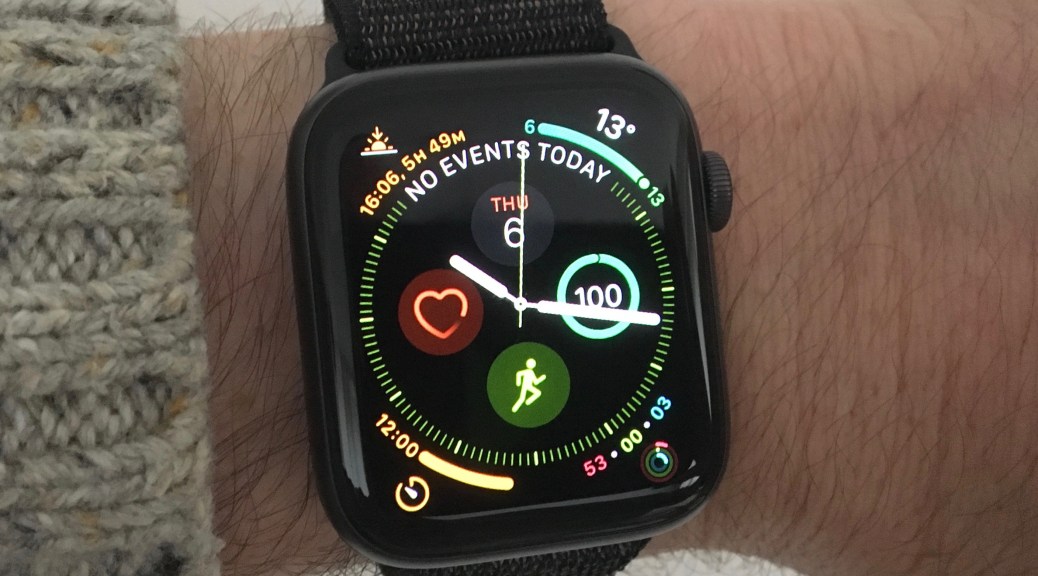
As for what it’s like in use, the responsiveness that Apple’s custom silicon provides means that simply raising your wrist (it asks during the setup procedure which hand you wear your watch on) brings it to life. Tapping the screen will do the same, and both of these actions will also wake Siri (of which more later). You can pick and choose among a wide range of watch faces, most of which are customisable in terms of look and utility. I opted for the Infographic watch face, which makes a scattering of commonly used apps and functions available through on-face “complications.”

Fitness Tracking

Fitness tracking has become a major feature of the Apple Watch because that’s what people wanted. Not only does it use Apple’s three-ring system to track calories burned, exercise duration, and hourly activity, but it also regularly reminds you to keep up a constant level of activity. I can see how these reminders (which can be turned off through the companion watch app) might become annoying, but as someone who has a tendency towards laziness, especially in the winter months, it’s a useful goad to avoid couch potato status.

Whereas the Pebble Time offered only a step tracker, the Apple Watch adds GPS and heart rate tracking. (There’s even an ECG function, though that hasn’t been enabled in the software yet and may not be outside the U.S.) Both GPS and heart rate tracking work well and consistently, and the battery life is good enough to use it as a sleep tracker one day out of two. One minor issue is that the glass back of the watch irritates the skin on my wrist a little—so it’s best not too wear it too tight or too consistently.

The Apple Watch also integrates well with whatever fitness apps you might be using. Not only can I activate Runkeeper within the watch, but it will also pay attention to what you’re doing at any given moment and ask you if you want to track your activity if you’ve been walking or running for ten minutes or more. As a GPS tracker, it’s great, but in Ireland the LTE version isn’t available yet, as no mobile providers support them. Which brings us to the next subject—the watch’s relationship with your phone.

Phone Companion

One of the reasons that I got the Pebble, and later the Pebble Time, in the first place was to reduce my habit of spending time looking at my phone and its notifications. That effort was … questionably successful, because while you could read the notifications on your wrist, you couldn’t respond to them. The Apple Watch actually allows that, within limits.

One of the big surprises with the Apple Watch for me is how well Siri works.  Simply raise your wrist and talk and it’ll respond. This makes simple actions like setting a timer or a reminder much quicker. You can even use Siri to dictate responses to messages, which again works much better than I expected. Certainly more quickly than the other Watch-specific option of drawing each letter out on the screen. The Apple Watch does provide canned responses to messages too, which are even quicker, if more limited (and easy to accidentally send).

The Apple Watch does a fine job of having some basic phone functions handed off to it. It’s not going to cure your Twitter addiction—thankfully for both you and its battery life, Twitter doesn’t work at all with the watch, beyond delivering notifications. However, if you’re looking for a way to reduce the number of times you take your phone from your pocket or bag, this could help a lot.

The Computer on Your Wrist

As for its most basic function, the Apple Watch is a fine watch. It’s not much to ask, and the WatchOS doesn’t get in the way of that simplest of jobs. In fact, WatchOS is largely solid across the board, with some odd quirks that are the result of the device’s history. The field of icons that used to be how the Apple Watch’s apps were navigated is still there, just a press of the Digital Crown away, and it’s still hard to find the app that you’re looking for in the field.

For the most part though, WatchOS does a good job of easing you into using the Apple Watch, teaching you the basics of the interface in your first few minutes of use, then leaving you to play, as is standard with Apple devices. It’s not the free-standing computer on your wrist that you might want it to be, at least not in the LTE-lacking version, but it’s as close as you can get right now, and if you can forget that your phone is somewhere nearby, there’s little difference. I’ve even indulged in a few Dick Tracy moments of phone calls made through the Apple Watch, though the otherwise solid built-in speakers struggle to overcome traffic and crowd noise. My main regret is that my much-loved AirPods suffered a washing machine-related incident from which they’ve never recovered, as they seem very much designed to work with the Apple Watch.

In short and in summary, if you’ve just skipped to the end to find out, I’m pretty happy with my Apple Watch. It wasn’t cheap, but that’s why I have a piggy bank in the first place—and it’s a lot cheaper than replacing any of my existing Apple devices. A month in and I’m comfortable with having it on my wrist, with the fabric Sport Loop keeping it sat snugly there. I haven’t even played with many of the apps and functions yet, and every few days I find another advantage or two to it. Thus far I’ve had few regrets buying Apple products, and while the Apple Watch might seem like it might be the most frivolous of those purchases yet, it sees as much use in everyday life as any of them.
On Female Leads and Genre Fiction

Taken in the British Library. Sadly he was busy saving the universe. Travelling by train is all very well, but travelling by Tardis...
An encounter of my own, some years ago. Though time travel makes that a tricky thing to pin down.

On a weekend when Roger Federer won his 8th Wimbledon title and Disney announced its intention to release all the movies coming out over the next three years (these were the things that registered with me – your mileage will undoubtedly vary), the biggest news was that the newest incarnation of the Doctor will be, for the first time, female. This is not only a big thing for me – a viewer of Doctor Who since an unreasonably young age – but it means that the three big ongoing science fiction/genre fiction franchises (Star Wars, Star Trek (with its new Discovery series) and Doctor Who) will soon have female leads.

Continue reading On Female Leads and Genre Fiction

A Long Time Gone


A picture of a dead whale. Because this blog is like a … never mind.

It’s been a long time, hasn’t it? Not that this was deliberate on my part. I had plenty of intentions of posting new and fascinating content, but circumstance and laziness always got in the way. I do intend to be better though. Thoughts about films, books and games will be forthcoming, and there will – in a not overextended period of time – be more travel journals. (Yes, that time of the year has come around again. I have become terribly predictable in my elder years.) In the meantime, a few thoughts on some of the media I’ve been consuming lately.

Mysterium: It’s a board game. Which is not something that I play enough of these days. (There’s a Tuesday evening boardgaming evening in the Black Sheep pub in Dublin that I’ve been making excuses for not going to for weeks now.) What sold me on Mysterium was the review from Shut Up and Sit Down, a site you should really be following. Boiled down to a brief description, it’s cooperative psychic Cluedo (Clue for Americans) and is as easy to play and strange as that description suggests. One player is a silent ghost who hands out vision cards to the gathered psychics; the others are those selfsame psychics, who must use those visions to solve a long-ago murder. Cue a lot of confused babbling about the exact meaning of the symbolism on the vision cards and exasperated gurning on the part of the Ghost, who doesn’t understand why they can’t figure it out. It’s a lot of fun, and most importantly you don’t need to be a boardgame veteran to play. Highly recommended.

(I also played Cards Against Humanity for the first time at a recent wedding (no, really) and proved beyond all reasonable doubt that I am a horrible person. Which is all that you need to know about that.)

The Just City: I burned my way through Lev Grossman’s The Magicians trilogy recently, having enjoyed the TV series to start with, so normally I’d be writing about that. But I’d been looking forward to reading Jo Walton’s The Just City for so long that it sneaks in ahead of it. The high concept – the goddess Athena decides to build the theoretical state from Plato’s The Republic as an experiment – is delightful, and the execution more than lives up to it. The viewpoint characters are chosen to pick apart the assumptions of privilege and precedent at the heart of Plato’s supposed clean-slate state, and while it’s no surprise when holes are poked in it, the manner in which it happens is consistently engaging. The second book in this series is already out, and the third is coming soon, and if they live up to the opener they’ll have a happy place for themselves on my bookshelves.

Stellaris: It’s been an odd year for games. This was the first of three games I was really looking forward to, and poor reviews for the latter two – No Man’s Sky and Deus Ex: Mankind Divided – have put me off splashing money on them until the next Steam sale. So in the moments between the vaguely social activities that are my forays into Lord of the Rings Online, I’ve been playing Paradox’s Stellaris, a mostly successful attempt to lift its grand strategy template into space and take the place of much-loved classics like Master of Orion. The opening stages of the game, as with all Civilization-style games, are the key draw, as you map out a galaxy for your new interstellar power (designed with plenty of freedom courtesy of the game’s engine), and the mid-game has improved with Paradox’s legendary post-launch support. As yet, none of my games have made it into the late-game phase, so I can’t really report on that (blame LotRO) but with larger patches and content expansions looming, I’m looking forward to seeing the game it becomes.

Film: Honestly, nothing I’ve seen in the past few months has really floated my boat. Which is a little depressing. Overhyped offerings are the order of the day in blockbuster season, and even those films that promise something more haven’t gone anywhere. There’s been no Mad Max: Fury Road this year, and while that’s a high bar to clear, it would be nice if someone at least got close. Or made the attempt.

So, that’s where I am right now. There are political thoughts (shudder) and other matters in my brain that may or may not get exposed in the three-and-a-bit weeks before I escape on another travelogue. In the meantime, my apologies for having been absent and my promise to be a little more present in the weeks and months to come.

Captain America: Civil War – Bucking the Trend

I'd prefer aquamarine vs. chartreuse, myself.
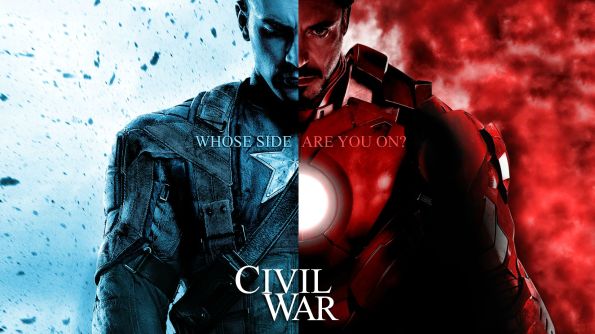
Red vs. Blue. Isn’t that always the way?

For all of the successes of the Marvel superhero universe, most of the sub-franchises haven’t enjoyed uninterrupted upward curves. Iron Man 2 was a mess, Thor: The Dark World was a bit dull, and Avengers: Age of Ultron seemed tired by comparison with its mega-successful predecessor. Only the Captain America movies have shown consistent progress: starting well with The First Avenger, getting better with The Winter Soldier, and now topping the lot with Civil War.

(All the spoilers below…)

Continue reading Captain America: Civil War – Bucking the Trend

Batman v Superman v The Critics

The photo is at least as dynamic as two thirds of the movie.
Its subtitle is Dawn of Justice. Which is certainly … a subtitle.

The fact that this movie is called Batman v Superman tells the audience ahead of time the sort of an experience they’re in for. This is really a Batman movie (Darkness, No Parents), albeit one in which he’s dealing with Superman’s world—Lex Luthor, Kryptonite and Superman himself. It’s also being savaged by both mainstream and geek critics, but is it really that bad?

Bat Spoilers v Super Spoilers…

Continue reading Batman v Superman v The Critics

JJ + SJW VS GG

Nowhere near as creepy as the character of Kilgrave actually was.
The promotional materials for Jessica Jones helped to tease the villain and set the mood.

Marvel’s Netflix offerings stand at a remove to the 4-colour heroics of their cinema offerings (and the connected Agents of SHIELD series). Drawing on modern iterations of street-levels heroes, the idea behind them was evidently to provide a darker and more complex take on superhumans than The Avengers. So far it’s working well. Daredevil was a promising beginning, and with Jessica Jones Marvel and Netflix kick it up a notch.

Spoilers for Jessica Jones below…

Continue reading JJ + SJW VS GG