Category Archives: Technology

Oculus

Though who knows, maybe not for long...
An old-style oculus, letting in light unaltered. Not owned by Facebook either.

Up until now, crowdfunding schemes have had one main pitfall: that even though you prepaid for something, you might not get it. Now, with Facebook’s purchase of Oculus VR, a pitfall has emerged on the other end of the success spectrum: that the thing you bought might evolve into something that maybe you wouldn’t have prepaid for in the first place.

The Oculus Rift headset was one of the biggest early success stories on Kickstarter. Virtual Reality is one of those never-was technology dreams, but Oculus’s promise was enough for backers to go for it in droves. It wasn’t just promise either: there was plenty of intelligence behind the Rift headset, and it seemed to keep improving as the months went by, with new versions of the development kit and some highly impressive game demos.

And then yesterday Facebook went and bought Oculus VR for $2 billion. This has not gone down particularly well in the technology press, either because the deal is a betrayal of Oculus’s indie roots, or simply because it makes no sense. Facebook, a company with a major games presence, albeit one that’s hardly on the cutting edge, seems to be buying into Oculus because it sees VR as a new field opening up, and with the recent announcement of Sony’s Project Morpheus, it might be right.

Still, the argument that the purchase doesn’t make much sense is a strong one. Unless Mark Zuckerberg has bought into the notion of The Matrix and sees it as the logical end point of Facebook’s parallel world of social connections, it’s not easy to guess where he’s heading with this. VR headsets may be providing increasingly realistic experiences, but they’re still bulky and obvious—only suited for home use, when you’re alone with a net connection. Vain hope it may be, but I don’t really want things to go that way.

Where VR headsets might be heading can be seen in the convergence of technologies. VR headsets replace reality with something new, which is perfect for games but isolates the user from the world around them. Augmented Reality headsets like Google Glass take the world the user is already in and layers extra information over it. Right now they’re limited in their application, but as they become more sophisticated, the tweaks they make to reality will become increasingly indistinguishable from the real thing. At some point, AR and VR are going to merge, and the choice of just how much of the real world to occlude is going to be left to the user.

With high-definition displays, motion tracking and fast response times, VR headsets are approaching the point where they can deliver a genuinely immersive experience. AR headsets are already extremely lightweight, and you don’t have to look too far in the future to see them being implanted in contact lenses. So maybe this is where Facebook is looking with its purchase of Oculus VR—not the immediate future of immersive gaming but rather the long-term play of a future in which your social world is always with you.

This could yet turn out well for everyone: Facebook certainly (?) isn’t stupid enough to kill off Oculus’s promise as something new in the world of gaming. The goodwill that the company gained over the course of its Kickstarter campaign and subsequently is gone already, but some of it could be clawed back if the hardware and its software ecosystem meet early hopes. Longer term, and more scarily, we might yet be facing a future where Facebook is always in the corner of your eye. That may not be a “Like” button that many are willing to click.

WhatsApp, Doc?

Big as $16bn is, it's small beans to Facebook.
No, I don’t spend a lot of time on these. Why do you ask?

If diplomacy is the art of saying “nice doggie” until you can find a stick, then Facebook may have found a stick big enough to deliver a final beating to the mobile network operators (MNOs).

SMS text messaging was an unexpected windfall for MNOs back at the dawn of the mobile era. Fitting 160-character text messages into unused network channels, they opened up a new revenue stream with next-to-no investment. It became such a lucrative slice of their business that they got very protective of it.

The problem is that SMS messages are pretty limited. MNO efforts to introduce an alternative in the form of the Multimedia Messaging Service (MMS) didn’t really take off, and the advent of smartphone apps and mobile data left the MMOs in the dust.

WhatsApp is probably the most successful of the text-message replacement apps, with 450 million active users at the most recent count. It’s tied to phone numbers, and it allows users to send voice, video, photos and more, as well as text messages of whatever length they like. As of yesterday, it’s in line to be purchased by Facebook for $16 billion (some reports put the price as $19 billion). That’s at least $35 per customer, however you slice it.

Whether or not WhatsApp is worth the price is beside the point. Facebook thinks it is. Why? Well, there are plenty of reasons, even beyond those 450 million users. WhatsApp is big in developing economies, where SMS costs tend to be high. It’s grown its user base faster than any other company ever and done so while remaining a relatively tiny company. The fact that it’s done so without any marketing spending indicates just how much its users like it.

However, it really is all about those 450 million users and however many it may be able to add in the future. The fact that Google is rumoured to have offered $10 billion for WhatsApp is indicative of the war for communication being waged between those two titans. Facebook has the biggest private social network out there, and WhatsApp marks a land grab among the services seeking to circumvent the MNOs’ control of how we communicate with one another.

This can’t be good news for the MNOs. They’ve been fighting a rearguard action against being turned into mere bandwidth providers ever since Apple launched the iPhone App Store, and with Google and Facebook seeking to dominate how we use the mobile space, that’s not going to get any easier in the future. Here in Ireland, companies like Vodafone, O2 and Meteor are increasingly getting shoved into the background—we get our phones from them and pay for our broadband, but beyond that? There are fewer and fewer spaces for them to make any extra money or offer extra value.

This isn’t necessarily bad for consumers, but it does steal from the MNOs one of the most valuable commodities of the modern world: data. Everything that we do online leaves a digital footprint, and what we do reveals better than anything else what we want now and what we might buy in the future. Theres money in them thar 1s and 0s. Google and Facebook want it and have a lot of it, and with the purchase of WhatsApp, Facebook will have even more, based on both our phone numbers and our contact books.

WhatsApp was founded on being a straightfoward replacement for SMS, free from ads, games or other frippery. That will inevitably change somewhere down the line, and how major the change is will affect at least to some degree how successful WhatsApp’s future will be. WhatsApp’s investors and employees have already won in this acquisition game. Facebook may well win in the future. As for us consumers, we’ll have to wait and see.

Changing the World in 3/4 Decades

D&D games on the Mac? Yeah, I remember that.
Kicking it old-style…

Last week was a week of anniversaries. World-changing anniversaries, in fact, though I’m going have to make an argument for at least one of them.

The anniversary that got the most press inches was the 30th anniversary of the introduction of the Apple Macintosh in 1984. The launch is best known for that Ridley Scott advertisement invoking Orwell’s Big Brother, but recently a video came to light revealing a launch event in front of the Boston Computer society.

It’s a fascinating watch, mostly for the fact that it contains so much of the future. The Mac is front and centre, and it’s amazing just how much of what we take for granted in our computers today appeared right at the start of the Mac age. It’s not just the MacOS that still bears the ancestral marks of its progenitor. Every modern desktop/laptop OS can trace its ancestry back to 1984. Amazingly, it’s a trick Apple has pulled off more than once: its iOS is similarly the root from which the modern smartphone/tablet ecosystem arose.

It’s also instructive to watch Steve Jobs at work, long before his keynote speeches grabbed attention around the world. The delivery isn’t as smooth as it later became, but so much of those keynotes is already in place: the idea of the intersection of art and technology, the attention-grabbing video segments, the on-stage demonstrations to wow the audience. Jobs would soon be ousted from Apple, only to return and lead it to world leadership years later, and his keynotes would be much more controlled, so getting to see him do a question-and-answer with the original Mac team is a rare treat.

The other anniversary is for an event ten years earlier and one less easy to nail down. Gary Gygax and Dave Arneson’s Dungeons & Dragons also changed the world, albeit in a less direct way than the Mac. It birthed, of course, the roleplaying game (RPG), a combination of board game and improvisational storytelling. RPGs have never been a big industry, but their influence has spread far and wide.

D&D drove an interest in fantasy, and followup RPGs drove interest in science fiction and horror, even as they followed trends in wider culture: Star Wars, Anne Rice, Ghostbusters, etc. RPG players got involved in the growing computer games industry and the entertainment industry, leading to a lot of what is now mainstream. Game of Thrones’ George RR Martin? A roleplayer. Joss Whedon? Roleplayer.

The Mac is still going strong, despite some dodgy moments along the way. D&D has lost its leading position everywhere except cultural memory, but the hobby it kicked off has endured and spread like a weed, its roots and tendrils going everywhere. The Mac changed how we interact with the world. D&D created a new spawning ground for content, and an avenue for storytelling and offbeat genres that wasn’t there before. Happy birthday to them both.

Don’t Be Evil?

Adapted from http://www.flickr.com/photos/nottsexminer/7181655884/
My Photo-fu ain’t getting any prettier. (Adapted from http://www.flickr.com/photos/nottsexminer/7181655884/)

It’s one of the best—and best known—corporate mottos of the technology age. Google’s three-word mantra positioned it as something different from the corporate behemoths it disrupted as a scrappy startup. It was also an implicit promise, that as a company it was on the side of the customers it served.

Except, that was years ago, and Google is now one of the biggest of those corporate behemoths. Many of its products may still be loved (just witness the Android/iOS flamewars) but the company itself? The reaction to its recent acquisition of Nest shows that beyond a sense of confusion as to what Google was paying all that much money for, Google itself just isn’t trusted all that much.

Nest is an odd little company in and of itself: founded by Tony Fadell, one of the creators of Apple’s iPod, it looks to bring the same design ethos to neglected home products and add some Internet-era connectivity and device awareness. Nest are one of the leading lights of the “Internet of Things”, so it’s not a surprise that Google has swooped in, but the reaction from technology pundits has been broadly negative.

Why? Well, we tend not to trust those with too great a power over us, and Google’s huge collection of information and ability to leverage it gives it immense power. Nest’s connected devices suggest a desire to extend its awareness of our activities even further into our homes and our every waking moment.

Paranoia? Maybe, but in this case they are watching us. Wasn’t Nest doing the same thing already? It was, but there’s a difference between communicating with devices that form part of our lives, and having those devices communicating with a vast database that already contains details on our lives.

A company like Nest, as with Apple, makes its money by selling products to consumers. A company like Google makes its money by selling advertising and licensing software, both to other companies. As long as there’s a viable alternative, it’s vital for Google to retain the goodwill of consumers, but the fact that their money comes from elsewhere means that they’re always going to be a servant of two masters, and the temptation is to rely on PR to deal with consumer attitudes.

This is not to say that Google, much less the people who work for it, is evil, but the company relegated its famous motto to the backburner a while ago. The pressures of capitalism, as practiced in the modern world, don’t leave much room for moral scruples. The law and how to follow or sidestep it is the main limiting factor on the goal of maximising profits.

The fact is, the Nest acquisition is a good deal, expensive though it may be for Google. Nest gets funding and the chance to supercharge its entry into homes around the world. Google gets not only the hardware design expertise of Fadell and his team of ex-Apple employees (something it badly needs) but also that extra angle of attack for visualising our lives in data.

As for whether Google can regain its standing in the eyes of consumers, the question is does it want to? It’s become one of the world’s largest corporations and it’s hugely profitable. There’s an inevitable sense of sadness at the loss of innocence from those idealistic startup days, but maybe that’s always the price to be paid for success.

The Invisible Phone

20131105-171024.jpg
The box of delights…

The piggy bank has been broken open, and the necessary pieces of paper (actually web forms) have been signed, sealed and delivered. As of last week, I have a new piece of shiny in my life in the form of an iPhone 5S. None of your gold-plated rubbish here, just the standard black for me. “Space Gray,” if you’re an Apple marketer.

Given that my previous phone was an iPhone 4, this marks a three-generation jump. It’s been interesting to observe what that change means in concrete terms. As it turns out, it all comes back to something I’ve mentioned before: the 5S is a phone that’s even better than its predecessor at disappearing when not needed.

The speed of the 5S is the first enabler of this. The 4 was far from a sluggard, but I had to switch off some of the frippery of iOS 7 in order to avoid stuttering animations. With the 5S, everything is silky smooth and instantly responsive. Apps launch without hesitation, and the notification and control centre overlays pop up immediately. Being able to deal with everything swiftly also helps with the already decent battery life—the more time the phone spends snoozing, the less its battery drains.

One of the 5S’s most marketable features is another time saver: the TouchID fingerprint sensor. Like most of the best Apple developments, it verges on being a gimmick but is saved by the fact that it just works. The time saved by using it instead of entering a security code is minimal, but the ability to jump directly to what you want to be doing rather than through a security hoop makes a meaningful difference, and it’s going to encourage people to use security if they weren’t already.

Something of a surprise to me was just how useful an older feature of the iPhone is: Siri. I tend to use features like the timer and alarm a lot, and while iOS 7’s control centre made it easier to get to that functionality, Siri pushes it up another level. You have to speak clearly, as the poor dear gets confused by enunciation that falls too short of BBC diction, but it’s already proven itself more than a toy.

I’ve yet to make more than a cursory acquaintance with the rest of the 5S’s feature set. The camera is clearly an improvement, especially in low light conditions, though I’ve not toyed with slow motion or burst shooting yet. The GPS seems to work a lot faster than in the 4, though as yet few apps make use of the phone’s vaunted motion coprocessor. Battery life seems solid enough, though this can dip quickly when the phone is searching for a decent connection, as mine was at last week’s Dublin Web Summit.

Taken together though, the theme stays the same. This is a phone that does what you want it to, faster and with fewer hurdles than before.

Cruise Control

One-handed operation.
Buttons to control your life. (via Mark Doliner)

I was at a wedding earlier this week, and since it was down in the wilds of Wexford, I opted to hire a car to get me there and back. As a result, I had the chance to play with one of those driving options that I’ve never really tinkered with before: cruise control.

It was an odd experience. On the way there, I switched it on, then off again after a few minutes, as the motorway to Wexford is only a motorway in parts. On the way back though, late at night and neither overtaking nor being overtaken between Gorey and Dublin, my speed changes all came courtesy of a switch on the steering wheel.

When I drive, I drive manual, because it’s what I’m used to. The few times I’ve driven automatic, I’ve had to adjust to the idea of having a hand and a foot rendered more or less unemployed. Cruise control removes the need for the other foot. It’s terribly convenient, seductively easy to get to grips with and absolutely nothing like driving a car.

Of course you realise, this means metaphor time.

Convenience is the way of the world. We’re buried in gadgetry that’s designed to smooth every possible step between our desires and their fulfilment. From the toaster and kettle in your kitchen, to the latest iPhone or Google Glass, where you only have to whisper your momentary whims to have them answered.*

It’s not a wholly bad thing. Dial this desire to make our lives easier back to where it began and you’ll find yourself kicking the sharpened rock out of the hominid’s hand as it tries to turn an animal skin into something wearable. And yet, and yet, I resist it.

I’ve written before about how Apple’s iPads have all but disappeared: they’re magic slates, on which appear a dazzling array of entertainments and utilities, designed to enhance our lives. Clarke’s Third Law comes into play here: we can still identify the iPad and its ilk as technology because we have to plug it in to the wall to charge, but its identifying marks are gradually disappearing.

It’s civilisational cruise control of a sort. We create the items to ease our way through the world, thereby in theory freeing ourselves up to achieve all sorts of other things. Yet along the way, the vast majority of us forget or never learn how things work. From technology to politics to business, we’ve become accustomed to thinking that so long as someone understands it—someone whose job it is to understand it—then it’s their responsibility to deal with it. All we have to worry about are the results. We flick the switch to get from A to B and think no more about it.

I’m far from perfect on this score, and it’s impossible these days to understand how everything works. Yet it’s worth making the effort to grasp the principles of the forces that move us, and have some ability to roll up one’s sleeves and shift them when the need arises. So I’ll keep on driving manual, and when I’m in a car with cruise control, I’ll think twice about flicking that switch.

*Incorrectly, usually, but at least they’re trying.

The New Baseline

All the colours of the candy rainbow.
Lickable shiny. Just … keep your tongue away from mine, okay?

The announcement this week of Apple’s new range of iPhones has generated some new and some standard complaints from pundits. For the new top-of-the-line iPhone 5s, the complaint is that it’s not all that different from the previous model. For the new midrange 5c, it’s that it isn’t a cheap iPhone. Oh, and the colourful plastic shells look tacky.

To deal briefly with the 5s: yes, it’s a speedbump. Everyone saw that one coming. However, initial reports suggest that it’s a substantial speed bump, and there are new and useful features in the form of an improved camera, an intriguing standalone motion detection chip and the much-discussed fingerprint sensor. Perhaps most importantly, it shifts the iPhone towards 64-bit computing, providing some decent futureproofing.

I’m not going to comment on the looks of the 5c until I have one in hand, other than to note that those who have handled them seem to have come away impressed. The issue of whether the 5c is too expensive to work for Apple as a “cheap” iPhone is the more interesting question, and it’s one where most critics (including the perennially misled markets) seem to have missed the point.

For all the talk of a “cheap” iPhone prior to the arrival of the 5c, Apple doesn’t do cheap, certainly not since the second coming of Steve Jobs. Its products tend to fit between “premium” and “affordable luxury”, depending on how you view those scales. In that sense, the 5c has been positioned as a “midrange” iPhone, fitting just beneath the new 5s.

Except that doesn’t tell the entire story either. Up until now, Apple had only one model of iPhone: the new iPhone. (It also sold last year’s new iPhone, and the previous year’s new iPhone too.) Selling older iPhones alongside the new model allowed Apple to leverage investments in manufacturing and economies of scale, but those old iPhones always felt a little second-hand.

With the release of the 5s, Apple has doubled the breadth of its new-iPhone product line in a stroke, giving consumers a choice much more appealing than one between the “new shiny” and the “old shiny that you can actually afford.” Relatively expensive the 5c may be, but to balance that it’s still a fully capable smartphone, in a brand new form factor that offers a splash of colour never seen on iPhones before.

Yes, an old-new iPhone still remains on the product list, in the form of the 4s, but I’m not sure that’ll last even a year. With two lines of iPhones above it, both using the iPhone 5 form factor and manufacturing lines, Apple is going to be shifting as quickly as it can to focus solely on these products. Improved manufacturing techniques and greater output lead to economies of scale and enhanced margins for Apple—or lower prices.

Because that’s really the thing with the 5s. Once the 4s goes, it becomes the new baseline for the iPhone line, and while it will never be “cheap”, I can see Apple cutting its price by €100 or so in about six months, making it even more price-competitive with Android smartphones.

After that, Apple suddenly has two product lines to work with—the “top-end iPhone” for those who want the latest and best iOS device, and the “iPhone for everybody” who wants an iPhone device but doesn’t want to break the bank for the latest and greatest.

What the 5c means is that the latter group no longer has to see themselves as buying last year’s cast-offs. The 5c isn’t about what it is now, as much as it might sell on its release. It’s about what it’s going to be a year from now. Because Apple always plays the long game, and it’s just shifted the iPhone baseline.

Beauty, not Brains?

20130822-141343.jpg
Hairy arm: model’s own.

Pebble Smartwatch, $150, iOS and Android

As people smarter than myself have already pointed out, taking part in a Kickstarter funding campaign is like buying a present for your future self: by the time it arrives, you’ll have forgotten that you paid for it, and be pleasantly surprised that it showed up at all. That and the feeling of actually participating in a product rather than just buying it are all the reasons you need to know why Kickstarter is still huge.

To date, I’ve participated in five Kickstarter campaigns, mostly for small amounts. In each case, it was clear that I’d be waiting a long time for the results, something I didn’t mind at all. Well, in recent months my currently impoverished self has been reaping the benefits of my affluent former self, in that two of the results have shown up (in one form or another).

My biggest Kickstarter contribution to date was for one of the site’s most famous campaigns: the Pebble ePaper watch. A customisable bluetooth watch for Android and iOS phones, the Pebble raised $10,000,000 through Kickstarter, far above an original funding goal of $100,000. Due to the fact that I opted for a grey watchface rather than black, red or white, mine took a little longer to arrive than it might have otherwise, but a few weeks ago I wrested it from the hands of Irish customs and onto my wrist.

For the first wave in a new breed of smartwatches (Kickstarter is already hosting its more ambitious next-gen brethren), the Pebble has a definite retro, plastic feel to it. Which is not to say it’s not solid: the plastic case keeps it watertight while allowing charging through a USB lead and keeps the body light despite the its bulk.

The ePaper screen is basic but readable, with a motion-activated backlight, and can be modified with a multitude of watchfaces. Figuring out how to do so can be a bit of a chore: the online setup process is straighforward enough, but for more expansive options, you’ll need to use your phone’s web browser and the app that manages the Pebble itself.

In use, the Pebble is a handy accessory. I often don’t hear my phone when it’s in my pocket, but I can feel the Pebble’s vibration on my wrist without a problem, alerting me to calls, texts and mails. I can even read the mails and texts, or at least the first few lines of the mails, on the Pebble’s screen, though this only works in the moment—there’s no way to browse older messages.

At the time of buying the Pebble, my main reason was to have it as a running accessory. I’d just started recording my running with RunKeeper, and the idea of having a watch that would tell me my pace and distance covered sounded pretty good. Well, mission accomplished on that front: the Pebble keeps updated throughout a run

There are only three issues with the Pebble, all of them technology based. The first is that it drops the bluetooth connection occasionally. This is an issue because the Pebble isn’t a smartwatch. It’s a terminal for your smartphone, and lacking the connection, it can tell you the time in various pretty ways but not much else (there are game apps for the Pebble, but the chunky buttons don’t allow for sensitive control).

The second issue is battery life. I’ve averaged around five days so far, which isn’t too bad for a bluetooth device, but the phone software doesn’t do a great job of indicating when you need to recharge, so there have been a couple of times when I’ve looked at my wrist and found a blank screen looking at me. Annoying, but some of those multitude of watchfaces promise to fix that issue.

The last issue is probably the biggest one for Pebble: this is a first-generation device, cute and functional, but staring down the barrel of technological innovation. As stated, Kickstarter is already hosting second-generation devices, and Apple and Samsung look set to enter the space before long, bringing all their engineering know-how to the field. When that happens, Pebble’s retro looks may become all-too apt.

For now though, I’m wearing a watch for the first time in a couple of years, and I’m more than happy with the present my former self bought me. Runkeeper functionality, message and call alerts and a variety of funky watchfaces. It may not be smart, but it sure is handy.

A Game of Words

20130716-120344.jpg
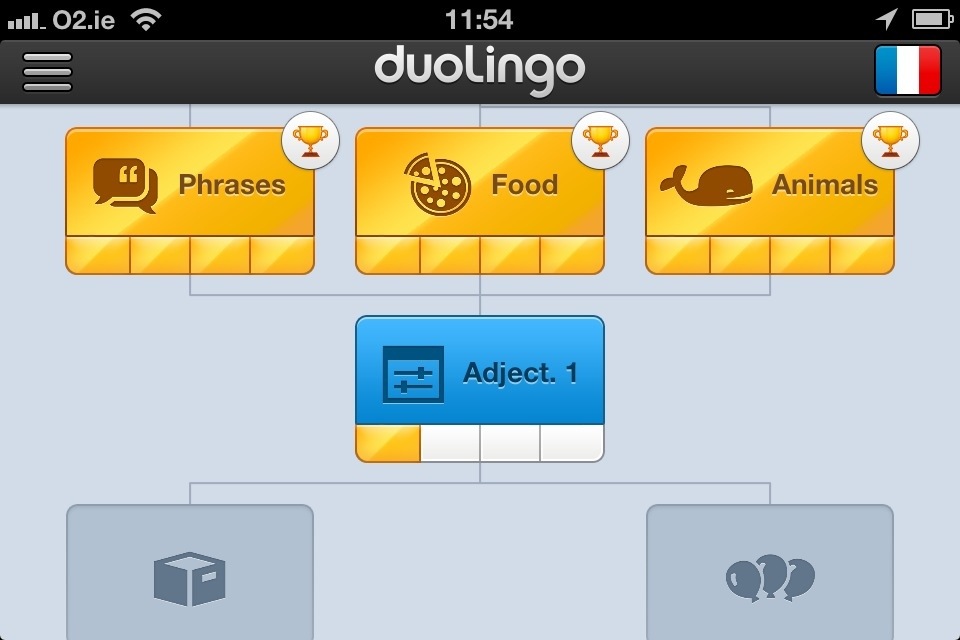
Early days on the French language tree.

Duolingo (iOS and Android, Free)

My several years of iPhone experience have seen me fall prey to a number of apps. Addiction to horticultural zombie escapades, miniaturised high-rise management and Indiana Jones-style sprinting have all proved fun, but I wouldn’t have called them beneficial. Well, now I may have found an app that is both addictive and good for me.

Duolingo is a language-learning app, based on the web site of the same name. The concept behind the service is a simple one: crowdsourcing humanity’s efforts to learn new languages by getting them to translate web content. Because the learners are providing a service, the learning experience is free.

Of course, having a free service doesn’t mean much if the experience is no good. Luckily, Duolingo’s app doesn’t fall down on that score. It sports a clean, colourful design that’s both welcoming and easy to understand. Each language is presented as a tree of connected lessons that users progress through at their preferred pace, from basic comprehension to complex concepts.

Lessons consist of 20 exercises, each taking no more than a few seconds to complete, with four or more lessons grouped into themed nodes (food, animals, adjectives, etc.) on the learning tree. As a barely competent reader of French, the early lessons in that language were a useful refresher for me, but if I’d wanted to jump ahead, each node offers the chance to “test out” and complete the whole thing in one short lesson.

Gamification elements are put to good use here: users get three hearts per lesson, so they can make three errors before a fourth requires them to start over. Completing a lesson earns a users points and builds their in-app vocabulary, and the number of consecutive days they’ve been playing is recorded. The intelligence behind the app seems well tuned thus far, and will point out certain errors, like misplaced accents, but not penalise users for them.

One of the big problems with learning a language (and maintaining that knowledge) is the issue of practice. Duolingo covers this too. First by offering users the chance to strengthen the skills they’ve already earned and second by providing a leaderboard so they can compare their acheivements with their friends. I can’t speak to the success of the latter as yet, but it’s another example of game mechanics intruding beneficially into the non-game world.

The Duolingo app is comprehensive in its treatment of the five languages it covers (French, German, Spanish, Portuguese and Italian) and demonstrates a wealth of thoughtful touches in its design. One feature I’d love to see is a searchable vocabulary of words in each language, but as a relatively new app, there’s bound to be more to come from this initiative.

Well, that was tense: Curiosity spots the landing

Even as the London Olympics strive to inspire a generation towards physical perfection through washboard abs, world records and tales of Olympian sexual shenanigans in the athletes’ village, inspiration of another kind was taking place several hundred million miles away. Human ingenuity, engineering and scientific skills combined to hurl an SUV-sized vehicle across the void of space and land it within a few hundred metres of its target on the red planet.

NASA has had plenty of practice at flinging scientific instruments at Mars, but this was still no small feat. Missions to Mars have failed before completing their missions around two in every three times. Moreover, the Curiosity rover, part of the Mars Science Laboratory mission, is far larger and more sophisticated than anything landed on Mars before, requiring a Heath Robinson-esque method of getting it safely to the planet’s surface, involving a parachute and a flying sky crane. Since I’m currently sitting here watching some of the first photos from Curiosity, it’s fair to say that the whole thing worked pretty well.

I’m far from alone in getting up early on a bank holiday Monday to catch a glimpse of humanity’s latest adventure on another planet. NASA’s dedicated TV channel lasted long enough to broadcast the euphoric celebrations in the control room before it crashed under the load of viewers from around the world. That kind of enthusiasm, allied to the sheer joy of the crew who have worked for years to bring Curiosity safely to the point where it could begin its mission to survey Mars for signs that it could have supported life at some stage in its past, is simply inspiring.

There will be plenty of news about this, and more science and pictures in the days to come. But for now, it’s great to be reminded of just what we can achieve as a species.