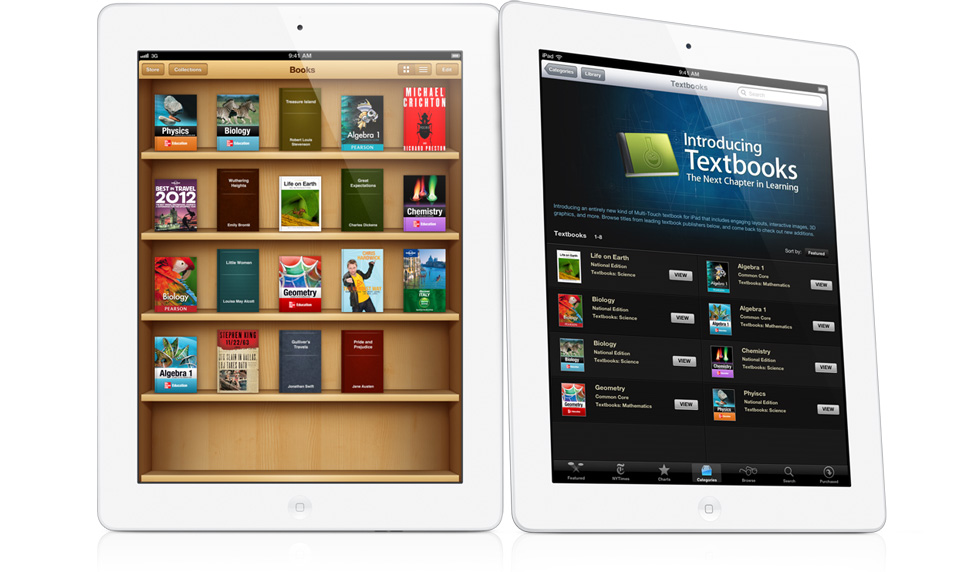
This afternoon saw Apple’s latest media event taking place in an unusual venue for the company – New York – and without the oversight of the company’s late founder, Steve Jobs. The focus of the event was education, a subject that Jobs claimed was close to his heart, and although the event was very much U.S.-centric, the announcements made there have much wider implications.
There are three main prongs to Apple’s education push: The first part is an upgrade to the iBooks application for the company’s iPad device in order to enable it to deliver media-rich, interactive text books for students in the U.S., focusing first on the high school level. The aim is to provide cheaper (assuming you factor in the cost of the iPad itself), more engaging, more up-to-date text books for students. That Apple has managed to get some of the main textbook providers on board already is undoubtedly due to the fact that if the technology company succeeds in turning the textbook market electronic, it will simultaneously kill the market in second-hand textbooks.
Prong number two is the new iTunes U app. I’ve been using the iTunes University section of the iTunes Store for a while, as it has an amazing selection of free audio and video recordings of lecture series. The new app takes that idea to the next step, allowing educators to create and manage courses and deliver them to students. Together with the iBooks app, it’s nothing less than an effort to make tablet computers in general and the iPad in particular central to education in the U.S. And where the U.S. leads in this regard, the world is likely to follow.
However, for me – someone who isn’t involved directly in education at the moment – the most interesting element of the announcement was the third prong: the iBooks Author application for the Mac. Although the focus at the event was on using this application to create textbooks, it’s clear that there’s much more potential here: iBooks Author allows anyone to put together rich media books, using video, audio, pictures and 3D elements together with text in an easy drag and drop environment. I’ve already downloaded it and am tinkering with it now to check out its capabilities, but already it’s reminding me a lot of a storied application from Apple’s past: Hypercard.
If you don’t know what Hypercard is (and unless you used a Mac in the late ’80s, you probably don’t), you could take away a few elements of the above description of iBook Author and it would apply pretty well: Hypercard created stacks (read: ebooks) into which content creators could place audio, graphics and even video, linked together with a programming language that prefigured the HTML code of the World Wide Web. iBooks Author may not offer the same degree of interactivity and expandability, but the capability is definitely there, and the drag-and-drop creation is much easier. The ebooks sold through Apple’s iBook store may be called books, but they’re really standalone apps, designed to run on the iPad. They’ll deliver content first and foremost, but the manner in which they do so will be limited only by the imaginations of those who use the app itself.
Of course, this being a brand new program from Apple, some caution is warranted. It’s already been pointed out that the EULA attached to iBooks Author may be overreaching itself. Similarly, Apple’s applications and devices tend to really hit their stride only when they reach the 2.0 milestone. Compare the original iBooks app, a polished but underwhelming competitor to Amazon’s Kindle, with the new textbook delivery system it has become. iBooks Author has a limited number of templates at present, and it will be a while before its users get to grips with what it can do. Already, however, I’m impressed with what I can see and am looking forward to playing with it and seeing the results.
 cerandor.com