Paisley and Legacy

That Paisley documentary, should you wish to delve into his mind.

So Ian Paisley is dead, as of a few days ago. I’m no more inclined to dance on his grave than I am to shed a tear at his passing, but the injunction not to speak ill of the dead mostly exists to preserve the feelings of the deceased’s loved ones, none of whom I know, nor are they ever likely to pay heed to anything I say. So some recollections might be in order.

When I was growing up in Northern Ireland, Ian Paisley was a constant presence. Back then he was a fringe character, albeit the most prominent one of his kind. To a child old enough to pay attention to the news but not old enough to understand the tangled truths and lies at the heart of the Northern Irish situation, there was something immediately appealing about this shouty man, spouting certainties at the top of his lungs wherever the lines between communities at war were in danger of becoming blurred.

The more understanding I gained, the more the limitations of his worldview became evident. Paisley was a complex man, even an exceptionally intelligent one, but those complexities were hammered flat by his fundamentalist worldview. Those he was close to remember him as warm, cordial figure, but one suspects that such warmth only extended to those who existed as human beings in his own eyes. Someone who could say that Catholics “breed like rabbits and multiply like vermin” had placed strict limits on his empathy.

In this, he was heir to centuries of anti-Catholic, biblical tradition arising from his Ulster Scots background, owning no authority save that of the bible. This is a man, after all, who founded his own church and his own political party. The common joke back in the Troubles was that Paisley had finally consented to a power-sharing agreement: with God. His famous heckling of Pope John Paul II suggested that he didn’t see him so much as a man as he did a figure of mythic significance, one that he was locked in war with.

All the stranger then that he executed an almost complete volte-face in his latter days. From being the most intransigent figure of the Troubles, he (once his party were in a position to take power) suddenly became open not just to power sharing, but to power-sharing with Sinn Fein, which he was more apt to call Sinn Fein/IRA. Which is either a breathtaking acceptance of the limitations of the principles he’d adhered to for decades, or an act of equally breathtaking hypocrisy.

That there were plenty willing to take the latter view may be seen in the fact that both his church and his party eventually rejected him. The former as soon as he took up that leadership role, the latter as soon as their grip on the reins of power was firm enough that they could afford to jettison their non-political anachronism of a founder.

As much as the Unionists may have had to hold their nose on going into government with Sinn Fein though, the same may have been true in reverse. His Damascene conversion on the road to government notwithstanding, Paisley was as responsible as anyone for generating the atmosphere of hatred and suspicion that drove the Troubles through three decades of murder. He’s gone to his grave with blood on his hands and no more willing or able to admit his culpability than Martin McGuinness or Gerry Adams have ever been.

His decision, in what turned out to be his last year, to participate in a tell-all documentary, stands now as a final preacher’s performance, a spouting of the truth as he saw it from the mountaintop. Perhaps even to make clear that the twists and turns of his own life could be looked back upon as a straight road, laid out according to his principles. If so, there were many lives bulldozed to make way for it.
Watching the Apple Watch

Go on, admit it. You want to at least play with them for a while.
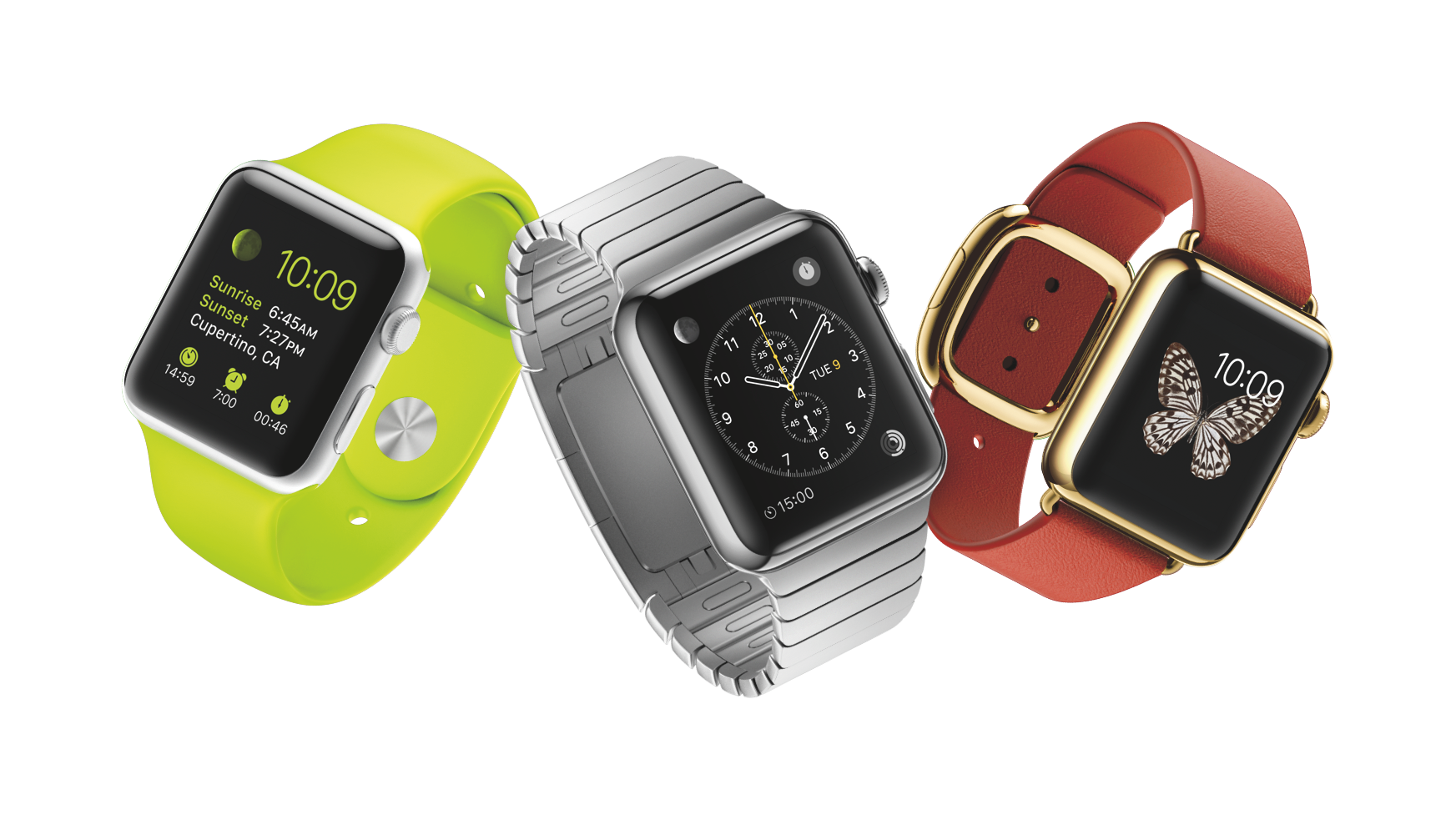
All these can be yours, for a (to be determined) price.

I’ve been an Apple user long enough that the company’s regular keynote events are a recognisable form of entertainment. Unusually, I didn’t watch this week’s well-publicised event until the day after it happened. (Possibly a good thing given the problems that the live streaming coverage faced.) By that time I’d already read enough of the media reaction to know exactly what I’d be seeing. Spoilers aren’t really the point with an event like this.

The first part of the event, to be fair, had already been well spoiled by leaks. Enough prototype parts and schematics had trickled out from Apple’s supply chain that only a few details remained to be filled in about the new iPhones. The 6 and 6 Plus looked much as expected and neatly relegated last year’s 5s and 5c to the minor places in Apple’s product lineup. A one-year-old free (on contract) iPhone is a better trick than a two-year-old free offering, but the 6 and 6 Plus are now the stars. The former seems the better bet, though the 6 Plus has its own appeal if you can handle its unwieldy dimensions—in its case, battery life and an improved screen are bigger draws than the optical image stabilisation of its slightly protruding camera.

Next up after the phones was something only hinted at in pre-show leaks: Apple Pay. A solution to the hassle of everyday credit card payments, it positions Apple well in the race to made commercial life more convenient. It’s the biggest leveraging to date of Apple’s credit-card enabled iTunes customers, bringing together a lot of pieces (iBeacon, Passbook) that Apple has been putting into place for some time now. However, given that it’s only usable with NFC-enabled devices (both the iPhone 6 and 6 Plus, as well as this article’s titular device) and is only to be deployed in the U.S. for the moment, its reach will initially be limited. Over the long term though, it could well be the most important announcement of the entire show.

Last up was the fabled “One More Thing,” returning to a very warm welcome from the crowd. This was, of course, the Apple Watch, likewise rumoured in the media but barely even glimpsed in advance of the show itself. It seems that Apple’s secrecy can still hold when they really need it to.

A handful of smartwatches have already hit the market. I owned one briefly, in the form of the Pebble, but most of them are now running Google’s Android in one form or another, and yet more are on the way. If the Apple Watch is going to be a success, Apple’s going to have to repeat a trick it’s already pulled with the iPod, iPhone and iPad: to enter an existing but nascent market and turn it upside down. So has it done so?

Well no, not yet, if only for the reason that the Apple Watch won’t be released until early next year and many important facts about it remain uncertain, but at least one watch industry watcher has been impressed by the unveiling, not just its implications for the smartwatch industry but for watches in general.

Whereas its competitors seem to have focused primarily on providing an adjunct to their Android phones, Apple is coming from the other direction. The Apple Watch is tethered to the iPhone (or possibly the iPad too?) true, but it’s as much a fashion accessory as it is a computing accessory. The fact that Apple paid attention to what people might actually want to put on their wrist can be seen in the simplest fact about the Apple Watch: it comes in two sizes, small and large. Just like non-smart watches do.

Physically, it’s arguably more attractive than any of the other smartwatches already out there. More importantly to potential buyers, it’s massively customisable, more so than any other Apple product before it. Between size, colour and strap type, as long as you fancy having an Apple Watch on your wrist, you’ll be able to make it look exactly the way you want it to. Moreover, Apple has gone to great lengths to design its straps so that you can fit and adjust them yourself, rather than heading to a jeweller to have it done for you, as is the case with several of the Android smartwatches.

As for the software, it certainly looks the part, with Apple once again tailoring an operating system to suit the device. The Apple Watch has a touch screen, but given that any touching finger would obscure a significant portion of the screen, it also has a “digital crown,” refashioning the traditional watch crown into a multifunction control wheel with an integrated home button. Another button devoted to bringing up a “favourite contacts” screen is a reminder that the Apple Watch, above all else, is meant to leverage the power of its linked iOS device, faster and with greater ease than ever, and preferably without needing to take it out of your pocket or bag.

As for whether I plan to get one or not, that depends. Depends on the battery life of the final device and the price of the various options. Depends on whether or not the eventual software manages to live up to the promises of the keynote speech. For, whatever else it may be good at, Apple is very good at selling its devices as objects of desire. I’ll be looking out for reasons not to break open the piggy bank come early 2015. It’s up to Apple to match its own hype.

Until then, I have iOS 8 (coming next week) and OS X Yosemite (coming a little later) to refresh my own devices, making them seem like new again. There’s a new U2 album as well, offered as an awkward freebie at the end of the keynote, but that can’t really compete as an attraction. After all, what we get for free, we never really appreciate as we should.

Negotiating a Breakup


The Saltire really did bring out the best in those crusader crosses.
Somehow it all seems a lot less colourful now…

All of a sudden, with under two weeks to go, the referendum on Scottish independence is making a lot of people nervous. Whereas its failure was previously treated as a foregone conclusion, with the media enjoying the raised voices and ridiculousness of it all, it’s now looking too close to call. So has it really come to this? Is the United Kingdom going to be split along Hadrian’s Wall?*

Well yes, probably. And it shouldn’t be too much of a surprise. The United Kingdom has been in a state of slow dissolution for a century and more. The colonies of the Empire headed for the exit one by one over many decades. The Irish had to kick and punch their way into doing the same, the results of which can still be seen in Northern Ireland. The Welsh? Well, they were first in, and they’ll probably be last out too. Feel sorry for them.

The Scots only joined in the first place because they were bribed with the crown of England. Not that it was a particularly easy unification, and indeed it took most of a century to sort out the details. (Ireland didn’t get roped in fully for nearly another century, and that happened at least partly as a result of rebellious efforts to head in the other direction.) In Scotland, the English are still the Auld Enemy, and while it can hardly be argued that Scotland hasn’t benefited through its part in the British-led Industrial Revolution and all that followed, the fact is that it has always been an unbalanced partnership.

For all that, this should have been a fairly straightforward vote. Countries don’t tend to break up for no real reason, especially not First World countries with several centuries of successful history behind them. So how has it come to this?

Well, the United Kingdom has, at the moment, the misfortune to be led by one of the most insular cliques of public school-educated toffs in many a long year. Hardly the kind of thing to appeal to the provincials. Not that the minor parties are notably better. Together, they’ve driven a “No Campaign” of staggering ineptitude, ricocheting between platitudes, hypothetical doomsday scenarios and hectoring condescension. Hell, even calling it a No Campaign was probably a bad idea. They never managed to move the media needle on that piece of negative campaigning, no matter how much they promoted the insipid “Better Together” tagline.

Would Scotland be better off independent? I don’t know, but cutting themselves off from the rest of the U.K. is not a risk-free move. Economically and politically, Edinburgh’s heft is far short of London’s. Culturally too. Though the calculus of the situation looks tougher to work out further down the line. The cussedness of the Scots suggests that if anyone can deal with the problems of independence and build themselves back up, it’s them.

As a native of Northern Ireland now living in the non-British-aligned South, the eventual outcome doesn’t hold a huge amount of immediate impact for me. Not that the Northern Irish aren’t involved at all. In fact, there a lot of resonances at play for the North. The Unionist movement up there is largely the legacy of Scottish planters. The Nationalist movement has been working on getting out of the U.K. for decades now. A shame it took Sinn Fein three decades and thousands of deaths to figure out that politics and P.R. are a much better way of getting what they want.

A “Yes” vote on September 18th might cut Scotland free of the U.K., but the implications will rattle along for years, and the U.K. is a more complicated place than a quickie divorce can mend. The Scots will make their mind up one way or another, but both they and the English will have to work on being either neighbours or partners giving it one more shot.

*Okay, not exactly along Hadrian’s Wall, but close enough.

Good Omens About the Radio

I'd give anything to have been at that reading...
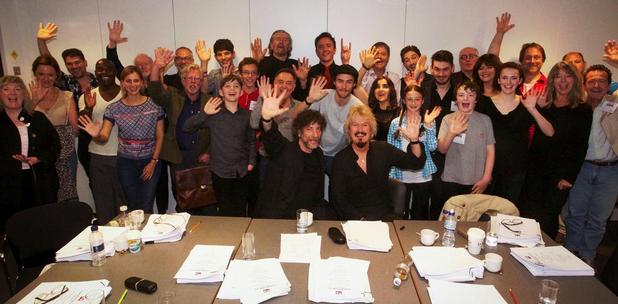
The Good Omens team gathered for a reading. Aren’t they a lovely bunch?

What’s your favourite book?

It’s always been a tough question to answer for me. What are the criteria? The Lord of the Rings is a superlative work of creation. Rubicon is as great a work of historical narrative as I’ve ever read. The Lies of Locke Lamora impressed me more than any novel in the past ten years and genuinely shocked me with one of its many twists. Planetary and V for Vendetta are superbly well-crafted comics series. I could dig in to my library and make an argument for many more of the books in there.

But if I’m allowed to narrow it down to the book that has given me the most joy, then the answer’s easier. Neil Gaiman and Terry Pratchett are two of my favourite authors, their storytelling skills and mastery of wordplay having made me smile more often than most, and when they collaborated to create a novel, they both surpassed themselves. That novel, Good Omens, reduced me to even more helpless giggling than Douglas Adams Hitchhiker’s Guide series ever managed.

The news, then, that Pratchett and Gaiman are adapting Good Omens as a six-part BBC Radio 4 dramatisation, just fills me with even greater joy. Add to that the fact that the team behind it was also responsible for last year’s wonderful adaptation of Gaiman’s Neverwhere and joy levels are starting to reach near-terminal levels. Anything else? Oh yes, how about the amazing Peter Serafinowicz as co-lead Crowley, “an angel who did not so much fall as saunter vaguely downwards”.*

Needless to say, a radio-centric Christmas can’t come soon enough. I may just have to dig out my very-well thumbed copy of the original novel** and remind myself of just how good it is in order to prepare myself…

*He hadn’t meant to fall. He’d just hung around with the wrong people.

**It was first published in 1990. That’s … quite a while ago.