Category Archives: Politics

Negotiating a Breakup


The Saltire really did bring out the best in those crusader crosses.
Somehow it all seems a lot less colourful now…

All of a sudden, with under two weeks to go, the referendum on Scottish independence is making a lot of people nervous. Whereas its failure was previously treated as a foregone conclusion, with the media enjoying the raised voices and ridiculousness of it all, it’s now looking too close to call. So has it really come to this? Is the United Kingdom going to be split along Hadrian’s Wall?*

Well yes, probably. And it shouldn’t be too much of a surprise. The United Kingdom has been in a state of slow dissolution for a century and more. The colonies of the Empire headed for the exit one by one over many decades. The Irish had to kick and punch their way into doing the same, the results of which can still be seen in Northern Ireland. The Welsh? Well, they were first in, and they’ll probably be last out too. Feel sorry for them.

The Scots only joined in the first place because they were bribed with the crown of England. Not that it was a particularly easy unification, and indeed it took most of a century to sort out the details. (Ireland didn’t get roped in fully for nearly another century, and that happened at least partly as a result of rebellious efforts to head in the other direction.) In Scotland, the English are still the Auld Enemy, and while it can hardly be argued that Scotland hasn’t benefited through its part in the British-led Industrial Revolution and all that followed, the fact is that it has always been an unbalanced partnership.

For all that, this should have been a fairly straightforward vote. Countries don’t tend to break up for no real reason, especially not First World countries with several centuries of successful history behind them. So how has it come to this?

Well, the United Kingdom has, at the moment, the misfortune to be led by one of the most insular cliques of public school-educated toffs in many a long year. Hardly the kind of thing to appeal to the provincials. Not that the minor parties are notably better. Together, they’ve driven a “No Campaign” of staggering ineptitude, ricocheting between platitudes, hypothetical doomsday scenarios and hectoring condescension. Hell, even calling it a No Campaign was probably a bad idea. They never managed to move the media needle on that piece of negative campaigning, no matter how much they promoted the insipid “Better Together” tagline.

Would Scotland be better off independent? I don’t know, but cutting themselves off from the rest of the U.K. is not a risk-free move. Economically and politically, Edinburgh’s heft is far short of London’s. Culturally too. Though the calculus of the situation looks tougher to work out further down the line. The cussedness of the Scots suggests that if anyone can deal with the problems of independence and build themselves back up, it’s them.

As a native of Northern Ireland now living in the non-British-aligned South, the eventual outcome doesn’t hold a huge amount of immediate impact for me. Not that the Northern Irish aren’t involved at all. In fact, there a lot of resonances at play for the North. The Unionist movement up there is largely the legacy of Scottish planters. The Nationalist movement has been working on getting out of the U.K. for decades now. A shame it took Sinn Fein three decades and thousands of deaths to figure out that politics and P.R. are a much better way of getting what they want.

A “Yes” vote on September 18th might cut Scotland free of the U.K., but the implications will rattle along for years, and the U.K. is a more complicated place than a quickie divorce can mend. The Scots will make their mind up one way or another, but both they and the English will have to work on being either neighbours or partners giving it one more shot.

*Okay, not exactly along Hadrian’s Wall, but close enough.

A New Beginning

It’s been way too long since I wrote in this blog. My writings have rarely been regular, but recent developments workwise have suppressed the writing impulse to the point where nothing has been appearing for several months. This is clearly unacceptable. So consider this a manifesto for getting back on track.

When I first set up this blog, it was as a receptacle for stray thoughts as I made my way eastwards around the world. (You can go all the way back and check it out if you like.) I also adorned it with some earlier blogging efforts and sprinkled a few of my more favoured attempts at fiction across the top. Further down the line, I began to throw a series of reviews at it, mostly books, cinema and games. Well, I’m still enjoying all of those, but the reviews have dwindled to nothing.

Along the way, there have also been moments of whimsy, political opinions and reflections on the current course of my life. All of this should provide plenty of material to keep the blog mill spinning. Which makes it all the more disappointing that it hasn’t. I still enjoy writing, it’s just that the moments where it previously fitted into my schedule have been shuffled around, and an attempt needs to be made to nail them down again.

There’s plenty to be said for commenting on the state of the world. Politics and the media are in no less surreal a state than they have been for the past few years. The Ferguson affair in the U.S. and the ISIS rearrangement of borders and peoples in the Middle East are raising hackles and some of the weirder excesses of both participants and commentators.

On a more personal level, my reading habit is finally getting back in gear after a few months (hell, call it a year and a bit) where it was hard to find time to fit reading into the rest of my life. Right now I’m rereading Julian May’s “Galactic Milieu” trilogy, having already raced through her “Saga of the Exiles.” May’s one of the best science fiction writers I’ve ever read, and the Saga of the Exiles would make a great TV miniseries in the mode of Game of Thrones. So add that to biweekly cinema excursions courtesy of a Meetup.com group and some PC and iOS game experiments (both good and bad), and there should be plenty of reviews emerging in the near future too.

Lastly, and most excitingly (for me at least), I’m finally planning to head off on a holiday lasting longer than a week. It’s been over two years at this stage, and it’s more than long overdue. The destination is Greece, as longstanding a travel goal as I have, and the itinerary is intended to take in as much beautiful scenery and sites of historical interest as the cradle of western civilisation has to offer.

So look for some brand new travel diaries coming towards the end of September. In the interim, I’ll try and keep the home fires burning by dropping the odd opinion, review and unusual fact into the hopper for general distribution. Possibly not tomorrow’s cinematic outing though. I’m not sure how much I’ll have to say about The Expendables 3.

Closing Down Dissent. Or Satire. Or Anything, Really…

I'm not really trying here, am I?
Shakespeare says NO! (via Wikipedia)

Ah, the joys of following the Northern Ireland news. Every so often, you get served up the kind of insanity that only the combination of parochial religious zealotry and a genuine 17th-century mindset can provide.

This week, it seems that the DUP councillors in Newtownabbey, evidently nostalgic for the days of the Life of Brian controversy, elected to force a shutdown of the Reduced Shakespeare Company’s The Bible: The Complete Word of God (Abridged), just a week before performance time. Because, hey, there’s nothing more important going on in Northern Ireland than a slapstick play that might put a few religious noses out of joint.

Let’s just clarify here: this is the Reduced Shakespeare Company that has been in existence for three decades and has been a fixture on the London theatre scene for much of that time. This is a show that has been around for nearly 20 years, winning awards, being performed around the world in numerous languages. And this is the DUP councillors standing up en masse and doing their best to bully the local arts board into shutting it down without a vote.

It would be funny if it weren’t so predictable. The combination of political power with the certainty of religious faith brings tends to results in the shutdown of dissenting points of view. Underdog sects and religions can favour freedom of conscience, but history shows that when the boot’s on the other foot, attitudes change. After all, when you’re in possession of the ultimate truth, isn’t it a public good if that’s the only truth that’s going to get promoted?

The trend towards secular government is one that took a long time to hit Ireland, and arguably it still hasn’t hit the North. Everywhere else, there has been pushback, in the form of Texas creationists altering school textbooks, Islamist efforts to marginalise secular Turkish youth, or a UKIP councillor linking gay marriage to recent floods. In Northern Ireland, the linkage between religion and the sectarian divide and the fact that parties from either extreme hold the whip hand means that it’s not so much pushback as an effort to hold onto power (something the Unionists have been doing for decades).

There’s no indication that anyone involved in cancelling the play had actually seen it, or had any interest in seeing it. Whether their chief interest was in “defending Christian values”, grandstanding for a few more votes or simply throwing their weight around, they both overstepped the mark in terms of their electoral mandate and completely undershot in terms of doing something of benefit for the people of Newtownabbey.

A Barricade of Bunting

20130113-142324.jpg
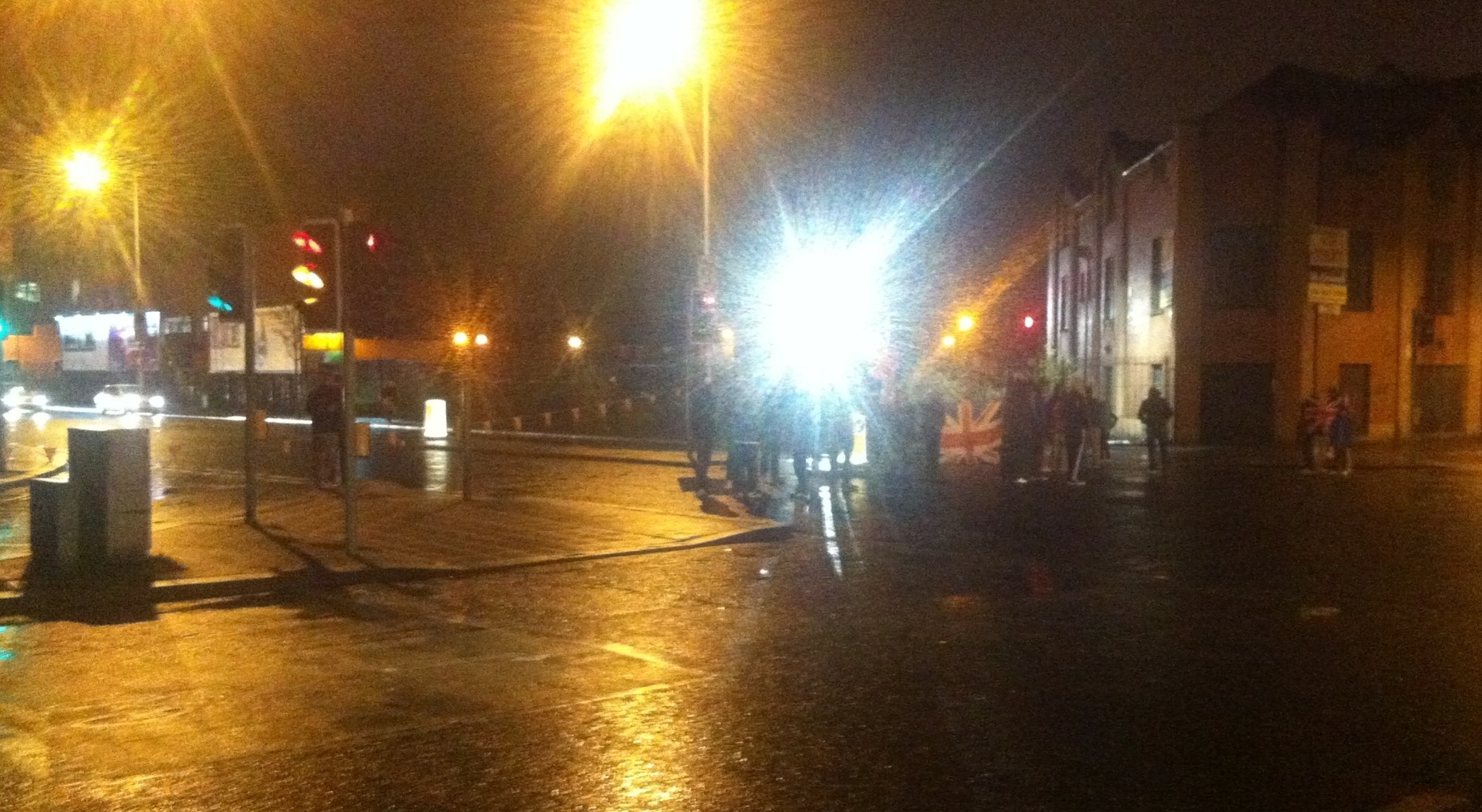
Hidden in the dazzle, the early evening protestors and their bunting.

In the end, it was a simple matter of stepping over a thin line of bunting stretched across the road. And then, later, walking through a line of mostly youngish men, hooded and masked. No one commented, or even looked my way. Even so, I felt my stomach knotting.

Why? There was no violence there, early on a wet night in Belfast, or later. (Though things did get hairy elsewhere and the next day.) The flag protests that have rolled across Northern Ireland for the past few weeks have been amply covered in the media, but this was my first direct contact with them. In place of brick and bottle throwing defiance, there was a slightly sullen matter-of-factness about the whole affair. Civil disobedience already turned into habit.

I’m not going to go into the justifications for the protests, which have already been covered elsewhere, except to note that few commentators on either side of the divide have dared to come out in support of violence as a response to putting a flag in a drawer as opposed to on a pole for most of the year. Unfortunately, both sides of the community in Northern Ireland are in the habit of launching the sort of street protest that inevitably leads to stone-throwing and worse. For the young and the hopeless, it’s better than dealing with the everyday grind.

So if I wasn’t facing violence, what was it that caused my stomach to curl in on itself? Some of it, perhaps, was a reminder of what I’d left behind. I’ve been in Dublin for a long time, and even when I lived in Northern Ireland it was in a relatively peaceful corner, where the Troubles mostly came in the form of daily news reports. In the North, old grievances run deep, and fears run along with them. Fear of the Other and what they might do if unchecked.

So the protests were a response to the apparent nationalist victory at getting the Union Jack taken off Belfast City Hall most days of the year. An effort by the loyalist community to throw their weight around, to prove to the police, nationalists and anyone watching that they could do so if they wanted. Swaggering is one word. Intimidation is another.

And it was that intimidation that my stomach was responding to. I’m not a violent person, and my first response to conflict is usually to avoid it. But when gangs decide to block passage along the Ormeau Road, as others did elsewhere that night, avoidance is no longer an option. Meekness works instead, avoiding eye contact and just passing by, hoping that the self-appointed big dogs have bigger fish to fry.

And where was I going that night? To Ravenhill, where an Ulster rugby team that has garnered the support of both sides of the community slogged their way to another victory in the rain. Among the flags there were plenty of Northern Ireland and Ulster banners, the best of which featured the Red Hand grasping a pint of Guinness. But no Union Jacks and no tricolours. We should all be so lucky.

Returning for the Endgame

20111028-212856.jpg
Any resemblance to Michael D. Higgins in terms of baldness or stature are entirely coincidental but hopefully amusing.

Around the time I was setting off on my round-the-world jaunt, the race for the Irish presidency had yet to kick into high gear. David Norris’s candidacy had sparked some life into the proceedings, but all the drama was revolving around his campaign and his past statements. Well, while I was gone, the drama levels hit the roof and the media wailed about negative campaigning while happily enabling it.

Until Mary Robinson took the ball and ran with it, the presidency was mostly viewed as a meaningless sinecure, but it has since become a more visible post, in which the occupant is expected to represent Ireland both at home and abroad. As the first count draws to a close, the winner seems likely to be the veteran Labour politician Michael D. Higgins, who remained more or less aloof from a vicious fray.

With the caveat that I’ve been aware of the race in the last few months only in a distant, Internet-enabled way, here’s how it seemed to turn out for the various candidates, ranked by their current standing in the polls.

Mary Davis: When she entered the race, there were more than a few references to a third Mary in a row holding the presidency. While she came across as fairly competent and seemed to suit the independent, anti-party mood, Mary Davis never really stood out, and to finish last behind Dana will hurt a lot.

Dana Rosemary Scallon: She’s done this before, back in 1997, but she still seemed to be running the same 14-year-old campaign this time around. And Ireland is not the same place it was 14 years ago. Weird outbursts about media harassment and veiled claims of vehicular sabotage probably didn’t convince anyone who wasn’t already on her side.

David Norris: The early front-runner in the race, it was his entry that sparked the whole thing into life, generating excitement among many and anger among more than a few. The Daily Mail in particular laid into Norris with great glee, digging up some questionable comments and actions, but as with another candidate, Norris sabotaged himself with his inability to cope with the pressure in a “presidential” manner. It will be a great day when Ireland elects a president regardless of their sexual orientation, but Norris won’t be that president, at least this time around.

Gay Mitchell: The government’s candidate never seemed too enthused with the notion of being president, and the apathy of the rest of the country matched that. It was Fianna Fáil that was kicked out of office earlier in the year, but Fine Gael is the other half of the duopoly that’s run Ireland for most of its independent history, and such is the distrust of politics as usual that being the government candidate was as much a hindrance as a help.

Martin McGuinness: If Norris’s entry kicked the race into life, the entry of Martin McGuinness took it to another level. The most visible and divisive political figure among the candidates, he also generated plenty of excitement and plenty of anger. The question is whether he actually expected to win and take up a post that offers mostly symbolic power instead of his current position as Deputy First Minister of Northern Ireland. As it is, he’s done Sinn Fein’s cause no harm, performed well enough to avoid negative comments, and played a key role in deciding the outcome of the race to boot. Speaking of which…

Seán Gallagher: The man who almost won it, until Sinn Fein took him off at the knees. A businessman and a television celebrity, he played the independent card hard and won a lot of support on that basis until it came to light that he was a lot deeper in the old Fianna Fáil culture than he claimed to be. He might even have survived that had he been able to deal with the pressure better than he did. As it was, he dodged, dissembled and complained, handing victory to the one competitor who maintained a statesmanlike demeanour throughout the whole thing.

Michael D. Higgins: Old age and guile will defeat youth and energy. Michael D. Higgins may lack stature and look older than his 70 years, but he has experience to burn and a long and varied career in politics and public service on which to base his claim for the presidency. The rise of Seán Gallagher as the alternative candidate almost overthrew him, but with the help of Sinn Fein and ultimately of Gallagher himself, he sailed over the finishing line well in front.