Category Archives: Reviews

Age of Ultron and Daredevil: Marvel Testing the Limits

Shiny happy heroes.
Age of Ultron definitely has higher production values on the posters at least. (Image via Comicvine.)

From a point of bankruptcy in the 1990s, Marvel has built its comic-book properties into a billion-dollar film and television franchise that’s so omnipresent you never have to wait long for the next Marvel product. Two movies a year and multiple TV series are enough to sate the most avid fan, and while we may be nearing oversaturation, the quality has remained remarkably high so far. The latest two offerings—Avengers: Age of Ultron and Daredevil—represent Marvel working harder than ever to maintain that quality as it stretches the limits of what superhero fiction can do on screen.

A:AoU is of course the follow-up to Joss Whedon’s ensemble blockbuster movie, whereas Daredevil marks the first offering from Marvel’s tie-up with Netflix, presenting heroics at a more gritty street level than Avengers’ apocalyptic, primary-colour adventures. Having watched them both to completion over the past weekend, I thought comparing the two might prove interesting.

Spoilers abound below…

Continue reading Age of Ultron and Daredevil: Marvel Testing the Limits

Terry Pratchett – An Appreciation


So much enjoyment in so little space.
A Pratchett bookshelf – and this isnt all of it.


Certain authors and novels, if you come across them at the right age, will change your life. Terry Pratchett was one of those authors for me, and while his recent death was long anticipated, due to the cruelty of early-onset Alzheimer’s, the news, when it came, proved just as gut-wrenching as the original announcement of his illness had been.

Already, there have been plenty of appreciations of the man and his work. It’s a mark of both the nature of the man and the talent of the author that someone who primarily wrote comedic fantasy touched as many people across as many fields as he did.

I never met Terry Pratchett—the closest I came was during one of his visits to Dublin, when I spotted him walking in College Green, heading from Trinity College to (presumably) a pub, surrounded by a gaggle of students and admirers. It would have been nice to have the chance to talk to him, but at that stage he’d been talking to me through his work for years.

Books like Good Omens, Small Gods and Pyramids reduced me to helpless giggling more than any since Douglas Adams’ Hitchhiker’s Guide to the Galaxy. (Another author and decent human being taken too soon.) Across the 40 books of the Discworld series, Pratchett mixed the deftest wordplay with humour both low and cutting and serious thoughts that stole upon you in the midst of the laughter and stuck around long after the jokes were done.

As a kid growing up in a Northern Ireland still caught up in the lunacy of the Troubles, Pratchett provided constant reassurance that there was a better humanity out there. That being decent to other human beings mattered most of all, that you ought to be suspicious of anyone or any organisation that would tell you what to think, that being curious, patient, and argumentative were all good things. Thoughts that I found it hard to express, even as I was working them out in my own head, I found reflected in his prose.

As an aspiring writer, the most important thing I learned from him was that it was possible to underlay fantasy and science fiction writing with serious topics without preaching to your audience. I learned as well that language was a game, one that you won if you brought a smile to your audience’s face, or just made them pause and consider for a moment.

As a human being, he was, like his collaborator Neil Gaiman, like Douglas Adams and Charles Darwin, one of those people it was possible to admire without having to look up to them. Possessed of immense talent that never overwhelmed his innately decent humanity, yet driven by an inner anger that allowed him to churn out books of breathtaking quality and wit year after year.

That same anger helped him to deal with the unfairness of his diagnosis. Deeming it “an embuggerance,” he continued to live his life even more fully than before, fighting on behalf of those suffering from Alzheimer’s and those who believed that they had a right to end a life that had become unbearable. His eloquent arguments in favour of the right to die in the manner of his own choosing revived a debate that is still going on.

Reading Pratchett and authors like him and growing up where I did and among my family and friends has led me to the belief that if we have a purpose in life, it’s to increase the amount of happiness in the world, both your own and that of those around you. Far more than the number of books he sold, the joy that his work and personality brought to so many is a marker of his success in life.

If I ever have any kids, I’ll enjoy sharing his books with them. And whether or not they turn out to be fans like me, I hope that some of the lessons that I’ve learned in reading his books will be the same lessons I share with them.

Someone to Root For

Should have gone with a photo of Amy Acker instead.
Sometimes you have to go with the obvious visual pun.

Most stories have a hero. Most also have a protagonist. The two roles aren’t mutually exclusive, but nor are they synonymous. The hero is almost always the protagonist. The protagonist is not always a hero. Following the latter course can lead to interesting places in the hands of a clever writer, but it also risks sacrificing the audience’s engagement in search of those interesting places.

Twice in the past few weeks, I’ve watched films that gave us protagonists who fell quite some way short of any definition of the word hero. Sadly, in neither case did the scriptwriters seem to acknowledge that this might be the case, let alone that it might be a problem.

The first case was the latest Will Smith vehicle, Focus. Smith plays the leader of a ring of conmen and criminals, a slick mastermind of innumerable crimes, both petty and serious. Into his world wanders the much less slick Margot Robbie, whom he takes first under his wing and then into his bed. So far so conventional, and in the manner of all criminal movies since The Sting, there are double crosses and fake outs aplenty to keep the audience guessing.

Sadly, the movie throws it all away early on, with a scene in which Robbie is taught to prey on sports fans at a championship game. Not high rollers, just ordinary fans and tourists, whose pockets are picked, valuables lifted and holidays ruined all so Smith’s crew can saunter off at the end of the weekend significantly richer, with no authorities any the wiser.

Films about criminals are common enough, and there are two main camps: the Robin Hood types, who prey upon the rich and greedy, and the hardened criminals, who tend to suffer just as much hardship as any of those whom they victimise. Focus seems quite happy to present its unrepentant criminals as heroes without making them suffer overmuch, content to coast on Smith’s slick personality and Robbie’s scantily clad charms (to be fair, Smith is scantily clad at least as often, and if I’d been working out as much as him, I would be too).

Skipping over whether any of the plot twists actually hang together (spoiler – they don’t), the fact that the film doesn’t bother making its characters sympathetic leaves the entire exercise hollow. Focus’s central romance never convinces, so the engine of the plot for the second half of the movie, centring around Smith’s efforts to get Robbie back, simply sputters and dies. The result is an impressively produced piece of nothing much at all.

More recently, I went to see Chappie, Neil Blompkamp’s latest offering. Unlike Smith, who lapsed into underperforming blockbuster mode a while back, Blomkamp has a 50-50 average so far, following up the impressively grungy District 9 with the unconvincing Elysium. With Chappie, the director and cowriter returns to the happier hunting grounds of Johannesburg, but he brings back with him some of the habits of Hollywood shallowness.

Actually, let’s be a little more direct here—Chappie is so shallow that if you dived in, you’d barely get wet before you broke your nose. The “Idiot Ball” is a common term in scriptwriting circles, denoting a character who does something stupid in order to advance the plot. The character doing so is said to be holding the Idiot Ball. In Chappie, it seems that they received a truckload of Idiot Balls, as the plot relies on everyone being stupid all of the time.

Mark Kermode summed up the film as Short Circuit meets Robocop, a description it’s hard to improve on. Dev Patel plays a genius robotics expert who never convincingly manages to explain how or why he wants to create a truly conscious artifical intelligence in the chassis of a police robot. Hugh Jackman plays a villain who’s just a moustache-twirl away from tying damsels to railway lines and cackling. Sigourney Weaver is … in the film. And the members of Die Antwoord play themselves pretending to be Jo’burger gangsters who adopt the titular Chappie by way of kidnap and some of the most half-baked scheming ever committed to celluloid.

That said schemes prove completely successful indicates that the scriptwriters had other things in mind. Quite what those things are, it’s hard to tell. Sharlto Copley does a decent job of portraying Chappie as a precocious infant, but his character’s intellectual growth spurts and stalls according to the needs of the plot. For all of Patel’s argument that this kind of AI could be “smarter than a human!”, the only bit of exceptional intelligence shown is a kind of reverse Idiot Ball, where Chappie’s AI brain provides a solution to a problem that enables the final denouement.

Amid all of the handwaving explanations and unconvincing twists, the arms corporation that everyone apart from the gangsters works for proves the least convincing element of all. Despite being solely responsible for the company’s success, Patel has a cubicle in the same open-plan office as Jackman, who has a barely concealed, quasi-religious objection to his AI products. Sigourney Weaver is the boss whose only role is to say yes or no to each of her underlings at plot-significant moments, and the security guards are only there to be conspicuous by their absence whenever Patel or Jackman want to do something underhand. Which accounts for about two thirds of their working hours, by my calculations. Performance reviews at that company must be amazingly lax.

Amid all of this, if you root for anyone, it has to be Chappie himself by default. This is despite the fact that his personality is limited to say the least. He defaults to obeying/remaining devoted to Patel, who doesn’t do much for him beyond creating him and bossing him about. He likewise mimics and obeys his gangster foster parents without learning much from either of them. There are a few scenes in which you sympathise with his plight, notably early on, but tonally the film jumps all over the place, right up until that ending.

Still, of the two films, Chappie is easily the better. That it retains some of the beautifully scrungy appeal of District 9 and a few imaginative and emotive scenes fails to hide the fact that it’s also wildly inconsistent, shallow and ultimately pointless. Despite this, it remains a long way ahead of Focus, which never stretches itself beyond shallow and self-satisfied.

Edit: In an interview, Blomkamp notes that unlike his other films, Chappie has no socio-political context. Which tallies with my feelings about the film – shorn of that context, it falls back on the infant AI and its implications for meaning but never follows through on that possibility with any conviction.

Not So Much Ascending as Coasting

Sometimes you just have to let go.
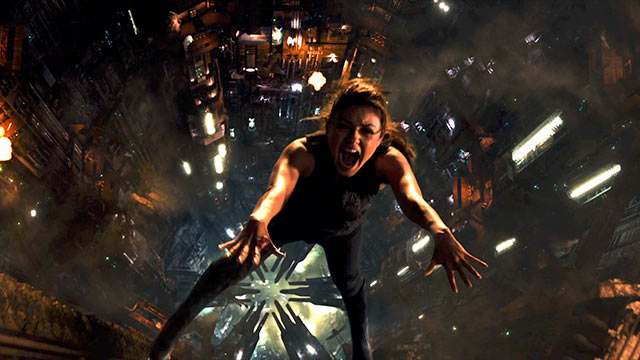
I know how you feel, Mila…

One definition of insanity is to repeat the same activity and expect a different outcome. A modern variation on that might be to go to a Wachowski Siblings movie expecting something akin to The Matrix. Watching Jupiter Ascending last week, I wondered if this was a case of optimism triumphing over experience or a more simple case of refusing to heed the signs.

This is not to say that The Matrix is a perfect movie—it hasn’t aged well. Nor is it to say that the Wachowskis haven’t done anything else of worth—their movies have remained visually imaginative and have never shied away from incorporating big ideas. All the same, the shadow of their game-changing early success seems to weigh as heavily on them as it does on their audience.

So what do we get with Jupiter Ascending? We get a weirdly unbalanced mix of overstuffed science fantasy, underplayed “big ideas” and a selection of narrative cliches that combine to waste just about everyone’s time. It’s remarkably ambitious, but it doesn’t seem to be ambitious to do anything in particular—it’s happy enough to just be ambitious.

To trade in spoilers for a little while, one of the nicer things about Jupiter Ascending is its heroine. Mila Kunis is a Russian emigre housemaid, cleaning the toilets of the super-rich in Chicago. Essentially, she’s a romantic comedy character who suddenly finds that not only is she in a science fiction epic, but that she’s genetically destined to be the ruler of the Earth. Actually, she’s the genetic owner of the Earth, rather than its ruler, but the legal basis for that, as well as just how she came to inherit her genetic payload (if it wasn’t just random chance), is one of the many things that Jupiter Ascending skips over rather than engages in.

So what is the galactic civilisation that she finds herself a player in? Well, you could watch the entire movie and not really have a clue. There’s a galactic police force that mostly exists to give people a spaceship to fly around in (because they’re certainly not enforcing any laws). There’s a bureaucracy borrowed from Terry Gilliam’s Brazil, to the point of including a bizarre cameo by Gilliam himself. And there are the main antagonists, who are competing over a valuable youth treatment—not that there seems to be anyone around to actually buy the stuff.*

This absence of context infects the entire movie, making it feel oddly hollow even as it tries its best to fill itself up with incident. The main victims of this include the aforementioned antagonist family: Of the three of them, one is shunted off the stage after explaining the plot to the heroine, another has an interesting scheme that he abandons at the end of the second act, and the last just pouts and scowls in the background until it’s time for the big finale.

If the movie had the confidence it desperately needed, it wouldn’t have felt the need to fire off every arrow in its quiver in one go. Whereas The Matrix was a focused, low-stakes, personal story—which led to the sequels increasingly revealing the lack of a coherent universe—Jupiter Ascending puts the fate of the Earth at stake from the start, leaving it nowhere to go but sideways.

So what about those big ideas that the Wachowskis like to play with? Well, they’re there, sort of. As mentioned, there’s the Soylent Green-style youth serum, but as it’s embodied in just three people, none of whom are given any depth as characters, it’s a rather one-sided critique of capitalism. (There’s even a wedding two-thirds of the way through the movie where the crowd are all robots.) Beyond that, well, aren’t the chase scenes and the explosions nice? Certainly, there’s nothing like The Matrix’s juxtaposition of an appealing simulated world with a grimy reality. Both movies might count as high concept, but The Matrix’s high concept informs the entire film. Jupiter Ascending’s high concept drifts out of sight for long stretches of time and is entirely absent in the finale.

Whatever flaws there are in the film though can’t be blamed on the actors. Eddie Redmayne happily chews away at the scenery as the final boss, and Douglas Booth is surprisingly good as his kid brother and the penultimate boss. Kunis and Channing Tatum are likeable enough leads, if never particularly believable in their underwritten romance, and Sean Bean commits to his supporting role as well as he ever does. The sad fact though is that there’s no one else in the film of note. This is a very, very empty galaxy.

The Wachowskis might never make another Matrix, but that’s hardly a criticism—few filmmakers ever make a film that has such impact. But their triumph is also their curse. Knowing what they’re capable of, we’re always going to hope, if not expect, that they’ll reach those heights again. Jupiter Ascending aims for that, but it never even comes close.

Out of the Machine, God?

Face to face with ... what exactly?
Vikander makes for an alluring and unsettling presence.

Amid all the bombast of superhero blockbusters and science fiction franchises starting with “Star”, it hasn’t been easy for thoughtful science fiction and fantasy to leave a mark in recent years. Which isn’t to say that there haven’t been efforts. Christopher Nolan’s Interstellar was as fascinating and ambitious as it was flawed, and Neill Blomkamp’s Chappie is hopefully going to remind us why District 9 was great and why we should all try to forget about Elysium.

In the meantime, we have Ex Machina, the directorial debut of writer Alex Garland, and I’m happy to report that it’s every bit as thought-provoking and unsettling a work as you might expect from the writer of The Beach, 28 Days Later and Sunshine.

Some spoilers below, inevitably, but mostly I’m going to be ruminating on themes.

Continue reading Out of the Machine, God?

There and Back Again

The inspiration for a thousand New Zealand holidays.
A young filmmaker, a familiar door, a journey begins.

In December 2001, a group of friends gathered in a cinema on the outskirts of Dublin. They’d known each other for six or seven years at that point, having met in college and bonded over roleplaying games, science fiction and fantasy. They were in the cinema to watch a film they’d been waiting years to see: Peter Jackson’s The Lord of the Rings: The Fellowship of the Rings. It didn’t disappoint.

Earlier this morning, I was in a cinema in central Dublin, watching the last of Jackson’s Tolkien films, The Hobbit: The Battle of the Five Armies. None of those friends were there, but there was another group of cinephiles around me. It was a very different person watching as the credits rolled for the last time. The experience was never going to be the same, but even so, some of the spirit of that first night carried over.

The Fellowship of the Ring was one of those events you never expect. We were all lovers of Tolkien to one degree or another, and there had been one very patchy animated version years before. Scepticism about Jackson’s version was high, but we weren’t about to miss it. One of us had just flown in from California that morning, and was fuelled by caffeine and Ben & Jerry’s as he took his seat.

From the opening credits and Cate Blanchett’s voiceover, the doubts washed away. Through the combination of music, actors, New Zealand scenery, artists and computer wizardry, Jackson had summoned Middle Earth to life. If it wasn’t what we’d seen in our minds’ eyes, it was undeniably a complete creation: the Nazgul were terrifying, the One Ring a force of evil bound in a band of gold, the Fellowship a believable cast of characters flawed and noble. Even moments that veered from the book, such as Gandalf and Saruman’s duel in Orthanc, worked. The sight of two elderly actors acrobatically battering each other somehow balanced perfectly with the gravitas that Ian McKellan and Christopher Lee have to spare.

We were sold, and most of the cinema-going world were too.

The arguments began with the sequel, The Two Towers. Though they’d all been filmed together, here and there Jackson’s vision failed to please everyone. For example, I liked the changes to the character of Faramir, who I’d never been fond of in the book. Others found the same changes annoying.

So it went through the next film, The Return of the King. A fine end to the trilogy, but more and more niggling arguments about how the books had fared in the translation. We disagreed, we debated, the films were over, we went on with our lives. Our lives changed, and years passed. Many of the events that nine years can bring were visited on us, but we stayed friends for the most part, drifting but not severing the ties.

Then came another Jackson film in Tolkien’s world: The Hobbit: An Unexpected Journey. Scepticism was higher yet, but it wasn’t something to be missed. Those of us who were able to made their way to the cinema. We watched it, we discussed it and it was clear that it wasn’t the same experience at all. As is often the case, I was looking for the good points, playing devil’s advocate against those annoyed by the bad. Even I couldn’t argue though that Jackson was suffering from auteur syndrome, which had previously afflicted J.K. Rowling, George Lucas and George R.R. Martin: he’d become so successful that either everyone else bought into his vision or no one dared to tell him when to rein it in.

The thing that has bothered me about the second Jackson trilogy is the lack of subtlety. Many of the best moments of the first trilogy came when actors interpreted words straight from Tolkien’s book. But The Hobbit is a much shorter book than The Lord of the Rings and written in a very different tone. It’s a children’s adventure that draw on fairy tales and Arthurian romances, with the mythic history of the later book very far in the background. In stretching a slender book out to three lengthy movies, Jackson had to fill in the gaps with much that Tolkien only hinted at, or material that he didn’t even write at all.

It can’t have been an easy job, and as much as he might be attached to the project, I imagine that he’s happy to put down it and move on to pastures new. Throughout the Hobbit movies, the need to provide something truly cinematic has been at the forefront. Stretched though they might have been, they’ve also been packed with incident, drama, action, humour and scares. Roller coaster cinema, with all the good and bad implications of that.

The final film is perhaps the strongest of the three. It’s also the shortest, showing signs of having been cut very tight. There are some impressive moments, and some annoying ones. I suspect most of my friends from that long-ago night would have been mostly annoyed, but I enjoyed it for what it was. I’ll not spoil any of it for those of you yet to see it, but I will mention one scene from right at the end, so if you don’t want to know about it, skip the next paragraph and know that I recommend the film.

In that scene, Martin Freeman as Bilbo and Ian McKellan as Gandalf sit quietly together in the aftermath of battle. No words are spoken, but you understand perfectly all that the two of them have been through. Jackson knows well enough to let the two actors, who between them have been the moral and emotional heart of six films, carry the weight of the moment. It’s beautiful and it’s subtle and to my mind it’s worth the price of admission on its own. It made me think of absent friends and shared experiences, of those who’ve gone and yet remain in memory and affection.

For all their ups and downs, Jackson’s films stand as a remarkable achievement. That they happened at all is impressive. That they built a recognisable world of their own, attracted millions of viewers and sparked a rebirth of fantasy and science fiction on our screens is something to be thankful for. HBO’s Game of Thrones wouldn’t exist without Jackson’s films, to say nothing of many other works, both lesser and greater. And while opinions may be divided between my friends and I, it’s a pleasure to have so much to argue about.

Interstellar and the Art of Humanity

...but seriously, it's not that much of a spoiler.
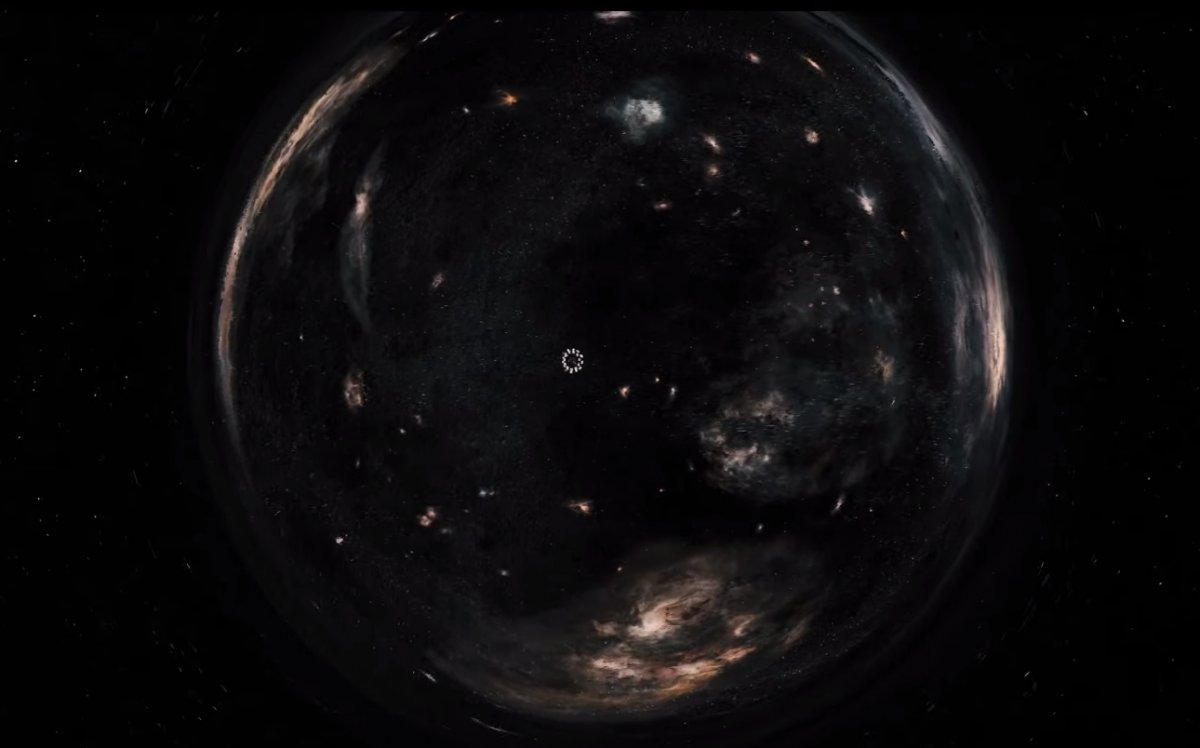
This image may count as a spoiler. So don’t look too close…

Films that are worth talking about are worth seeing twice. Sometimes the second viewing can open up a film, revealing just how good it really is. On the other hand, it can confirm that despite all its promise, it somehow falls short of being truly great.

So far I’ve only seen Christopher Nolan’s Interstellar once, so I can’t say for certain where it falls on this scale. All I can say is that it is worth talking about. Rather than a review, this is going to be a critique, a musing on certain points, and thoughts about where Interstellar fits into the history of science fiction cinema.

Spoilers, obviously, but not too many.

With Interstellar, I made as much of an effort as I ever have to avoid learning anything about the film. It wasn’t an entirely successful effort. Thanks to Facebook and RSS feed summaries, I ended up learning about the movie’s main scientific conceit and the surprise cameo. Thankfully, neither of these are key to what the film cares about: it’s a space opera rather than hard science fiction, despite its trappings, and the cameo is, well, a little pointless.

When it comes to space-based science fiction films, two great films loom largest for me: 2001: A Space Odyssey and Moon. Like Interstellar, both of them focus on humanity against the background of space and science, yet they present this central obsession in different ways. 2001 universalises its humanity, to the point where Keir Dullea’s Dave Bowman becomes an everyman, no more specific than one of the apes who encounters the monolith at the start of the film. Interstellar’s debt to 2001 is everywhere, from its use of music and model work for effect to scenes that harken back to specific scenes in 2001. It’s a very high bar to aim at, but Nolan has never had a problem with ambition.

Moon, on the other hand, makes its humanity intensely personal, and in Sam Rockwell it has an actor whose agonies are always believable. It’s a much more focused film than either 2001 or Interstellar, and its use of science is limited to its setting and the twist that sets its plot in motion. Interstellar bears no specific debt to Moon, but it is as just as emotional and its science is if anything relegated even more to the role of window dressing.

The problem with Interstellar is that it falls between two stools. Despite an excess of verbiage (something neither Moon nor 2001 could be accused of), there are some fine performances here. the emotional heart of the film falls by the wayside in the second act and only really comes into focus in the third, by which point it’s too late to sell it. And in trying to restart that emotional heart, it abandons its efforts to say something all-encompassing about humanity apart from a vaguely voiced notion that we’re going to save ourselves. For Nolan, who mastered the difficult art of the closing scene in Memento and Inception, Interstellar feels like it just peters out, unsure of what it’s trying to say.

A larger problem in terms of Interstellar’s potential to become a classic of the genre is the fact that, at its heart, it’s an American film, not a universal one. The Dust Bowl theme standing in for environmental collapse is one thing, the self-mythologising tendency at its heart, the repeated moments of folksy wisdom, and the cowboy hero of the last frontier that it can’t look away from is quite another. That last one is perhaps Interstellar’s biggest problem. Matthew McConaughey’s Cooper is the ostensible hero, and his adventures are certainly the most cinematic and visually interesting aspect of the film, but the focus on him detracts from the role of his daughter Murph, played with equal weight by Jessica Chastain and Mackenzie Foy. Her struggle becomes incidental, when it could and perhaps should have received equal billing.

This may seem like a negative article so far, but in balance of that, remember that I had big expectations when it came to Interstellar. Nolan’s record is as good as anyone’s at the moment, and I’ve only seen it once (and my initial reaction, before I’d had a chance to think about it, was a lot more negative). On the plus side, it looks beautiful, even though there are a few points where the models look a little too model-like. Hans Zimmer’s score hits the high notes too, as ought to be expected of him by now. Now that I’ve had a chance to read a few reviews, it seems that mixed responses are the order of the day.

Bear in mind too that 2001 was met with similarly mixed responses when it first appeared and only ascended to its towering role within the genre over time. Interstellar may well have a similar path ahead of it. I doubt I’ll ever love it as much as I do Moon though. Whether it’ll improve on second viewing will depend on whether, behind all of its verbiage, there’s brain to match its heart.

Edit: So I went to see Interstellar a second time (this time in IMAX). And while I’m glad I did, it didn’t change my mind much. It’s a fascinating, ambitious, flawed film, notable as much for its tendency to hammer you over the head with its themes as for the epic sweep of its visuals. For all its focus on delivering an emotional, almost mystical experience, there’s only one point where it succeeds in truly touching the heartstrings. That particular scene though is the one part of the movie that is a classic piece of cinema, and while I won’t spoil it by describing it, I will say that it involves a countdown.

Good Omens About the Radio

I'd give anything to have been at that reading...
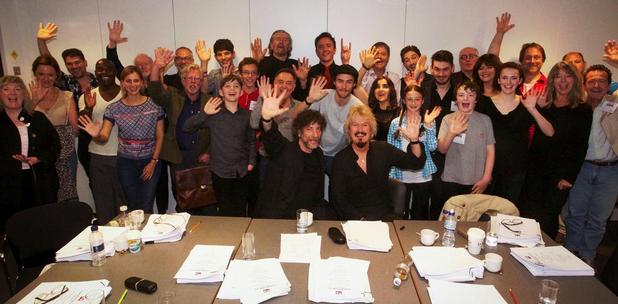
The Good Omens team gathered for a reading. Aren’t they a lovely bunch?

What’s your favourite book?

It’s always been a tough question to answer for me. What are the criteria? The Lord of the Rings is a superlative work of creation. Rubicon is as great a work of historical narrative as I’ve ever read. The Lies of Locke Lamora impressed me more than any novel in the past ten years and genuinely shocked me with one of its many twists. Planetary and V for Vendetta are superbly well-crafted comics series. I could dig in to my library and make an argument for many more of the books in there.

But if I’m allowed to narrow it down to the book that has given me the most joy, then the answer’s easier. Neil Gaiman and Terry Pratchett are two of my favourite authors, their storytelling skills and mastery of wordplay having made me smile more often than most, and when they collaborated to create a novel, they both surpassed themselves. That novel, Good Omens, reduced me to even more helpless giggling than Douglas Adams Hitchhiker’s Guide series ever managed.

The news, then, that Pratchett and Gaiman are adapting Good Omens as a six-part BBC Radio 4 dramatisation, just fills me with even greater joy. Add to that the fact that the team behind it was also responsible for last year’s wonderful adaptation of Gaiman’s Neverwhere and joy levels are starting to reach near-terminal levels. Anything else? Oh yes, how about the amazing Peter Serafinowicz as co-lead Crowley, “an angel who did not so much fall as saunter vaguely downwards”.*

Needless to say, a radio-centric Christmas can’t come soon enough. I may just have to dig out my very-well thumbed copy of the original novel** and remind myself of just how good it is in order to prepare myself…

*He hadn’t meant to fall. He’d just hung around with the wrong people.

**It was first published in 1990. That’s … quite a while ago.

Hitman GO and the Pit of F2P

IMG_2804.PNG
On my way to make a killing…

I’ve been looking for a new smartphone game recently. It’s a fraught process these days. The goal is to secure a source of entertainment. The dilemma you face is this: do you go free or do you pay? I’ve done both, and I’ve returned from the wilderness of the App Store with dusty wisdom.

Free-to-play (F2P), or freemium (ugh), games have flooded App Stores in recent years. After all, with so much competition, it’s all about about ensuring that as many people as possible sample your wares. Free entry means that there’s no barrier, so the potential audience is everyone who has a device capable of playing your game. With such a large audience, only a small percentage have to make “in-app purchases” for a game to be profitable.

The problem is that F2P games are a balancing act. On the bright side, they can offer you plenty of enjoyment at no cost, with the option of throwing in some cash for more of the same, or faster progression. On the dark side, the reminders to spend money can be relentless, multiplayer games can fall into “pay-to-win” scenarios, and progression can become a terrible grind for those unwilling to fork over their money.

My first attempts at finding a new game headed in the direction of golf games. (Blame Rory McIlroy’s recent success for that.) I’ve an old copy of EA’s Tiger Woods PGA Tour 2012, but it’s creaky and buggy now. EA’s King of the Golf Course seemed like a sensible replacement, and its core mechanic was beautifully smooth, but the game structure of a linear set of challenges devolved into a slow grind after a couple of days. Com2uS USA Inc.’s Golf Star was even worse: old-fashioned mechanics stuffed into an overly ornate game that never missed a chance to encourage you to spend money. Both were highly rated on the App Store. Both are no longer on my phone.

It doesn’t have to be this way for F2P games. NimbleBit’s NimbleQuest is an addictive arcade game that is fun to play even as you’re grinding, and their Pocket Trains trades a little immediate fun for a lot more strategy. Plain Vanilla Corp.’s QuizUp is still one of the best multiplayer experiences on the iPhone for trivia geeks. Gameloft’s Rival Knights devolved into excessive grinding by the end but was fun until then. PopCap’s Plants vs. Zombies 2 took a F2P approach to a superlatively fun paid game and only suffered because it made the game more complex, a different kind of entry barrier.

The fact is though, I’ve found that the best results are to be had when you’re willing to pay for a game that isn’t going to nag you or slow your progress. You’re rarely going to be paying more than the price of a pint or two for an iPhone or iPad game, and for that price, ten or more hours of entertainment is a small price to pay.

Paid games seem particularly suited to more story-based titles, games with a finite span. Capybara Games’ Superbrothers: Sword & Sworcery is an absorbing adventure, beautifully presented. Bossa Studios Thomas Was Alone is a similarly absorbing recreation of an atmospheric online puzzle game. Lastly, usTwo’s Monument Valley is a perspective-based puzzle game, perfectly suited to touch screens. I paid for all three and don’t regret it, even if Monument Valley is a little light on content.

There’s plenty of space for both models in the App Store economy. F2P games when you want to sample, browse and check things out. Paid games when you know what you want. Well, I tried out the browsing side of things, but if was paying that got me what I wanted.

Square Enix’s Hitman GO, (pictured above) is a genuinely strange mobile adaptation of a first-person assassinate-em-up. Rather than try to recreate the shooting segments of the game that inspired it, the mobile version focuses on the tactical thought behind it, locking the player into a turn-based board game as they make their way through a multitude of levels, setting numerous targets along the way.

The board-game aesthetic is beautifully realised and feels only a little cramped on a phone screen. The rules of the game are rigid enough to allow the player to plan, and the occasionally mutually exclusive achievements encourage replay. There are a massive number of levels too, with the option of paying for more if you want to. (The line between F2P and paid is blurry in places.) At some point in the future, I may exhaust its appeal, but by then I’ll have long since got my money’s worth.

Three Writers, One Reader

IMG_2802-0.JPG
Not pictured: Bloody huge and expensive collected editions.

So today I managed to make it to the comics shop, for a rather expensive visit. I only bought three actual comics, but the majority of the expense came from two omnibus editions that I’d been waiting on. More about those anon, but the three single-issue comics I picked up make for an interesting compare-and-contrast, so that’s what I’m going to do. Three writers, all British, of differing eras and evoking rather different responses.

First up on the critical chopping block is Grant Morrison with Multiversity #1. Morrison was an early arrival to American comics, part of the first wave of British writers who invaded in the wake of Alan Moore’s work on Swamp Thing and Watchmen. That makes him a contemporary of Neil Gaiman, but whereas Gaiman is a master storyteller, Morrison is more interested in the intersection between stories and the real world. With Morrison’s work, the storyteller’s mind is almost always visible, and while that can create intellectually challenging work, it also leaves the writer in danger of disappearing up his own fundament.*

With Multiversity, Morrison continues his role as the mad genius of DC Comics. In this role, he’s been responsible for some fascinating comics (Batman Inc., Seven Soldiers of Victory), some messy disasters (Final Crisis), and at least one work of genius (All-Star Superman). Multiversity is very much more in the mode of Final Crisis—a massive crossover “event” title, but whereas for that Morrison was seen as an architect of DC strategy, with all the associated editorial fetters that brings, here he’s been given multiple alternative universes to play with, outside of DC’s mainstream output. The result is a title that’s fascinating to read but not exactly easy to understand.

Multiversity is very much a comic about comics, addressing itself directly to the reader on the first page. It’s illustrated in classic heroic style by Ivan Reis, but as always with Morrison, there’s little assistance for the initiated. The tendency of characters to declaim rather than talk, the inspection of all the strange corners of superhero comics, the combination of playfulness with epic themes: there’s plenty of meat here for Morrison fans and superhero scholars, but if you’re not one or the other, or possibly both, you’re likely to be left cold.

If Multerversity tends towards the opaque, Warren Ellis’s Supreme: Blue Rose #2 is wilfully obscure. Ellis is of the generation after Morrison, arriving in American comics with Marvel before proceeding to redefine the breadth of the superhero genre with The Authority and its depth with Planetary, then kicking it in the balls with the genuinely hilarious Nextwave. Ellis’s comics output has been sketchy in recent years for various reasons, not least of which is his own curiosity. He jumps from theme to theme and technique to technique in a manner that’s probably a little frustrating to his fans (such as myself), but the result is a body of work that’s probably the most diverse in mainstream comics today.

With Supreme: Blue Rose, Ellis is doing an unusual thing for him and walking in already-trodden ground. The character of Supreme was created by Rob Liefeld as a modern Superman clone and reinvented by Alan Moore as a vehicle for investigating and celebrating the strangeness of Golden Age superhero comics. Ellis’s take on the character is hard to define as yet (two issues in and there’s no sign of anyone called Supreme) but he’s definitely found something in the idea that he thinks is worth mining, as the central character of Diana Dane begins to explore a universe seemingly gone awry and existing as one of many possible realities.

So far, it’s hard to tell where Ellis is going with all of this. That’s not to say that the feeling of being confused is an unpleasant one. Ellis likes to experiment with the comics form, occasionally paring it back to the bare essentials, but on his game he’s as good a storyteller as anyone, and here he’s aided and abetted by the painterly beauty of Tula Lotay’s artwork, all sketchwork and pastel colours. Supreme: Blue Rose may eventually take its place among Ellis’s finest works, or it may falter and prove to be a flawed experiment. Either way, on current evidence, it’s fascinating and worth your time.

Rounding out the British trio is Kieron Gillen, with The Wicked + the Divine #3. Gillen is a recent arrival on the American comics scene, having enjoyed critical and fan acclaim for his runs on Journey into Mystery and Iron Man. Here he’s working again with his most notable artistic partner, Jamie McKelvie, with whom he’s already created Phonogram and Young Avengers. I’ve only recently started picking up his work, but he started by reading the same sort of comics as me**, and I’ve been reading his writing since his time as a writer for PC Gamer magazine.

With The Wicked + the Divine, as with Phonogram, Gillen is riffing on his love of music. A tale of mortals reborn as gods, living two years of glory before inevitable death, it’s laden down with as many fascinating resonances and sources as the work of Ellis and Morrison but presented in a much more approachable fashion. Perhaps a little too approachable—the first two issues had introduced the world and its main characters in sure-footed fashion, but #3 not only brings in a tricky character in the form of the triple-goddess Morrigan but also lays out the murder mystery that’s driving the series’ opening arc. It does so in a playful fashion, but it’s creaking a little at the seams, never more so than on the third page, which is painfully reminiscent of Ellis’ work on Transmetropolitan.***

However, when the worst you can say about a comic is that it creaks a little in presenting its backstory, and the only actual misstep takes up no more than a single page, then you’re talking about something special. McKelvie’s art is clear and attractive, fitted perfectly to Gillen’s tale of modern-day gods of the music world, and this is just the first act of a series that’s aiming to be another long-form novel in graphic form, akin to Sandman and Transmetropolitan. Gillen’s fondness for twists in the narrative is already much in evidence, and for myself I wouldn’t be surprised if his reader-substitute, point-of-view character Laura is hiding a few dark secrets of her own. Whether you prefer single issues or collected editions, The Wicked + the Divine is something you might want to sample to see if it fits your frame of mind.

Oh, and as for those omnibuses? Well, one of them was the second half of Gillen’s run on Journey into Mystery, wherein his mastery of building a twist narrative and his equal mastery of screwing with the emotions of his Tumblr followers first came into public view. The other was the fourth and penultimate volume of Mike Carey’s Lucifer, the real successor to Neil Gaiman’s legendary Sandman. Carey is a writer who deserves a post all of his own, given my love of his work, and I hope to get around to writing that eventually.

*One of Morrison’s best works, to my mind, is We3, in which he restrains his metatextual tendencies.

**During his Iron Man run, Gillen managed to secure my everlasting affection by bringing back one of my favourite characters, Death’s Head, in a pitch-perfect cameo role.

***Ellis is an acknowledged influence on Gillen’s work. Gillen has also taken to heart Ellis’s engagement with his online audience, focusing in particular on Tumblr, where he regularly dissects the thinking behind his own work.