The Historical Traveller

Mind you, I live in Dublin now, so visiting this is a holiday in itself.
A millennium and a half of history just down the road. But if you can go further, why wouldn’t you?

There’s a certain set of rituals to be undertaken before a long holiday. Eating the last of the perishable food in the house. Considering what clothes to take with you (there may be shorts, and the baring of milky-white leg flesh). Making sure that no one gets left in the lurch at work (inevitably, though, the clock draws the eyes more and more strongly as the end of the last day approaches). Reminding yourself not to forget your passport (which has absolutely no effect on whether or not you do eventually forget it).

I’m in the middle of all of this right now—in two days I leave Dublin for Greece (via Copenhagen for reasons of cheap flights and the prospects of a pleasant layover). On this trip, I’m staying true to one of my main reasons for travelling. There are many things that can drive one to visit distant places—time in the sun, adventure in an exotic locale, a new cultural experience, encounters with natural wonders—and over the years I’ve resorted to them all, either solo or in company. The draw that most informs my list of “must visit” places though? History.

Experiencing history is something like floating on an ocean. There are depths below you, all around, and every so often you can catch glimpses of what lies below. Back at home, familiar sights included a schoolhouse more than a century old, a ruined church more than a thousand years-a-crumbling and a stone circle dating back to the Neolithic period. Being surrounded by all of this as a child made me feel like I could reach out and touch the people who shared my homeland, no matter how separated in time we might be. The same feeling hits me on my holidays too, whether in the Colosseum in Rome, Tycho Brahe’s observatory in Copenhagen or a temple in Kyoto.

Greece has been on my top-ten list of places to visit for a long time. In fact, in the current political climate (which rules Egypt and Iran out) and in the absence of a long sabbatical from work (ruling out much of the southern hemisphere), it’s probably the most desired unvisited destination I have. Ten days won’t be near enough to see everything that I want to see (I’m focusing on the mainland rather than the islands) but they’ll be a packed ten days.

Why Greece? Look back to a childhood dominated by myths and legends for the main clue. To travel around Greece is to step back through time: from Ottoman rule to Byzantine domination, beyond that to the time of Imperial Rome and Macedonian kings, then to classical Athens and archaic Mycenae and Knossos. To return to the ocean metaphor, travelling through Greece is like floating above a wonderful mix of coral reefs and abysses. There’s always going to be something to see, layered everywhere you look. It’s a beautiful country too, full of wild mountains and deep valleys.

My basic plan is to start in the north, near Thessaloniki, and make my way south through the mainland, visiting Delphi, Athens and Mystra before hopping on a ferry to Crete, from where I’ll fly home again. Unlike my last long journey through Russia and beyond, there’s no need to exhaustively plan everything out, so I’m happy to wing it to an extent. That’s another benefit of travelling solo, I suppose: you can indulge your own whims without worrying about the impact they might have on your travelling partner. Of course, the drawback is not being able to share your enthusiasm and experiences, but that just provides a reason to repeat the journey again in the future.

All of which is to say that there should be, before too long, another travelogue appearing under the long-neglected “Travel” tab above. Between now and then, there will be reports from Greece whenever I get the chance to add them (not having planned out my accommodation to the last detail, I have no idea when and where I’m going to have Internet access—again, on the bright side, it’ll be nice to get away from LCD screens for a while).

In the last couple of days, I’ve realised all the things I’m going to be missing while I’m gone: a comics convention, Dublin’s Culture Night, the Ryder Cup and two weeks of rugby, West Brom and Doctor Who. For all that though, it’s been too long since I travelled. The excitement is just starting to kick in now, and it’s a nice, unfamiliar feeling. When I finally head to the airport, it’ll be in my preferred fashion, with a bag on my shoulder, a passport in my pocket and history in my future. I hope, in whatever I come to write about it, I manage to share some of that excitement with you.
Paisley and Legacy

That Paisley documentary, should you wish to delve into his mind.

So Ian Paisley is dead, as of a few days ago. I’m no more inclined to dance on his grave than I am to shed a tear at his passing, but the injunction not to speak ill of the dead mostly exists to preserve the feelings of the deceased’s loved ones, none of whom I know, nor are they ever likely to pay heed to anything I say. So some recollections might be in order.

When I was growing up in Northern Ireland, Ian Paisley was a constant presence. Back then he was a fringe character, albeit the most prominent one of his kind. To a child old enough to pay attention to the news but not old enough to understand the tangled truths and lies at the heart of the Northern Irish situation, there was something immediately appealing about this shouty man, spouting certainties at the top of his lungs wherever the lines between communities at war were in danger of becoming blurred.

The more understanding I gained, the more the limitations of his worldview became evident. Paisley was a complex man, even an exceptionally intelligent one, but those complexities were hammered flat by his fundamentalist worldview. Those he was close to remember him as warm, cordial figure, but one suspects that such warmth only extended to those who existed as human beings in his own eyes. Someone who could say that Catholics “breed like rabbits and multiply like vermin” had placed strict limits on his empathy.

In this, he was heir to centuries of anti-Catholic, biblical tradition arising from his Ulster Scots background, owning no authority save that of the bible. This is a man, after all, who founded his own church and his own political party. The common joke back in the Troubles was that Paisley had finally consented to a power-sharing agreement: with God. His famous heckling of Pope John Paul II suggested that he didn’t see him so much as a man as he did a figure of mythic significance, one that he was locked in war with.

All the stranger then that he executed an almost complete volte-face in his latter days. From being the most intransigent figure of the Troubles, he (once his party were in a position to take power) suddenly became open not just to power sharing, but to power-sharing with Sinn Fein, which he was more apt to call Sinn Fein/IRA. Which is either a breathtaking acceptance of the limitations of the principles he’d adhered to for decades, or an act of equally breathtaking hypocrisy.

That there were plenty willing to take the latter view may be seen in the fact that both his church and his party eventually rejected him. The former as soon as he took up that leadership role, the latter as soon as their grip on the reins of power was firm enough that they could afford to jettison their non-political anachronism of a founder.

As much as the Unionists may have had to hold their nose on going into government with Sinn Fein though, the same may have been true in reverse. His Damascene conversion on the road to government notwithstanding, Paisley was as responsible as anyone for generating the atmosphere of hatred and suspicion that drove the Troubles through three decades of murder. He’s gone to his grave with blood on his hands and no more willing or able to admit his culpability than Martin McGuinness or Gerry Adams have ever been.

His decision, in what turned out to be his last year, to participate in a tell-all documentary, stands now as a final preacher’s performance, a spouting of the truth as he saw it from the mountaintop. Perhaps even to make clear that the twists and turns of his own life could be looked back upon as a straight road, laid out according to his principles. If so, there were many lives bulldozed to make way for it.

Watching the Apple Watch

Go on, admit it. You want to at least play with them for a while.
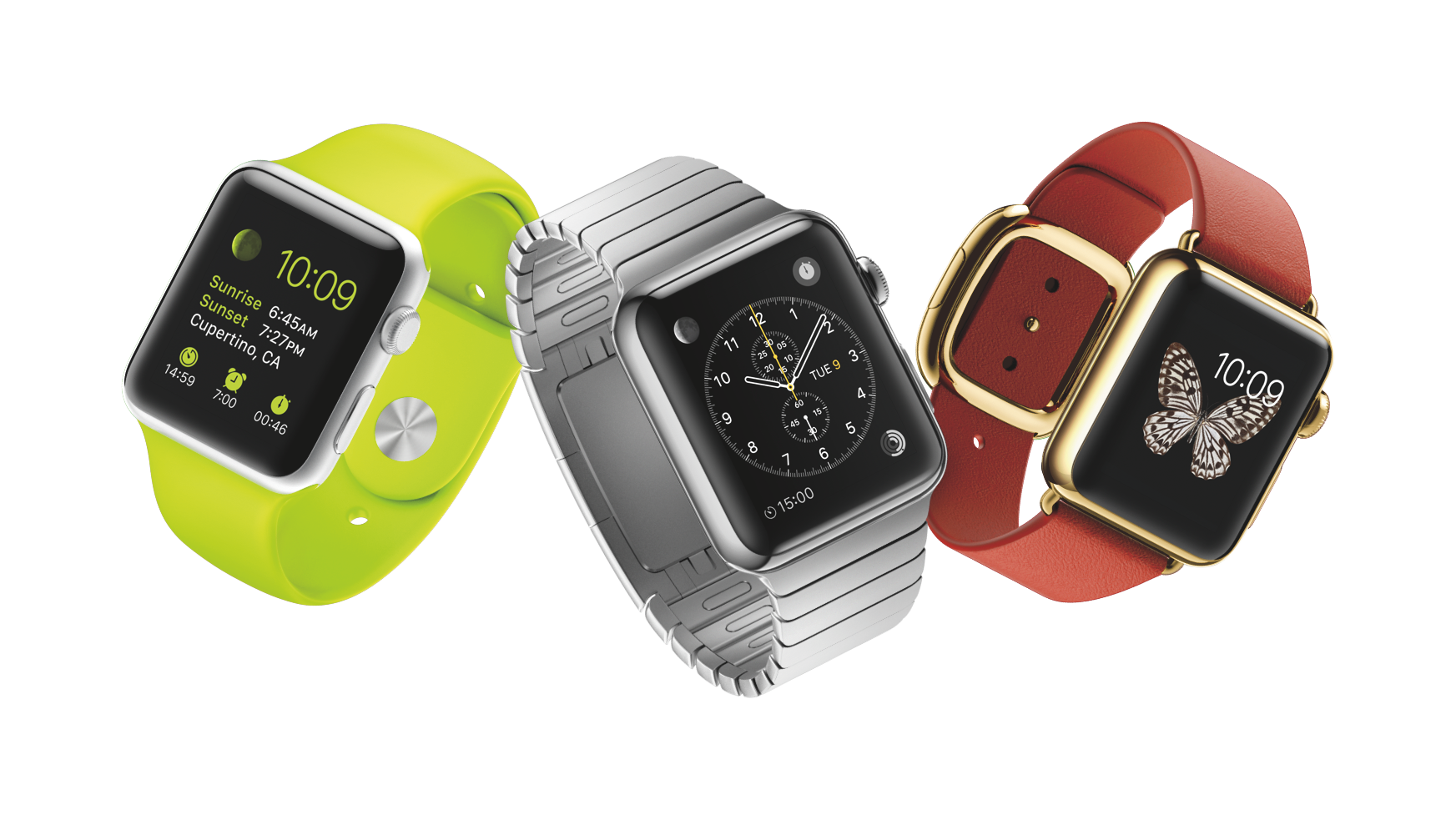
All these can be yours, for a (to be determined) price.

I’ve been an Apple user long enough that the company’s regular keynote events are a recognisable form of entertainment. Unusually, I didn’t watch this week’s well-publicised event until the day after it happened. (Possibly a good thing given the problems that the live streaming coverage faced.) By that time I’d already read enough of the media reaction to know exactly what I’d be seeing. Spoilers aren’t really the point with an event like this.

The first part of the event, to be fair, had already been well spoiled by leaks. Enough prototype parts and schematics had trickled out from Apple’s supply chain that only a few details remained to be filled in about the new iPhones. The 6 and 6 Plus looked much as expected and neatly relegated last year’s 5s and 5c to the minor places in Apple’s product lineup. A one-year-old free (on contract) iPhone is a better trick than a two-year-old free offering, but the 6 and 6 Plus are now the stars. The former seems the better bet, though the 6 Plus has its own appeal if you can handle its unwieldy dimensions—in its case, battery life and an improved screen are bigger draws than the optical image stabilisation of its slightly protruding camera.

Next up after the phones was something only hinted at in pre-show leaks: Apple Pay. A solution to the hassle of everyday credit card payments, it positions Apple well in the race to made commercial life more convenient. It’s the biggest leveraging to date of Apple’s credit-card enabled iTunes customers, bringing together a lot of pieces (iBeacon, Passbook) that Apple has been putting into place for some time now. However, given that it’s only usable with NFC-enabled devices (both the iPhone 6 and 6 Plus, as well as this article’s titular device) and is only to be deployed in the U.S. for the moment, its reach will initially be limited. Over the long term though, it could well be the most important announcement of the entire show.

Last up was the fabled “One More Thing,” returning to a very warm welcome from the crowd. This was, of course, the Apple Watch, likewise rumoured in the media but barely even glimpsed in advance of the show itself. It seems that Apple’s secrecy can still hold when they really need it to.

A handful of smartwatches have already hit the market. I owned one briefly, in the form of the Pebble, but most of them are now running Google’s Android in one form or another, and yet more are on the way. If the Apple Watch is going to be a success, Apple’s going to have to repeat a trick it’s already pulled with the iPod, iPhone and iPad: to enter an existing but nascent market and turn it upside down. So has it done so?

Well no, not yet, if only for the reason that the Apple Watch won’t be released until early next year and many important facts about it remain uncertain, but at least one watch industry watcher has been impressed by the unveiling, not just its implications for the smartwatch industry but for watches in general.

Whereas its competitors seem to have focused primarily on providing an adjunct to their Android phones, Apple is coming from the other direction. The Apple Watch is tethered to the iPhone (or possibly the iPad too?) true, but it’s as much a fashion accessory as it is a computing accessory. The fact that Apple paid attention to what people might actually want to put on their wrist can be seen in the simplest fact about the Apple Watch: it comes in two sizes, small and large. Just like non-smart watches do.

Physically, it’s arguably more attractive than any of the other smartwatches already out there. More importantly to potential buyers, it’s massively customisable, more so than any other Apple product before it. Between size, colour and strap type, as long as you fancy having an Apple Watch on your wrist, you’ll be able to make it look exactly the way you want it to. Moreover, Apple has gone to great lengths to design its straps so that you can fit and adjust them yourself, rather than heading to a jeweller to have it done for you, as is the case with several of the Android smartwatches.

As for the software, it certainly looks the part, with Apple once again tailoring an operating system to suit the device. The Apple Watch has a touch screen, but given that any touching finger would obscure a significant portion of the screen, it also has a “digital crown,” refashioning the traditional watch crown into a multifunction control wheel with an integrated home button. Another button devoted to bringing up a “favourite contacts” screen is a reminder that the Apple Watch, above all else, is meant to leverage the power of its linked iOS device, faster and with greater ease than ever, and preferably without needing to take it out of your pocket or bag.

As for whether I plan to get one or not, that depends. Depends on the battery life of the final device and the price of the various options. Depends on whether or not the eventual software manages to live up to the promises of the keynote speech. For, whatever else it may be good at, Apple is very good at selling its devices as objects of desire. I’ll be looking out for reasons not to break open the piggy bank come early 2015. It’s up to Apple to match its own hype.

Until then, I have iOS 8 (coming next week) and OS X Yosemite (coming a little later) to refresh my own devices, making them seem like new again. There’s a new U2 album as well, offered as an awkward freebie at the end of the keynote, but that can’t really compete as an attraction. After all, what we get for free, we never really appreciate as we should.

Negotiating a Breakup


The Saltire really did bring out the best in those crusader crosses.
Somehow it all seems a lot less colourful now…

All of a sudden, with under two weeks to go, the referendum on Scottish independence is making a lot of people nervous. Whereas its failure was previously treated as a foregone conclusion, with the media enjoying the raised voices and ridiculousness of it all, it’s now looking too close to call. So has it really come to this? Is the United Kingdom going to be split along Hadrian’s Wall?*

Well yes, probably. And it shouldn’t be too much of a surprise. The United Kingdom has been in a state of slow dissolution for a century and more. The colonies of the Empire headed for the exit one by one over many decades. The Irish had to kick and punch their way into doing the same, the results of which can still be seen in Northern Ireland. The Welsh? Well, they were first in, and they’ll probably be last out too. Feel sorry for them.

The Scots only joined in the first place because they were bribed with the crown of England. Not that it was a particularly easy unification, and indeed it took most of a century to sort out the details. (Ireland didn’t get roped in fully for nearly another century, and that happened at least partly as a result of rebellious efforts to head in the other direction.) In Scotland, the English are still the Auld Enemy, and while it can hardly be argued that Scotland hasn’t benefited through its part in the British-led Industrial Revolution and all that followed, the fact is that it has always been an unbalanced partnership.

For all that, this should have been a fairly straightforward vote. Countries don’t tend to break up for no real reason, especially not First World countries with several centuries of successful history behind them. So how has it come to this?

Well, the United Kingdom has, at the moment, the misfortune to be led by one of the most insular cliques of public school-educated toffs in many a long year. Hardly the kind of thing to appeal to the provincials. Not that the minor parties are notably better. Together, they’ve driven a “No Campaign” of staggering ineptitude, ricocheting between platitudes, hypothetical doomsday scenarios and hectoring condescension. Hell, even calling it a No Campaign was probably a bad idea. They never managed to move the media needle on that piece of negative campaigning, no matter how much they promoted the insipid “Better Together” tagline.

Would Scotland be better off independent? I don’t know, but cutting themselves off from the rest of the U.K. is not a risk-free move. Economically and politically, Edinburgh’s heft is far short of London’s. Culturally too. Though the calculus of the situation looks tougher to work out further down the line. The cussedness of the Scots suggests that if anyone can deal with the problems of independence and build themselves back up, it’s them.

As a native of Northern Ireland now living in the non-British-aligned South, the eventual outcome doesn’t hold a huge amount of immediate impact for me. Not that the Northern Irish aren’t involved at all. In fact, there a lot of resonances at play for the North. The Unionist movement up there is largely the legacy of Scottish planters. The Nationalist movement has been working on getting out of the U.K. for decades now. A shame it took Sinn Fein three decades and thousands of deaths to figure out that politics and P.R. are a much better way of getting what they want.

A “Yes” vote on September 18th might cut Scotland free of the U.K., but the implications will rattle along for years, and the U.K. is a more complicated place than a quickie divorce can mend. The Scots will make their mind up one way or another, but both they and the English will have to work on being either neighbours or partners giving it one more shot.

*Okay, not exactly along Hadrian’s Wall, but close enough.

Good Omens About the Radio

I'd give anything to have been at that reading...
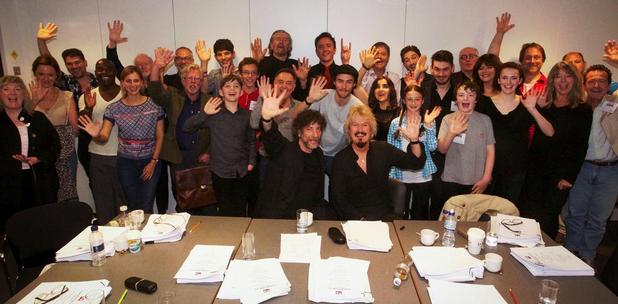
The Good Omens team gathered for a reading. Aren’t they a lovely bunch?

What’s your favourite book?

It’s always been a tough question to answer for me. What are the criteria? The Lord of the Rings is a superlative work of creation. Rubicon is as great a work of historical narrative as I’ve ever read. The Lies of Locke Lamora impressed me more than any novel in the past ten years and genuinely shocked me with one of its many twists. Planetary and V for Vendetta are superbly well-crafted comics series. I could dig in to my library and make an argument for many more of the books in there.

But if I’m allowed to narrow it down to the book that has given me the most joy, then the answer’s easier. Neil Gaiman and Terry Pratchett are two of my favourite authors, their storytelling skills and mastery of wordplay having made me smile more often than most, and when they collaborated to create a novel, they both surpassed themselves. That novel, Good Omens, reduced me to even more helpless giggling than Douglas Adams Hitchhiker’s Guide series ever managed.

The news, then, that Pratchett and Gaiman are adapting Good Omens as a six-part BBC Radio 4 dramatisation, just fills me with even greater joy. Add to that the fact that the team behind it was also responsible for last year’s wonderful adaptation of Gaiman’s Neverwhere and joy levels are starting to reach near-terminal levels. Anything else? Oh yes, how about the amazing Peter Serafinowicz as co-lead Crowley, “an angel who did not so much fall as saunter vaguely downwards”.*

Needless to say, a radio-centric Christmas can’t come soon enough. I may just have to dig out my very-well thumbed copy of the original novel** and remind myself of just how good it is in order to prepare myself…

*He hadn’t meant to fall. He’d just hung around with the wrong people.

**It was first published in 1990. That’s … quite a while ago.

Gerry Anderson – Learning to be Northern Irish

Two men who had a lot of influence on the Northern Ireland I grew up in died last week. One was the taoiseach who first brought ceasefire talks with the IRA to the highest levels of government, beginning the process that led to the Good Friday Agreement and a halt to three decades of slaughter. The other was a radio DJ who, through those years, provided a wry, human voice for those trying to live a normal life.

I don’t think it’s any insult to the memory of Albert Reynolds to say that for me, Gerry Anderson was by far the more important of the two.

Let me clarify that. One of my very earliest recurring memories is of travelling in the family car with one or both of my parents. The school my sister and I went to (and where my parents taught, and where my two brothers would later go) was several miles away from where we lived. So in the morning and the evening, we’d be driven there and back. Whenever that happened, and indeed whenever we were driven anywhere else, the radio was usually on, tuned to one of Northern Ireland’s local radio stations.

This was the 1980s, when the Troubles in Northern Ireland were more than a decade old and had become soul-grindingly mundane. I would be much older before I learned that being stopped in the middle of the night by soldiers in full camouflage, wielding automatic rifles; that cycling past police stations that looked more like fortresses; that listening to the news and hearing the tally of the latest bombings, shootings and burnings wasn’t something that everyone else in the western world had to deal with on a day-to-day basis.

The radio shows, which mostly mixed music with phone-in segments, were a means of holding together the majority of the population who didn’t support the lunatics on either side and didn’t care for living in a militarised zone. They maintained the thread of normality, of entertainment, good humour and common experience that frayed every time another bullet was fired or car bomb exploded. You could listen to them on the way to Belfast, arrive and have to deal with a city centre that had been fortified, then return and listen to them on the way home, restoring some sense of balance and sanity to your world.

Gerry Anderson was my favourite and still embodies much of what I think of as the best of Northern Ireland. For me, his dry humour, the way he dealt with the myriad strangenesses of daily life in the North, and his insistence that all those things were, in their own way, more important than the blood and thunder of the lunatics, is quintessentially Northern Irish. Famously, he was the man who cut through the Gordian knot of the Derry/Londonderry debate by renaming the city Stroke City. A Northern Irish solution to a Northern Irish problem if ever there was one.

Twenty years ago, the IRA ceasefire began, marking yet another step in the peace process, which has now taken firm, if occasionally painful hold on Northern Ireland. As bad as the Troubles were, those of us who lived through them were, in a way, lucky. We had the space to hold on to normal lives in the midst of it all, with the help of Gerry Anderson and many others. It’s hard not to look at the Middle East today and the chaos swirling around Syria and Iraq and wonder just how many people there won’t have as much of a chance. How much of their way of life is being destroyed. I hope that when the sound of the guns and the bombs fades away, there might be the sound of a radio somewhere, and of a dry-witted host engaging with everyday concerns before reaching for another record.

No More Internet Until You Learn to Behave

Be warned – there’s a lot of unpleasant imagery in the above video.

John Oliver’s rants on Last Week Tonight are becoming destination television for me. Or at least destination YouTube-ery. For his new show, the former Daily Show correspondent has replaced that show’s hit-and-miss interview segment with an extended single-topic rant, delivered as only a pissed-off English gentleman can and filled with truth bombs. The World Cup/Fifa rant is a classic already, but the more recent diatribe on the Ferguson affair had a particularly perfect closing line.

“If (the police) can make it through a whole month without killing a single unarmed black man, then, and only then, can they get their f**king toys back.”

Infantilising your opponents is no way to engage in a debate. But it’s so bloody hard to resist when they’re insistent on acting like three-year-olds throwing a tantrum. Take the response to Anita Sarkeesian’s latest Tropes vs. Women video, in which she dissects the often extremely unpleasant treatment that video games have doled out to women over the years. I don’t agree with everything that Sarkeesian is saying, but I’d love to do is have the chance to talk to someone about it and debate the issues she raises. Unfortunately, the people who have responded by hurling abuse and issuing threats of murder and rape are not interested in anything other than silencing a voice that annoys them.

Let’s be clear: there is no excuse for this. Anyone who did this in person, in a newspaper, on television, or in any other media would be shunned, shut down and perhaps even arrested. So why does it happen so regularly on the Internet, and why does it seem to happen particularly often with regard to video games? As for the Internet, the obvious answer is the anonymity that being online provides. The less obvious answer is that this anonymity facilitates communities of like-minded souls, just as the white hoods of the Ku Klux Klan allowed their activities to proceed in the not-so-distant past.

Why video games though? That’s harder to unpick. The industry, both producers and consumers, has been predominantly male for most of its history. This has served to enable attitudes to women that are proving very hard to shake. Anita Sarkeesian’s videos may depict only some of the symptoms of this problem, but she has a huge amount of material to work with. To truly dig into the gender issues in video games (which are just an outcropping of the issues in society as a whole) will take a lot more than a series of videos on YouTube.

I wonder, though, if there isn’t something to video games themselves that encourages this mindset. When Valve’s Half-Life 2 debuted its physics engine, giving us the ability to play with physical objects, it was just a more sophisticated version of what games had been allowing players to do for years: play with every interactive object in their arsenal. And in games, there’s no real difference between people and things. Both can be shot, thrown, punched and manipulated if the game designer allows it.

As games moved into the multiplayer era, this mindset didn’t change. The ranting, foul-mouthed Halo player, often teenage or younger, is something of a cliché. I’ve yelled at single-player games when things have gone badly for me, in a way I wouldn’t dream of doing to another human being. But if you’ve been trained to see your opponents as no more than sophisticated versions of computer-generated enemies rather than human beings, what’s to stop you from screaming abuse at them too?

One article on this topic nailed it for me: “There’s a fundamental lack of empathy or understanding for other human beings at play here.” I consider myself lucky to have played (and preferred) games where face-to-face contact with other human beings was a necessary part of the experience—roleplaying games and board games. How many of those who hurl the vilest kind of abuse at Anita Sarkeesian and anyone who dares to stand up for her make it a habit to engage with people who might challenge their point of view?

It’s a pointless argument to say that not all men are like this, not all gamers are like this, not all game creators are like this. In any community, from the global to the local, there are always those who take the opportunity to disrupt and destroy where they can. Every community has to figure out how to deal with this element. On the Internet, the goal of freedom of expression is colliding painfully with the notion that everyone ought to be free to make use of this new medium. In the corner devoted to video games, the howling mob is doing its best to ensure that the common space is shaped according to its preferences. I can’t imagine that it will win in the long term, but how much pain is going to be inflicted before humanity prevails?

Hitman GO and the Pit of F2P

IMG_2804.PNG
On my way to make a killing…

I’ve been looking for a new smartphone game recently. It’s a fraught process these days. The goal is to secure a source of entertainment. The dilemma you face is this: do you go free or do you pay? I’ve done both, and I’ve returned from the wilderness of the App Store with dusty wisdom.

Free-to-play (F2P), or freemium (ugh), games have flooded App Stores in recent years. After all, with so much competition, it’s all about about ensuring that as many people as possible sample your wares. Free entry means that there’s no barrier, so the potential audience is everyone who has a device capable of playing your game. With such a large audience, only a small percentage have to make “in-app purchases” for a game to be profitable.

The problem is that F2P games are a balancing act. On the bright side, they can offer you plenty of enjoyment at no cost, with the option of throwing in some cash for more of the same, or faster progression. On the dark side, the reminders to spend money can be relentless, multiplayer games can fall into “pay-to-win” scenarios, and progression can become a terrible grind for those unwilling to fork over their money.

My first attempts at finding a new game headed in the direction of golf games. (Blame Rory McIlroy’s recent success for that.) I’ve an old copy of EA’s Tiger Woods PGA Tour 2012, but it’s creaky and buggy now. EA’s King of the Golf Course seemed like a sensible replacement, and its core mechanic was beautifully smooth, but the game structure of a linear set of challenges devolved into a slow grind after a couple of days. Com2uS USA Inc.’s Golf Star was even worse: old-fashioned mechanics stuffed into an overly ornate game that never missed a chance to encourage you to spend money. Both were highly rated on the App Store. Both are no longer on my phone.

It doesn’t have to be this way for F2P games. NimbleBit’s NimbleQuest is an addictive arcade game that is fun to play even as you’re grinding, and their Pocket Trains trades a little immediate fun for a lot more strategy. Plain Vanilla Corp.’s QuizUp is still one of the best multiplayer experiences on the iPhone for trivia geeks. Gameloft’s Rival Knights devolved into excessive grinding by the end but was fun until then. PopCap’s Plants vs. Zombies 2 took a F2P approach to a superlatively fun paid game and only suffered because it made the game more complex, a different kind of entry barrier.

The fact is though, I’ve found that the best results are to be had when you’re willing to pay for a game that isn’t going to nag you or slow your progress. You’re rarely going to be paying more than the price of a pint or two for an iPhone or iPad game, and for that price, ten or more hours of entertainment is a small price to pay.

Paid games seem particularly suited to more story-based titles, games with a finite span. Capybara Games’ Superbrothers: Sword & Sworcery is an absorbing adventure, beautifully presented. Bossa Studios Thomas Was Alone is a similarly absorbing recreation of an atmospheric online puzzle game. Lastly, usTwo’s Monument Valley is a perspective-based puzzle game, perfectly suited to touch screens. I paid for all three and don’t regret it, even if Monument Valley is a little light on content.

There’s plenty of space for both models in the App Store economy. F2P games when you want to sample, browse and check things out. Paid games when you know what you want. Well, I tried out the browsing side of things, but if was paying that got me what I wanted.

Square Enix’s Hitman GO, (pictured above) is a genuinely strange mobile adaptation of a first-person assassinate-em-up. Rather than try to recreate the shooting segments of the game that inspired it, the mobile version focuses on the tactical thought behind it, locking the player into a turn-based board game as they make their way through a multitude of levels, setting numerous targets along the way.

The board-game aesthetic is beautifully realised and feels only a little cramped on a phone screen. The rules of the game are rigid enough to allow the player to plan, and the occasionally mutually exclusive achievements encourage replay. There are a massive number of levels too, with the option of paying for more if you want to. (The line between F2P and paid is blurry in places.) At some point in the future, I may exhaust its appeal, but by then I’ll have long since got my money’s worth.

Three Writers, One Reader

IMG_2802-0.JPG
Not pictured: Bloody huge and expensive collected editions.

So today I managed to make it to the comics shop, for a rather expensive visit. I only bought three actual comics, but the majority of the expense came from two omnibus editions that I’d been waiting on. More about those anon, but the three single-issue comics I picked up make for an interesting compare-and-contrast, so that’s what I’m going to do. Three writers, all British, of differing eras and evoking rather different responses.

First up on the critical chopping block is Grant Morrison with Multiversity #1. Morrison was an early arrival to American comics, part of the first wave of British writers who invaded in the wake of Alan Moore’s work on Swamp Thing and Watchmen. That makes him a contemporary of Neil Gaiman, but whereas Gaiman is a master storyteller, Morrison is more interested in the intersection between stories and the real world. With Morrison’s work, the storyteller’s mind is almost always visible, and while that can create intellectually challenging work, it also leaves the writer in danger of disappearing up his own fundament.*

With Multiversity, Morrison continues his role as the mad genius of DC Comics. In this role, he’s been responsible for some fascinating comics (Batman Inc., Seven Soldiers of Victory), some messy disasters (Final Crisis), and at least one work of genius (All-Star Superman). Multiversity is very much more in the mode of Final Crisis—a massive crossover “event” title, but whereas for that Morrison was seen as an architect of DC strategy, with all the associated editorial fetters that brings, here he’s been given multiple alternative universes to play with, outside of DC’s mainstream output. The result is a title that’s fascinating to read but not exactly easy to understand.

Multiversity is very much a comic about comics, addressing itself directly to the reader on the first page. It’s illustrated in classic heroic style by Ivan Reis, but as always with Morrison, there’s little assistance for the initiated. The tendency of characters to declaim rather than talk, the inspection of all the strange corners of superhero comics, the combination of playfulness with epic themes: there’s plenty of meat here for Morrison fans and superhero scholars, but if you’re not one or the other, or possibly both, you’re likely to be left cold.

If Multerversity tends towards the opaque, Warren Ellis’s Supreme: Blue Rose #2 is wilfully obscure. Ellis is of the generation after Morrison, arriving in American comics with Marvel before proceeding to redefine the breadth of the superhero genre with The Authority and its depth with Planetary, then kicking it in the balls with the genuinely hilarious Nextwave. Ellis’s comics output has been sketchy in recent years for various reasons, not least of which is his own curiosity. He jumps from theme to theme and technique to technique in a manner that’s probably a little frustrating to his fans (such as myself), but the result is a body of work that’s probably the most diverse in mainstream comics today.

With Supreme: Blue Rose, Ellis is doing an unusual thing for him and walking in already-trodden ground. The character of Supreme was created by Rob Liefeld as a modern Superman clone and reinvented by Alan Moore as a vehicle for investigating and celebrating the strangeness of Golden Age superhero comics. Ellis’s take on the character is hard to define as yet (two issues in and there’s no sign of anyone called Supreme) but he’s definitely found something in the idea that he thinks is worth mining, as the central character of Diana Dane begins to explore a universe seemingly gone awry and existing as one of many possible realities.

So far, it’s hard to tell where Ellis is going with all of this. That’s not to say that the feeling of being confused is an unpleasant one. Ellis likes to experiment with the comics form, occasionally paring it back to the bare essentials, but on his game he’s as good a storyteller as anyone, and here he’s aided and abetted by the painterly beauty of Tula Lotay’s artwork, all sketchwork and pastel colours. Supreme: Blue Rose may eventually take its place among Ellis’s finest works, or it may falter and prove to be a flawed experiment. Either way, on current evidence, it’s fascinating and worth your time.

Rounding out the British trio is Kieron Gillen, with The Wicked + the Divine #3. Gillen is a recent arrival on the American comics scene, having enjoyed critical and fan acclaim for his runs on Journey into Mystery and Iron Man. Here he’s working again with his most notable artistic partner, Jamie McKelvie, with whom he’s already created Phonogram and Young Avengers. I’ve only recently started picking up his work, but he started by reading the same sort of comics as me**, and I’ve been reading his writing since his time as a writer for PC Gamer magazine.

With The Wicked + the Divine, as with Phonogram, Gillen is riffing on his love of music. A tale of mortals reborn as gods, living two years of glory before inevitable death, it’s laden down with as many fascinating resonances and sources as the work of Ellis and Morrison but presented in a much more approachable fashion. Perhaps a little too approachable—the first two issues had introduced the world and its main characters in sure-footed fashion, but #3 not only brings in a tricky character in the form of the triple-goddess Morrigan but also lays out the murder mystery that’s driving the series’ opening arc. It does so in a playful fashion, but it’s creaking a little at the seams, never more so than on the third page, which is painfully reminiscent of Ellis’ work on Transmetropolitan.***

However, when the worst you can say about a comic is that it creaks a little in presenting its backstory, and the only actual misstep takes up no more than a single page, then you’re talking about something special. McKelvie’s art is clear and attractive, fitted perfectly to Gillen’s tale of modern-day gods of the music world, and this is just the first act of a series that’s aiming to be another long-form novel in graphic form, akin to Sandman and Transmetropolitan. Gillen’s fondness for twists in the narrative is already much in evidence, and for myself I wouldn’t be surprised if his reader-substitute, point-of-view character Laura is hiding a few dark secrets of her own. Whether you prefer single issues or collected editions, The Wicked + the Divine is something you might want to sample to see if it fits your frame of mind.

Oh, and as for those omnibuses? Well, one of them was the second half of Gillen’s run on Journey into Mystery, wherein his mastery of building a twist narrative and his equal mastery of screwing with the emotions of his Tumblr followers first came into public view. The other was the fourth and penultimate volume of Mike Carey’s Lucifer, the real successor to Neil Gaiman’s legendary Sandman. Carey is a writer who deserves a post all of his own, given my love of his work, and I hope to get around to writing that eventually.

*One of Morrison’s best works, to my mind, is We3, in which he restrains his metatextual tendencies.

**During his Iron Man run, Gillen managed to secure my everlasting affection by bringing back one of my favourite characters, Death’s Head, in a pitch-perfect cameo role.

***Ellis is an acknowledged influence on Gillen’s work. Gillen has also taken to heart Ellis’s engagement with his online audience, focusing in particular on Tumblr, where he regularly dissects the thinking behind his own work.

The Highs and Lows of Bone Hunters

For someone who's millions of years old, she's still got it...
Yes, it’s a selfie. One of the hazards of travelling solo is that you have to resort to them occasionally.

Somewhere in my parents’ house is a yellowing piece of paper, over thirty years old. It’s a newspaper clipping, of a brief article with an attached photograph. In the photo are myself and my sister, still in primary school, clutching a book about dinosaurs. We’d just won a competition about those terrible lizards, the prize of which was said book and a trip to the Ulster Museum’s then-new dinosaur exhibit.*

I wish I had a copy of that photo to use for the picture for this article. Instead, you’ll have to settle for a slightly more mature me and an even more appropriate female guest star. Lurking over my shoulder is Sue, the star exhibit of Chicago’s Field Museum, and now a movie star in her own right, with the release of the documentary Dinosaur 13.

I was a dinosaur nut as a kid, perhaps even more so than is usual. I read everything I could get my hands on, not just about the dinosaurs themselves but also about the history of their discovery. From Gideon Mantell’s reconstruction of the Iguanadon to the Bone Wars of Othniel Marsh and Edward Drinker Cope, I loved it all. I even wanted to be a palaeontologist before a love of writing got in the way of scientific ambition.

So I wasn’t about to miss the opportunity to watch a documentary on the subject of dinosaurs and their discovery. I didn’t even know that Sue was the star turn of the movie until shortly after it began, but as it turns out, her story is far more interesting than the Field Museum was willing to admit.

Still the most complete Tyrannosaurus Rex skeleton ever found, Sue was uncovered in South Dakota in 1990. It took years for her to find her way to the main hall of the Field Museum, only after many court cases as the government sought to convict the bone collectors who’d struck the jackpot in uncovering Sue. Without going into too much detail, it’s a story that combines pride, joy, greed, bureaucracy and naiveté.

It’s not as heavy on the scientific or historical detail as I might prefer, but that’s a personal judgement. This is the story of those who love fossils and dinosaurs and thought that in finding Sue they would finally put their small town on the map. That they ended up facing fines, prison and the combination of government obfuscation and personal greed is something that might conspire to put some people off palaeontology as a career.

Which would be a damn shame. Any career that offers the opportunity of coming into physical contact with the long-vanished past is one that every child ought to at least consider. And thanks to those who seek out fossils such as Sue, millions of children each year now have a chance to come into contact with one of the most impressive creatures ever to walk the planet. As victories go, it may not be complete, but it’s worth the celebration of sentiment that underlines all the hardships that Dinosaur 13 depicts.

*My sister, a year older than I, was nowhere near the dinosaur nut that I was, and was more than a little apprehensive about getting dragged into my interest. Luckily, no one in the museum was interested in interrogating her on the subject.