Not Quite Star Trek—Discovery and The Orville

These are, in theory, great times to be a Star Trek fan. Sure, the film series is currently on hiatus, its spangly attempt to reboot continuity having had, at best, mixed results. Even so, television (where Trek first found fame) has not one, but two Trek offerings. One is the official Star Trek: Discovery, which has just kicked off its second season. The other is the ersatz Trek, Seth MacFarlane’s The Orville, which is several episodes into its own second season.

Both of these series have struggled against a sense that they’re not really Star Trek. It’s an easy accusation to face in the case of The Orville, which was born out of MacFarlane’s love of all things Trek, but despite its often juvenile humour, it regularly harks back to the era of The Next Generation in its storylines and characters. Discovery‘s task as the latest incarnation of official Trek is, if anything, tougher, because treading on fans’ hallowed ground is a sure route to a firing squad at the first sign of deviation from the holy canon. And the first series of Discovery provided plenty of ammunition for those kinds of fans.

But just what is genuine Star Trek anyway? Can there be any such thing for a franchise that’s spread across six main TV series (not counting the animated series) and more than a dozen movies? How do those former offerings inform the Trek and Trek-like shows we’re getting now? Let’s take a look.

The Original Series: Born out of the remnants of 1950s golden-age science fiction and the optimism of the 1960s, Star Trek set the template in a lot of ways. “Its five-year mission, to explore strange new worlds, to seek out new life and new civilisations,” is still what people think of when they think of Star Trek. But even Star Trek wasn’t Star Trek at first. The pilot famously had a different captain (Pike) and though the core trio of Kirk, Spock, and Bones was in place when the series began, the rest of the multicultural crew took time to fill in. Even so, the sense of exploration and of encountering the strangeness of outer space was always at the heart of the show.

The Movies (Original Cast): Though the original show died after three seasons and 79 episodes, it never really went away. Fan culture grew up around it, and the massive success of Star Wars in the late 1970s made its rebirth a real possibility. Once again though, Star Trek changed over time. The first movie had a lot of the original series’ wonder but lacked any fun and action. The second movie, the much-loved Wrath of Khan, and especially the fourth, The Voyage Home, redefined the template around the original crew, casting them as wisecracking renegades, with heavily emphasis on fan nostalgia. Sometimes it worked wonderfully, but often it didn’t—the rule of even-numbered movies being good and odd ones bad held for a surprisingly long time.

The Next Generation: Born as the original-cast movies were at their height, The Next Generation (TNG) was an attempt to recreate the original series for, well, a new generation. By any measure, it was a massive success, but once again it took time to become itself. Its multicultural crew now included an alien and an android, as well as more than one woman, but it took a step back from the action of the movies at first. Only with the introduction of the Borg as an adversary with real thematic heft did TNG take flight. Likewise, the intellectual Picard was a contrast to the action-hero Kirk of the movies but not quite so far from the curious, emotional Kirk of the original series, showing just how the sense of what Trek was had divided. Moreover, just as the movies were telling an ongoing story, The Next Generation started to move away from single-episode stories towards longer arcs—a trend that would continue in both Star Trek and television series in the wider world.

Deep Space Nine: If TNG was an attempt to recreate the Original Series, Deep Space Nine (DS9) was an attempt to do something different. Different from Star Trek anyway—its resemblance to the contemporaneous series Babylon 5 was widely noted. In this series, humans were almost in a minority, acting as peacekeepers between multiple alien races. Actively political compared to previous series, it still suffered the Star Trek curse of taking time to become itself. Uncomfortably bumpy at the start of its run, it remains deeply loved by its fans, not least because it leaned into its own strangeness, mysticism, and character relations. An ever-increasing focus on long-running story arcs allowed it to develop real depth and the stories it wove to have massive payoffs across its seven seasons.

Voyager: By the time Voyager showed up, Star Trek was suffering from diminishing returns. TNG had just ended, DS9 was still running, and several more movies were released during its run. Like DS9, Voyager had a fascinating concept: a misfit crew flung across the galaxy trying to make their way home. Unlike DS9, Voyager never quite managed to make the most of that concept; unlike earlier Trek series, it never quite became itself. It had its high points, but the possibilities of a long-form story were largely ignored, and the characters remained mostly bland remixes of what had gone before. Kate Mulgrew’s Captain Janeway was easily a match for any prior lead, but her own crew’s voyage never inspired.

The Movies (Next Generation cast): With the original cast aging out of being action heroes, the obvious step was to replace them with the popular TNG crew. And at this stage in its evolution, Star Trek was nothing if not obvious. The Next Generation crew would get four swings at the ball, but only one of those proved to be a strike. Generations was a clumsy handover from the old to the new, giving Kirk an underwhelming death that spin-off media has done its best to retcon ever since. First Contact brought back the Borg in fine style, as well as plenty of the signature Trek optimism that TNG had done so well, delving into Trek history with a time-jumping plot that raised memories of The Voyage Home. Insurrection was mostly forgettable, though it wasn’t as bad as it is remembered, being mostly an expanded Next Generation episode. It was Nemesis that killed the franchise at the movies, flinging too much CGI at the screen and criminally underusing a young Tom Hardy as it stumbled through an action-oriented plot and chickened out of the one interesting character move it made.

Enterprise: At this point, the travails of Voyager and the movies had clearly spooked Star Trek’s guardians, because Enterprise was a weird mishmash of familiar elements, shoehorned into Trek continuity. With Scott Bakula (best known for the Quantum Leap series) at the helm as Captain Archer, the show centred around a previously unmentioned USS Enterprise, from the early days of Trek’s Federation. This put it in the odd position of being a step back from earlier series, as its crew was more homogenous and its world building was largely restricted to “first encounters” with already established bits of Trek lore. In the latter half of its four-season run, Enterprise did push towards becoming itself, rather than warmed-over Trek bits, but it was too little, too late. Enterprise died in a final episode that just reiterated everyone’s affection for other, better Trek series, and with it ended 18 consecutive years of Trek on TV.

The Movies (Kelvin crew): Once again, Trek was resurrected at the movies. This time, under the stewardship of JJ Abrams, the outcome was a reboot rather than a continuation. A new Kirk, Spock, and Bones inhabiting a glittering universe of action and drama, with wisecracks and high-flying action as standard. There was some of the Trek optimism in the new movies but little exploration, and in recreating the original series there was little room for anything new. The presence of Leonard Nimoy’s Spock in the first movie just drove that point home, as did the second movie, Into Darkness, a ham-fisted recreation of The Wrath of Khan. While the third film, Beyond, was altogether more joyful and interesting, it still hewed to the action and explosions formula. The three films made plenty of money at the box office but perhaps not enough, because whether or not they’re going to come back again is up in the air at this point.

So we’ve had many different versions of Trek, born from the original series and spinning its ideals of exploration, optimism, and camaraderie in different ways. TNG succeeded in bringing back those values twenty years after the original, and DS9 successfully transplanted them to a very different setting, but every other Trek has had more limited success. Voyager never quite settled on an identity of its own, and that failure likely pushed a subsequent sense that sticking with already known Trek lore is the best idea. That need for familiarity is poison to a franchise that was once about discovery and the new, and Enterprise suffered from a fatal dose, for all its efforts to find its own identity as other Treks had done before it. Then there’s the movies: the blockbuster need for spectacle and action leaves little room for the wonder of the universe, though the one thing that the movies have consistently succeeded at is evoking the camaraderie between the various crews.

So we now have both Discovery and The Orville now on their second seasons, having spent both of their first seasons finding their feet. First-season Discovery took a lot of chances: shoehorning the story into existing Trek lore, set a few years before the original series, gave it little room to manoeuvre. Its season-long story arc was packed full of deceptions, and its sense of discovery was limited to the story of the war it revolved around. For all that, it was entertaining, with interesting characters trying and occasionally succeeding in building relationships as the plot and character revelations overturned things every other episode.

The Orville was a lot more predictable in its first season, using a Trek-like setting to tell Trek-like stories, leavened with Seth MacFarlane’s frat-boy humour and jokes about alien bodily functions. There was no ongoing story to speak of, but the show did make a gradual effort to deepen its characters as it went. Even so, it rarely hit levels that TNG had managed on its off days, and its sense of being Trek-lite was pretty solidly confirmed.

With the arrival of the second season, not much has changed for The Orville. It’s matured to the point where it’s a fun watch, and the juvenile humour has eased to the point where it won’t put off someone who can’t stand that kind of thing. It stands or falls by the strength of its characters though, as there’s no ongoing plot and only a paper-thin universe to inhabit. Luckily the cast is generally appealing, so it’s likely to hang around and maybe become even more Trek-like in its ability to find itself.

Second-season Discovery is a very different beast. The first episode of season two was an exhilarating left turn from the darkness and deceit of season one. With the arrival of Anson Mount’s Captain Pike, transferring across from the USS Enterprise to the USS Discovery, and the provision of a genuine scientific mystery to explore, this feels closer to the core of Trek than any series in years. Yes, it’s still shoehorned into existing Trek lore and filled with CGI and action sequences, but if one episode can be any indication, there’s a real sense that Discovery has figured out what worked about season one and decided to build on that. An increased focus on crew and camaraderie and the joy to be found in exploring the wonders of the galaxy seems to have been transplanted into the heart of the series. Maybe it’s just me, but that seems pretty hopeful.

And isn’t hope what Trek is really all about?
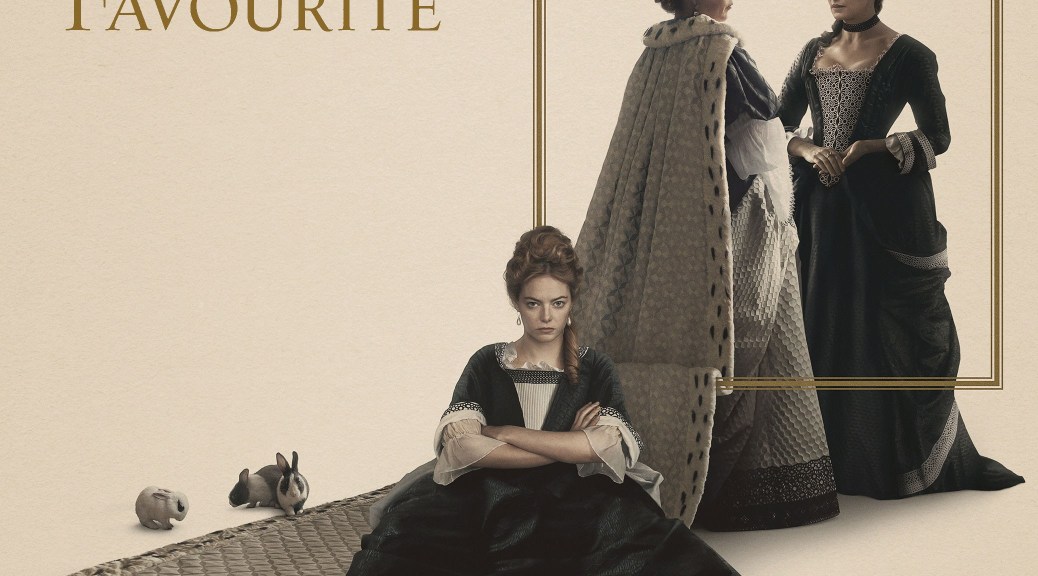
The Not-So Subtle Knife—The Favourite

Do you have a favourite? Not just a best friend, though they can play that role. Perhaps a sibling or a spouse, someone whose judgement you trust, someone who knows you as well as you do yourself. Someone you could rely on so much that they could take over your life. What if the power you gave to this favourite was, effectively, power over an entire nation? What, then, if you found yourself with two potential favourites? What would that reveal about where the true power lay?

The Favourite*, the latest film from Yorgos Lanthimos, sees men play games of war and politics as women wield the real power.

Continue reading The Not-So Subtle Knife—The Favourite

Memento Mortem—Return of the Obra Din

The best stories in games are those that the player has a part in telling. Usually this role is one of making choices that determine how the story goes. The story in Return of the Obra Dinn (Mac / PC) is of a different kind. Here, the story has long ended, and it’s up to the player to piece it together from scraps of information, building their understanding of what happened, when, and to whom.

Some spoilers for Return of the Obra Dinn below, and if you’re planning on playing it, spoilers are worth avoiding.

Continue reading Memento Mortem—Return of the Obra Din

A Life in Comics

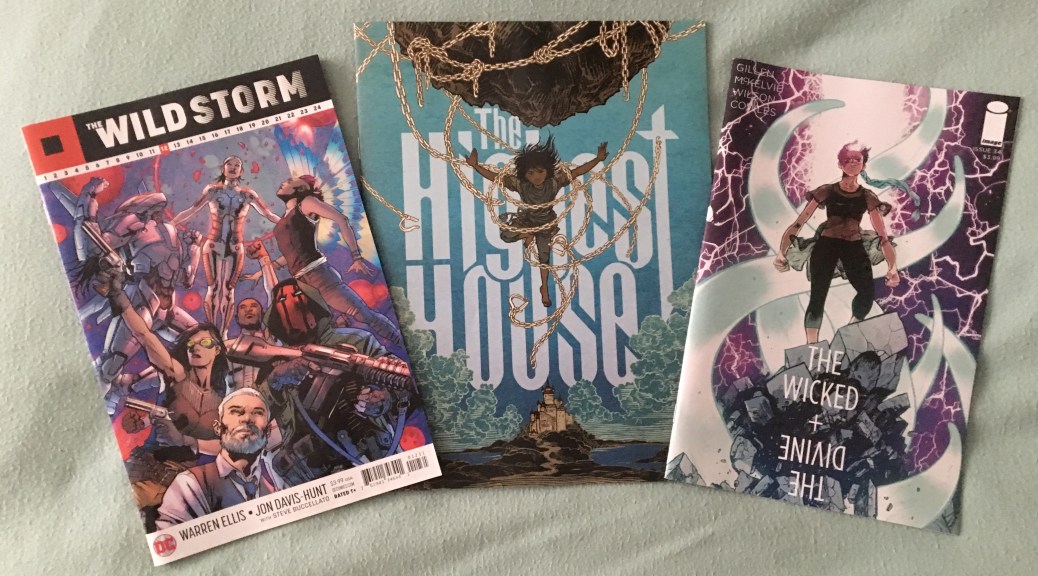
I started reading comics far enough back that I’m not sure of the exact age when I began. There have been ups and downs in the decades since then, but I still pop into a comic store every Wednesday to see if there’s something new worth reading. With the western comics industry looking as diverse and healthy as it has ever been, I thought it might be nice exercise to review some of the comics that have stood out for me over the years.

There are loads of comics missed out from the list below, of course, but these are the ones that spring to mind when I try to remember what had the greatest impact on me as a reader and writer. Most of them are still accessible in trade paperback form too, so if you’re looking for something to read, you could do worse.

Continue reading A Life in Comics

Spider-Diversity

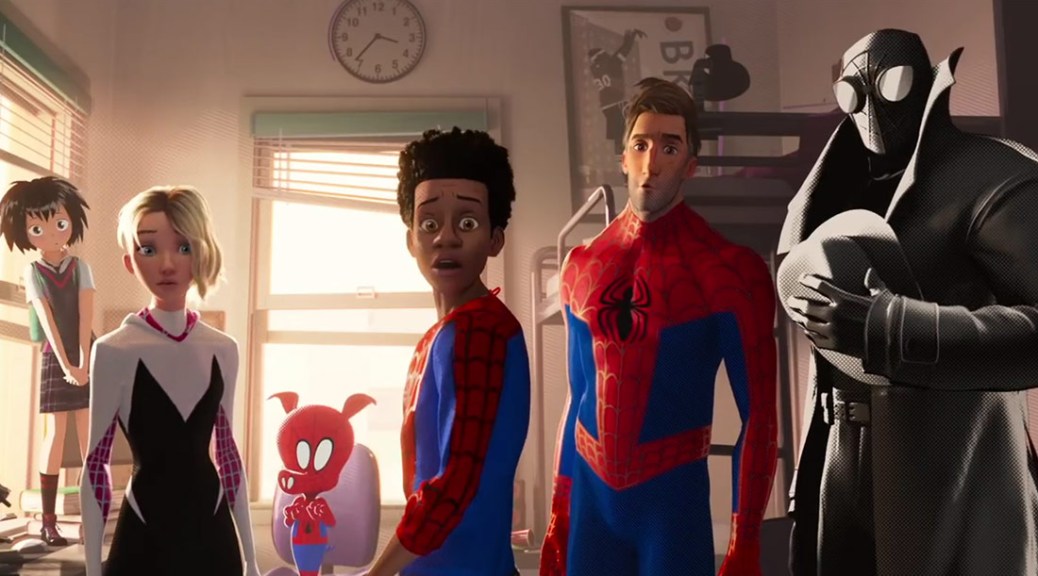
Anyone can be Spider-Man. It’s an unusual theme for a superhero movie, where the exceptional nature of the central character is usually the central point. However, Spider-Man: Into the Spider-Verse is an unusual superhero movie. Animated at a time when live-action superheroes rule at the box office, it’s currently struggling against the live-action Aquaman, but if there’s any justice, it will find success in the long term, because Into the Spider-Verse is a far more interesting movie and a fitting bookend for a superhero year that started with Black Panther.

Spoilers for the movie (which you really ought to go and see) below.

Continue reading Spider-Diversity

Aquaman—An Overstuffed Fish Taco

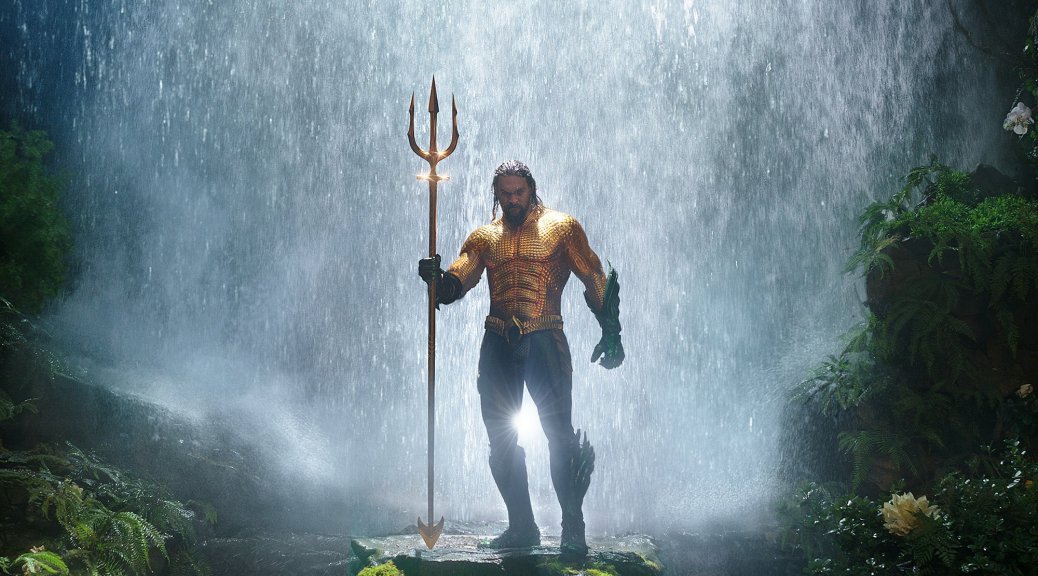
DC/Warner Bros.’s latest superhero movie, Aquaman, manages the impressive trick of being both too long and too short. Before you get to the end of it, you’ll have the feeling that you’ve been tricked into starting an epic series of novels, yet there’s also an ongoing feeling that the amount of story it’s trying to fit in exceeds the amount of minutes it’s prepared to devote to it.

(Spoilers beyond this point, but not too many.)

Continue reading Aquaman—An Overstuffed Fish Taco

Brexit and Northern Ireland

You probably don’t want to talk about it. I don’t want to either. But this is something of a climactic week for the act of supreme national self-harm/heroic crusade to restore national pride that’s been gripping the islands off the western coast of Europe. U.K. Prime Minister Theresa May is about to deliver her Brexit plan to the House of Commons, where it looks set to be defeated. And what then? No one knows. Everyone seems to know what they want to happen, but no one knows what actually will happen.

So what is Brexit? Well, “Brexit means Brexit,” as May herself famously said, which strikes close to the heart of the recursive absence at the heart of the whole project. For all the talk of restoring national sovereignty that Brexit supporters have spouted, none of the fine details have ever meant so much as the act of Brexit itself: removing the U.K. from the grip of the European project. To which end, they have clung to the slender referendum victory achieved in 2016 with the grim determination of a dying man.

Brexit, like Athena, was born out of the splitting headache that’s afflicted the Conservative (and Unionist) Party in the U.K. for decades. At least as far back as the regime of Margaret Thatcher, a rump of Eurosceptic MPs have made Conservative leaders’ lives hell by putting their anti-Europe views ahead of any other needs. David Cameron, in the manner of Prometheus, decided to resolve the problem by taking an axe to it: having promised a referendum on the subject, he duly delivered in the hope that it would resolve the matter. Unfortunately, what he delivered was not a goddess of wisdom but rather a goddess of discord, who has since spread the Conservative split to the nation at large and the continent of Europe. Cameron promptly departed for parts unknown, and we’ve been living in the world he created ever since.

If the Brexit victory had been a decisive one, delivered on a clear platform, this might not have turned out as bad as it did. Unfortunately, “Brexit means Brexit” was as clear as it ever got. Worse, infighting among the Brexiteers themselves delivered Theresa May as the successor to Cameron—having campaigned against Brexit, she now promised to deliver it, meaning that no one trusted her. Two years of inelegant negotiations have followed, with Europe patiently coaxing along a nation and a party at war with itself. All the details that were glossed over during the referendum campaign have come back to haunt the Conservatives—the border between Northern Ireland and the Republic of Ireland as perhaps the main one—with the result that May’s proposed Brexit solution is a fudge that makes no one happy and seems doomed to defeat.

Which is where I come in. I’ve been crossing that border on a regular basis for 24 years. In the early days, back in the waning years of the Troubles in Northern Ireland, most of the border crossing points were closed, and the ones that were in use featured passport and security checks, with watchtowers on overwatch from nearby hills. While the end of the Troubles didn’t bring as much of a peace dividend as Northern Ireland might have hoped (a subject for another day), the border has all but disappeared. Those border crossings are wide open, with the only sign of the change being a switch in the road markings and the units used for speed limits (miles in Northern Ireland, kilometres in the Republic). Brexit’s threat to return this situation to the bad old days is part of the reason why May’s solution is such a fudge.

Part of the argument for Brexit in the first place was for the U.K. to recover control of its borders. Not that it didn’t have that control a few years ago, but in an age where immigrants get blamed for everything, it was a powerful emotional call. It’s certainly one that Brexiteers have harkened back to as their struggle to achieve their goal proceeded by stumbles and flops. Unfortunately, the Northern Ireland border is one stumbling block that refuses to go away, and boy does it make them mad.

There were those who saw this coming, and warned about it back during the Brexit referendum campaign, but their warnings weren’t plastered across the side of buses, so they went unnoticed. Accordingly, when the EU negotiations had to deal with the details glossed over during the campaign, there was a lot of disbelief, frustration, and plain anger. The whole thing is a knot of conflicting desires and promises, and unpicking it is far from easy. But let’s take a dive:

  1. The Northern Ireland border right now is open, as are all borders in the EU. Brexit would see it closed, but that would conflict with…
  2. The Good Friday Agreement, which brought an end to the Troubles. Closing the border would breach the agreement, something that…
  3. The Irish Government really don’t want. In this desire they have the backing of the EU, frustrating the hell out of the Brexiteers. One suggested solution is to put the customs barrier in the Irish sea, between Britain and Ireland, but that would cause an explosion among…
  4. The DUP, who are currently taking a break from not running a government in Northern Ireland to spend time holding the whip hand over Theresa May’s minority Conservative government. The idea of closer ties to Ireland than the U.K. is pretty much anathema to everything the DUP stand for, so they’re now even willing to turn to…
  5. The Labour Party, led by old-school socialist Jeremy Corbyn. Strange times make for strange bedfellows, and there’s none stranger than the fundamentalist Free Presbyterian DUP and the red-or-dead Corbyn, whose suspicion of the EU project is long-held and has kept Labour from serving as a capable opposition during the entire Brexit imbroglio. Worse for the DUP, Corbyn has long been sympathetic to…
  6. Sinn Fein (Northern branch), who are taking a break from not running a government in Northern Ireland (with the DUP!) to continue not taking their seats in the U.K. parliament. Like the majority of people in Northern Ireland, Sinn Fein are anti-Brexit, but they find themselves impotent on three fronts to do anything about it. They haven’t even been particularly vocal in support of a…
  7. People’s Vote. Essentially a re-run of the Brexit Referendum, this time with more clarity and detail, it’s the favoured option of most Remainers, though the success of any effort to remain in the EU is far from assured. And given the lack of time remaining, the absence of a plan for a new referendum and the poor odds of getting a negotiated Brexit deal through, we might end up with a…
  8. No-Deal Brexit. It’s the outcome that none but the hardest of Brexiteers are hoping for, but it still lurks on the fringes, waiting for its moment. The U.K. (including Northern Ireland) simply drops out of the EU next March, with no new trading agreements in place. Food and medicine shortages and travel barriers all await, and no one knows just how bad it might get.

The frustration among Brexiteers with what their slapdash approach to negotiating with the EU has delivered boiled over this week. Priti Patel, an emblematic figures for a government that’s big on rhetoric and small on detail, complained that Ireland too was likely to suffer from food shortages in the event of a No-Deal Brexit and that the Conservative negotiators should have used this as a lever to get a better deal from the EU. Not only was this wrong-headed on a factual basis—Ireland is more food-secure than the U.K. is—but the spectacle of a U.K. parliamentarian suggesting food shortages as a way of dealing politically with Ireland was historically inept to a staggering degree.

Yet this is where we are right now. Staring down the barrel of a process that began two years ago and has no more certain an outcome now than it did then. Those driving it in the U.K. are more wedded to the ideal than they are to any of the details. Those dealing with it from the outside are restricted to managing the fallout (the Irish government have spent a lot of money preparing for the worst case outcome), and there have been continual reminders that the EU would be happy if the U.K. just gave up on the idea and gave the EU another go.

I’d be happy to see that myself. Not only would it make crossing the border to Northern Ireland in future a less fraught affair and keep those of my family who live there more secure, but I like the fact that the U.K. are in the EU. As grumpy and unwilling a member as they’ve been, they’ve also served in some ways as a counterbalance to the centralising influence of France and Germany. The EU is not perfect, but its contribution to peace and prosperity across the continent has been a strong one. I’d rather see the U.K. inside, pushing for the changes it wants to see, than on the outside, lacking the power to push for changes and having to deal with it in a purely self-interested fashion. If there’s one big benefit that EU membership has brought, it’s confirming that nations, no less than people, are part of a society. Brexit would be a big step back from that understanding.

A Month with the apple watch

I’m one of those terrible people who opt for Mac instead of Windows, iPhone instead of Android. I have an excuse—I’ve been using Apple devices since the Mac Plus, back in the 1980s—and I’ll argue the advantages, but I know the costs too. As much as Apple devices tend to be reliable and enjoyable to use, they’re not cheap. So if I’m going to add to my collection, I don’t do it without a lot of thought.

I’ve been eyeing the Apple Watch for years now. Partly because I like having new shiny technology to play with, and partly because of my mini-ecosystem of Apple devices that it can interact with. However, the earlier versions suffered the limitations of new technology in such a small form factor, and I had cheaper options available to me. It was only with the release of the Apple Watch Series 4 a while ago that I decided the time had come. I broke open my piggy bank and availed myself of some new wrist decoration.

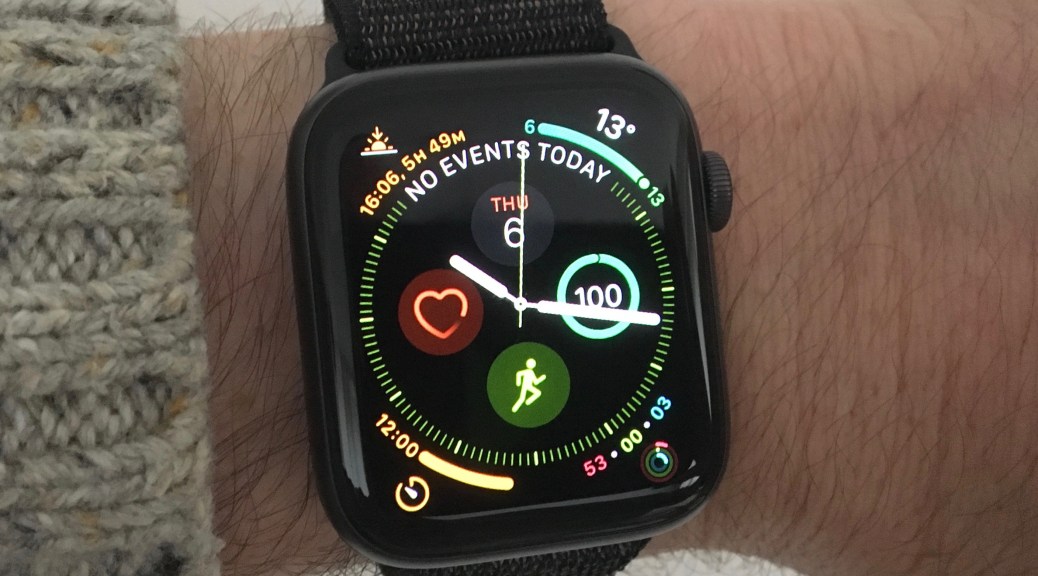
My resulting purchase is the 44mm Apple Watch Series 4 with a Space Grey Aluminium Case and a black Sports Loop wristband. The Series 4 represents a step up in screen quality and device speed over previous iterations, but the basic functions are essentially the same: it’s a combination of fitness tracker, mobile phone adjunct, and, well, watch.

All of these things my previous smartwatch, the late, lamented Pebble Time, also did to some degree, and its colour e-ink screen provided allowed around five days of battery life, at the cost of much slower responsiveness. However, Fitbit’s buyout of Pebble has finally led to support being cut off. Given that the Pebble Time no longer works with my favoured fitness app, Runkeeper, moving to the new platform was an idea whose time had come.

Initial impressions of the Apple Watch were as favourable as they usually are for Apple Products. Out of the box, it paired with my phone and set about downloading watch apps to match those on my phone. The build quality is good too—a month in, and there are no signs of any scratches or damage, which is something that the plastic-bodied Pebble couldn’t boast for as long. Battery life testing revealed that it wouldn’t match the Pebble, but I get two days out of it without struggling, which feels pretty solid.

As for what it’s like in use, the responsiveness that Apple’s custom silicon provides means that simply raising your wrist (it asks during the setup procedure which hand you wear your watch on) brings it to life. Tapping the screen will do the same, and both of these actions will also wake Siri (of which more later). You can pick and choose among a wide range of watch faces, most of which are customisable in terms of look and utility. I opted for the Infographic watch face, which makes a scattering of commonly used apps and functions available through on-face “complications.”

Fitness Tracking

Fitness tracking has become a major feature of the Apple Watch because that’s what people wanted. Not only does it use Apple’s three-ring system to track calories burned, exercise duration, and hourly activity, but it also regularly reminds you to keep up a constant level of activity. I can see how these reminders (which can be turned off through the companion watch app) might become annoying, but as someone who has a tendency towards laziness, especially in the winter months, it’s a useful goad to avoid couch potato status.

Whereas the Pebble Time offered only a step tracker, the Apple Watch adds GPS and heart rate tracking. (There’s even an ECG function, though that hasn’t been enabled in the software yet and may not be outside the U.S.) Both GPS and heart rate tracking work well and consistently, and the battery life is good enough to use it as a sleep tracker one day out of two. One minor issue is that the glass back of the watch irritates the skin on my wrist a little—so it’s best not too wear it too tight or too consistently.

The Apple Watch also integrates well with whatever fitness apps you might be using. Not only can I activate Runkeeper within the watch, but it will also pay attention to what you’re doing at any given moment and ask you if you want to track your activity if you’ve been walking or running for ten minutes or more. As a GPS tracker, it’s great, but in Ireland the LTE version isn’t available yet, as no mobile providers support them. Which brings us to the next subject—the watch’s relationship with your phone.

Phone Companion

One of the reasons that I got the Pebble, and later the Pebble Time, in the first place was to reduce my habit of spending time looking at my phone and its notifications. That effort was … questionably successful, because while you could read the notifications on your wrist, you couldn’t respond to them. The Apple Watch actually allows that, within limits.

One of the big surprises with the Apple Watch for me is how well Siri works.  Simply raise your wrist and talk and it’ll respond. This makes simple actions like setting a timer or a reminder much quicker. You can even use Siri to dictate responses to messages, which again works much better than I expected. Certainly more quickly than the other Watch-specific option of drawing each letter out on the screen. The Apple Watch does provide canned responses to messages too, which are even quicker, if more limited (and easy to accidentally send).

The Apple Watch does a fine job of having some basic phone functions handed off to it. It’s not going to cure your Twitter addiction—thankfully for both you and its battery life, Twitter doesn’t work at all with the watch, beyond delivering notifications. However, if you’re looking for a way to reduce the number of times you take your phone from your pocket or bag, this could help a lot.

The Computer on Your Wrist

As for its most basic function, the Apple Watch is a fine watch. It’s not much to ask, and the WatchOS doesn’t get in the way of that simplest of jobs. In fact, WatchOS is largely solid across the board, with some odd quirks that are the result of the device’s history. The field of icons that used to be how the Apple Watch’s apps were navigated is still there, just a press of the Digital Crown away, and it’s still hard to find the app that you’re looking for in the field.

For the most part though, WatchOS does a good job of easing you into using the Apple Watch, teaching you the basics of the interface in your first few minutes of use, then leaving you to play, as is standard with Apple devices. It’s not the free-standing computer on your wrist that you might want it to be, at least not in the LTE-lacking version, but it’s as close as you can get right now, and if you can forget that your phone is somewhere nearby, there’s little difference. I’ve even indulged in a few Dick Tracy moments of phone calls made through the Apple Watch, though the otherwise solid built-in speakers struggle to overcome traffic and crowd noise. My main regret is that my much-loved AirPods suffered a washing machine-related incident from which they’ve never recovered, as they seem very much designed to work with the Apple Watch.

In short and in summary, if you’ve just skipped to the end to find out, I’m pretty happy with my Apple Watch. It wasn’t cheap, but that’s why I have a piggy bank in the first place—and it’s a lot cheaper than replacing any of my existing Apple devices. A month in and I’m comfortable with having it on my wrist, with the fabric Sport Loop keeping it sat snugly there. I haven’t even played with many of the apps and functions yet, and every few days I find another advantage or two to it. Thus far I’ve had few regrets buying Apple products, and while the Apple Watch might seem like it might be the most frivolous of those purchases yet, it sees as much use in everyday life as any of them.

Passionate Intensity

I’m not a poetic soul, but a few poems have stuck in my head over the years. One of the first was William Butler Yeats’ “The Second Coming.” For a kid who was brought up Catholic and always preferred readings from the condensed strangeness that is the Book of Revelations, Yeats’ poem seemed like a distillation and perfection of that theme. Even so, it featured one couplet that my understanding stumbled over.

The best lack all conviction, while the worst
Are full of passionate intensity.

As a kid, that never made much sense. How could you be the best if you lacked all conviction? How could passionate intensity be a bad thing? The context of the rest of the poem didn’t help much, revolving as it did around a world falling apart and seeming to approach some kind of apocalypse. Maybe I just needed to mature a bit and learn more about the world, but the meaning of that couplet seems all too clear in these days, when the world is indeed falling apart and the future is looking darker than it has in a long time.

We’re surrounded by people who are full of passionate intensity these days. You see them at podiums, hear them declaiming the facts that they know, endure their scorn whenever you try to engage or argue with them. It’s the age of Trump, but he’s just the most visible modern version of a long-standing situation. Those of us from Northern Ireland will be just as familiar with Ian Paisley, whose granite-cold certainty admitted of no doubt and swept along many others in its wake.

Yeats’ poem is endlessly quoted because it’s endlessly applicable. Within the poem itself, it looked back to the devastation of the First World War, observed the bitterness of the Irish War of Independence, and looked forward to the horrors of the Irish Civil War and the Second World War to come. It seems prophetic because of what came after it was written, but it also simply records what always happens, and the couplet above is central to that.

The passionate certainty of those like Trump and Paisley comes from the fact that they rest their beliefs on certainties of their own. In Trump’s case, his certainty is that he is never wrong and never fails. Paisley’s was his own fundamentalist reading of the bible. If you’re certain, no time needs to be wasted in reflecting on the rightness of your actions: you have a launching point and a direction to travel in. Moreover, others will see your certainty and envy it, seeing in you someone to emulate and to follow. In your certainty, their own doubts will dissolve, or at least be forgotten about. They can forsake their own intellectual work in favour of having answers provided from someone who presents themselves as having them all.

What of Yeats’ “the best,” who lack all conviction, then? If the worst are those who never doubt themselves, the best are those who have spent large portions of their lives examining their own actions, developing a habit of doubt that haunts and slows them. They rarely share the dynamism of the worst, and without gifts of rhetoric or charisma, they struggle to convey just why it’s a good thing to question and to understand. In the world we now live in, “experts” are dismissed when their carefully constructed logic crashes up against dearly-held certainties.

Of course, this is a simplification. The world is complex, and not all of those who interrogate their beliefs are paralysed by doubt.

We’ve been lucky until quite recently, living in the shadow of the twentieth century’s horrors. We’ve had living reminders of the damage that Yeats’ “worst” can do, of what handing over our doubts and fears to those who seem utterly certain of their rightness will lead to. Having a strong public education system helps with that too—the world is massively complex, not least in how the people within it interact, but giving people the tools to decipher it for themselves lets them make an informed decision as to whether they will go along with others’ certainties.

Amazingly, I managed to get all the way through that without mentioning Brexit. Draw your own conclusions from that—or maybe I’ll return to that particular collision of dreadful certainty and earnest doubt at a later date.

The Upgrade Urge—Apple’s October Event

I’m really not in a position to be buying new technology now.* I’m in the middle of a job hunt and I ought to be saving every penny while the employment market remains a fickle, teasing wretch. Why, then, did Apple run an event yesterday designed to remind me that my existing array of gadgetry is but a dusty heap of aluminium and silicon, no more than one careless step from the technological grave?

Yes, all of Apple’s announcement events are supposed to do this. But this one was personal. They specifically announced updates to (almost) every Apple product that I own, and if I find out that Tim Cook did this just to annoy me, I’m going to be … well, I’m going to be impressed. Impressed, but also annoyed.

I wish I was exaggerating. My mostly superannuated selection of Apple technology consists of my elderly Mac Mini, my much-used MacBook Air, and my relatively youthful iPad Pro (which, with accompanying Apple Pencil and Smart Keyboard case, has taken on many laptop-style duties over the past year). Everything mentioned in the last sentence saw an update at Apple’s October 30th event, and none of those updates were small ones.

Mac Mini

The oldest of my Macs is my Mac Mini, which has been sitting beside my TV since 2010. It’s done solid service over the years, and I’ve kept it youthful by feeding it as much RAM as it will take and performing some mild surgery to replace its hard drive guts with a solid-state alternative. Yet it’s been slow and clunky for some time now, its major services taken over by an Apple TV (along with my iPhone, the one Apple item I use so much that I often forget it exists), with only the lack of a viable upgrade from Apple keeping me from considering a replacement.

Well, yesterday Apple answered the prayers of us Mac Mini devotees and delivered unto us a new machine, sleek in its smallness, patterned in gunmetal grey, and pulsing with barely contained potency. In other words, it’s been so long since the Mac Mini had an upgrade that Apple was able to claim that the new one is five times faster than its predecessor. Which was a good bit faster than my much older version, so this one would blow the doors clean off if I were to opt for it.

Which I won’t. Not yet anyway. Not because I don’t want to—it’s a desirable little chunk of metal and silicon—nor because I can’t afford to—I can, I just know I shouldn’t—but because, as mentioned above, most of its main duties have now been shifted onto the much more suitable (and cheaper) shoulders of the Apple TV. While not a perfect machine in and of itself, the Apple TV is designed to work through a television and does so nicely. To the point where I’ve ditched cable TV in favour of broadband services. In the meantime, my Mac Mini remains as it is, quietly acting as a media server. It’s happy, I’m happy, and one day we shall part, but that is not this day.

I’m sure the new Mac Mini will sell well anyhow. Just not to me right now.

MacBook Air

My MacBook Air is a little younger than my Mac Mini, being of 2012 vintage. For all that, it’s still running well and speedily, courtesy of having an SSD from the start. I don’t ask too much of it these days, as the battery has long since left behind the days of offering multiple hours’ service, but when I just need to type something, it’s the go-to machine. It’s also survived an unfortunate encounter with a glass of breakfast orange juice, courtesy of a replacement keyboard and some repair guides from iFixit.com—living to suffer another day.

The MacBook Air has seen more regular updates than the Mac Mini, but in comparison to the Retina screen-enabled rest of the Mac laptop lineup, it’s been something of a red-headed stepchild for a while. Minor processor tweaks have bumped up its speed, but the budget Mac laptop was looking a little dated and cheap before yesterday. Now, though, it has been given the Retina screen users have been crying out for, as well as substantial processor and graphics speed bumps and the new butterfly keyboard that Apple is much enamoured of (though its users are more ambivalent). Available in multiple colour options and with a Touch ID fingerprint sensor, the MacBook Air finally feels like a modern laptop again.

Not that I’ll be upgrading though. For a start, all the upgrades have seen its price jump to €1,379 for the base model. Less than the ultralight MacBook or the MacBook Pro but no small beans. The price may well come down in time, but for the moment it’s not really a budget option. Second, my iPad Pro has usurped most of my MacBook Air’s functions in daily life. And that’s what I’ll get to below.

iPad Pro

Having saved up my pennies, I splashed out on an iPad Pro just over a year ago. This was very deliberately meant to be a laptop replacement—I added a Smart Keyboard and Apple Pencil to the purchase, and I made sure the device itself had plenty of storage onboard. In the year since, I’ve been more than happy with it. It’s light enough to tote anywhere, powerful enough to handle anything I care to throw at it, has a good enough battery to last for days at a time, and is a serviceable enough typing machine for me to write a NaNoWriMo novel on it last year. All in all, I like it a lot.

This love wasn’t ended by Apple’s announcement of a new iPad Pro yesterday, but maybe it was dented a bit. The new machine is both an upgrade and a refinement: faster and better looking, with the physical Home/Touch ID button removed in favour of a Face ID camera system. The gadget ecosystem has been upgraded too, with a new Smart Keyboard case that provides a better typing experience and better protection and a new Apple Pencil that locks magnetically to the iPad for safekeeping and charging. As is not unusual for an Apple upgrade, everything just feels a little better, a little fresher.

And I won’t be buying one. Of course I won’t—my iPad Pro is only a year old. I’m not crazy! Much though I may envy the improved gubbins that my newly aged device will never provide me with, it does everything I need to it to with aplomb, and nothing other than an excess of cash and a sudden break with reality could persuade me to spend that much on such (ultimately) minor improvements.

Technological envy is a real thing, but patience works as an antidote. The tech you’ve got will serve you well, and the longer you wait, the better the reward when you finally do decide to splash out. Whether it’s for one, six, or eight years, the upgrade urge can be resisted, no matter how well Apple targets its events at you.


*This hasn’t stopped me. I broke open my piggy bank** to add an Apple Watch to my Apple menagerie just three days ago. A review will be forthcoming once I’ve been using it for a while.

**Actually a real thing, but also actually a cow bank. It was a present from a friend. Don’t judge me.