Tag Archives: Marvel

Thunderbolts*—Punch the Dark Away

It’s been a while since I came out of a Marvel movie with anything more than a feeling of having been adequately amused. Like a lot of other nerds and comics fans, I got caught up in the initial rush of not only comic book movies done right, but a comic book universe splashed across the big screen in release after release. We had a roller coaster ride for ten years, with the payoff of Avengers: Endgame to complete it all, and then… it kept going.

(Spoilers for Thunderbolts* below.)

That it kept going wasn’t in itself the problem. The problem was that there didn’t seem to be a solid reason for it to keep going. The success of telling an increasingly coherent story over the first three “phases” of the “Marvel Cinematic Universe” necessitated some sort of structure to what came next, but the MCU as such had started with only the vaguest hints of an endgame, whereas the next saga was instantly anticipated but largely left hanging in the movies and television shows, outside of a nebulous concern with the multiverse, a concept broad enough to cover any potential stories but hardly one to stir audience interest.

With a mix of tentative new stars and second-stringers stepping up to prime time, the MCU went on struggling to fill its sizeable shoes, usually managing to deliver that adequate entertainment but increasingly losing the buzz it once had. In this growth-obsessed world, holding steady (or worse, slight declines) don’t cut it. To audiences and studio bosses, the MCU was starting to look a little shabby.

This is the ground that Thunderbolts* steps into. Presenting a collection of Marvel’s broken toys in a story of betrayal and despair, it’s a surprisingly bleak little offering. Yet in contrast to what I’ve heard of the preceding MCU movie (Captain America: Brave New World) it does seem that Thunderbolts* at least knows what it’s about and how to stick to its guns. Because I came out of a showing last weekend not only adequately amused but wholly charmed.

Much of this, of course, is down to Florence Pugh. Playing Yelena Belova, the grieving, self-loathing sister of Scarlet Johansson’s Black Widow, she’s rightly kept at the core of the film, her path towards acceptance and her growing awareness of the suffering of others as important as the occasional beatdowns she inflicts on anyone unlucky enough to get in her way. She’s a magnetic presence, nakedly emotional against the Marvel tendency to be ironically cool.

Along the way, Pugh gets to pinball off (both literally and figuratively) some of those aforementioned broken toys: Wyatt Russell’s U.S. Agent, a similarly self-loathing replacement for Captain America; Sebastian Stan’s Bucky Barnes, stuck in a job he can’t stand and desperate to punch someone; Hannah John-Kamen’s Ghost, a mercenary with phasing powers (and the one character underserved by the story); and especially David Harbour’s Red Guardian, Yelena’s bombastic but failure-addled super soldier father.

And then there’s Bob. Now, I have to admit some bias here. Bob Reynolds, aka the Sentry, is one of the more divisive Marvel characters among fans. Created as a Marvel mirror image of Superman and often used to explore the terror of godlike powers in the hands of an unstable personality, the Sentry rubs some people up the wrong way, especially as his origin retconned him into decades of Marvel continuity. Here, that isn’t a problem, but I have a lingering affection for a character I’ve followed since his creation, and I was fascinated to see how the MCU would treat him.

As it turns out, Thunderbolts*, in the hands of director Jake Schreier and writers Eric Pearson and Joanna Calo, very much knows what it’s about with Bob and his terrifying alter ego. From the very first moments, when he appears amnesiac and confused in the middle of a fight to the death between Yelena and some of the other broken toys, to Yelena’s quickness to ascertain that things aren’t quite right with him and her first instinct being to help, we’re clued into the notion that Bob is important, not just for what he is, but simply for who he is.

So when we get to the grand confrontation with the villain and ensuing punch up that normally marks the denouement of a Marvel movie, Thunderbolts* is ready to start twisting the script. First of all, it’s not much of a fight. The broken toys are hopelessly, hideously outclassed by the Sentry, who even saves their lives during the fight when he might have accidentally killed them instead. Bob, it seems, doesn’t want to kill people he knows, even if the only way some of them know to get through to him is punching.

There’s an oft-quoted Terry Pratchett line that I’m going to mangle here: “Sin, young man, is when you treat people like things.” That theme seems to run through the background of the movie—I can’t imagine that at least one of the writers didn’t know that line. The broken toys are treated as things to be discarded by Julia Louis-Dreyfus’ Valentina, then Bob is treated as a prize to be used (to save her ass) and then discarded when he turns dangerous. It’s treatment that causes only hurt and makes the world worse, and it unleashes the dark flip side of the Sentry, the Void.

This kind of broad-strokes storytelling of the light and dark side of a personality can fall very flat if not handled right, but the movie stays on target. As the Thunderbolts were outmatched before, so they are now. All they can do is try to save people from the Void’s wrathful self hatred (did we forget that the fantasy of the super hero is that someone is coming to save us?), and ultimately try to save Bob from himself.

There is only a little punching at the end of Thunderbolts*, and it’s a terrible thing. The victory of the climax is that we get to a point where punching isn’t necessary. Where the characters realise that it doesn’t help, and that what they are there for is to help. It’s a surprisingly uplifting, lighthearted turn for a movie that spends so long looking at self loathing and despair, but it’s all the more earned for that.

I’m not saying it’s a perfect movie. There’s more than a bit of clunky exposition, certainly more than I was comfortable with, and one or two characters were poorly served by the script, but overall this is one of the bigger Marvel successes in a while. The series as a whole may yet get sucked back down into the maw of chasing those post-Endgame highs, but for now it’s shown that it can still make good use of its broken toys.

Wandavision—Absolution, Forgiveness, and Redemption

If the global virus of the past year has been good for anything (other than billionaires), then it’s been good for the Marvel division of Disney’s entertainment megaplex. Not long after their ten-year story hit its climactic peak with Avengers: Endgame, the world got dropped into an enforced hiatus. As a result, instead of risking saturation of the market, Marvel got to take a break that Disney would never have allowed and instead begin its new era with smaller-scale TV offerings.

Moreover, those TV series themselves got rearranged in favour of those that could be filmed on closed sets, so instead of leading with the more traditional action offering of The Falcon and the Winter Soldier, Marvel kicked off phase four with the much stranger, much more personal Wandavision. Which, as its nine-week run unfolded, proved to be a tale of trauma and the harm that can spill out from it.

In an era when binge-watching has faded from prominence, but in which people are as eager as they’ve ever been for new media to consume, Wandavision was discussed and dissected endlessly online across its run, not just among Marvel fans but among more casual viewers. It’s mostly great in my opinion, so if you haven’t watched it, don’t read any further, as I’m mostly going to be talking about the ending.

Continue reading Wandavision—Absolution, Forgiveness, and Redemption

Captain America: Civil War – Bucking the Trend

I'd prefer aquamarine vs. chartreuse, myself.
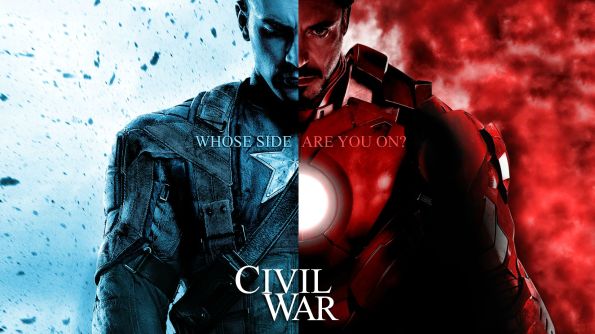
Red vs. Blue. Isn’t that always the way?

For all of the successes of the Marvel superhero universe, most of the sub-franchises haven’t enjoyed uninterrupted upward curves. Iron Man 2 was a mess, Thor: The Dark World was a bit dull, and Avengers: Age of Ultron seemed tired by comparison with its mega-successful predecessor. Only the Captain America movies have shown consistent progress: starting well with The First Avenger, getting better with The Winter Soldier, and now topping the lot with Civil War.

(All the spoilers below…)

Continue reading Captain America: Civil War – Bucking the Trend

JJ + SJW VS GG

Nowhere near as creepy as the character of Kilgrave actually was.
The promotional materials for Jessica Jones helped to tease the villain and set the mood.

Marvel’s Netflix offerings stand at a remove to the 4-colour heroics of their cinema offerings (and the connected Agents of SHIELD series). Drawing on modern iterations of street-levels heroes, the idea behind them was evidently to provide a darker and more complex take on superhumans than The Avengers. So far it’s working well. Daredevil was a promising beginning, and with Jessica Jones Marvel and Netflix kick it up a notch.

Spoilers for Jessica Jones below…

Continue reading JJ + SJW VS GG

Flawed Heroes, Edgar Wright and the Incorruptible Ant-Man

Which one won?
The grand “what might have been.” The eternal tale of how life is. Image from here.

Director Edgar Wright’s departure from Marvel Studios’ Ant-Man before it was due to start filming will keep film critics and academics in coin for years. Wright, one of the most creative and inventive directors around, had worked for several years on the film and retains both executive producer and screewnwriter credits on the final feature. However, for all that Ant-Man retains some of the hallmarks of Wright’s work, it’s not one of his films. For better or worse, his replacement as writer and director, Peyton Reed, has made it his own. Continue reading Flawed Heroes, Edgar Wright and the Incorruptible Ant-Man

Free-to-Play Three Ways: Capitals, Future Fight and Fallout Shelter

Sometimes, I just revert to mucking around in Pixelmator instead.
*Some terms and conditions may apply.

I have no aversion to spending money on mobile games, and some of my best experiences with iOS games have been paid for: Plants Vs Zombies, Hitman Go, Thomas Was Alone and Monument Valley to name but four. Still, the plethora of free-to-play games does allow me to try out new gameplay experiences more or less forever, as long as I’m willing to risk the intrusion of money-making schemes into your fun. Recently, I’ve been playing three F2P games that have taken very different approaches to monetising fun, with very different results.

Monetization-Lite: Capitals, NimbleBit

Capitals is a clever little app that combines a Scrabble-like word game with some simple head-to-head strategy. You and your opponent start with one space each (your “capital”) on a hexagonal board, and the aim is to grow your territory and ultimately conquer your opponent. You do this by claiming spaces: each space has a letter, and if you use the letter in a space connected to your territory, you expand into it. But if your opponent claims territory bordering yours, some of your territory will turn neutral again.

A huge amount of strategy emerges from this simple gameplay: Sometimes it’s better to avoid a big word in favour of shoring up your defences. Sometimes you see an opportunity to strike deep into your opponent’s territory. Sometimes you want to use up convenient letters so as to cramp your opponent’s options. In the games I’ve played, some have been brief and wild struggles, others chess-like confrontations of advance and retreat.

There’s not much to complain about on the gameplay front: a few games turned into slogs as I tried to grind my opponent down (or they tried to grind me down), but there’s plenty of fun to be had. All the same, you wonder whether NimbleBit thought out their F2P strategy very far. Right now you can pay for unlimited “lives,” which you can also claim by watching promotional videos (one view equals one life). It feels restrictive, and Nimblebit might have been better simply making this a cheap paid game instead. Still, they’ve been updating Capitals gradually since it came out, and they might yet get the balance right. In the interim, I’d recommend giving it a try.

Monetization-Heavy: Marvel Future Fight, Netmarble

I’m a comic book geek, and when it comes to superheroes, you can Make Mine Marvel. So a F2P fighting game starring a range of Marvel heroes, with good gameplay and high production values should be a winner, right? Future Fight certainly makes a good start, giving you three leading heroes (Iron Man, Captain America and Black Widow) to start with and plenty of free goodies just for logging in every day. But it then buries the whole experience under layers of complexity, social networking hooks and premium currencies.

The core gameplay is a lot of fun—the three hero types (brawler, speed and ranged), are each stronger or weaker against one of the other types. Missions last no more than two minutes, providing experience and equipment to improve your heroes, and there’s even a story illustrated with quick cut scenes before and after missions. So that’s fun. The problem is that managing everything else becomes a chore. There are multiple ways to improve your hero, multiple types of mission you can take on, and coins, gems and tokens galore to collect.

If you’ve got the patience to get to grips with all of this, there’s a rewarding game to be found under all of the cruft. However, I found myself reduced to logging in once a day to pick up my daily reward, telling myself that I’d try to get to grips with it later. I never did. It’s one of the problems of F2P—having paid nothing, I’m not invested, and the grind of gaining expertise and levelling up my characters has put me off. Which is a shame. This is a well-coded, slick and fun game that might have done better had it been paid-for with much less in the way of complications.

Just Right?: Fallout Shelter, Bethesda Game Studios

Fallout Shelter caused a lot of fuss when Bethesda announced it alongside Fallout 4 at E3 recently. As a promotional iOS app, trading on an established franchise name and using a F2P model, it could have been awful. It isn’t. In fact, it’s one of the friendliest F2P games out there, with an in-app purchase model that actually seems to work. (It’s currently at #18 in the top-grossing games in Ireland.) How did Bethesda manage this? By keeping things simple and sticking to the feel of the Fallout franchise.

Whimsical ‘50s nuclear paranoia might not seem like a good basis for a game, but it’s worked for Fallout for years. The main Fallout games have been roleplaying-focused, but this is a management game that charges you with creating a paradisiacal “Vault” in the midst of a post-apocalyptic wasteland. To do this, you’ll have to guide your vault dwellers to create food, water, energy and medical supplies, send them out to explore the wasteland, and encourage them to breed in order to swell your population. Do it right and everyone will be blissfully happy. Do it wrong and you’ll have miserable, radiation-raddled inhabitants who fall prey to radroaches, raiders and the occasional nuclear reactor fire.

The first ingredient that makes this game so appealing is the grace notes sprinkled across the game (equipment descriptions, wasteland explorers’ journals, and cheesy banter between dwellers—the writing is uniformly excellent). The second ingredient is an in-app purchase system that doesn’t intrude and even enhances the game. The standard currency is bottle-caps, with which you pay for new rooms (and occasionally resurrecting unlucky vault dwellers). The premium currency is lunchboxes, which serve as booster packs that contain equipment, caps or dwellers, some of them better than any you’re likely to find in game. You can earn these lunchboxes through the game, but the excitement of opening a new one is enough to encourage you to plonk down actual money for more.

It’s not a perfect game—the learning curve is a little steep if you don’t RTFM, and there’s a lack of depth in the challenges you’ll face as you build your Vault beyond 100 inhabitants. But even so, it manages the SimCity trick of making you feel proud of what you’ve created while allowing you to peek in on the lives of your dwellers and even get a little invested in their continued existence.

Age of Ultron and Daredevil: Marvel Testing the Limits

Shiny happy heroes.
Age of Ultron definitely has higher production values on the posters at least. (Image via Comicvine.)

From a point of bankruptcy in the 1990s, Marvel has built its comic-book properties into a billion-dollar film and television franchise that’s so omnipresent you never have to wait long for the next Marvel product. Two movies a year and multiple TV series are enough to sate the most avid fan, and while we may be nearing oversaturation, the quality has remained remarkably high so far. The latest two offerings—Avengers: Age of Ultron and Daredevil—represent Marvel working harder than ever to maintain that quality as it stretches the limits of what superhero fiction can do on screen.

A:AoU is of course the follow-up to Joss Whedon’s ensemble blockbuster movie, whereas Daredevil marks the first offering from Marvel’s tie-up with Netflix, presenting heroics at a more gritty street level than Avengers’ apocalyptic, primary-colour adventures. Having watched them both to completion over the past weekend, I thought comparing the two might prove interesting.

Spoilers abound below…

Continue reading Age of Ultron and Daredevil: Marvel Testing the Limits