Tag Archives: travel

Five Years, Five Months On

Well, it’s been a year. Or 13 months, to be more accurate. I kept meaning to write, but every time I did, I would look out at the world around me and feel that my words, whatever they were, would be inconsequential and inadequate to the moment. And it’s not like things have been getting better, has it? Everywhere, from every front, the walls seem to be closing in.

I wish I had a more cheerful way to start this post. For me at least, things aren’t too bad. I’m still employed, I’m still as healthy as I was at the time of my last post (plus a couple of stone lighter, for reasons I may get into later), and I’ve even started travelling properly again, slowly filling out that map of Europe to the point where one more trip should more or less finish it. Even so, with the moral void of Trump on one side and the utter absence of guiding principles of Starmer on the other, it’s been a little uncomfortable to be viewing the world from Ireland in the past year. Layer on top of that the continued disgrace to the world that is the treatment of Gaza and the feeling that the still-there threat of global environmental collapse has gone onto the back burner, and it’s not a recipe for a settled state of mind.

So, the world around me is not supportive of optimism right now. When I started writing this (early, to give a bit of time for editing) I was sitting at home with my mum, at the beginning of an Easter weekend when I was hoping to get to see all the members of my family, one week shy of the five-years anniversary of dad’s passing, almost five and a half years into my own treatment for a cancer that ten years ago almost certainly would have killed me by now … well, there are still good things in the world. Good people are everywhere, and the ties that bind are also the ties that hold us up when things get hard.
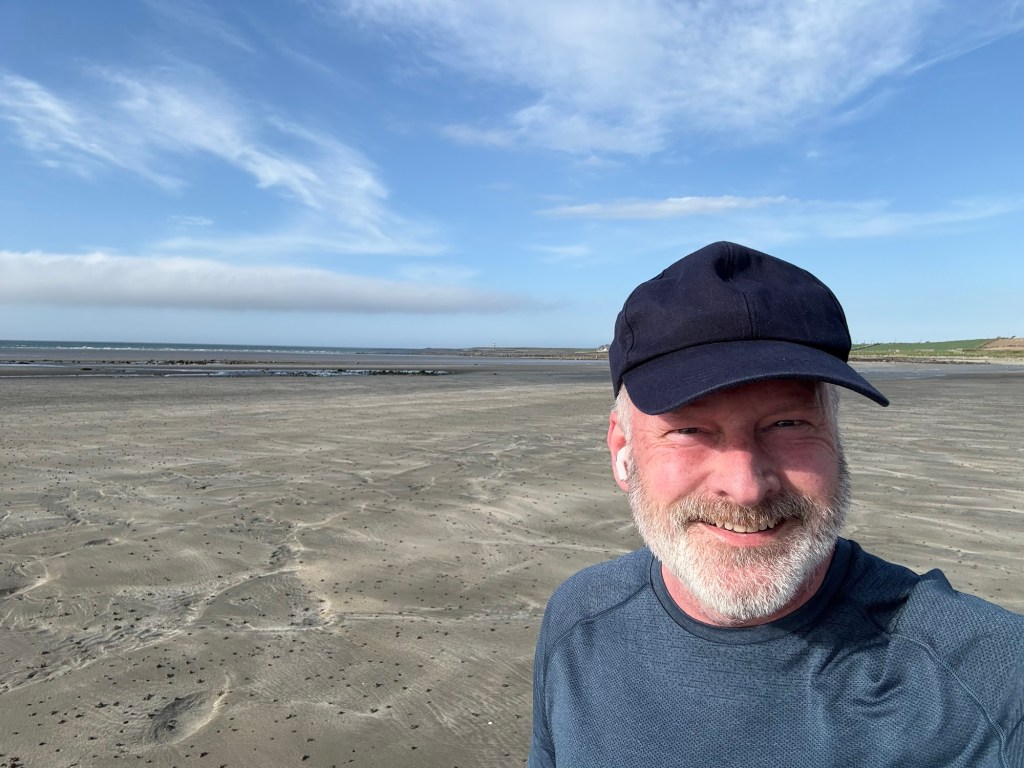
A selfie of the author, a smiling man with a short grey beard and a baseball cap. Behind him is a sandy beach stretching to the horizon, where it meets a blue, cloud-speckled sky.
Out on the shore, trying to run.

To start at the beginning then, home is home. I’ve lived in Dublin more than half my life, but the eastern end of Dundrum Bay, the southeast corner of Lecale, is and always will be where I’m from. I didn’t get a car until around two decades after I moved away, but now that I have one, it’s easier by far to get back for the weekend. There’s powerful healing in being around one’s loved ones, to be by the sea and shore, to sit in familiar seats and let the day fade over the evening without needing to turn the lights on. I bring friends here when I can, because it’s something of value I have that deserves sharing. And I lose nothing in the sharing of it.

Mum remains the heart of the family, as always. A steady presence, even when pulled one way and the other by the need to help out with grandkids, whether it’s homework, lifts to and from home, and impromptu meals. I’ve never been the best at saying “I love you,” so I started to say it at the end of every video call to mum and dad a few years back. I still keep that habit. It’s worth saying it, even if it’s a known thing. Hearing it can be even more important.

Easter’s an odd time, of course. I stepped away from the Catholic Church almost as soon as I hit Dublin, and from religion in general some years after. Not angrily, though some of the causes for that departure were causes for anger too. Over time, I found my balance. Religion provides something for some that it never did for me. The why of it, I never succeeded in dissecting, and I’m not sure of the benefit had I managed it. I listened and learned and built myself an outlook that works for me, and I hope for those around me too. All those nieces and nephews are part of the school system up here, of course, so they’ll go through the same rituals I did. Who knows where they’ll end up?

I still miss dad, of course. I wanted to do something to mark his fifth anniversary, but there’s reluctance to pull people out of the new shape of their lives when so much time has passed. Wakes are for the immediate moment of grief, a gathering of the living around the sudden absence in their lives. These days, the absence is there, but it’s not a gaping hole, it’s a green patch of good memories and faded regrets. I’ll visit his grave at some point over the weekend, stare out over the bay and tell him how I’ve been and what the news is. What I miss is talking to him, but I can still fill in my half of the conversation.

A view down a country path, which is made a tunnel by the gorse bushes that stretch over it from both sides, covered in yellow flowers.
Would you believe me if I said there was a stone circle at the end of this? Probably.

As for myself and my health, that remains, as I said, as positive as could be hoped. Last year I’d had a bit of a thyroid downturn, but things seem to have balanced out now, with my new array of pills and dosages keeping me on an even keel. My doctor’s visits have crept out to six weeks, and I’ve even tried running a few times (laziness is a factor here). As mentioned, I have succeeded in losing a chunk of weight, which has a lot to do with feeling better about myself and was a direct result of being told I was on the verge of diabetes given how much sweet stuff I was cramming in every day. So—sugary foods minimised, and as a result, the pounds fell off. Who knew it was so easy?

Truth be told, I’d let my health and fitness drift a bit, after the dual blows of cancer and Covid lockdowns. Hermitry isn’t an aid to a healthy life. I’m clawing it back inch by inch, still hoping to hang around long enough to avail of an eventual miracle cure. That’s assuming Trump doesn’t shut down all the research labs or sell them off to Elon to research hair replacement medications. I mean, I could do with that too, but I know where my priorities lie.

The corner of a building in Split, Croatia, with painted decorations in the form of a coin and scroll that tell the story of Julius Nepos.
Not Diocletian, but his less august successor, Julius Nepos, the last surviving emperor of the Roman west.

Anyway, having ensured that this post will get picked up by some lowly spook somewhere, I may have come to the end of things I wanted to say. I would promise to write more often, but without looking I’m pretty sure I made that promise last time, and look how that turned out.

Oh! There is one last thing to talk about. Travel! More specifically, the two trips I’ve been on since I last wrote. Actually, I tell a lie, it’s three: thirteen months, after all. I meant to post proper descriptions up to the travel section of this site, and I still do, but in the interim some brief descriptions.
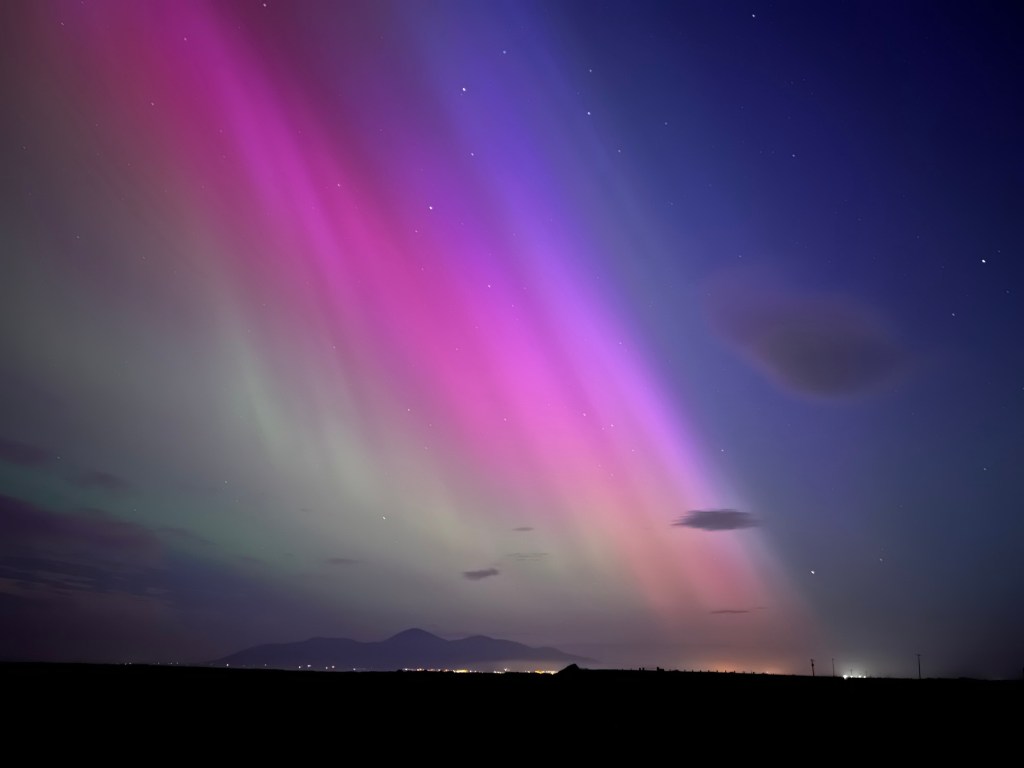
A night sky, with the Mourne Mountains on the horizon, silhouetted by an auroral curtain.
Oh, and I got to see the aurora borealis. Forgot to mention that.

Trip one, in March 2024, was to a city, a state, a site, and whatever else came after. More specifically, Barcelona, Andorra, Carcassonne, and Marseilles. It was the first proper trip I’d been on post-Covid and post-cancer, and I was a bit wary. It wasn’t easy at times, especially given my thyroid-affected tendency to sweat way too much when exerting myself (and being a bit overweight at the time) but it was hugely freeing. Barcelona was a pleasure to wander around, Andorra a fascinating oddity (with an excellent city centre spa), Carcassonne every bit as impressive as its reputation, and Marseilles a character-filled coda to a trip that outdid my expectations.

Trip two, in September 2024, was occasioned by a wedding. My cousin getting married in a Tuscan villa, and myself with an invite (mum was supposed to come but was unwell and unable to travel). The wedding was a delight, and I span the trip out into nearly two weeks of travelling: to Venice via a few hours in Florence, a day in Padua, a few days in Trieste, then over the hills into Slovenia and lovely Ljubljana, and from there into Croatia, for stays in both Zagreb and Split. The latter was a particular highlight, the centre of town being built in and around the remnants of the palace of Diocletian, one of the more storied Roman emperors. I splashed out a little more cash than usual and made sure my hotel was in the walls of that palace. In fact, if I may offer a little advice, if you’re doing a city-hopping trip like those I favour, it’s a good idea to save a little spending money to make the last stop more plush, so that you return home rested, refreshed, and positive. It seems to work for me anyhow.

A view of the citadel of Carcassonne at night, the medieval walls lit up with orange light.
Carcassonne by night. Because by day is not enough.

This year’s trip, again in March, was one of the two trips left to mainland European countries I haven’t visited. (Ukraine and Belarus being out of reach for the moment.) In this case, it was a tour of the Baltic states and Finland, which I dubbed a “Last Chance to See” tour in a moment of black humour. I started off in Helsinki, still in the grips of the fading chill of winter but with a population already dreaming of summer and willing to take any opportunity to stroll in the sun. Across the Gulf of Finland lies Tallinn, a return visit from more than a decade before, where I had a lot of fun wandering around one of Europe’s most intact medieval cities. After that it was railways all the way, first to Riga by the banks of the Daugava River, where wandering through Soviet-era architecture brought me to a trio of museums: a rickety collection of fire engines and fire brigade memorabilia, a paean to a brand of chocolates that once delighted the children of the USSR, and a tour through the cells and depravities of the KGB’s effort to keep the people of Riga down. Last of all was Vilnius, where I roamed forested hills, independent districts, and restored palaces as I learned about the history of Lithuania and the determination of its people not to lose their identity.

If you’re still here, thank you for allowing me to ramble on about my trips. Getting to venture out and see more of the world has been one of the big wins of the modern era of technological advancement and no wars between major powers. For me, Covid and cancer conspired to take it away for a few years, but the past 13 months have given it back. So that’s a victory I don’t take lightly. I hope to get back to writing properly again too, so that’s a task for the next 13 months. Will see you there, with any luck.

Four Years, Four Months On

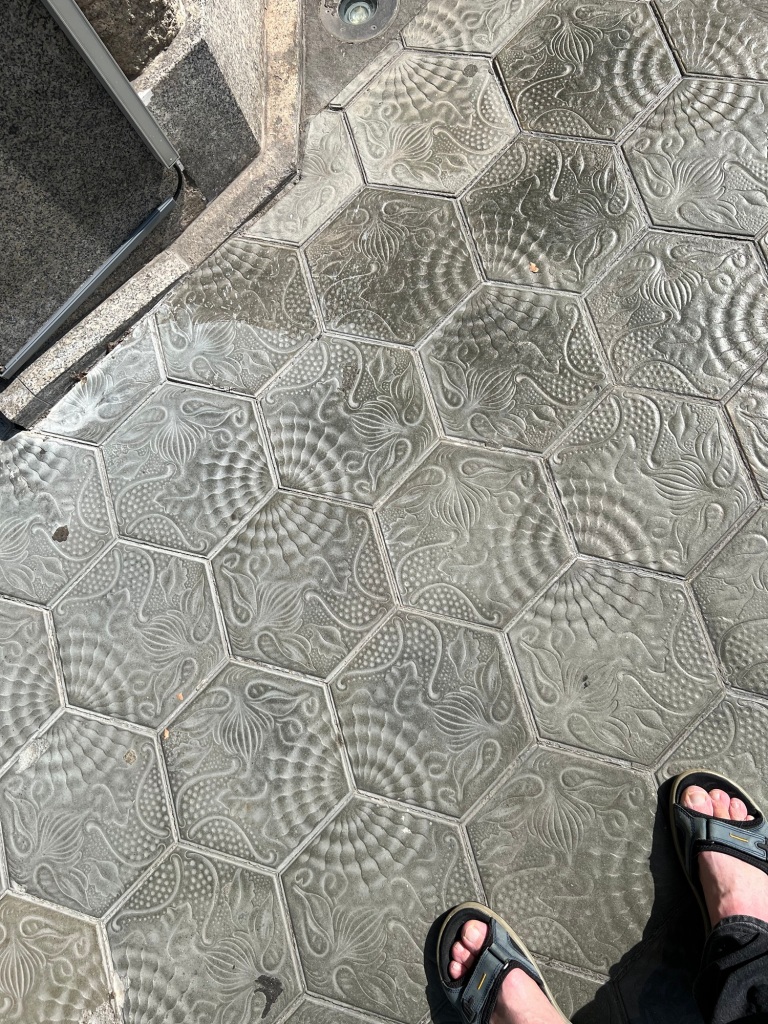
Spiral patterns in the paving stones of Barcelona. Feet author’s own.

The first philosophical thought I remember having (we were living in the old house, so I would have been ten or a little under) had to do with solipsism. It suddenly occurred to me that though I was aware of my own thoughts and feelings, I had no access to the thoughts and feelings of others. How could I prove that they were the same as I was, had the same interiority? (Ten-year-old me wouldn’t have used that word, of course.) What if I was the only person like this?

I wouldn’t have used these words to express the feeling, of course, and as I wasn’t equipped to resolve this particular solipsistic worry, I don’t think I dwelt on it for long. The fact is that none of us can prove that others feel or think in the same way that we do. We can infer it by observing them, but that’s as far as that goes. This missing link affects how we view humanity and why we create art. I’ll get to the art later, but let’s talk about humanity first.

Because we have first-hand access only to our own thoughts and feelings, we have to grant others equal status to ourselves in our estimation. That’s done naturally enough with family and friends, who share so much with us, and even to others like us, but there are many who we may not think of enough to even consider it. And there are plenty of examples in the past, and sadly now, of whole populations being taught to think of “others” as lesser, unworthy, unwholesome, or simply not human at all.

I was brought up Roman Catholic, and repeated many times across the lives of Christ in the gospels is the insistence that everyone is worthy of the same consideration and care, no matter their age or origin. It’s not a sentiment that survived those who came after with their legions of “You see, what he really meant was” but it’s a good lesson to learn, and many have. Despite no longer holding to that or any faith, I imagine it’s where I got the idea from.

If I hold to one belief about humanity, it’s this: we are all unique, possessed of untold abilities, and here on this planet for a limited time. If there is any purpose to our existence, it’s has to be a purpose we create for ourselves. In the decades since that first philosophical thought, the only purpose that has ever made sense to me was ensuring that we and those we share a span of time and space with feel as much joy as possible during our time together. Joy being a catch-all word for fulfilment, pleasure, tranquility, what have you.

If I believe that, and I believe that all of humanity is deserving of the same respect, then I can’t exactly be happy at the current state of the world, can I? An ongoing slaughter in Palestine, of people who have been deliberately dehumanised for decades by both the occupying power doing the slaughtering and those who are supporting and funding their efforts. A seemingly worldwide effort to push fascism as a valid ideology; fascism of course being all about “othering” outgroups and favouring violence as a solution to all of life’s problems. All against the backdrop of market-driven capitalism winding itself into its planet-destroying death throes.

Because, yes, the quarterly profit figures won’t look so good when there’s no market left to admire them. The latest folly to cross the news is that Amazon and Microsoft are planning to buy their own nuclear power plants in order to meet the wild increase in power needed to fuel new “AI” services.

Now, there’s a conversation to be had about nuclear energy’s role in a sane energy policy. But this is not that conversation, nor is it anything approaching sane. I watched an episode of Chernobyl before setting off on my current holiday, and as bad as Soviet employment practices might be, I shudder to contemplate Amazon management getting their hands on some control rods.

They’d probably let an AI manager run it anyway. That’s the point of all this. Not to provide better services to customers but to remove all human expense, to remove as entirely as possible all jobs that lie below the executive line. Perhaps AI Wrangler might remain as an entry level post in some businesses.

This is why, when the first inklings of AI burst upon the public consciousness, it did so in the form of “AI art.” Nothing is quite so indicative of humanity, of what we might call a soul, as art. Art is, after all, an effort to communicate the secrets of one heart so that another can understand it. If this AI could make art, didn’t that mean there was something at its heart? Didn’t that elevate it in worth?

Well, no and no. “AI” doesn’t understand its “art.” It’s not trying to communicate anything. It’s taking whatever instructions it’s given and matching them against the actual art it was trained on, then tossing out a guess of what the instructor wants. That’s why it’ll throw out multiple guesses, never the same twice. It’s why any factual accuracy in AI-generated text is the result of refined guessing, not innate knowledge.

AI is only half accurate. It’s certainly artificial, but it’s not intelligent by any useful meaning of that word. It’s a well-trained parrot, regurgitating phrases it doesn’t understand. The Large Language Models currently being passed as AI may have massive potential as productivity tools. But so did capitalism, and we made the mistake of letting that run everything too.

These days, I’ll gladly grant any other human being the same interiority and worth as myself. It feels to me like the best way to live. I don’t have to do that to what’s being sold to us as AI. Perhaps I will, someday. I hope we all live that long.

Health Update

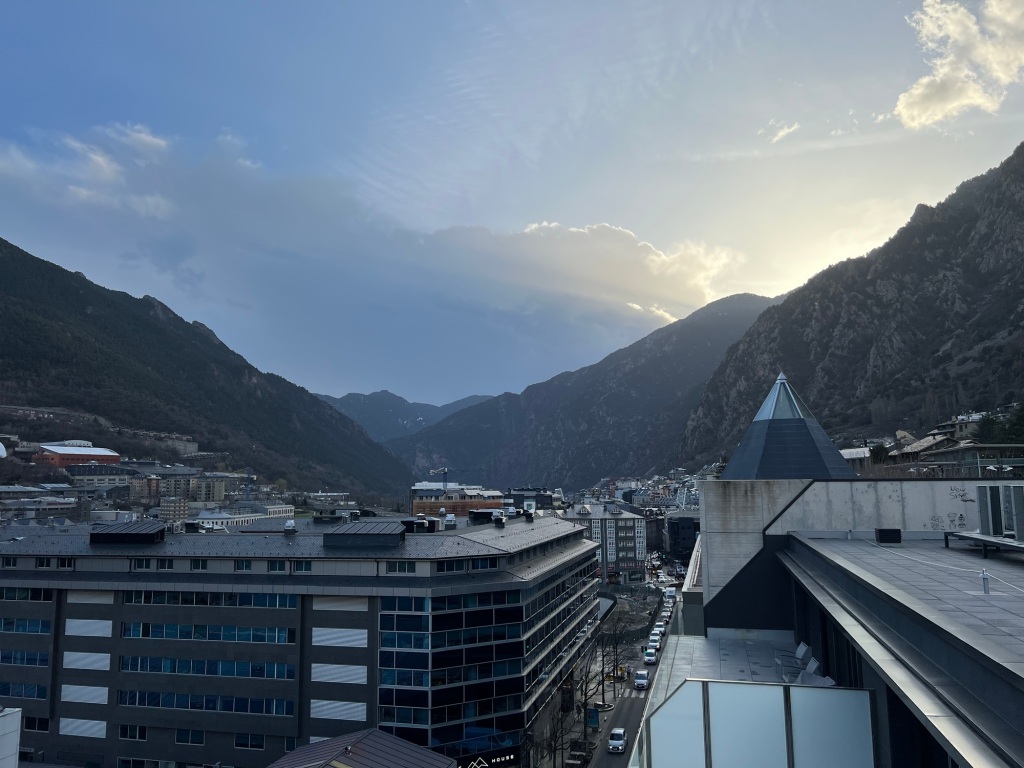
Sunset over Andorra. Still plenty of light—the sun sets early in the mountains.

This is the fourth of these thirteen-monthly updates that I’ve provided. Once again, despite the nature of my initial diagnosis, I hit this arbitrary celebration in good shape. As I type this, I’m passing through a Pyreneean tunnel on a bus from Barcelona to Andorra. The first lengthy solo trip I’ve been on since I went to Chile to see an eclipse in 2019.

Covid had more to do with that hiatus than ill health, but I will admit to some trepidation. I’m not as fit as I was in 2019, and the medications I take require an extra regime of care. The cancer, thankfully, remains as quiescent as it’s been since the last update, but the new medication I shifted to in January 2023 did a number on my thyroid, resulting in swollen feet and sweating.

Medication for the thyroid has brought both under control, but dialing in the dose is a tricky matter, and it’s an issue that has to be observed over the long term. I worry a bit about my physical capability being slowly whittled away over time, but I’m still up for a day of tramping around Barcelona (with a siesta) and I’m looking forward to the cooler climes of Andorra and the walls of Carcassonne.

So as we descend toward La Seu d’Urgell, I’ll just say that I’m happy to be in good health and good spirits. I’m glad I still get to travel this way and enjoy a job that my younger self would have dreamed of. I’m less glad to be living in a world that has horrors like the Gaza Genocide and the prospect of Trump II in it, but we can work against those things. In fact, I think we have to.

The Grand Tour Ten Years On—An Ending

Endings are tricky things. Ten years ago, I came to the end of my trip round the world with the most unstructured section of the trip to date. I’d booked my flight home at this stage, so I had an end date, but everything else was booked at the shortest notice I could manage. It’s probably not surprising that my memories of those last few days are a bit confused. And that’s absolutely what I’m blaming for being so late in getting around to writing about it.

The train dumped me in Boston late in the day, and I had the scraps of an October afternoon left to wander around in the rain and look at this city with so many ties to Ireland. In truth, I don’t remember much of it beyond the green spaces and the utter disaster that was the remnants of the Big Dig, a decade-plus effort to reroute the city centre highway into less obtrusive tunnels.

An extremely wet Boston evening.

Liz had pointed me to a decent Boston pub, where I’d be able to enjoy some craft beer and decent food, and I remember crashing for the night in a city centre hotel room, but my clothes and bags were just as frayed and overused as I was at this stage, so I definitely didn’t stay out too late or attempt any socialising. Instead, I did a brief self-guided walking tour the next morning before heading out to the city airport and my hire car.

The highways of New England were no friendlier to public transport than the streets of Los Angeles, so I’d opted for my own wheels in exploring Vermont, New Hampshire, and Massachusetts. Not that I ventured too far from Boston at first. Salem, New Hampshire, was my main base for the next few days, though I eventually ventured as far afield as northern Vermont, Cape Cod, and Walden Pond.

Post Mills in Vermont, the northern limit of my travels.

New England in the fall is one of those recommended experiences for travellers and locals alike, and even if I was a little late for the best of it, I managed to douse myself in russet and gold woods for the space of a few days. I took a slow tourist train north along the Vermont/New Hampshire border, where the riverside was cast in autumnal hues. I specifically drove along narrow lanes instead of straighter highways when I could, just so as to enjoy the ambiance.

Make no mistake though, this was perhaps the most stereotypically American experience of my trip. I stayed in a motel, I ate breakfast at roadside diners (even drinking coffee so I could get free refills), and I took advantage of every amenity that threw itself in my way. Spotting a Halloween-themed festival in Canobie Lake Park near Salem, I spent an evening among a host of generally much younger revellers, just as I had in Stockholm, two months and thousands of miles earlier.

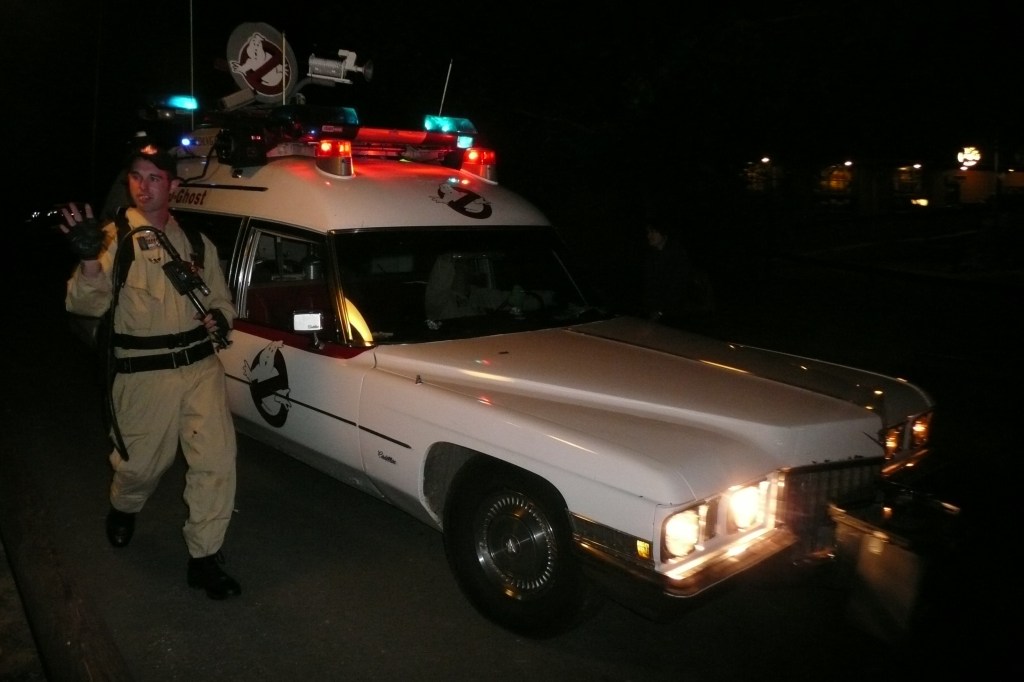
Ecto-1 in Canobie Lake Park, for that Ghostbusters special experience.

Walden Pond hadn’t been on my radar before the trip, but I knew the story of Henry David Thoreau and his retreat to the wilderness in search of simplicity, so when I came across signs for it on my driving I decided to drop by. The remains of the cabin itself weren’t much to write home about (and Thoreau was far less isolated than he claimed in his writing), but Walden Pond itself was absolutely worth the visit, and I circumnavigated the water itself along paths lined with autumn leaves.

Cape Cod was the last big experience of this part of the trip. A longer drive than any I’d tried since California, it took me all the way out along the point until I found a beach where I could sit and watch the last light of day. I’d been along the East Coast for a while at that point, but it was nice to actually reach the ocean and complete my continental crossing, and I celebrated with a dish of Atlantic clams at the first diner that I found on the way back to the motel.

Looking off towards Ireland from Cape Cod.

The end was rapidly approaching though, and it was time to bring the car back. Unusually for me, I’d booked the car without the need to fill the tank on the return, so I ended up playing a game of chicken with the fuel gauge, which I’m glad to say I won, heading back into Boston and catching the train to New York before the day was out.
New York was a familiar place to me. This was my third visit but my first one solo, and once again I was hosted by some of my dad’s relatives who lived in Manhattan. The time for the flight home was approaching, so I wouldn’t have more than a day or two, and all of that time would be spent under grey skies, but as has always been the case with New York, I enjoyed every minute of it.

Tired and damp but very high up on top of the Empire State Building.

I dropped by the Apple Store cube on Fifth Avenue, which was covered in building materials but still hosted a queue waiting to buy the latest piece of shiny technology. I wandered the length of the High Line linear park, a slice of greenery cutting along an old elevated train line. I even visited the Empire State Building and took the elevator to the top floor, enjoying a view that I’d missed out on during my previous visits.

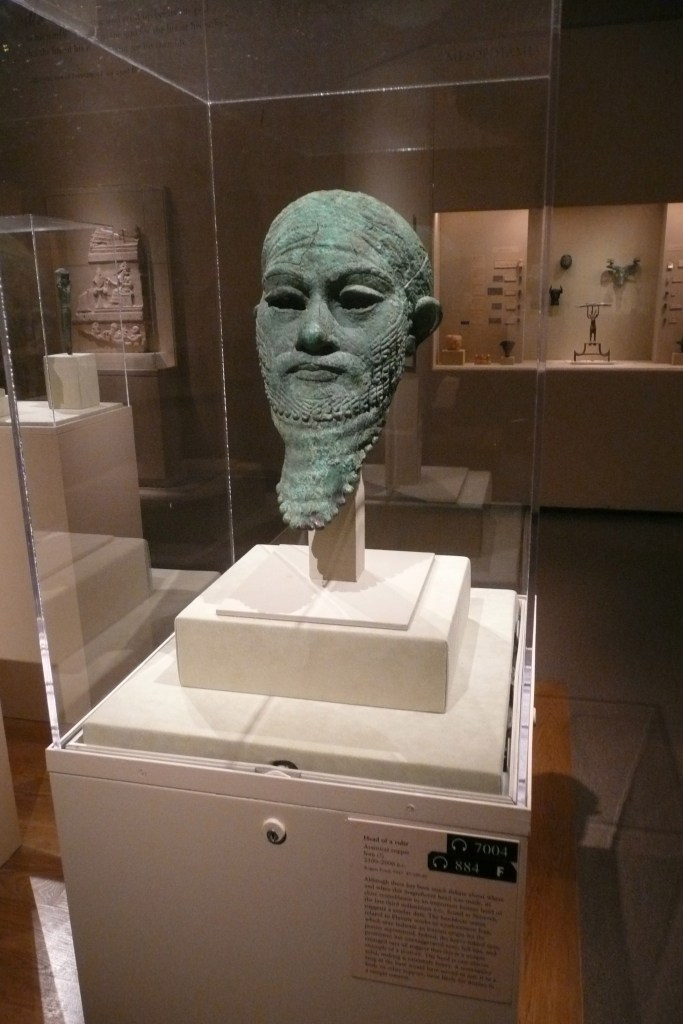
Mostly I just wandered around Manhattan and through Central Park, but I set aside a day for a treat provided by my hosts: free entry to the Metropolitan Museum of Art. Probably the greatest collection of art in the New World, it’s stuffed with not just paintings but pieces of sculpture and more useful items through the whole span of human history. Like museums I’d visited earlier in the trip, like the Winter Palace in St. Petersburg, there was an entire day and more of wandering to be done amid its halls.

An Elamite king in a museum that would make any jealous.

A little further south on the island, I saw the camp of the Occupy Wall Street movement, an uprising that has long since faded but didn’t need to be prescient to see the problems that had been growing for a long time and still haven’t lessened. In truth though, what I was mainly doing was just being in New York. Seeking out a state of mind, dragging out the last few hours as departure approached.
In the dying light of a New York day, I took the train to JFK. An entire life experience was coming to an end, though I knew there were all sorts of new things beginning. A new impulse to travel, a new direction for life. Ten years of life began as that trip ended, and if things are moving differently now, it’s just the next step in the process.

A last meal for the travelling man. Pizza, beer, and garlic bread.

There would be a final flight from London to Dublin when I landed, and I would see the shores of Ireland under grey clouds as October drew near a close. My parents would be waiting for me when I landed, to welcome me and hear all the stories. But the trip ended there in JFK, eating pizza and drinking beer bought with the last of my dollars, thinking back on everything I’d been through. Everything else was wrapping up.

The Grand Tour Ten Years On—A Third Continent

Growing up in the U.K. in the eighties, you absorbed a lot of knowledge about the U.S. through TV and film. Some of it eventually got erased in favour of more accurate information. Some of it didn’t. One thing that lasted until just about a decade ago was the idea that the Rocky Mountains were a narrow range running along the U.S. West Coast, part of the great Pacific ring of mountains. Well, that isn’t true. Wasn’t even close.

Leaving Oakland on the California Zephyr, I’d hit mountains quickly enough, but those would be the mountains of the Sierra Nevada, themselves further inland already than the Coast Ranges, into which the San Francisco Bay is tucked. I was setting out to cross the third continent on my trip, once more by train, and Amtrak was my carrier from embarkation at Emeryville to de-training in Boston.

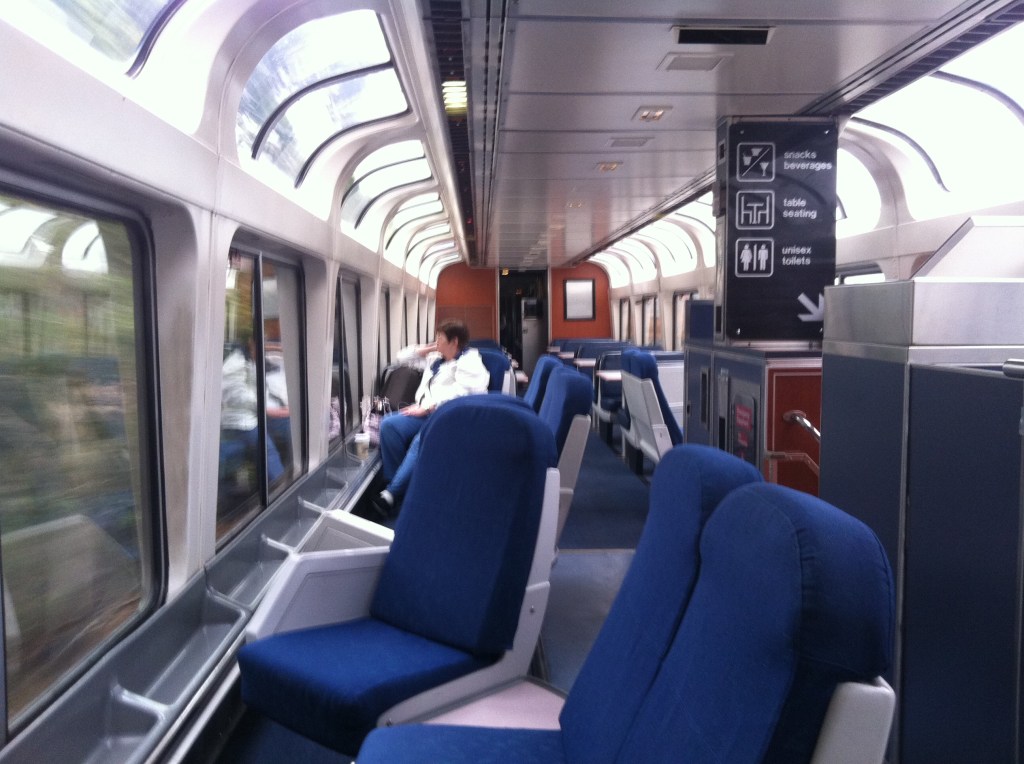
A California Zephyr viewing lounge. Seats are first-come, first-served.

For a nation that was stitched together by rail, from sea to shining sea, the U.S. has largely moved away from rail as a way to move people in favour of road. It was a bit jarring in comparison to Japan, where rail is king, but the U.S. is a lot larger and emptier and is very much its own thing. (If you want to know more about why U.S. rail is the way it is, try this video.) Blame Eisenhower anyway. He’s a Republican who’s gotten away scot-free for too long. (And courtesy of a brief Wikipedia trawl, I now know that scot-free refers to being free of the need to pay royal duties or imposts.)

For purposes of my travelling plans, some longer rail routes still endure, mostly as draws for tourists, the curious, and the romantic. At least two of which applied to me back then. I’d visited the East and West Coasts before, as well as Chicago only a little while before this trip, but I’d never ventured far beyond city limits in each case. This train journey was an expression of why I prefer trains to planes: maintaining a sense of connection to the landscape while travelling, and ensuring that travel remains meaningful.

The landscape of the West. Which has its own more modern resonance for me.

On the California Zephyr, I spent most of the first few days ensconced in the viewing lounge. A specially designed car with curving panoramic windows and seats designed for sitting and watching the world go by. The seats in the lounge aren’t bookable, or weren’t then. Instead, people wander in and out as they please. Since I was just there for the travel, I settled in and over the course of the next few days I made a couple of new friends and had some fun conversations, mostly with Mormons, one of whom professed to be revealing the inner secrets of the church to me. Given that the first stop of my trip was Salt Lake City, this raised an eyebrow or two, but any weirdness was balanced out by perfect politeness in every case.

Cities with names as familiar as Sacramento and Reno fled by, but when the train hits the Great Basin between the Sierra Nevada and the Rockies, the scope and scale of the U.S. becomes apparent. It’s less vacant than the grand forested expanses of Russia but no less impressive. River-cut valleys, low ridges, tiny villages, huts in odd places. The history here is not written, but rather experienced. White settlers are newcomers. Even the native tribes have only two tens of millennia here. No time at all to write oneself into the story of the land.

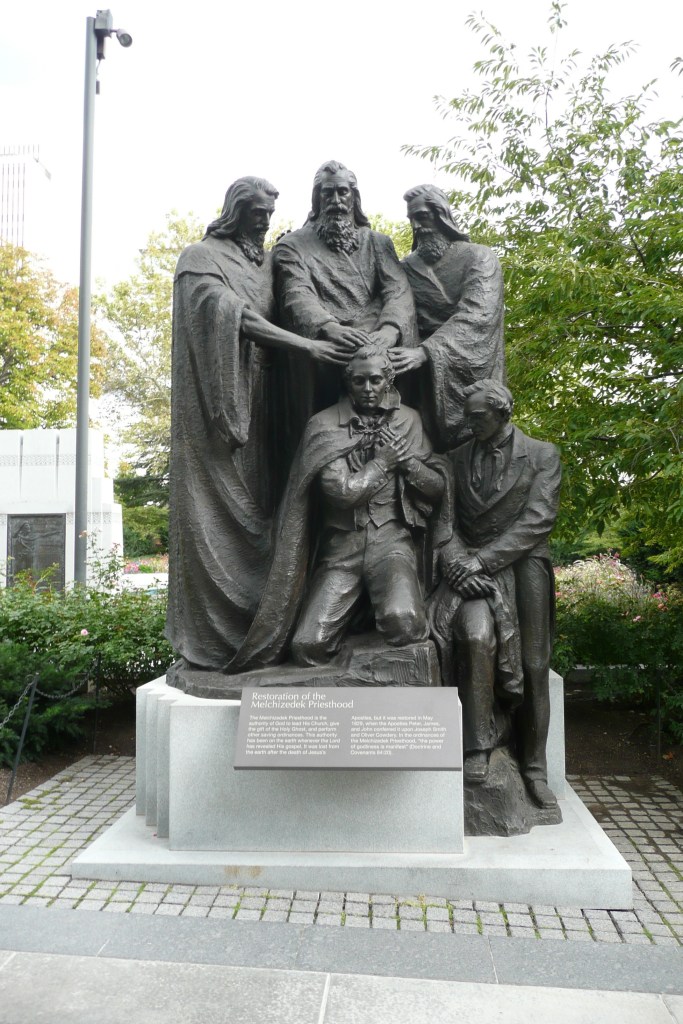
Joseph Smith getting the Lay On Hands treatment.

The rhythm of night and day received a jolt with my arrival in Salt Lake City. The train crossed the Great Salt Lake Desert in darkness and skirted the shores of the Great Salt Lake itself with only the lights of the distant city as a guide. The California Zephyr leaves once a day and can be caught along its route once a day likewise. I’d chosen Salt Lake City for a stop, but the drawback was that I disembarked at around 4:00AM in the morning, knowing that I had 24 hours to explore, not sleep, and endure before I could take to the rails again.

Cue a very strange day. The larger of my two bags was safely stowed in the station, but all was still in silence and darkness as I wandered into the city. The broad, open streets of the city held almost no one else, and in the distance there was the blindingly white light of the Salt Lake Temple as a guiding star. It felt like I was in a mash-up of 28 Days Later and Jesus Christ Superstar.

Salt Lake City from above. The temple is a little less white in the daytime.

It wasn’t too hard to spend 24 hours in Salt Lake City. The first few hours were the trickiest, but once I’d found a tourist office that offered free Wi-Fi through its closed doors and an early-opening Starbucks, I was in decent shape. I’d climbed to the hill where the State Capitol sat for sunrise, but most of the rest of the day was spent in doing some religious learning in the form of Mormon (Church of Jesus Christ of the Latter-Day Saints if you prefer) history. There’s more to Salt Lake City and Utah than the Mormons, but it’s hard to avoid the church, and I had no particular reason to do so, being a temporary visitor.

So I kept my scepticism to myself and listened and learned as the day went on, taking suggestions as to where to go and enjoying the odd non-Mormon experience like the Public Library. Those non-Mormon experiences expanded when the sun went down, which I watched from the Capitol Hill again. Sunset over the Great Salt Lake is definitely worth catching, by the way.

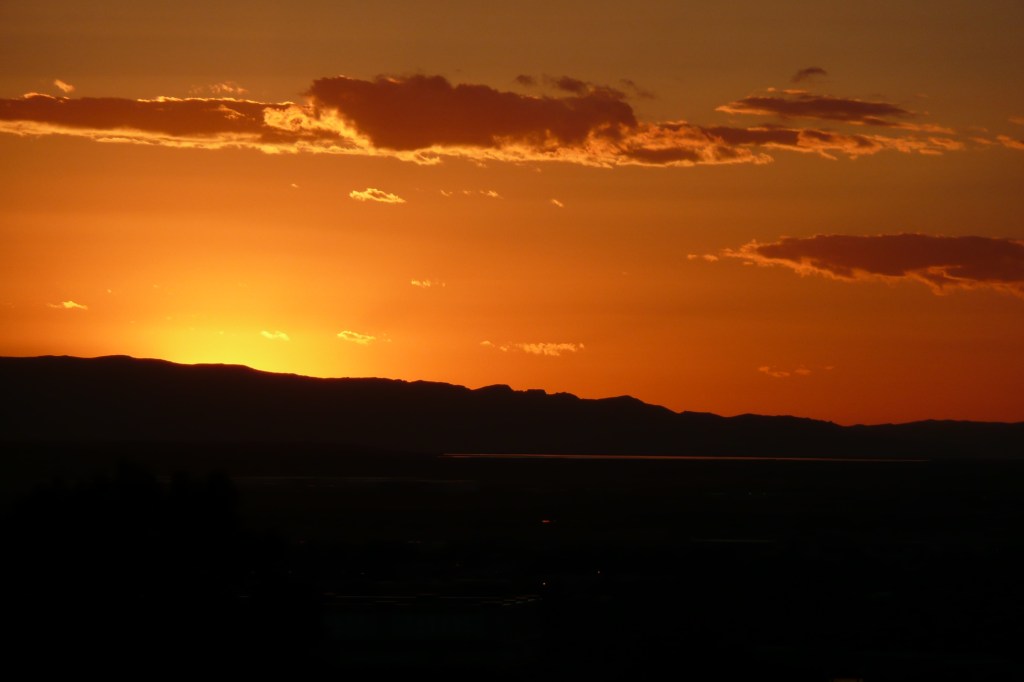
Those sunset skies. (Oh to have had the phone camera I have now.)

Because I had to stay awake and active until 4AM again, didn’t I? Sunset being over, I headed for a bar. Despite what you may have heard, it’s perfectly possible to imbibe in Utah. The rest of the evening went approximately pub quiz, planetarium, Led Zeppelin laser light show, and late night movie. All of which brought me to a little after midnight, upon which I headed to the station for a few hours sitting in the dry cold until the Zephyr showed up again and I found my way to my seat to sleep through the remaining morning hours.

It was a weird, half-awake day that followed. Sleeping in a seat following 24 hours of not sleeping at all (and not having been in a bed since San Francisco) does not for a healthy mental state make. The fact that I was poorly shaved and showered probably contributed to the fact that I don’t really remember talking to anyone on the trip from Salt Lake City to Denver. But balancing this out was the view.

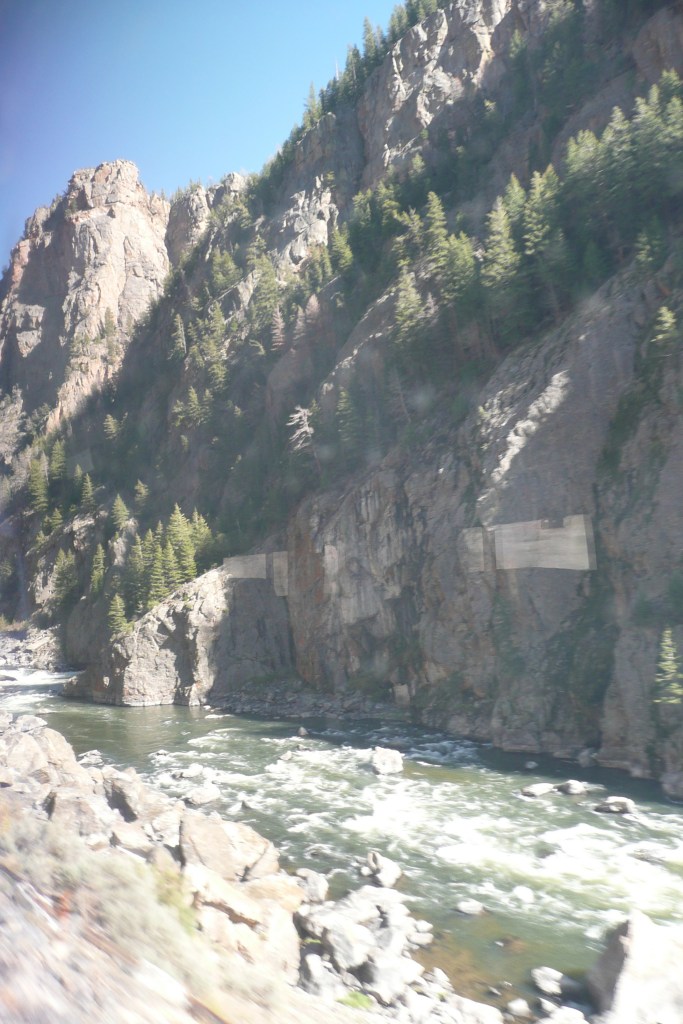
Glimpsed from the viewing lounge, up among the mountains.

This was proper Rocky Mountains stuff as we climbed towards the Continental Divide then descended throughout the rest of the day towards Denver itself. Proper American landscapes of the Old West school, looking half-untouched by human boot or horse hoof. As I had been on the Trans-Siberian, I was transfixed, with the bonus of proper panoramic windows for the view.

We pulled into Union Station in Denver as twilight was falling. Well, I say we pulled in, but we were actually dumped on a platform some distance from the station, which was in the midst of refurbishment. Luckily, I’d learned my lessons from California misadventures and had booked ahead. A short walk took me to a youth hostel, where I showered and changed, then ventured out into the darkness feeling like a new man, in search of pizza and beer.

Denver pizza and beer. So very gratefully received.

Like Salt Lake City, and for much the same reasons, I had exactly 24 hours in Denver. Of course, sleep was going to take up one third of that, but as it turned out a whistle-stop tour of the Mile High City was just enough to fall in love with the place. There was a cold, dry, crisp feel to the air, which left me parched a good deal of the time but was exactly what a wandering traveller needed to encourage exploration.

I found the Mile-High markers at the Capitol building (or rather the three of them, as they took a few shots to get it right), roamed through museums of art and archaeology to get a feel for the culture of the West, and generally enjoyed the vibe of a city that felt like somewhere I might want to live some day. I also came across something that I’d encountered a couple of times on the West Coast: a large “Occupy” protest in front of the Capitol, attended by the odd joker in a V mask and a “Don’t worry ma’am, we’re from the Internet” sign. Ah for more innocent days.

Much of Denver’s fantastic art is Native in origin and all the more worth seeing for it.

But 24 hours was a hard limit, and as the sun sank I was heading for the loose vicinity of Union Station again. It was time for the last leg of the California Zephyr, taking me across the Great Plains to Chicago, where I would be spending another night. Or rather I would have been if hotel prices hadn’t soared through the roof for some reason. I guessed some kind of conference taking place, but regardless, there was no possibility of finding a place to stay on a budget. This being 2011 and long before the world became properly aware of Airbnb.

So I did my best to sleep through the night as we crossed the former Western Interior Seaway, the vast open plains of the Midwest, and towns and cities like Yuma and Omaha. There was plenty of scenery but from the low perspective of a train it didn’t quite strike the eye in the same way as the heights of the Rockies. And despite my best efforts to keep an eye out, I spotted no farm boys racing trains on foot while passing through Kansas.

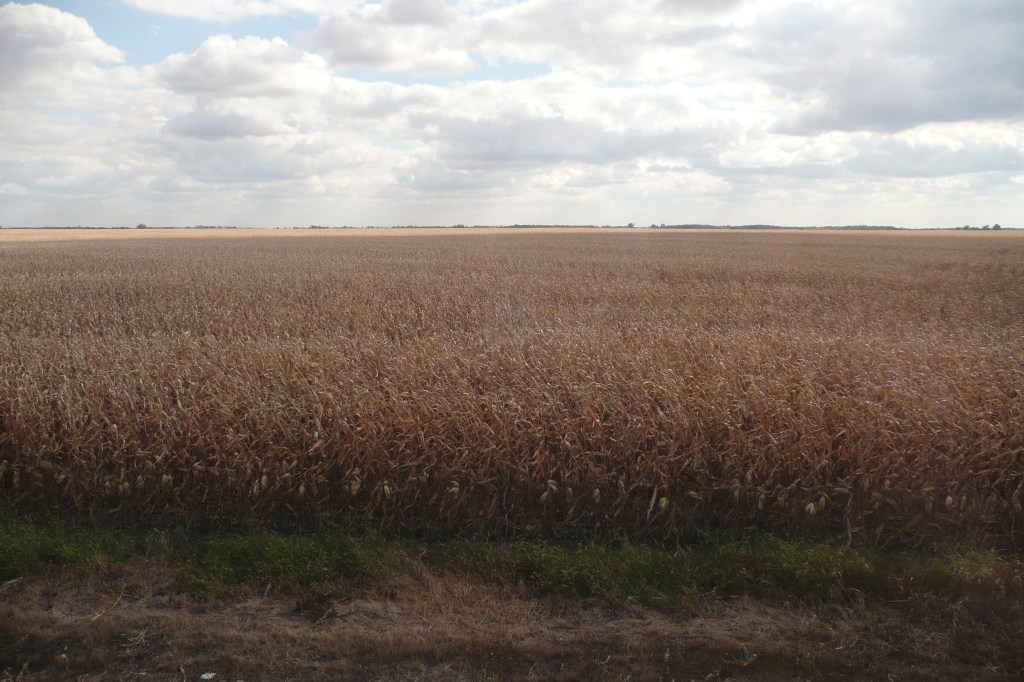
Corn? In the Midwest? Who knew?

So I landed in Chicago with plans to stay no longer than it took me to jump on a train that took me to my next destination. Missing out on the Windy City wasn’t as big a blow as it might have been, as I’d enjoyed a freezing trip there back towards the start of the year. I enjoyed a late lunch and made my way to the Capitol Limited, headed for the heart of American political power.

It was a shorter trip than the previous legs of my journey, save perhaps the hop from Salt Lake City to Denver, and it returned me to some proper landscapes, no small amount of them soaked in rain. I’d been lucky on the trip to that point in that I’d avoided inclement weather most of the time, and on this rail trip I got to enjoy some of the scenery while enjoying dinner in the dining car with a collection of folks heading for D.C. for reasons that were many and varied.

The train, it has to be said, was not always the fastest, but the view made up for it.

Washington D.C. marked an end of sorts to my third continental crossing. I’d continue to explore the East Coast of the U.S. for a while and eventually make it to the sea, but the Potomac was close enough to the Atlantic to count for me. It was also where I’d be hosted by yet another American friend. In this case Liz, who met me at Union Station (it’s almost always Union Station in the States) and proceeded to take me out for beer and burritos, and from thence to a D.C. United game, Liz being not only a craft beer expert but a leading figure in the cheering section for her local team.

Once again, having a base of operations and a knowledgeable local made Washington D.C. a special experience. While I worried a bit about outstaying my welcome, skipping Chicago had left me with an extra day to explore, and Liz proceeded to take me upriver for some park exploration, and then host me at her place with some home brewing. When I said she was a craft beer expert, I meant it.

One of those photos of yourself that’s way more flattering than you deserve.

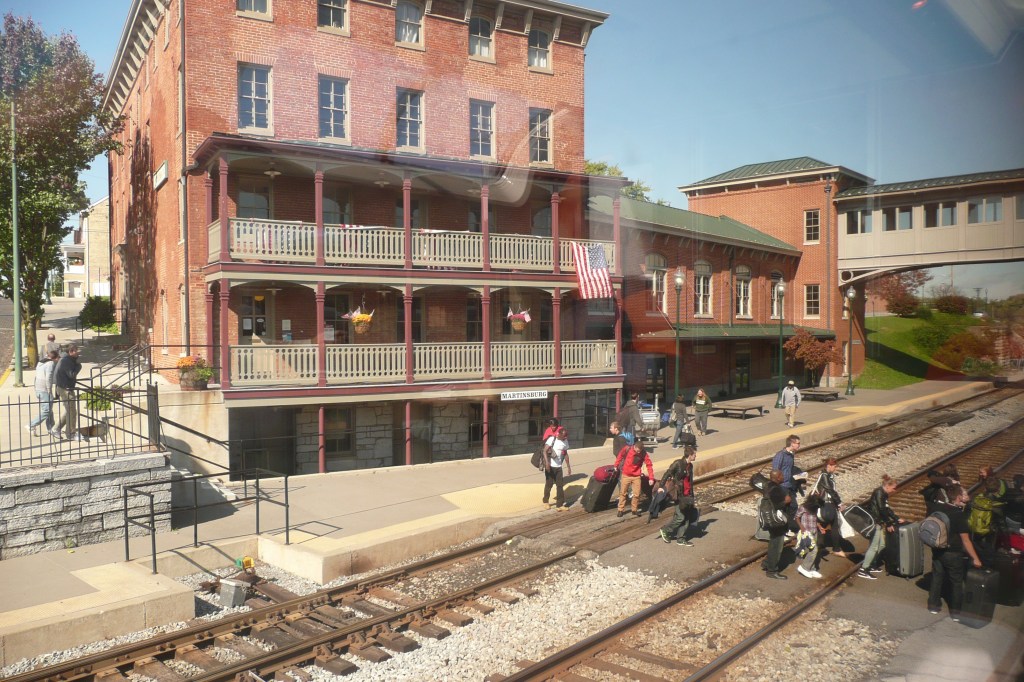
As for D.C. itself, there was ample to explore. Unlike Los Angeles, D.C. has decent public transport (funny how it’s always good enough for the ruling classes, hmm) so Liz could just set me loose in the morning when she was off to work. I did a circuit of the museums around the National Mall, including the Newseum, the Air and Space Museum, and the Museum of Natural History. I visited all of the presidential monuments and peeked in at the White House and its pitch black squirrels. (As an aside, I also picked up a book on Thomas Jefferson that thoroughly punctured the admiration I’d held for him previously—being a talented and principled man is only of so much use when you limit on whose behalf you exercise those talents and principles.)

D.C. is also a surprisingly walkable city, and the monuments of the Mall took me to Theodore Roosevelt Island and its population of deer, who seemed as surprised to see me as I was to see them. There were canals to wander along and Arlington National Cemetery to roam through. Not all of which was done on a single day, but there was plenty to keep me busy, and I could have kept roaming for a lot longer had I wanted to.

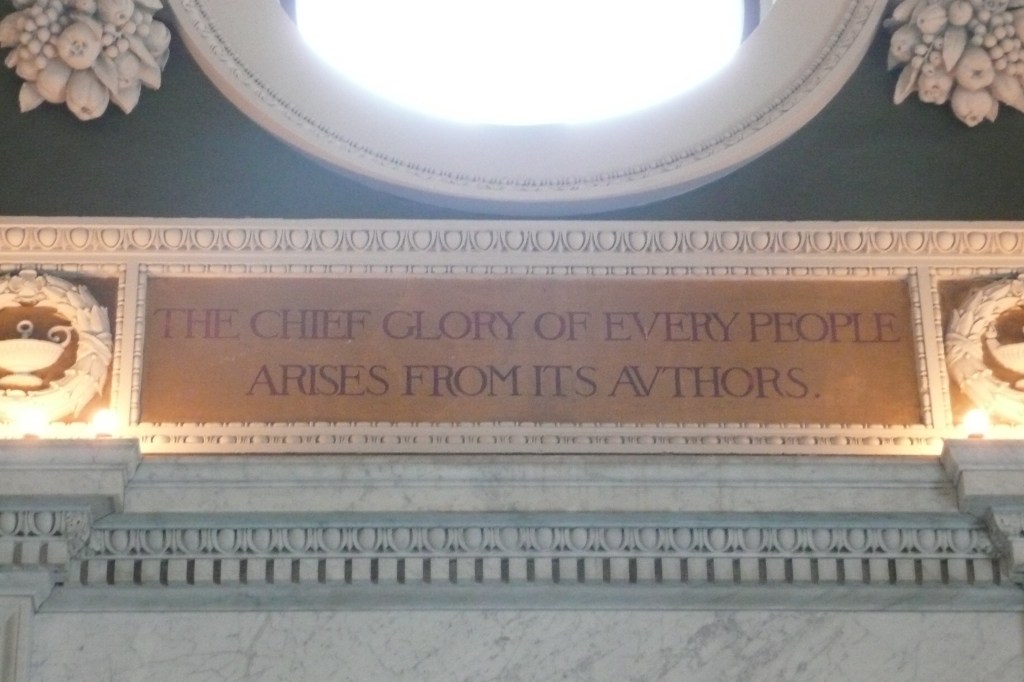
I did peek into the Library of Congress too, though not solely for the purposes of ego reinforcement.

At length though I needed to keep on wandering, and I had things to see and do before I was homeward bound. I said my farewells to Liz and took one last morning spin around the sights of a cloudy D.C. before heading for that old Union Station. The time had come for the last leg of the journey, into the heart of the oldest part of the U.S.: New England in the Fall.

The Grand Tour Ten Years On—California Roaming

From London onwards, my travels across the world had been relentlessly solo. Even when I was hanging out with others, such encounters had been either brief or negotiated across the barrier of a language gap. It had been a liberating but alienating way to travel, and it came to a crashing halt when I landed on the West Coast of North America.

The author of this change was Colleen, a friend of a friend who I knew from Dublin and who insisted on hosting me for the handful of days that I’d be spending in Los Angeles. She did more than that too, introducing me to her family and friends before I’d been there an hour or two, and loaning me her car (the only sensible way to get around the city). In other words, she couldn’t have been more hospitable to a bewildered Irish traveller still getting his head around the 24 hours he’d regained, Phileas Fogg-like, by crossing the International Date Line.

Apparently I was singing. I’m not sure this was a good way to repay her hospitality.

It was as fulsome a welcome as I could have hoped for and way more than I had expected. Truth be told, I’d been a little wary of landing in Los Angeles, which is a notoriously unfriendly city for the non-car-equipped traveller. As it was, I wouldn’t pick up my hire car until I was ready to leave, and prior to that I would have one day of car-equipped journeying around the city and plenty of chauffeured experiences to bars, Mexican restaurants, and people’s homes.

Though where do you drive as a first time visitor to a city like this, so sprawling and so famous? There’s the beach at Santa Monica, of course, famous from Baywatch, and the Hollywood Hills to the north. I didn’t find driving in or through the city too tricky, and a scribbled pencil map from Colleen was enough to take me north to the Getty Centre, with its collection of spectacular art tucked away in the hills, and then to Griffith Observatory, long before La-La-Land and its dancing stars.

On this particular day, I was in the Getty, then I was looking at the stars.

Synchronicity worked in my favour as it had tended to since the trip had started. I joined a queue without knowing what it led to and got to look through the Griffith’s massive telescope at the craters and mountains of a dazzling moon, then enjoyed the sight of a nuclear orange sunset over the City of Angels. And despite the unfamiliarity of it all, I made it back across the city as my phone was dying and delivered Colleen’s perhaps carelessly loaned car back to her.

Company and care made Los Angeles a friendly city, and it even found me a bar in which I got to watch my first match from the Rugby World Cup. (I’d searched in vain for a viewing point in Tokyo, only to stumble across one as I was heading to airport.) But I could only dwell on others’ hospitality for so long, and despite an offer of backstage tickets to a Sting concert, I had to say my farewells and take to the road again.

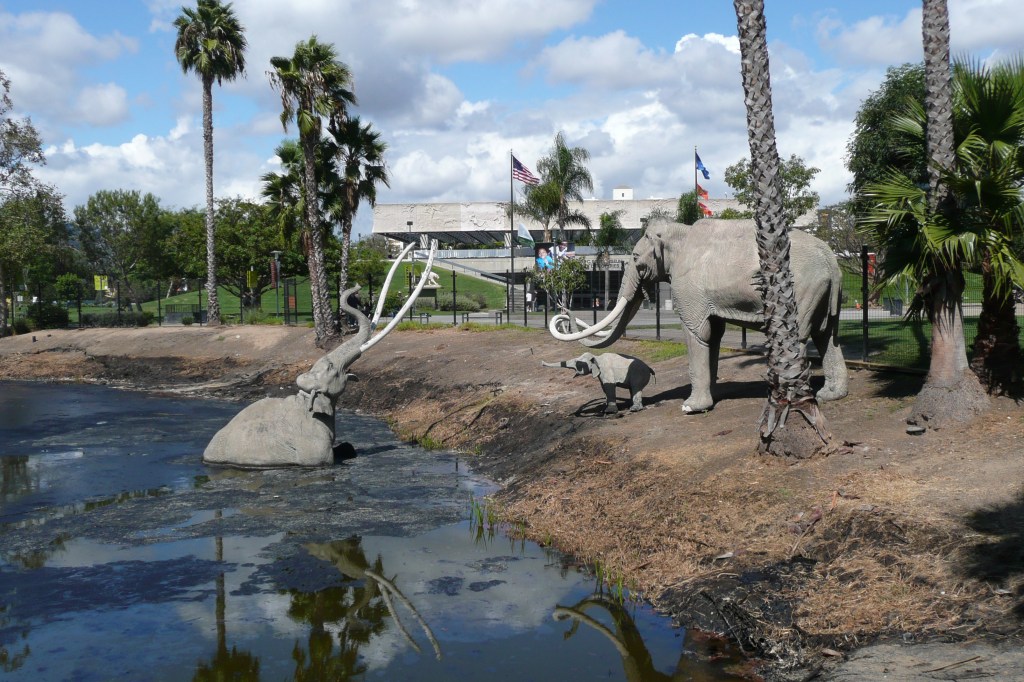
Somewhat more stuck in one place than I was at the La Brea Tar Pits.

Still I lingered though. Once I’d grabbed my hire car, I paid a visit to the La Brea Tar Pits and the next-door grounds of LACMA with its warehouse-like store of modern art. Never having been much of a fan of modern art before, I have to admit that LACMA part-converted me. Perhaps there was something about Los Angeles, that city of artistry, commerce, and eternal newness, that particularly suited it.

In any case, I was overdue for departure, and after a final visit to the beaches of Santa Monica I headed out. Only to realise that I’d left things so late that I didn’t really have accommodation sorted. Cue some covert Wi-Fi hogging from a car park and the aid of Booking.com and I was finally sorted, but it was a weirdly disjointed start to the first part of my voyage to be navigated by car.

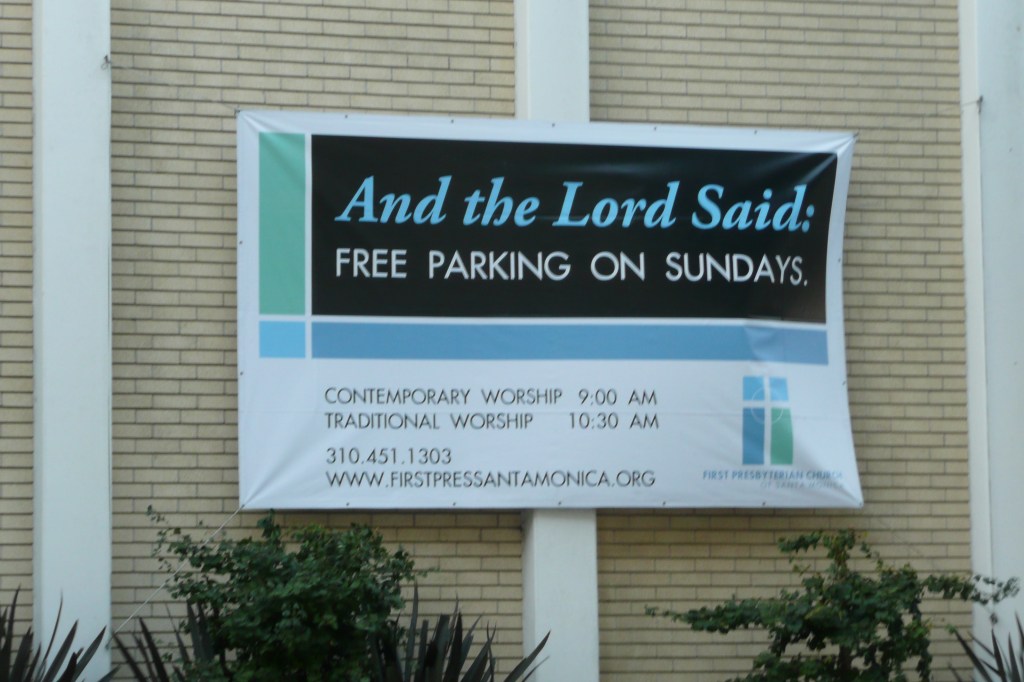
The Lord is less forthcoming on the topic of WiFi piggybacking.

The goal for the next few days was to follow Highway 1 north along California’s coast, and that’s more or less what I did. The first day was a bit of a washout, with some backtracking in torrential rain to explore Topanga Canyon near LA, then onwards through the rain to Santa Barbara with its moneyed mansions. I kept having to stop to take photos along the way, and the rainbows that cropped up between the intermittent rain showers added to the scene.

Grover Beach was the next stopping point, just down the road from the more famous Pismo Beach but close enough to make a visit for some fish tacos not just optional but mandatory. After more than a month of travelling by sea and rail, I’d hit a stretch of the trip where I was making the schedule as I went along. I liked it, and I had a chunk of coastal America to experiment with.

The wreckage of industry along the coastal way.

Highway 1 is an experience I’d recommend to anyone with the chance to try it. There are beaches aplenty if you like that kind of thing, but some of them are occupied by elephant seals and others have weird industrial relics clinging to them and oil rigs visible off shore. Further inland are relics of a different type: William Randolph Hearst’s castle at San Simeon is the gilded age in stone and memory, with art and architecture of the very best, much of it retrieved from post-war Europe, and haunted by the glitterati of Hollywood’s Golden Age.

The stretch of coast between San Simeon and Big Sur is perhaps the highlight of Highway 1, running as it does along crumbling cliffs, between sheltered coves and tree-covered hills. I had a restaurant recommendation for Los Angeles, and I enjoyed an overpriced meal in Big Sur, followed shortly by a double rainbow sighting across the forests nearby. Everything thereafter felt like I was travelling downhill, it was such a natural high point.

In San Simeon did Randolph Hearst, a stately pleasure dome decree…

Carmel and Monterey, just up the road, provided an opportunity for a dip in the Pacific Ocean as well as a sampling of some more industrial relics, in this case from the fisheries industry. But my goal lay on the north side of Monterey Bay, and I pulled into a motel in Santa Cruz late one evening for a two-day stay.

My goals for being there were three-fold. First, meet up with Kalin, a local friend who I’d met at a wedding in San Diego years before, and who’d visited Ireland only a few months earlier. Second, courtesy of her guidance, visit some of California’s redwood forests, which I’d been dreaming of since I was a child. And last, find a place to watch the Rugby World Cup quarter final between Ireland and Wales.

Your occasionally humble narrator, at home amid the redwoods.

All of this was accomplished with some pleasure, and I even got the chance to storytell some of my travel experiences and show off my collection of photos, which at this point numbered in the thousands. The redwoods were just as spectacular as hoped, and there was the bonus of exploring the Santa Cruz boardwalk in fine company. Sadly, the later quarter final (enjoyed in the company of a couple of professional caddies who had escaped from a tournament in nearby Pebble Beach) proved to be just the latest in a long line of disappointments for the Irish rugby team at that stage of World Cups.

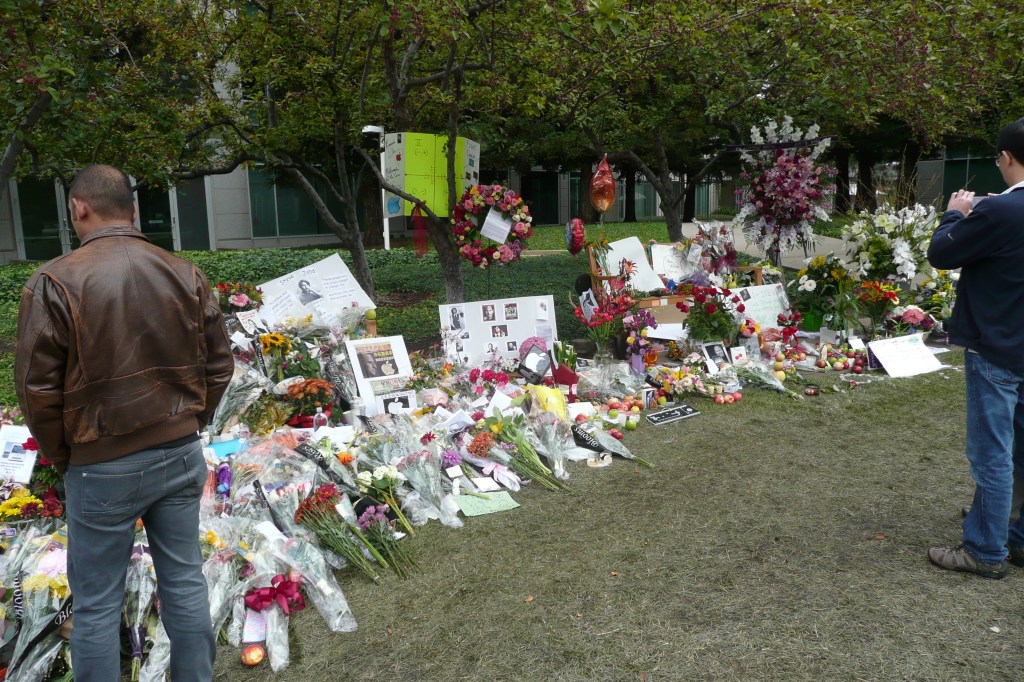
San Francisco was only a short hop away, but there was a stop I wanted to make on the way. In Santa Cruz I’d logged on to discover the news about Steve Jobs’s death. I’d been a Mac user since the 1980s, so I’d experienced his wilderness years, triumphant return, and release of devices like the iPhone on which a good chunk of my photos were being taken. I’d planned to drop by Apple’s headquarters on Infinite Loop in Silicon Valley anyway and now it seemed even more appropriate.

The Steve Jobs memorial, just a day or two after his death.

Apple then wasn’t the world-straddling behemoth it’s since become, but it was on its way, and the old headquarters in Silicon Valley were a weird tie to the older company, the one Jobs had founded. I didn’t linger too long there, and not too long later I was driving along San Francisco’s narrow streets to drop off my rental car and head for the hostel I was staying in overnight.

I’d visited San Francisco a few years earlier, so my arrival felt like something of a homecoming. Synchronicity was definitely at work too, as I headed for the heights of the Coit Tower, only to find myself enjoying the sight of a aerobatic display from some navy flyers. After all the travelling, it was hard to avoid the feeling that all of this was meant for me in some way.

Reach for the skies, mister.

The rest of that day and the day after was spent in exploration. First the Ferry Building and Fisherman’s Wharf, then Chinatown and Nob Hill, as well as further strolls all the way to Haight-Ashbury, Golden Gate Park, and the Pacific Ocean. Chinese Food, craft beers, and sea breezes. It was an exploration that mirrored the one I’d enjoyed San Francisco’s Pacific twin, Vladivostok, even if I wasn’t planning to stay as long this time.

For there was a train awaiting me. Across the bay in Emeryville, the California Zephyr met its terminus, and on its next departure I aimed to be on board. I’d bought myself an Amtrak ticket to cross the nation and the continent, and this time I’d be making plenty of stops along the day. California had been an experience that had refreshed my love for other people as much as my love for travelling, and now I got to take that refreshed soul across an entire nation.

The Grand Tour Ten Years On—Past and Present

If Kyoto felt like a pitch-perfect blend of Japan’s past and present, the latter half of my sojourn in the Land of the Rising Sun saw those two elements divided and explored in isolation. I had four days left in Japan, and while Tokyo was the inevitable end goal of the experience, I still had a day to spend in a capital city of an older vintage.

Nara sits in a quiet valley south of Kyoto and east of Osaka. It’s something of a quiet adjunct to those major metropolises now, but back in the 8th century AD it was the capital of a nation that was still in the process of forming itself. Long before the age of samurai, Japan was developing its connections to China and Korea and absorbing influences like Buddhism. It was probably a chaotic, uncertain time, as can be seen in the fact that the Nara period lasted less than a century, but for me Nara proved a peaceful getaway in the midst of an overwhelming week.

Deer don’t care. And they will chase you if you have biscuits.

There was an element of familiarity to the layout of the smaller, older city. Like Kyoto, Nara’s city centre is small and manageable, and to its east lies a much larger temple complex that is probably the main draw for most visitors. Booking at short notice, I ended up in a hotel instead of the ryokan I’d enjoyed in Kyoto, but in both cities I ended up spending most of my time wandering and exploring.

The key memory I have of Nara is the deer. If the temple district is where most tourists go, then the deer are the stars. The deer know it too. Regarded as divine messengers, they have absolutely no fear of tourists, and when it comes to eating some of the biscuits that shops sell to feed to them, they will practically bully their way into your pockets to get at them—as I learned no more than 30 seconds after buying some of those biscuits. Lesson learned. For the rest of my wanderings, I contented myself with watching them rather than encouraging stampedes.

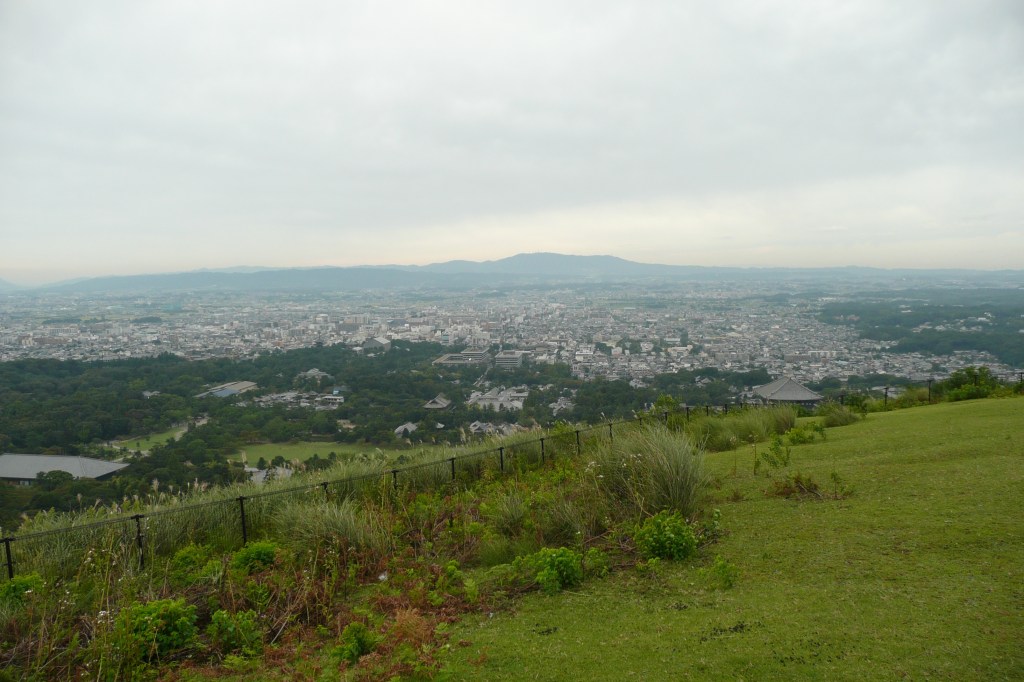
Overlooking Nara from the east.

There’s plenty to see amid the temples too, even discounting the deer. A massive statue of the Buddha and some pleasant country walks offering lovely views over the entire valley add to the appeal of the temples themselves, some of which were founded back in the Nara period themselves. (Although, given their wood construction, the odds are that very little of the material inside actually dates to that period.)

On the other side of the city centre, there are more solid remnants of Nara’s storied past, in the form of the keyhole-shaped kofun tombs from centuries earlier than the imperial period, and the remains and reconstructions of Heijo Palace, where the imperial family dwelt back in the day. Exploring all of that, as well as Nara’s restaurants and chilled out nightlife kept me engaged without being exhausted, and even if it didn’t have as much to offer as Kyoto, Nara proved the perfect addition to my exploration of that city.

Playing games in an underground bar in Nara.

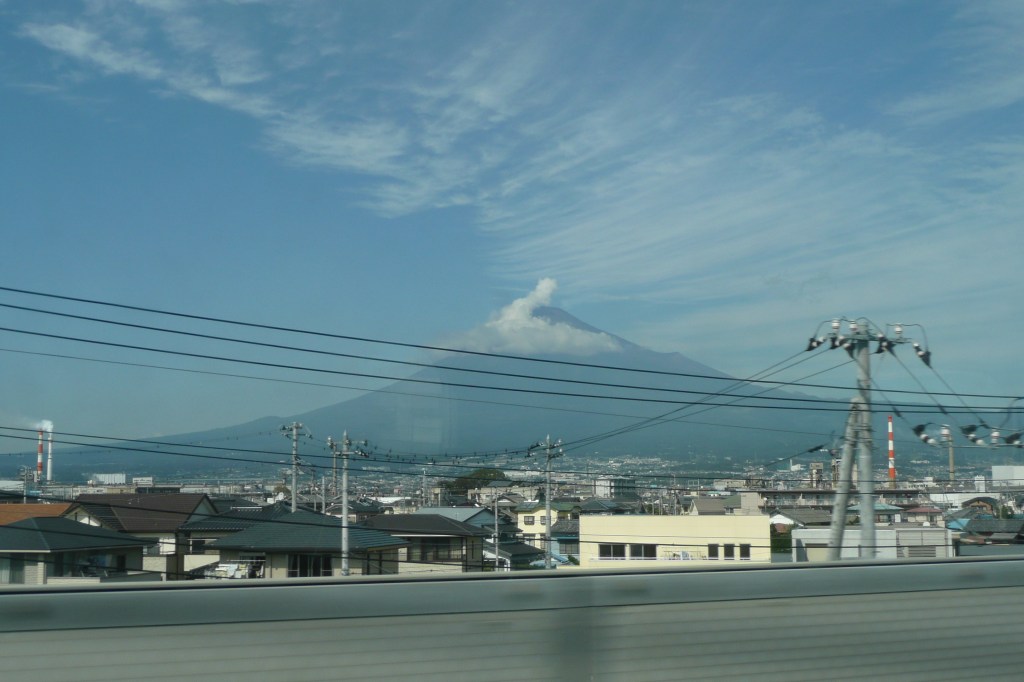
Which left Tokyo. A short train trip took me back to Kyoto and a connection with the Shinkansen line. For the second time, I was hurtled at high speed through the Japanese countryside, on a packed train with tiny windows that created the feeling of being on an earthbound airplane. For the first time, I got a view of Mount Fuji, even if it was more limited than any that Hokusai might have enjoyed. I’d get another few before leaving, but I was short the extra day that I would have needed for a day trip from Tokyo to visit.

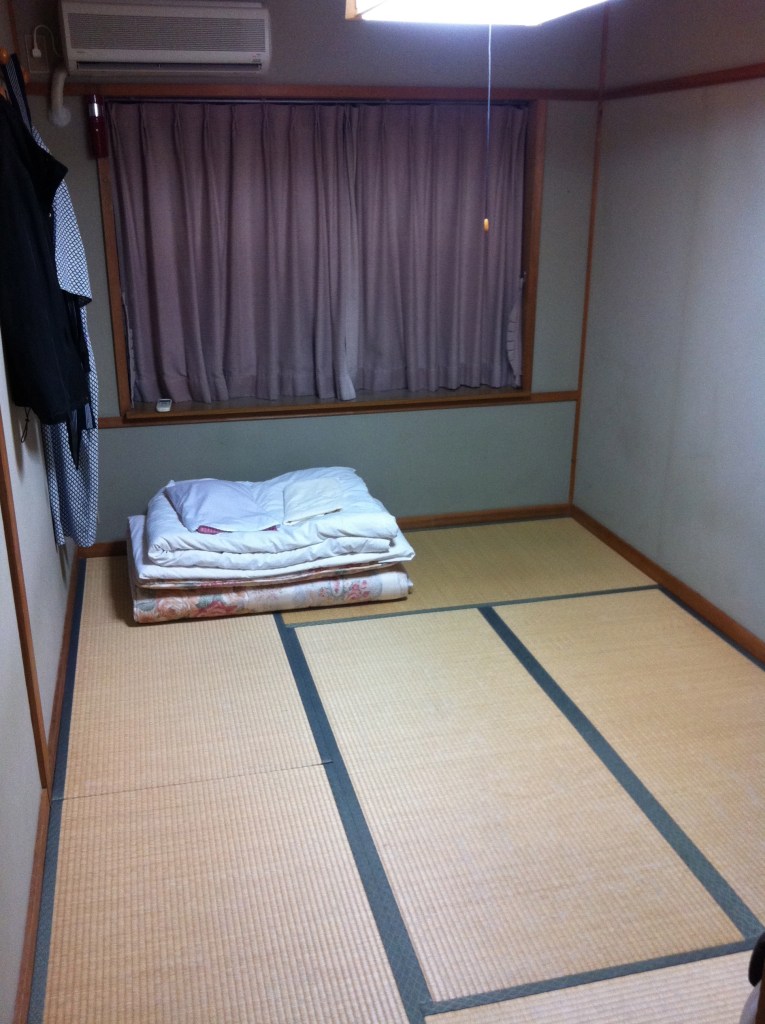
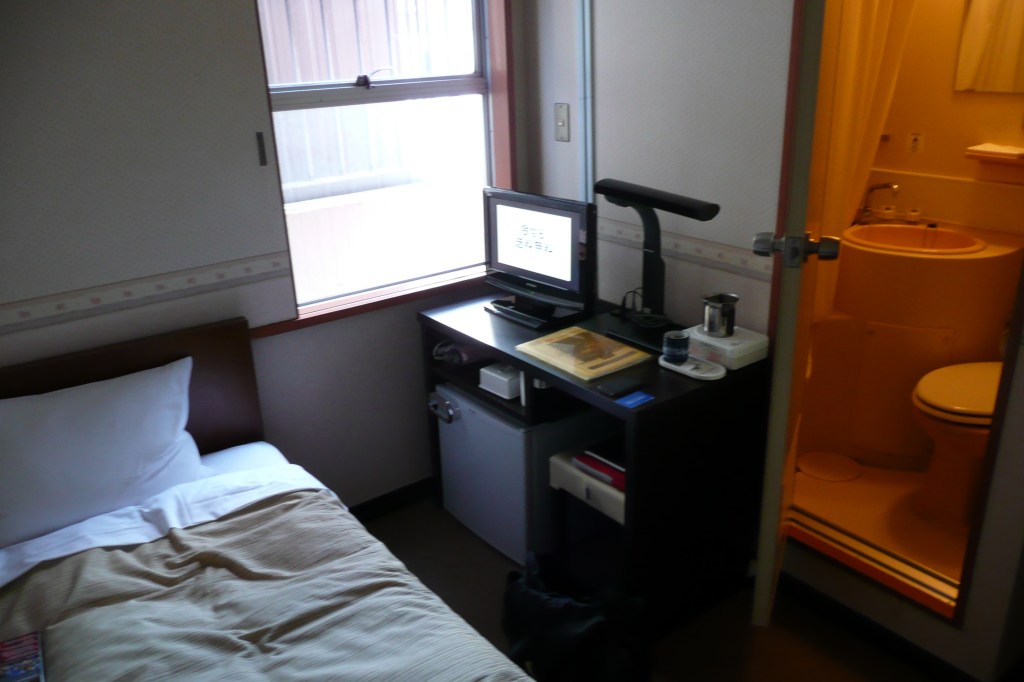
I’d actually managed to book my accommodation in advance this time, and while I’d considered going for a capsule hotel in pursuit of the true Japan experience, I ended up in a room that wasn’t much bigger and was definitely made for someone much shorter than a six-foot-plus Irishman.

A Tokyo hotel room in its entirety.

The great advantage of this hotel though was its location. I was just a short walk away from Ueno train station, which meant I was right beside the museum district and just a short stroll north of the famous Akihabara district. Despite being one of the world’s genuine megalopolises, Tokyo’s public transport system is amazingly efficient, so picking the perfect location for your hotel isn’t the most important thing, but it worked for me given my love of walking whenever I can.

Talking about the next few days could end up as a long and mostly boring travel itinerary. Not only would that not work for my hypothetical reader, but it would also entail a lot of work for me in terms of checking exactly what I did. And that’s against the spirit of these reminiscences, which are mostly about what I remember and how I felt at the time. And what I felt about Tokyo is that Kyoto had been practice, Nara a short rest, and Tokyo the real deal.

Cloud-wrapped Fuji from the Shinkansen.

To be clear, Kyoto was and is my favourite, but I’d budgeted the largest portion of the trip for Tokyo, spent most of my days there on my feet from early morning until after midnight, and racked up multiple experiences that have stayed with me through the years, and I still don’t think that I more than scratched the surface of this incredible city. It’s too much, no matter where you look, but it’s accessible for all that, and it’s only slightly behind Kyoto on my list of places to revisit.

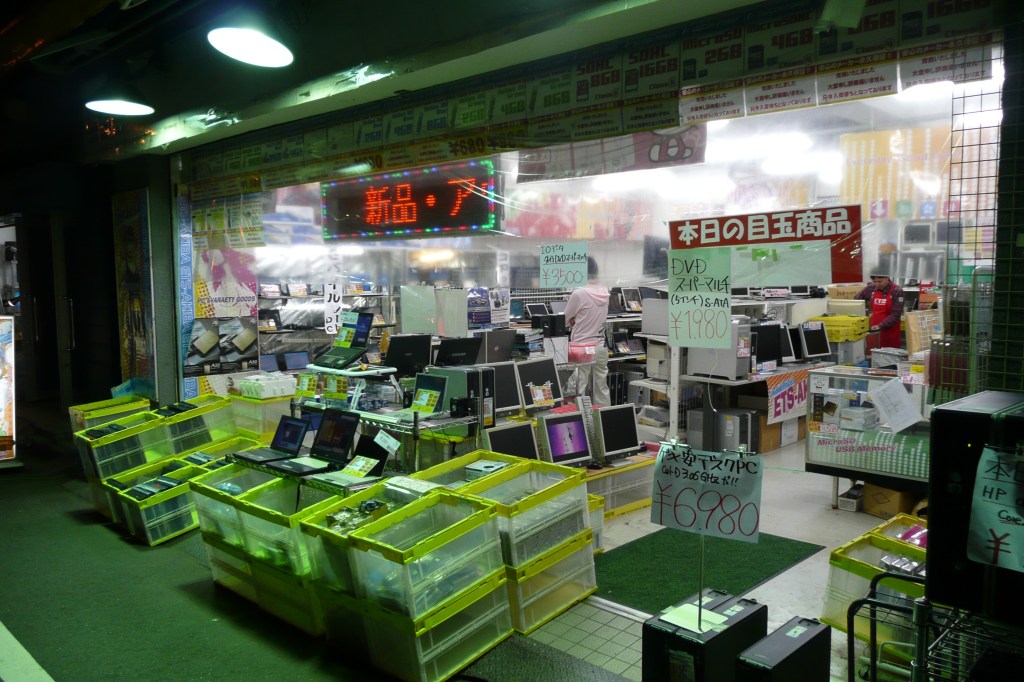
Perhaps the best way to discuss Tokyo is to talk about its districts. I’ve already mentioned neon-drenched Akihabara, with its array of electronics and games stores and its maid cafes, but it’s just a tiny little sliver of the city as a whole. Closer to where I was staying, there was Ueno Onshi Park, where some of the country’s best museums offer an insight into how Japan came to be and how it sees itself.

An Akihabara store, open to all with electronic needs.

Efforts to view the Tsukiji Fish Market took me through the high-class Ginza district, though the market itself proved to be closed. Nearby were the peaceful Hama-rikyu Gardens though, and I passed a pleasant hour in a tea house looking over still waters and calming greenery. A few days later, I’d take a boat across the bay to the Odaiba Seaside Park, with its Ferris wheel, Hello Kitty store, and Toyota museum. From a glance at a map, a lot has happened to that area in the past ten years, but one of my favourite experiences proved to be walking back across the bay, on the walkway of the Rainbow Bridge.

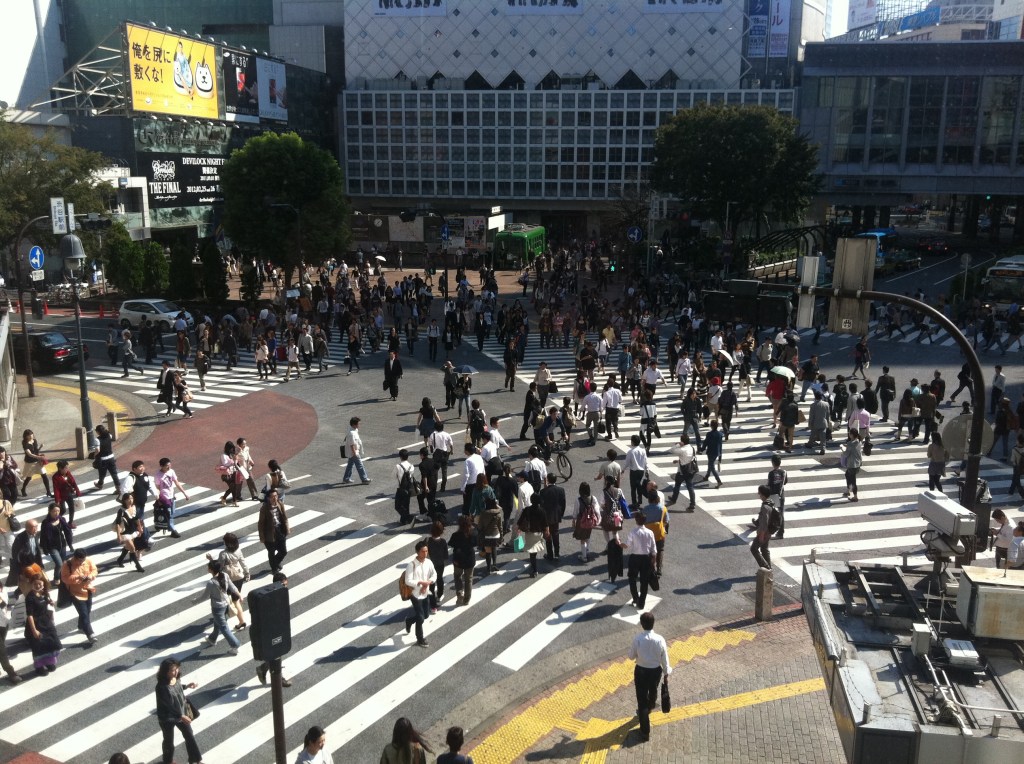
Ignoring for the most part the imperial palace that lies at the heart of the city (as I tended to use it as a shortcut across Tokyo), we hop to the west and come to the districts of Shibuya, Harajuku, and Shinjuku. Shibuya is best known for the famous Shibuya Crossing square, which I viewed from a McDonalds after having a long and tiring walk from one side of the city to the other.

Shibuya Crossing, in its natural element—crowded.

Lest it be thought that I’m a complete savage, I did take the opportunity of a visit to Harajuku to try out some top class sushi and break my long-time dislike of that food before going for a ramble around the Yoyogi Park next door, with its massive Meiji Shrine still heavily trafficked by both Japanese and tourists.

Yoyogi sits on the doorstep of Shinjuku, which is almost a city within a city in Tokyo. Rail lines converge here and buildings reach for the sky. In particular, the massive bulk of the Tokyo Metropolitan Government Office, offers a view not only over Tokyo itself, but all the way to Fuji in the distant west. It was a bit too hazy to enjoy that view when I made my way up there, thereby fulfilling my habit of climbing to the top of the tallest viewing point in every city, but the view was good enough for me to return at night and take in the glittering view of Tokyo in the dark.

Tokyo from above at night.

Tokyo in the dark needs a mention all on its own. Back in Moscow I’d felt uncomfortable and out of place when the sun went down. In Tokyo, I felt free to explore in a city that felt safe and was more than welcome to keep running on a 24-hour basis. It probably helped that I didn’t drink much, though I did find my way into a hostess bar for an hour or so that thankfully ended when I ran out of the small amount of money I was carrying on me.

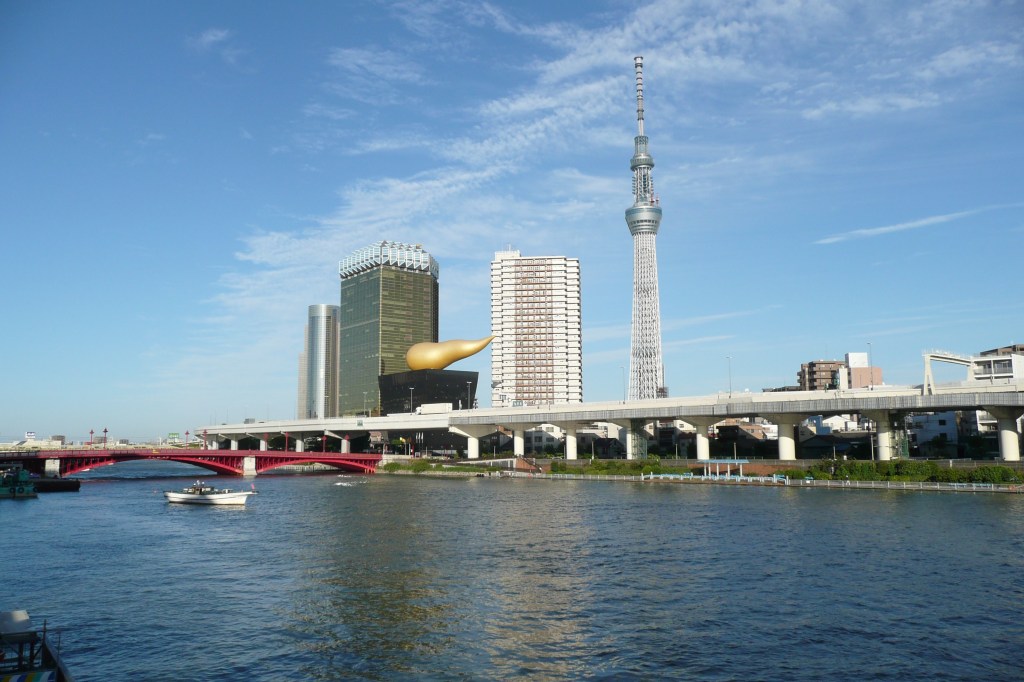
Tokyo never stopped welcoming me or showing me new things over the days that I spent there. And I never ventured too far beyond the loop line that connects all the districts that I’ve talked about above. So there’s doubtless far more to be seen and experienced. I haven’t even talked about streetside noodle bars, hidden shrines, or the odd architecture of the Asahi Beer Hall.

Asahi Beer Hall. Odd.

However, time runs out, especially when you’ve only assigned yourself a small amount. Eventually I summoned my bags, closed the door on my tiny hotel room, and jumped on a train to Narita airport. There I had one last new experience in Japan: a delay. It was handsomely compensated for with a dinner voucher, and before too long I was decanted onto one of Airbus’s great white whales of the sky, an A380. I had a long flight to look forward to, my first since landing in London, and an entirely new country and continent to cross.

Cancer Update

I said that I’d only provide these when I had news to impart, didn’t I? Well, there’s some news. The most recent of my regular scans spotted something untoward in my left lung, and a subsequent PET scan (one of those that leaves me too radioactive to be in the company of small children and pregnant women) determined that it was something that needed treating. So I’ve been referred to radiology for the purposes of thoroughly zapping said something via a tube poked into the host lung. All being well, it’s been spotted early enough to deal with it without too much trouble. I’ve done well out of treatment so far and hopefully that will continue.

The Grand Tour Ten Years On—Kyoto Nights

I spent a week in Japan in 2011. As I was told at the time, it wasn’t long enough. It’s also the only time that I’ve spent in Japan to date, despite my desire and plans to return (blame an eclipse for that). In my defence, I was planning the trip on the run, aware that I was eventually going to run into funding and timing issues. So I figured that spending a week crossing the centre of Japan from west to east would do for a taster.

It wasn’t enough, as the desire to return should make clear. But it was an experience that was endlessly entrancing. For the seven days that I was there, the moments of rest that I had saw me soaking in a culture entirely unfamiliar to me, and the time I spent wandering until my feet ached felt as refreshing as a soak in a deep Japanese bath.

A birthday view of sunrise over Japan.

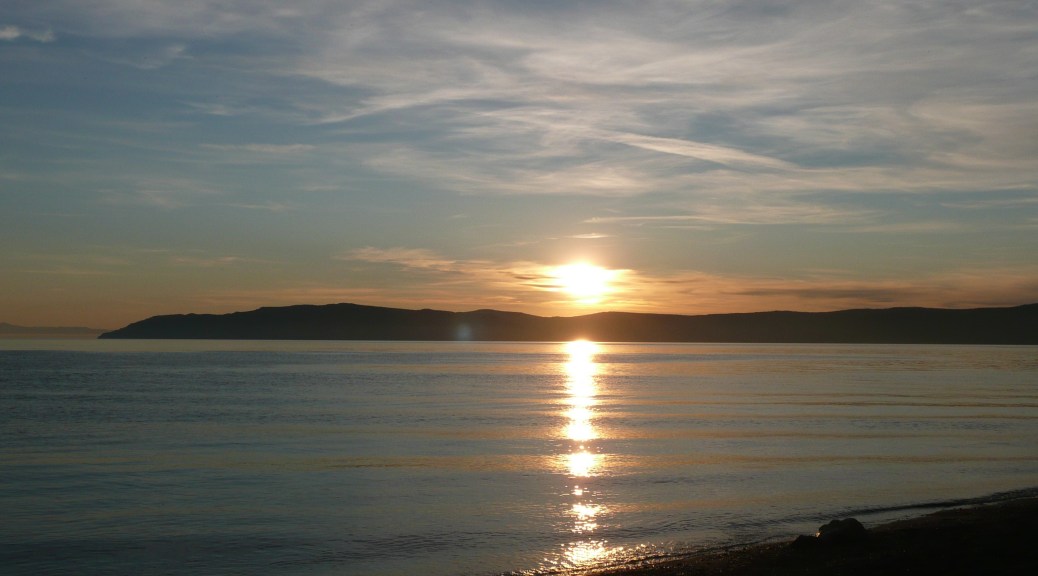
The Japan section of the trip was dreamlike from the start. I woke up on my birthday and, along with those of the travelling group still on board ship, went up above decks to watch the sunrise. As presents go, the perfect sunrise over the Land of the Rising Sun was a close to perfect as you could ask for. I felt frazzled and exhausted after about a month of travelling, but from that moment I hit a groove that would last most of the rest of the trip.

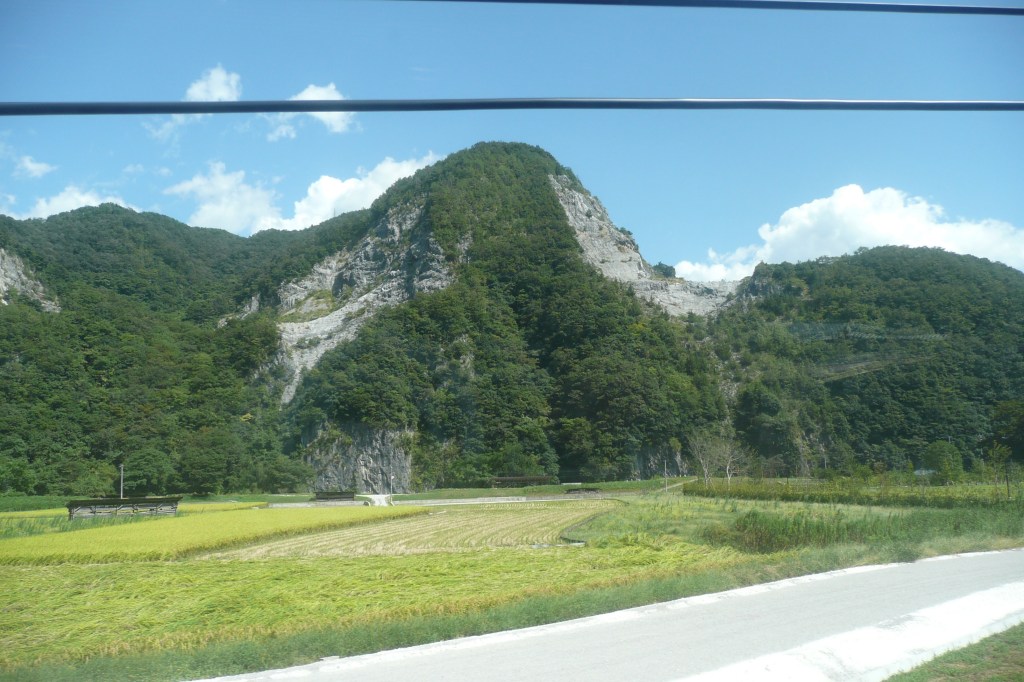
Landfall was accomplished at Sakaiminato, a small port town set amid gorgeous forests hills, and farewells were said by the few of us who’d shared the past few days on board. As with much of my travels of the previous few weeks, my communication abilities were restricted to saying thank you and please, but that proved enough (along with my multiple ticket and booking printouts) to get me on a train through landscape of fairytale beauty, until I got arrived at a Shinkansen station to take me the rest of the way.

The view from the slow train from Sakaiminato.

There was a bit of a hiccup with regard to ticket prices (my Japan rail card didn’t cover the fastest versions of the Shinkansen bullet trains) but that was quickly smoothed over and I was set on my way at speeds that sent my dodgy camera equipment into a tailspin. Everything looked slanted in the pictures, and while the ride was perfectly smooth, I felt like I ought to be leaning into the speed.

Time dilation effects aside, I’d arrived in Sakaiminato early in the morning, and it was no later than lunchtime when I got off the Shinkansen in Kyoto. The gaps in my forward planning got the better of me again, as the hotel I’d planned to stay in was booked up, but a helpful tourist advice staffer set me up in a nearby ryokan, just south of Kyoto’s city centre and just across the river from the temple district.

Ryokan living. Not pictured—the deep soaking bath in the next room, which I grew to love.

As an introduction to traditional(ish) Japanese hostelry, this turned out better than I could have hoped. Drop the shoes at the door, shuffle into a pair of slippers, shower yourself clean and soak in the deep bath for an hour or so, then sit on the tatami mat in your kimono and watch sumo. That works, doesn’t it?

Once settled, I went a-wandering, getting my first look at the hillside full of temples that sits to the east of the city, as well as the Tokyo-lite neon wonderland of the city centre. If there’s a reason to recommend Kyoto over the other cities I visited, it’s this: you get both sides of Japan living cheek by jowl. There are temples and palaces aplenty, but the city stays alive deep into the night, with pockets of fun to be found if you’re willing to look.

First meal in Japan: herring noodles and my namesake beer.

This hungry traveller fed himself at a Lonely Planet-recommended traditional restaurant that was mostly empty when I ventured in. For the first night at least, I was very much out-of-sync with local sleep-wake scheduling. Fed and beered, I wandered a little more, but my steps spiralled in on my ryokan, where my futon bed and tatami mats awaited me, to be followed by a brief period of unconsciousness, and then followed by an even more welcome breakfast of thick-cut toast and orange juice.

If Kyoto and Japan had been welcoming to the confused traveller the day before, they were now about to entrance me completely. I set out to wander the temples of the city and the hillsides that they sat on, and I proceeded to do so for until sunset caught me with aching feet, far from home. I experienced temples, palaces, and spider webs stretched across entire paths. Bamboo groves and overgrown canals. I got a haircut despite the language barrier, and I sampled many different flavours of ice cream. I fell entirely under Kyoto’s spell, as I suspect many have before me.

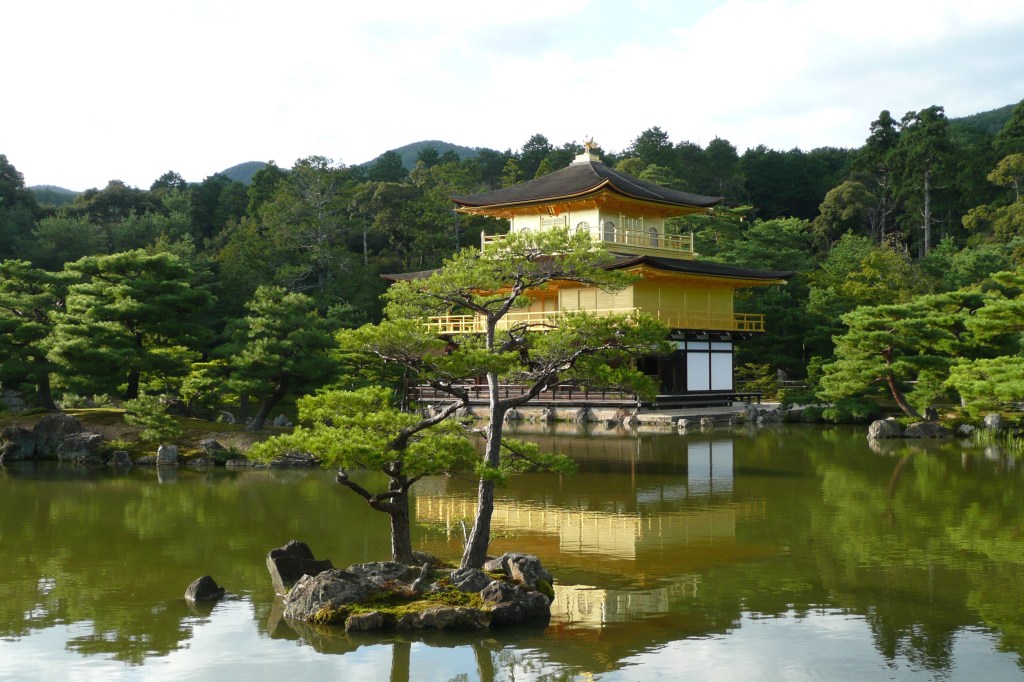
The Kinkaku-Ji golden temple, where my day of wandering came to an end.

While my body was refreshed by a soak in the bath on returning to the ryokan, my mind was still fizzing with new experiences, and I ventured out again for a beer in one of the pubs I’d spotted during my earlier explorations. This kicked off several more hours of adventures, as I fell in with a Tokyo-based musician from Louisiana and his local friend, who brought me to a tiny rock bar, around a quarter of the volume of which was taken up with speakers, which proceeded to play Irish music for the rest of the evening as soon as they learned where I was from.

The next day wasn’t quite so Kyoto based. I headed south on a slow train to Uji, site of the Tale of Genji museum. Based around a classic of Japanese literature, this was perfect for a day trip and a dive into the history of Japan, which I’d mostly neglected in favour of immediate experience while in Kyoto. Again, I enjoyed simply roaming this place on the fringes of the greater Kyoto urban area, getting a feel for Japan (and a taste for yet more flavours of ice cream).

Green Tea ice cream. Well worth giving a go.

I couldn’t stay too long though. I’d stuffed my bags into a locker at the train station, for I had plans to continue further south along the line, this time to another ancient capital of Japan, Nara. But that can wait until the next post.

My introduction to Japan had been dreamlike and unceasing, and in Nara I would get a chance to slow the pace a bit and adjust properly. But I had no complaints about my few days in Kyoto. The people had been wonderful, the culture a constant delight, the food and drink next to perfect, and every step brought me something new. I’d already made my first plans to return, and I mean to stick to them.

The Grand Tour Ten Years On—Eastern Shores

In European myth and storytelling, the western ocean is romanticised. Whether it’s Atlantis or Tir na nOg, or Tolkien’s Valinor, there’s a feeling of something of worth to be attained in the uttermost west. A few years before the Grand Tour, I’d visited California for a wedding and watched the sun set over the Pacific from the San Diego waterfront. For me, that moment was my furthest west. It could hardly be a surprise that my exploration reoriented itself afterwards.

When the time came to plan the Grand Tour, I had a choice. Take the Trans-Mongolian into China, like most travellers do, or take the traditional route past China to Russia’s eastern entrepôt, Vladivostok. Deciding that China was best kept for a more focused trip (because there would always be time, wouldn’t there?) and that I could hardly resist the opportunity to travel to Vladivostok when it presented itself, I went for the latter option.

All Siberia, all of the time.

First though, there was the small matter of actually getting to Vladivostok. My journey across Russia from Moscow to Irkutsk had been just the first half of my Trans-Siberian experience, and now I had four days from Ulan-Ude to Vladivostok to look forward to. For company on the train, I was sharing my cabin with two Russian women and one of their sons. Luckily for the sake of my fast-atrophying social glands, they had a smattering of English and a willingness to teach the strange Irishman some Russian card games.

So that was how the next four days went. Getting taught card games, questioned about what I was doing in Russia, and interrogated about why I, a man in my mid-30s, wasn’t yet married with kids. Staring out of the window at landscapes to which dissidents had been exiled in all-too-recent times, and roaming the carriages of the train and feeling like that ghost of the iron rails again. (Approach the restaurant with as much caution as the bathroom facilities on these trains.)

On a four day trip, what else are you going to look at?

Even more so than the first half of the Trans-Siberian journey, this part felt like a venture into unknown spaces. Russian East Asia backs onto the furthest edges of the Russian realm, reaching all the way to the Bering and Arctic Seas. The first signs of oncoming winter were visible in patches, but I was surfing the line of its arrival and passed north of China and on towards Vladivostok before any great change came over the land.

So to the eastern city then. The Trans-Siberian reached its terminus in the early morning of September 19th (I think. The dodgy clocks on my phone and camera and the effects of time zone shifting make timing awkward.) and I said my farewells to my fellow travellers in the darkness of the train platform. I was wildly early to check in at my hotel, so once again I hefted my bags and found a coffee shop to lurk in until dawn.

Vladivostok Rail Station in the early hours.

The exploring itch was hard to ignore, but first I needed to shuck my burden. When I could, I headed for the hotel and once again ran into a wall of Russian bureaucracy and had to explain that, yes, everything had been booked long ago. Eventually alternating between sitting around waiting and standing at the desk pointing at my printouts proved an effective strategy and I was accepted as a guest. While I couldn’t set up in my room, I could at least leave my bags behind and go a-roaming.

I had three days, more or less, in the city. I won’t take you through every step of the way, but it was a dreamlike experience to be so far from home and surrounded by so much that was familiar and so much that was a reminder of that distance. Like San Francisco, Vladivostok is a port city, built on hills by the sea, and like San Diego it’s also a naval base, with a massive Russian navy presence.

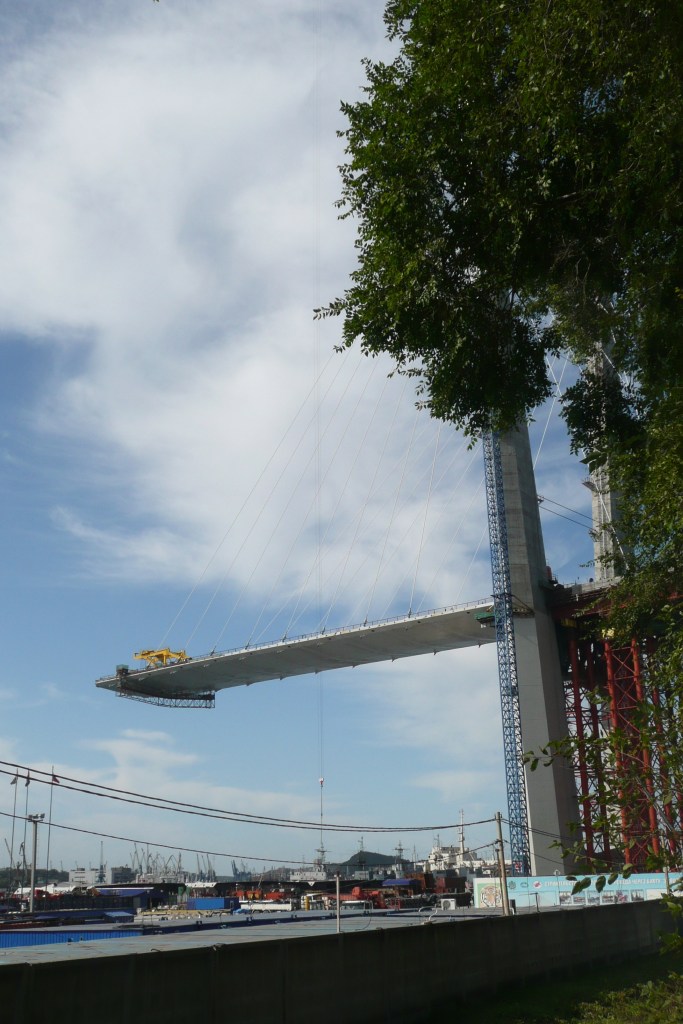
A bridge, unfinished, yesterday. Well, ten years ago, actually.

The massive bulk of the half-completed Zolotoy Bridge became my constant companion, looming over the city as it stretched across the Golden Horn Bay. (Another familiar name from a previous trip.) I climbed the hills to watch the sun go down and rise, I ate dinner in a rooftop restaurant for Russia’s rich, and I roamed around the crumbling wharves where fishermen waited patiently at their rods.

Like Ulanbaatar, Vladivostok’s pavements veered between pristine and piecemeal, depending on where in the city you ventured, and I had to watch my step. Still, I spent happy hours crossing the city while listening to the Kermode and Mayo podcast, peering into tiny tanks in a hidden garden and taking a tour through a beached submarine where I somehow managed to avoid banging my head off the low-hanging ironmongery.

Have a submarine, streamlined for your pleasure.

As much as I tried to connect into the city’s social life though, I didn’t manage it in Vladivostok. It’s not something I was good at, either then or now, but the city itself has a weird melting pot quality. The European side of Russia exists in full force here, as an outpost of the empire that was, but it’s layered with Chinese, Korean, Japanese, and even American flavours. Vladivostok is a city well worth the visiting, but it’s not likely to offer you any easy answers.

On my last day in the city, I roamed in the morning and did a bit of shopping, picking up a proper Russian fur hat from a military surplus store (which would mostly serve as a store for my growing collection of fridge magnets over the rest of the trip). I’d located the ship that was to take me onwards the day before, and it was no great problem to get on board and find my berth.

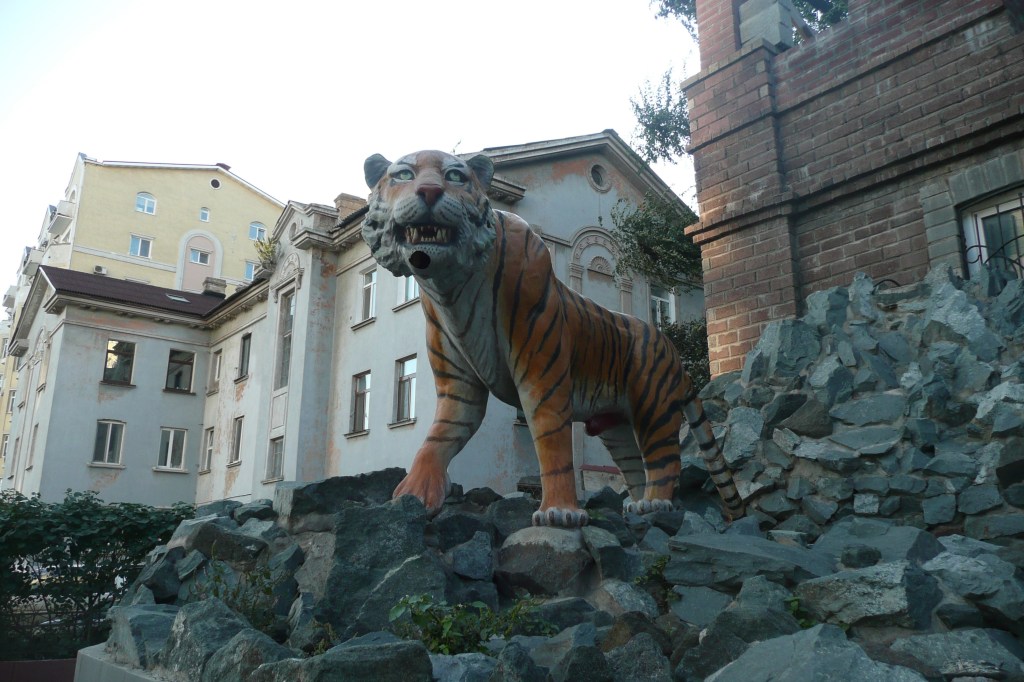
Vladivostok’s famously well-endowed tiger.

The actual experience of being on the ship was the first time I’d been around other traveller since leaving the Australians in Vladivostok. Our sleeping quarters were bunks in shared dorms (segregated by male and female) so most of the time we just wandered the decks. Most travellers were Korean and Chinese, but there was a core of people like me, who were in Vladivostok as part of longer journeys and now set to move on.

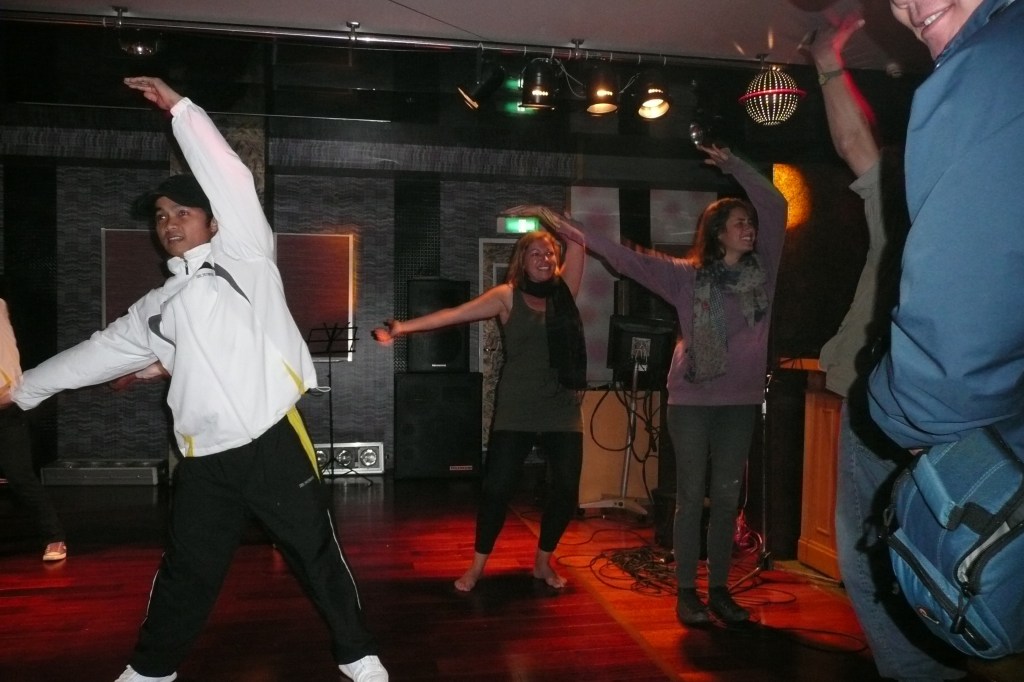
We formed a temporary social circle, one I was very glad of, and we chilled out, chatted, and partied as the evening drew on and the sun and land both disappeared in the west. It was a release for me, awkwardness mostly forgotten as I tried to restart those social skills enough to get through the experience.

Party time on the boat.

The next day, we were due to pull in at Donghae on Korea’s eastern coast. The Eastern Princess plied a triangular route between Russia, Korea, and Japan, and this was the intermediate stop between when I got on and when I got off. Eager to add an extra country to my journey, I joined a few of the other travellers in braving Korean customs and catching a bus to the city centre. One quick trawl of the markets later, we returned to the ship laden down with fresh food, just in time to cast off.

We’d lost a few of the travellers to Korean adventures, including a couple of Austrian motor bikers, so it was a smaller group who partied that night. I even tried out the boat’s Japanese-style pool, but the dregs of a typhoon raised some heavy waves, resulting in an excess of sloshing. The bathers were ejected from the pool and returned to a ship that was still rocking and rolling.

Saying farewell to the Austrians in Korea.

I’ll leave it there for now. That was the evening of the 22nd, and it’s the evening of the 22nd now too. Russia had been left behind and Korean become another stop along the way. The Grand Tour felt like it had a momentum of its own now, and I was happy to just enjoy it, but Japan was waiting under the rising sun, and I had yet to understand just how much I was going to enjoy the next week.

The Grand Tour Ten Years On—Khan of Khans

My idea to turn getting laid off from work into a round-the-world trip might have seemed a bit odd, but I didn’t actually get called crazy and have my life choices questioned until I was on the train to Ulanbaatar.

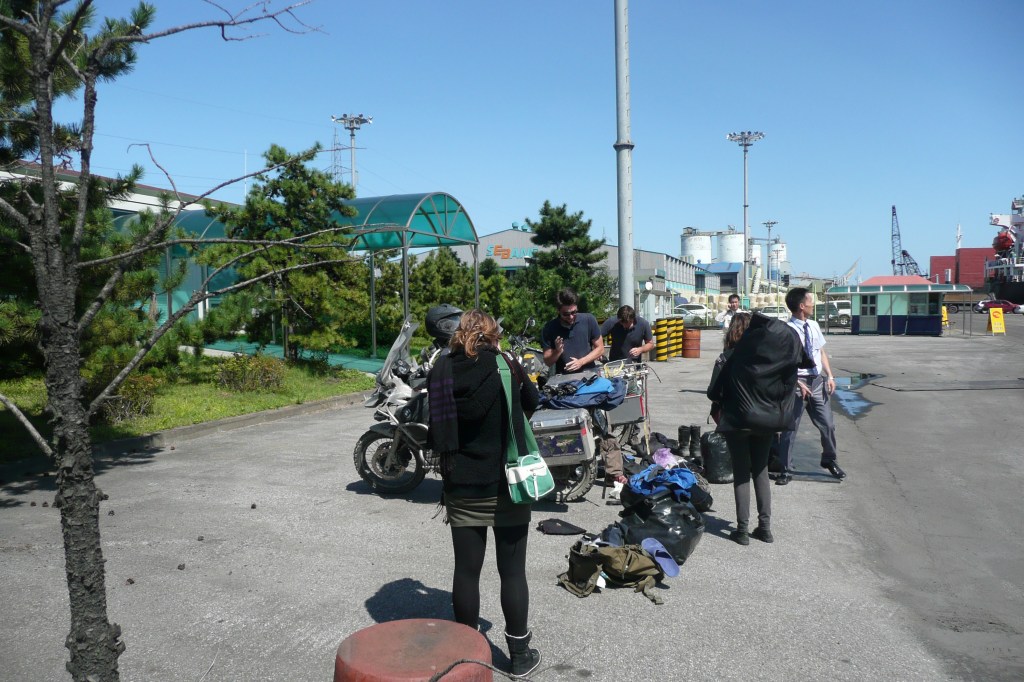
To be specific, I was sharing a four-person berth on the Trans-Mongolian train from Irkutsk to Ulanbaatar, along with two Icelandic fellow travellers and a Russian tour guide. Being that they were doing the same thing as I was (as were the rowdy crowd of mostly Spanish travellers whom the tour guide was shepherding), that in itself wasn’t a problem for them. No, what bothered them was the fact that I was crossing the Russian-Mongolian border twice.

My Icelandic fellow travellers, whose contact details I sadly lost, somewhere on the Russian-Mongolian frontier.

Why was this a silly, nay crazy thing to do? Because not only does the bureaucracy of post-Soviet states result in a multi-hour, passport-less ordeal of tedium in a settlement that’s essentially a neglected border town from a forgotten era, but the fact that Russia and Mongolia use different rail gauges means that the entire train has to be taken and, carriage by carriage, lifted from one set of bogies to another (look it up). During this, all you can do is to roam around the content-deprived wasteland and hope to god that you’ve remembered to bring a decent book.

And I, knowing none of this, had volunteered to do it twice. Because my visit to Mongolia was a two-day add-on for my Trans-Siberian experience, and I would be returning to Russia when I was done. All of this only occurred to me when I was counting the minutes and seconds in an empty and little-used waiting room, and while I didn’t regret my choice, I could only hope that the company for the return trip would be as good. As it turned out…

Much of the Trans-Siberian is single rail. Have I mentioned that?

But that’s getting ahead of myself. After the sun went down and our passports were returned (and I bought a bag of “Khaan” chips to sample the local fare) we boarded the train again and slept through the night until we were dropped off at Ulanbaatar railway station. Farewells were said, though temporarily in the case of the Icelanders, who I’d run into again before leaving, and I was collected by my own personal tour guide. It turns out that travelling solo on an eclectic schedule in the off-season gets you a little bit of attention.

Cue a drive in a sensibly priced, medium-sized sedan out of the city and past the outlying tent suburbs, into the first taste of the Mongolian steppe. From here, world-conquering armies once arose. Somewhere in the vicinity anyway, even if the sole remaining sign of them was the Chinggis Khan Country Club golf course. What I was being brought to was a tourist tent camp for that authentic, ersatz Mongolian experience.

Your author at his rest beside the wood-burning stove in a Mongolian ger.

Try not to judge me too harshly. I’d booked the entire trip quickly and was relying on Trailfinders to get me from A (St. Petersburg) to B (Vladivostok) with a stop in C (Ulanbaatar) along the way. They did a good job, and while I might do things differently now, I was excited then and remain excited now to actually have been in Mongolia.

My tour guide did her absolute best to guide the clueless, oversized Irishman around a range of traditional Mongolian activities. A little bit of archery, some pony trekking on a steed who was far more in control than I was, and a bit of clambering over the famous Turtle Rock. Even getting dressed in traditional garb and sampling some traditional tea and curds. My first and only night in the tent camp ended with some knuckle bones in the company of some Norwegian tourists who were the only others in the mostly deserted resort that night.

Mongolian knucklebones with genuine Mongolian sheep knuckles.

The highlight of my stay though, and indeed one of the highlights of the trip, came the next morning. Looming over the camp was a decent sized rocky hill, and I decided I wanted to greet the dawn from its summit. The night before had been one of the most startlingly clear I’d ever known, with a blazing full moon, and I scrambled up the slope in the pre-dawn, dodging marmot burrows and their ankle-threatening depths in time to see that same moon descending towards the horizon, even as the sun rose on the other side of the sky.

Not to descend too far into a mysticism I don’t pretend to indulge in, but as I sat there on the hill, I could see a lone rider cutting a path across the heart of a broad valley. I could feel for a moment distant from the modernity that had brought me here. And I could feel, for a moment, a strange kind of balance in the world, with me sitting at the fulcrum point. No wonder the heart of Asia has given rise to so many empires when it inspires such thoughts.

Golden Eagle and Black Vulture by the roadside.

I had a few hours more in the camp, but before too long breakfast was done and I was on my way into the capital once more. We paused for a moment or two to say hi to a kid with a few hunting birds perched on roadside stakes, but before too long I’d been dropped off at my hotel for the second half of my Mongolian visit.

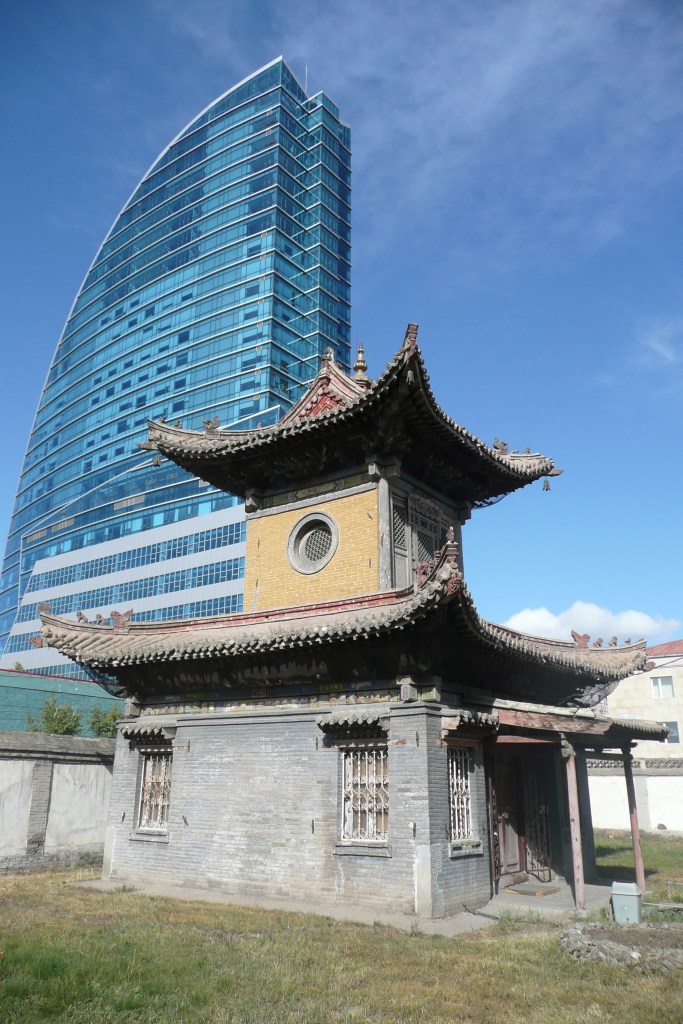
The important thing to know about Ulanbaatar is that it has layers. The age of the Mongol Empire may be restricted to the museum and celebratory statues in the public square, but there are the famous dinosaurs of the Gobi Desert there too, as well as Buddhist temples and palaces from the days of the Bogd Khan, the last independent ruler before communism. Then too there are Soviet era trains rusting in a neglected railway museum, and tall glass skyscrapers overshadowing tiny shrines.

Skyscraper and shrine, living together in harmony.

It’s a fascinating city that was in the throes of rapid change when I visited, and I felt more comfortable roaming it than any city I had since Stockholm. Even if the occasional absence of pavements to walk on was a problem, I still managed to fill every hour going and wear down my shoes a little more. What Mongolian cuisine there was on offer, I sampled, but it was mostly my eyes and ears drinking things in.

Looking back, it feels like it was in Ulanbaatar where I finally clicked into travel mode properly. The initial concerns of dealing with Russian bureaucracy in St. Petersburg and Moscow faded away, and I was able to just enjoy new experiences. As with Japan later, I regretted not having more time to spend in Mongolia, but I didn’t regret a single second of the time I did spend there.

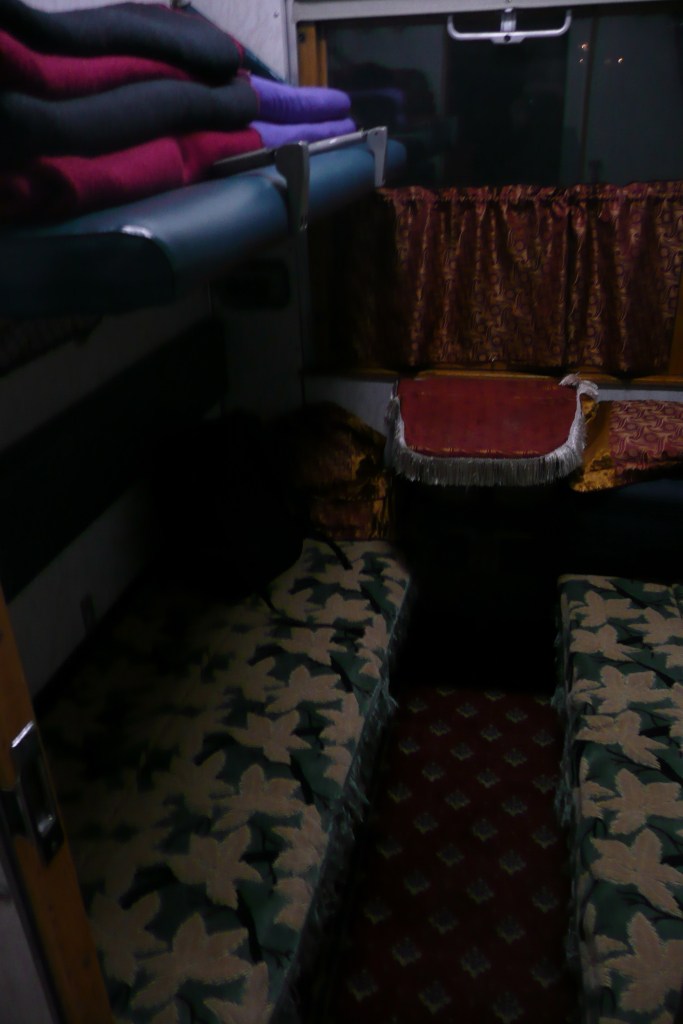
A four-person berth on the Trans-Mongolian.

Eventually the time did run out, and I had to get to the train station. For the return trip across the border, I didn’t have any fellow tourists to travel with. Instead, I was bunking with a few members of the Mongolian security forces, travelling to Russia for training. They didn’t have more than a word or two of English, so there wasn’t much conversation, and after sleeping and living through the return trip across the border (this time without any distractions at all, so I got plenty of writing done, I got into Ulan Ude towards the end of the day.

Ulan Ude sits on the eastern side of Lake Baikal. If Irkutsk is where European Russia meets its ultimate limit, then Ulan Ude is where Asian Russia truly begins. The city felt more Mongolian than Russian, even with its famously massive head of Lenin dominating the town square. I was lucky enough to be hosted by the family of a famous writer for my one night there, but roaming the city while waiting for my train onwards only emphasised the feeling of being in a truly distant land that I felt.

A really big head of Lenin. Really big.

So distant from home was Ulan Ude that the local Irish pub (for there is always an Irish pub, no matter where you go) is known only as “The Irish Pub.” No other identifier would be useful. The local museums and art galleries are well worth roaming, but even more worthwhile is just taking the time to admire the traditional wooden architecture that remains in the post-Soviet era. Much of it might be decaying, but it’s a taste of the Siberia that was, before the Russia swallowed but never digested it.

For it was Siberia that awaited me now. This last part of my train trip would take me across four days of Siberian wilderness, around the northward spreading bulk of China and from there to Vladivostok. From the very heart of Asia, the Pacific was calling, and the iron rails were ready to take me there.

The Grand Tour Ten Years On—The Lake in the Middle of the World

Four days on the train. Four days when nothing much changes except the world around you. A constant stream of changes, gently but insistently carrying you into a new world. Punctuated only by the occasional train station, offering you a chance to test your Cyrillic comprehension and sometimes even a chance to stretch your legs further than the length of a railroad car.

If I had my time again, I would probably arrange a few more stops along the way. The cities of Russia slipped by and looking back at the photos I took then, I can’t recognise any of them. Storied Novgorod was on the other Trans Siberian line, and while Omsk was on mine, it was just a brief stop among many, where people more sensible than I disembarked.

Omsk railway station, glimpsed only briefly.

There isn’t another rail line like the Trans Siberian. Or rather there is, but it’s the Trans-Siberian’s sister line, the Trans Mongolian, which runs from Moscow to Beijing instead of Vladivostok. This first stage of my journey was the part of the line shared between the two, a four day run from Moscow to Irkutsk. There’s a northern and a southern branch for part of it, but I can’t imagine there’s much difference between the two.

For those travelling long-distance on the Trans Siberian, most of whom are Russian, not tourists, it can be a hypnotic experience. The rhythm of life on the rails infuses everything, from the moment-to-moment rattle of the rails themselves, to the sunrise and sunset schedule of sleep, to the gradual shifting of the immense landscape of Russia, carrying you imperceptibly from fields to mountains to plains that all seem to stretch on forever.

One of many water (signal?) towers on the Trans-Siberian railway.

For four days I shared a four-person cabin with a rotating cast of Russians. Or rather myself and an elderly Russian couple shared the cabin with multiple guest stars. I did my best to communicate when I wasn’t scribbling in my notebook or staring at the landscape as it passed by, but I wasn’t wholly successful. The one fact I did manage to convince them of was that strange Irish tourists couldn’t feed themselves. I’ve no idea how my diet of snack bars, bottled water, and black tea from the carriage samovar could have given them that idea, but they pressed a share of their own food on me whenever they thought I looked hungry.

It was probably standard Catholic guilt over not being able to repay this kindness, along with a breed of recklessness that comes from being train-bound for four days, that led me to supplement my diet with a strange meat and pastry combination from a vendor’s stall on one of the platforms the train stopped at. For the standard Trans-Siberian traveller with guts of iron, this would be a straightforward choice. For me it was to cause significant gastro-intestinal distress over the next few days.

The Trans Siberian is a living experience, a long way from here-to-there travel.

Eventually though, Irkutsk approached. I said my farewells to my long-time companions when they disembarked a few stops before the city. For myself, I lasted around an hour longer before being deposited on the platform of Irkutsk’s main station. I had no time to look around though, as everything had been booked and arranged months before. Myself and a few other travellers were bundled into a jeep and driven along the short and well-paved road to Listvyanka, on the shores of Lake Baikal.

If the Trans Siberian can feel like it crosses half the world, then Baikal feels like the lake at the centre of the world. In the very heart of Asia, there’s much about it that could be dropped into a fantasy novel and not feel out of place. Unfathomably deep, its waters are cold and clear and freeze thick with ice when winter comes. It has its own species of seal and sturgeon, and while I saw neither, I saw sunset over the lake from Listvyanka and didn’t feel robbed.

Sunset over Lake Baikal, as seen from Listvyanka.

Listvyanka as a resort is very popular with Russia’s well-to-do set, but I’d arrived in the off season, so myself and a small group of Australians heading in the other direction on the Trans-Siberian felt like we had the place more or less to ourselves. Despite the ongoing trauma of my culinary adventures the previous day, I felt a deep peace while we were there, whether lazing in our chalet or roaming the shores of the lake itself.

No pause lasts forever, and no moment of ease can be luxuriated in too much, especially when the call of travel continues. But I did have one thing that I wanted to do before I left. On my last afternoon in Listvyanka, I donned my swimming trunks (mostly unused on the trip other than this) and baptised myself in the waters at the centre of the world. It was as cold and refreshing as I’d hoped and worth the trip thus far, even if the Russians on the shore were undoubtedly wondering who the crazy pale person was.

The author post-Baikal dip. Cold but very pleased with himself.

That was it as far as the blue skies and deep waters of Baikal went though. The next morning, the jeep returned to bring me back to Irkutsk, so I said my farewells to the Australians and boarded. My train wasn’t setting off until late in the evening, and the Irkutsk station was pretty unfriendly when it came to people hanging around in the lobby, so I had a day to myself to explore the city.

If St. Petersburg is an imperial city, and Moscow is the seat of power, then Irkutsk is an outpost. From this city, the vast Siberian wilderness had been explored and, if not tamed, at least brought within the compass of the Russian state. Here, the European soul of Russia reached its limits and came to a compromise with its greater Asian self. The museum of Siberian exploration is a must visit for anyone roaming Irkutsk, but there’s just as much to be seen across the city itself.

A photo of Russian explorers, as seen in the museum.

I wandered the shores of the massive Angara River and watched a judo exhibition in the sunlight (Putin was a fan, apparently). I saw another of those fairytale Russian weddings take place under blue skies, with a gilded crystal carriage straight out of Cinderella. I saw Russian Imperial architecture clash and meld with frontier Siberian wooden shacks. I saw statues and fountains of modern Russia sit incongruously amid it all. But at length I saw the sun go down and returned to the train station to wait.

For I was continuing not onwards but southwards. For the next few days at least, I was abandoning the Trans Siberian for the Trans Mongolian. A border crossing or two awaited me, and a nation of people feted across history as conquerors. It was Genghis I was going in search of, and as I settled into a new cabin, with two Icelandic travellers and a Russian tour guide for company, I had an inkling that the best was yet to come.