So. Ch-ch-changes…

Trinity Front Gate in the sunshine.
Trinity in the sunshine. Not all that common, sadly.

I’ve noted a tendency in myself to be overly mysterious in this blog. It’s the drama ham side of me, which doesn’t get many chances to emerge into the light. So when I said that I would talk a little about the things making my life busy lately, I did mean to. It’s just that I’ve been, well, busy.

About a month and a week ago, I returned to college for the first time in just over 14 years. The initial experience was somewhat akin to taking a point-blank blast in the face from the shotgun of knowledge. In a good way. Trinity’s MSc in Interactive Digital Media is nothing if not comprehensive. Over the course of one year, students are expected to absorb as many elements of media theory and production as their tiny minds can cope with. From the practicality of programming, web authoring or 3D modelling to the theoretical realms of cultural and critical theory or interactive narratives, it’s all covered here, and the result is a 9-to-5 (or more) immersion in all aspects of the modern media world.

At this early stage, I’m pleased to say that it’s been not only fascinating but even fun at times. I had a grounding in some fields from previous educational forays (cultural and critical theory, in particular) and from general interest and reading (game design and development, for example), and my liking for puzzling out solutions has helped me to scramble through the early weeks of courses where I was going in more or less blind (programming and 3D modelling). Of course, it helped that the rest of the students have proven to be not only impressively able but also a very friendly bunch.

Almost as interesting, at least to me, is how the course is structured. Each module stands alone, and even the individual strands within those modules are clearly delineated. Even so, there are names and references that crop up across strands, and it’s not hard to see that somewhere further down the line, all of this is going to start fitting together. Maybe not in time for our individual research papers (due early next year), but certainly in time for the group projects that take the place of our final dissertations.

If I may be allowed another metaphor (and I am, because metaphors are cool now), we’re in the “wax-on, wax-off” stage of the Karate Kid. Learning all the basic moves that we’ll string together into massively impressive multimedia projects somewhere further down the line. That’s my theory as to what the idea behind the course is anyway, and right at the moment I feel rather optimistic about getting there.

For now though, I have a reading week without classes and a long list of assignments to get back to. Which reminds me that I’ve probably spent way too long writing this…
October Book Reviews

20121103-090904.jpg
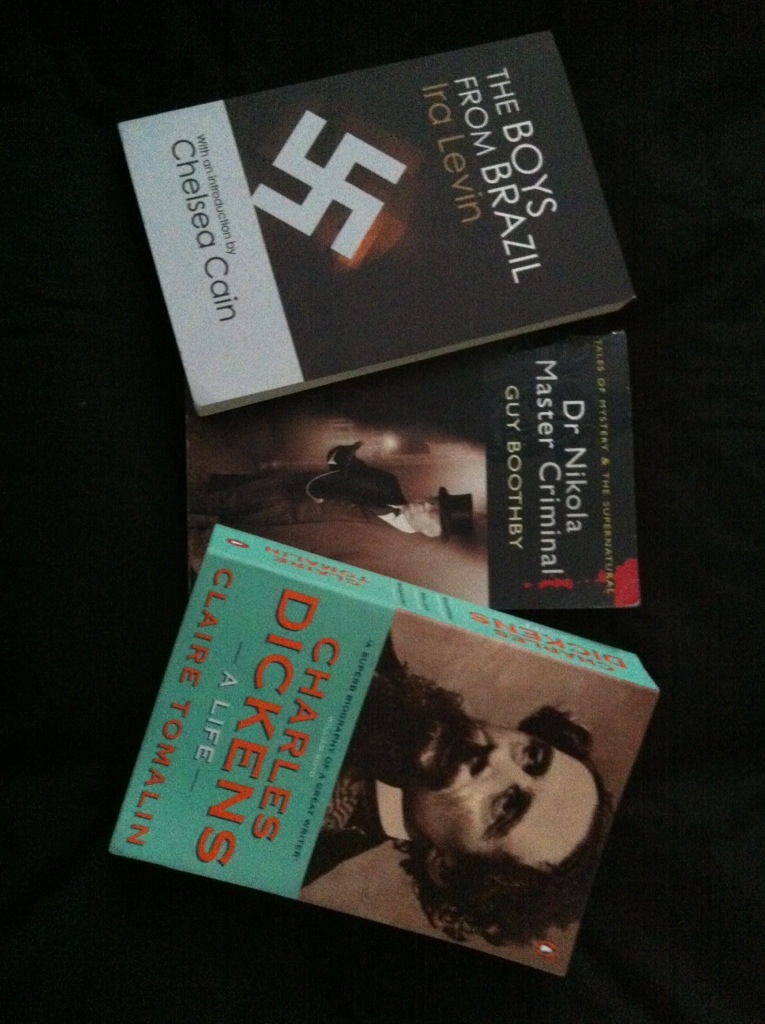
Light, medium and heavy reading.

A quiet month on the book front, due to circumstances about which I’ll be going into more detail anon. The next few months are likely to be just as quiet if not more so on the fiction-reading front, but other things are going to be filling in. So more details on that soon, but for the moment, here are some views on books that came my way last month. (Three of which, by the way, were birthday presents – so thanks John!)

The Boys From Brazil, Ira Levin: A classic of the thriller genre, with the best villains of all – Nazis – pitted against an aging, tired hunter faced with a an unthinkable plot. Levin lays out all the elements of the plot carefully, playing each card at the right time all the way up to the final confrontation. If you’ve seen the movie, then the central twist has already been revealed, but knowing it hardly spoils the book, and in fact the book even explores its ramifications more deeply, though the very last page might be a little too cliched.

Revolution 2.0, Wael Ghonim: A personal memoir of the revolution that toppled Egypt’s government in January and February 2011, told by the Google marketing executive who inspired much of it, this is an eye-opening tale of just what can be achieved through social media. Despite his post at Google, Ghonim’s point of view is a solidly Middle Eastern one, and his revolutionary activities were born out of a love of his country and a desire for justice—two traits that saw him abducted just as the revolution was reaching its height. This is a personal story rather than a blueprint for similar activities elsewhere, and it is unapologetically focused on Egypt, but anyone who is interested in how governments and the Internet are likely to interact in years to come, it’s a must read.

Doctor Nikola, Master Criminal, Guy Boothby: The tales of Doctor Nikola, a gentlemanly criminal mastermind, and his more rough-and-tumble adversaries and compatriots, were exceptionally popular in their time, and two of them are collected here. Boothby’s prose has not dated as well as some, and his action is now too reserved for pulpish excitement and his writing too stilted to get anywhere near the imprimatur of serious literature. However, as a window into British Victorian attitudes and a snapshot of a world where there was still adventure and mystery beyond the horizon, it’s a fascinating diversion.

Charles Dickens: A Life, Claire Tomalin: England’s most representative author gets a thorough going-over from Claire Tomalin, revealing the exceptional talents and the the darker corners of someone who did his best to live up to his own legend. Splitting her attention more or less equally between the man and his works, Tomalin isn’t afraid to point out where Dickens fell short, and indeed she does so with such regularity that you have at times to wince for a man who was protective of his own reputation in his lifetime. Yet with all his flaws and failings, Dickens still manages to come through as someone deserving of his status, and this is an exceptionably readable portrait of a man of genius and the world he inhabited and depicted with unsurpassed skill.