One of the quieter announcements that Apple made during its WorldWide Developers Conference recently was that its forthcoming MacOS and iOS updates will give developers the ability to create “Content Blockers” for its mobile and desktop Safari browsers. While the exact content blocked is up to the developer (you could block the Daily Mail if you want—and you really should), no one is under any illusions as to the target of this feature: ads.
Ad blockers already exist as extensions to most existing browsers, but the majority of users probably don’t avail of them, especially in the mobile sphere. Apple’s decision to push this feature and the reaction to its quiet announcement says a lot about the current state of the mobile web and the dominant role that ads have come to play in it.
Faster computers, mobile phones and broadband have contributed to a smoother experience online, but this has helped to hide the fact that the vast majority of what we download is ads and spyware. Blocking out most of that would massively speed up browsing and have the simultaneous benefit of cutting down on the amount of activity tracked online.
As pleasant an outcome as this sounds though, there’s a downside: online advertising pays the bills for many of the sites we enjoy, some of them from smaller content providers. Killing off that revenue stream would likely kill off a lot of the richness and the niche content that the web provides. It’s not like the people running these sites are preying on you through the ads either—they’re often stuck in a system that they don’t like, making do as well as they can.
The power blocs behind online advertising inform the nature of the system and the conflict that Apple is wading into. Facebook and Google ensure that web users have access to a wealth of content for free by harvesting their data and selling it, funnelling a portion of the proceeds back to the content creators in order to keep the whole thing going. This is the system that’s driven the growth of the web to date, but it’s far from perfect, and web site bloat is just one of the symptoms.
Whatever your thoughts on Apple—you won’t look at the comments on any Apple article on a non-Apple site for long before you find mentions of ‘iSheep’ or ‘Apple fanboys’—the fact is that Apple’s profit model is completely different from that of the web titans. Apple’s iAds platform is distinctly small scale, and its money comes from the sale of hardware instead. Providing an improved user experience is vital to enhancing the sale of that hardware, and enabling the creation of content blockers achieves that.
Safari is a minority browser on desktop machines, but it’s a major player on the mobile web, and iOS users are a lucrative market. So while this initiative isn’t going to bring down the current financial underpinnings of the mobile web, it’s a definite shot across Google’s bows. (Less so Facebook, which has a closed ecosystem of its own that it can profit from.) For users, it raises the question: are we happy to receive things for free, with the understanding that we’re being sold in return, or are we going to accept that we should pay for the things we value?
There’s an interesting parallel to be seen in the U.K., where the Tory government is once again taking the knives to the public broadcaster, the BBC. U.K. TV viewers have long been accustomed to paying a TV licence, and in return they’ve gained a globally renowned service that entertains, educates, and informs. Of course, a publicly funded broadcaster has a head start over its private sector rivals, and in the view of the Tories, that’s unfair competition. Speaking as someone who was raised on a diet of BBC television, I’d call the licence fee a small price to pay, but the future that the private sector envisions could look a lot like YouTube: ostensibly free to use but scattered with pop-up ads and laden with user tracking.
When we’re offered something free, it’s convenient to overlook the fine print. We’re okay with being the product as long as it’s not thrown back in our face. It would be nice to think that users’ desire for speed and convenience would eventually find a balance with providers’ need for compensation. But while Apple’s intervention might be to our benefit, Apple doesn’t fund web content, only content provided through its own app store ecosystem. So if its ad blocking does gain traction, either we’re going to have to learn to pay for our content or some of those content providers are going to go under.
The grand “what might have been.” The eternal tale of how life is. Image from here.
Director Edgar Wright’s departure from Marvel Studios’ Ant-Man before it was due to start filming will keep film critics and academics in coin for years. Wright, one of the most creative and inventive directors around, had worked for several years on the film and retains both executive producer and screewnwriter credits on the final feature. However, for all that Ant-Man retains some of the hallmarks of Wright’s work, it’s not one of his films. For better or worse, his replacement as writer and director, Peyton Reed, has made it his own. Continue reading Flawed Heroes, Edgar Wright and the Incorruptible Ant-Man→
The sceptical eye is probably a decent icon for this event.
One day I will go to the San Diego ComicCon (SDCC). This year, though, is not that year. Instead, while Northern Ireland prepares for its annual renewal of sectarian grudges, my brother provides me with my second niece, and my sister’s kids do their best to physically and mentally exhaust both my parents and myself, I’ve been keeping up with ComicCon online.
Over the past few years, as SDCC has risen to become the flagship event of the geek-driven media industry, the stars have been the movies of Marvel Studios’ superhero super-franchise. This year though, Marvel Studios is absent, presumably to await a dedicated event of its own later in the year. So the field was open to new challengers, with another Disney super-franchise foremost among them.
With the weekend mostly over, then, it’s time to take a completely subjective look at some of the standout offerings.
Doctor Who
SDCC is well-timed for Doctor Who, which is returning to screens this autumn. So at the panel this year, in addition to the cast and crew, audiences got their first peek at the new season. And it all looks…very Hollywood and action packed. Which isn’t a bad thing in a trailer, but part of the appeal of Doctor Who is a protagonist who eschews violence in favour of intelligence. Nu-Who (the series since its relaunch) has had some great moments but the last few series in particular varied wildly in quality. So a polished trailer raises hopes that those variables might come into alignment this season, but it doesn’t do much to convince.
Sherlock
Speaking of variable quality, when Sherlock is good, it’s very, very good, but when it’s bad it’s…still watchable, due mainly to the two leads. Instead of a new season, there’s only a special episode on the way (Martin Freeman and Benedict Cumberbatch both being in heavy demand these days), and accordingly we got somewhat less than Who provided: a snippet of a scene instead of a trailer. Given the success of retelling the Victorian-era stories in the modern day, it’s odd that the special takes the characters from the revamp and puts them back into the Victorian era. It’s all a little odd, if not counterproductive, and the scene released online does suggest that it’s all going to lean on humour rather than drama. Which, given the indication that the eventual return of the show proper will see some very dark and dramatic turns, is probably a good thing.
Marvel Comics
With movies absent, Marvel’s comics presentations had a prominence that they haven’t had in years. Which is well-timed, as the company’s current Secret Wars crossover is probably its most critically acclaimed in years and looks set to lead into something of a soft reboot, with the best parts of its Classic and Ultimate lines mashed together and cleaned up by its stable of writers in order to welcome in a bevy of new readers. (Multi-media marketing being what it is, there’s some alignment with upcoming movies as well.) There were plenty of new titles to announce and discuss, but my detachment from the majority of superhero comics these days can be measured by the fact that one of the characters depicted in the fourth blurry image on this page was by far the most exciting thing in their entire presentation for me. (If you can guess which one, you get a cookie.)
Marvel TV
Marvel’s TV output stands as the poor relation of the movies, which is a shame, as the quality is quite high. But they were definitely lost amid the rest of SDCC. Not much was to be heard of the new season of Agents of SHIELD, though the midseason miniseries Agent Carter got a welcome push, with its period glamour and post-war pulp stylings boosted by a move from New York to Los Angeles. I’ll be tuning in for that, as well as Marvel’s Netflix series: the return of the excellent Daredevil and the upcoming Jessica Jones. Neither of those were brought to SDCC, but we got images and castinginformation to keep the hype bubbling away and keep existing fans paying attention.
Pseudo-Marvel Movies
Sort of an unfair description, but then Marvel sold off the rights to its key properties years ago, back when it was in bankruptcy and long before Iron Man paved the way to cinematic dominance. Sony has since moved its Spider-Man into the orbit of Marvel’s franchise, but 20th Century Fox’s X-Men and Fantastic Four properties are still out on their own, and they have a fair amount to recommend them. Their presentation was a mishmash of everything they have planned, from the upcoming Fantastic Four to the further-out X-Men Apocalypse and the R-Rated Deadpool. There’s a lot of talent involved, but not much in the way of coherence, and in the age of colour-coordinated mega-franchises, that’s actually a little refreshing.
Star Wars
What is this strange feeling? Could it be the human emotion called…hope? In my head, JJ Abrams has a lot to make up after the twin travesties that were the two nu-Trek movies (wherein the corpses of the classic movies and TV shows were savaged and the result ground up with an excess of lens flare and quality actors, then slung in the oven until undercooked and served to the rabid masses), but I can’t really complain about anything that’s been done with Star Wars so far. True, we still don’t know a lot about the upcoming The Force Awakens, but I like that. Keep the trailers few and far between, and maintain a bit of secrecy in this era of instant gratification. What we’ve seen so far looks to be in the spirit of the original trilogy, with a dusty, lived-in universe inhabited by dashing scoundrels, noble heroes, imposing villains and the scum of the galaxy. In short, it looks like Star Wars, on the kind of epic scale that modern CGI allows. If Jurassic World showed just how bad the overuse of CGI could get, The Force Awakens might—just might—show how good it can be when it’s done right. (The free concert for convention attendees may have been a stunt, but it was an impressive one.)
And now I’m doomed to be disappointed, aren’t I?
DC Movies
Though I’m a Marvel fan, not a DC reader, I’ve seen most of the movies that DC have put out though (even if Green Lantern was only because it was free and on a trans-oceanic flight). Given how little I thought of Zack Snyder’s Man of Steel and how my opinions of Frank Miller’s The Dark Knight Returns have trended downwards over the years, I really wasn’t expecting much from a movie that looks to be the product of an orgy between those two and every other major DC comic hero, all desperate to generate a franchise to match’s Marvel’s billion-dollar success. So, perhaps it’s my low expectations talking but…that’s one hell of a trailer. The grimdark tendencies of the Nolan Batman movies are balanced, if not exactly tempered, by Snyder’s operatic excesses, and enough of the story is hinted at in order to suggest that Ben Affleck’s Batman might actually be justified in kicking the crap out of Henry Cavill’s Superman. Plus, Jesse Eisenberg as a Mark Zuckerberg-esque Lex Luthor remains an inspired piece of casting. It could still all collapse into a complete mess, but there’s a spark of excitement that wasn’t there before, and DC might just have lit a fire under Marvel’s ass that could benefit everyone further down the line.
Random Other Stuff:
The new season of The Walking Dead and its spin-off Fear the Walking Dead both received new trailers and heavy promotion. And I…don’t really care. I’ve stuck with The Walking Dead way longer than its entertainment value warranted, and I couldn’t even be bothered to fire up the new trailer. I’m sure it’ll be a huge hit.
I’d put Quentin Tarantino in the same category—his movies can be fun, but have always seemed more flash than substance to me. Still, the news that the western he’s working on will be scored by Ennio Morricone? Worthy of your attention at least.
One of my favourite ever comics series was Vertigo’s Lucifer, which used Milton’s rebel angel (as first shown in Neil Gaiman’s Sandman) to examine obsession and self-determination. It’s now being brought to TV as a…police procedural? Where the devil helps cops fight crime while running a piano lounge in Los Angeles? It sounds utterly terrible, but early reviews suggest it could be fun. I’ll be tuning in out of morbid curiosity if nothing else.
The Man From UNCLE is one of those old TV shows that was regularly repeated when I was a kid. I even had a Man From UNCLE annual once upon a time. So this hits my nostalgia button squarely on, and I don’t mind admitting that I love the look of it. Suave secret agents butting heads, feisty women, 1960s glamour, and action aplenty. Again, there’s only a couple of trailers to go on, but Henry Cavill could be getting some more of my cinema money in the year to come.
Joss Whedon has earned a deserved break after the madness of Avengers: Age of Ultron, and his next project is…a Victorian female Batman. Which from anyone else might seem odd but seems right in Whedon’s wheelhouse. Sadly, it sounds like we’re going to be waiting a long time for Doctor Horrible 2, but such are the vagaries of life.
My experience of Warcraft the game was limited but fun, much like the information released to the public on the upcoming movie. Duncan Jones is a director to trust, and the cast and early imagery are very promising, but even though the built-in fanbase is sizeable, it’ll have to work to reach beyond it. Taking the Star Wars path of teasing rather than showing could be a wise move.
DC’s other movie properties (unlike Marvel, their movie and TV properties operate in unconnected universes) operated in the shadow of Batman V Superman, and they’re too far out to judge as yet. A lot’s going to depend on whether BvS is a success, but they seem to have learned from the mistakes of the past at least. As for the TV properties, Arrow and Flash have a lot of fans, and while I’m not among them, I may just tune in to Legends of Tomorrow to catch Doctor Who alumnus Arthur Darvill in a new role.
HBO makes good TV. Jonathan Nolan (Christopher’s brother) is responsible for one of my favourite series in Person of Interest. So bring the two of them together for a relaunch of Michael Crichton’s Westworld and you have my interest. Sadly, Vladivostok’s favourite son Yul Brynner is no longer available to reprise his role as the deadly android gunman, but this could be something special.
Speaking of good TV, Bruce Campbell is always worth watching. Bruce Campbell revisiting his Evil Dead glory days in a TV series? Practically required viewing. Do yourself a favour and watch the only trailer that rivals Deadpool in the humour stakes.
Also in the quality TV arena is Amazon’s The Man in the High Castle. It’s an impressively faithful adaptation of one of Philip K. Dick’s best books, and the pilot episode showed massive promise. The fact that it’s going to be made into a full series makes me very happy.
Pride and Prejudice and Zombies kicked off an entire subgenre of rewriting classical literature to include fantastic elements. Diminishing returns kicked in long before publishers lost interest in the idea, and the movie version of the original of the species languished in development hell for ages. It’s here now though, and it looks to be adopting a straight-faced approach to the silliness of its concept. That may help it to avoid being a complete mess, but the amount of trouble it had getting to the screen does not bode well.
One Last Thing
The sheer quality and amount of cosplay on offer at SDCC never ceases to amaze. I’m genuinely impressed by all of it and not a little jealous. If I ever do get to attend SDCC, a decent costume will definitely be part of the agenda, no matter how overheated San Diego in July is likely to be.
I have no aversion to spending money on mobile games, and some of my best experiences with iOS games have been paid for: Plants Vs Zombies, Hitman Go, Thomas Was Alone and Monument Valley to name but four. Still, the plethora of free-to-play games does allow me to try out new gameplay experiences more or less forever, as long as I’m willing to risk the intrusion of money-making schemes into your fun. Recently, I’ve been playing three F2P games that have taken very different approaches to monetising fun, with very different results.
Capitals is a clever little app that combines a Scrabble-like word game with some simple head-to-head strategy. You and your opponent start with one space each (your “capital”) on a hexagonal board, and the aim is to grow your territory and ultimately conquer your opponent. You do this by claiming spaces: each space has a letter, and if you use the letter in a space connected to your territory, you expand into it. But if your opponent claims territory bordering yours, some of your territory will turn neutral again.
A huge amount of strategy emerges from this simple gameplay: Sometimes it’s better to avoid a big word in favour of shoring up your defences. Sometimes you see an opportunity to strike deep into your opponent’s territory. Sometimes you want to use up convenient letters so as to cramp your opponent’s options. In the games I’ve played, some have been brief and wild struggles, others chess-like confrontations of advance and retreat.
There’s not much to complain about on the gameplay front: a few games turned into slogs as I tried to grind my opponent down (or they tried to grind me down), but there’s plenty of fun to be had. All the same, you wonder whether NimbleBit thought out their F2P strategy very far. Right now you can pay for unlimited “lives,” which you can also claim by watching promotional videos (one view equals one life). It feels restrictive, and Nimblebit might have been better simply making this a cheap paid game instead. Still, they’ve been updating Capitals gradually since it came out, and they might yet get the balance right. In the interim, I’d recommend giving it a try.
I’m a comic book geek, and when it comes to superheroes, you can Make Mine Marvel. So a F2P fighting game starring a range of Marvel heroes, with good gameplay and high production values should be a winner, right? Future Fight certainly makes a good start, giving you three leading heroes (Iron Man, Captain America and Black Widow) to start with and plenty of free goodies just for logging in every day. But it then buries the whole experience under layers of complexity, social networking hooks and premium currencies.
The core gameplay is a lot of fun—the three hero types (brawler, speed and ranged), are each stronger or weaker against one of the other types. Missions last no more than two minutes, providing experience and equipment to improve your heroes, and there’s even a story illustrated with quick cut scenes before and after missions. So that’s fun. The problem is that managing everything else becomes a chore. There are multiple ways to improve your hero, multiple types of mission you can take on, and coins, gems and tokens galore to collect.
If you’ve got the patience to get to grips with all of this, there’s a rewarding game to be found under all of the cruft. However, I found myself reduced to logging in once a day to pick up my daily reward, telling myself that I’d try to get to grips with it later. I never did. It’s one of the problems of F2P—having paid nothing, I’m not invested, and the grind of gaining expertise and levelling up my characters has put me off. Which is a shame. This is a well-coded, slick and fun game that might have done better had it been paid-for with much less in the way of complications.
Fallout Shelter caused a lot of fuss when Bethesda announced it alongside Fallout 4 at E3 recently. As a promotional iOS app, trading on an established franchise name and using a F2P model, it could have been awful. It isn’t. In fact, it’s one of the friendliest F2P games out there, with an in-app purchase model that actually seems to work. (It’s currently at #18 in the top-grossing games in Ireland.) How did Bethesda manage this? By keeping things simple and sticking to the feel of the Fallout franchise.
Whimsical ‘50s nuclear paranoia might not seem like a good basis for a game, but it’s worked for Fallout for years. The main Fallout games have been roleplaying-focused, but this is a management game that charges you with creating a paradisiacal “Vault” in the midst of a post-apocalyptic wasteland. To do this, you’ll have to guide your vault dwellers to create food, water, energy and medical supplies, send them out to explore the wasteland, and encourage them to breed in order to swell your population. Do it right and everyone will be blissfully happy. Do it wrong and you’ll have miserable, radiation-raddled inhabitants who fall prey to radroaches, raiders and the occasional nuclear reactor fire.
The first ingredient that makes this game so appealing is the grace notes sprinkled across the game (equipment descriptions, wasteland explorers’ journals, and cheesy banter between dwellers—the writing is uniformly excellent). The second ingredient is an in-app purchase system that doesn’t intrude and even enhances the game. The standard currency is bottle-caps, with which you pay for new rooms (and occasionally resurrecting unlucky vault dwellers). The premium currency is lunchboxes, which serve as booster packs that contain equipment, caps or dwellers, some of them better than any you’re likely to find in game. You can earn these lunchboxes through the game, but the excitement of opening a new one is enough to encourage you to plonk down actual money for more.
It’s not a perfect game—the learning curve is a little steep if you don’t RTFM, and there’s a lack of depth in the challenges you’ll face as you build your Vault beyond 100 inhabitants. But even so, it manages the SimCity trick of making you feel proud of what you’ve created while allowing you to peek in on the lives of your dwellers and even get a little invested in their continued existence.
“The Indominus Rex really needs to work on its diet choices.”
Along with half the world, or so its box office returns would indicate, I went to see Jurassic World last week. It’s all about the dinosaurs with me, and despite some middling reviews, I have an unrelenting optimism that you never know, a movie might be fun (see also: Star Trek Into Darkness). Or maybe I’m just addicted to being grumpy about underwhelming movies. Spoilers on…
The past year has been an interesting and diverse one for fans of cinematic science fiction. We’ve had Christopher Nolan’s ambitious, if flawed, Interstellar, and Alex Garland’s fascinating Ex Machina. Right at the moment, cinemas are sporting two further major releases that do what all good science fiction does: reflect the concerns of the present in visions of the future.
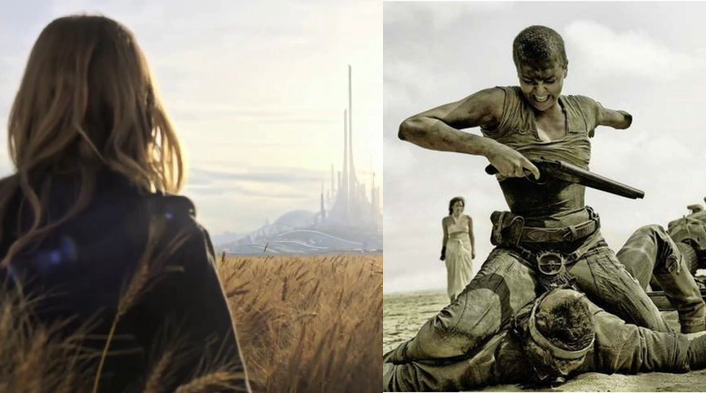
George Miller’s Mad Max: Fury Road and Brad Bird’s Tomorrowland are both visually stunning, but their similarities go deeper than that. Both films depict an alternate present instead of a distant future, albeit both warning in their own way of how our own present could go. In doing so, they become fables, trying to make their points symbolically, with characters who represent much more than the journeys that they go on. A central theme of both films is the need to avoid giving up, to retain optimism and humanity in the face of cynicism and despair.
But for all of the similarities, there are multiple differences too. Most glaring is their storytelling success—Fury Road is good enough that it’s hard to pick holes without coming across as petty, whereas Tomorrowland struggles to avoid being dragged back down into the summer blockbuster mire. Taking a look at the differences between them might help to illustrate this.
The “eclectic” results of a bookstore raid, as someone else described them.
Every so often, I drop into a bookshop. I try not to do it too much, because once there, I have a tendency to buy things. On one of my more recent visits, I picked up three good-sized books, which did wonders for my loyalty card. Less so for my wallet. Luckily for this blog, there was a thematic connection running through all three of them, so I get to package up their reviews in a single post. (Arranged, for the convenience of the reader, in order of increasing worth.) The Swerve, Stephen Greenblatt
The concept behind Greenblatt’s book is an appealing one: in the 15th century, a bibliophile, classicist and proto-humanist called Poggio Bracciolini rediscovered Lucretius’s De Rerum Natura (On the Nature of Things) in an Alpine monastery. This lost work of Epicurean philosophy offered a new way of looking at the world and helped spark into life the Renaissance. Sadly, while Greenblatt weaves an entertaining story, he doesn’t quite manage to live up to the headline.
There are a lot of moving parts here, and Greenblatt does a good job of outlining Epicurus’s philosophy and why works like Lucretius’s epic poem were suppressed in an increasingly Christian world. He also succeeds in portraying the slippery character of Poggio Bracciolini, a cynical papal secretary in love with the classical world, as well as the political and religious milieu he operated in. Where the author falls down is in demonstrating how the rediscovery of De Rerum Natura fed into the heaving intellectual scene of the time.
Notable figures from Shakespeare to Da Vinci certainly read Lucretius’s poem, and Greenblatt points out many times and places where references to it crop up. However, as a work of classical poetry and philosophy, it’s hardly alone in that sense, and the book peters out rather than rises to a climax. It’s a shame—in the life of Poggio Bracciolini, the impact of Epicurean thought and the turbulent times of 15th century Europe, there’s enough material for a handful of books. As it is, Greenblatt has delivered an entertainingly told, but ultimately unsatisfying, tale. Action Philosophers Omnibus, Fred Van Lente and Ryan Dunlavey
From the impact of one philosopher to the body-slamming impact of more than two dozen heavyweight thinkers in a comic book battle royale. Van Lente and Dunlavey’s exploration of the thoughts and lives of some of the greatest thinkers in human history is constantly entertaining and far more thought-provoking than its funnybook styling would suggest.
An omnibus edition of previously published comics, the individuals profiled are here arranged into something resembling chronological order, from the Pre-Socratics to Ayn Rand. And while the authors’ preferences sometimes shine through, they do their best to be even-handed, pointing out facts like Thomas Jefferson’s multiple hypocrisies and the fact that almost all we know of Socrates (who doesn’t get a section of his own) comes through the words of Plato, presented here as the former wrestler he actually was.
Unlike a lot of comic books and graphic novel, Action Philosophers requires the reader to pause in their reading and consider the words and thoughts of the great philosophers. This is to its detriment as a comic book, but given that there’s a lot of clever ideas and imagination at work in presenting these sometimes complex ideas, it doesn’t suffer all that much. And while philosophy majors might decry the short shrift given to their heroes in the few pages each one is afforded, as an introduction to some of the deepest thinkers of the past 2,500 years, it’s hard to beat. Plus, as a bonus at the end, a reading list and a guide to critical thinking and argumentation are provided in the same fashion as the rest of the omnibus. Highly recommended. The Thrilling Adventures of Lovelace and Babbage, Sydney Padua
Unlike her hero and heroine, Sydney Padua actually managed to turn her concept into an actual product, and we’re all the beneficiaries. From an initial one-shot webcomic about Charles Babbage and Ada Lovelace, inventor of the first computer and the first computer programmer respectively, Padua spun off into an irregular webcomic and has now produced a book that manages to be both riotously funny and deeply informative about its two protagonists and the machine they never quite created.
Never quite created in the real world that is, as the conceit of Padua’s book is the creation of a bubble universe, in which the wonders of steampunk technology and boundless optimism have allowed Lovelace and Babbage to indulge their every technological whim while encountering just about every major figure of Victorian England’s social scene (Isambard Kingdom Brunel as a burly action hero is a particular highlight). That the result is such a well-balanced book is down to a combination of Padua’s skill as an artist and writer, her comprehensive research, her clear affection for her protagonists blends nicely with the poignancy of the fact that in the real world Lovelace died young and Babbage old, having never brought to fruition any of the schemes that he devised.
The Thrilling Adventures is simultaneously a tribute to its heroes, a rollicking series of adventures in which they star and a deep dive into their lives and the technology that almost (but probably never could have) started the computer revolution a century early. Add to that the fact that the hardback edition of the book is a beautifully made tome and I can’t really recommend it highly enough. It’s enough to make you wish you were living in a steampunk world of dashing, pipe-smoking female mathematicians, absent minded technological geniuses and action-hero engineers.
Kind of giving away the side of the fence I’m, but please read on…
“Marriage may be contracted in accordance with law by two persons without distinction as to their sex.”
Next Friday, the people of Ireland go to the polls in a referendum to add the above sentence to the constitutional definition of marriage.* Ireland seems to hold a referendum every few years, far more often than its neighbour, the U.K., mostly because a referendum is the only way in which amendments can be made to the nation’s constitution.
In this way, referenda have come to serve as an important marker of Ireland’s sense of itself and how that sense of itself has changed over the less-than-a-century in which the country has existed. That the marriage referendum is not only being put to the people but appears to have broad popular support is a marker in and of itself—it was only in 1993 that homosexual relationships were decriminalised, and only in 1996 that the constitution was altered to remove a prohibition on divorce.
The most recent polls suggest that voters in favour of expanding marriage rights are in the majority by two-to-one over voters opposing the change, with as many as a quarter of voters undecided. This might suggest a foregone conclusion, but as the recent U.K. elections showed, it’s unwise to trust polls too much. Voters have a tendency to be cautious of change, especially when that change brings uncertainty.
This referendum campaign has also been notable for its vitriol on both sides.** Posters have been defaced and torn down, and social media has become a battlezone between camps who have set out their positions and are prepared to think the absolute worst of anyone who disagrees with them. There are more sensible, rational voices to be heard on both sides, but they’ve been getting drowned out in the noise. The traditional media doesn’t help much either—entertainment sells, and a calm discussion of the points is never going to attract as many viewers as a shouting match.
For myself, I intend to vote yes in the referendum. Why? I’m not gay, but I believe that I deserve the same rights as everyone else. I shouldn’t be privileged with rights because of who I am any more than I should be denied them by the same.
By far the strongest voices on the No side come from a conservative Catholic background. To anyone familiar with Irish history, this won’t come as much of a surprise. What’s more notable is that the church itself has taken a back seat to these campaigning groups—the scandals of recent years have damaged the church’s moral standing, perhaps irreparably. Those who believe strongly that Catholic morality, as practiced in Ireland since its founding, ought to be the guiding light for the nation, have had to get out ahead of a church that advises a No vote but isn’t willing to shout about it.
Yet behind all of the shouting, there’s an interesting split developing in the church itself, between dogma and conscience. Whereas the hierarchy of the church in Ireland have hewn to the party line that marriage is a sacred institution***, many voices closer to the people that make up the church have dissented. The most famous is Sister Stanislaus Kennedy, founder of the Focus Ireland charity, who has described entitling gay people to marry as a “civil right and a human right.”
Next Friday’s vote, whether yes or no, would change Ireland overnight. That change has been happening for decades, and will continue to happen for decades yet. Hopefully, it will never stop changing. Change can be frightening, especially for those who have known only one truth all their lives and have been told that everything different is false, dangerous or the just the first step towards chaos and damnation. Yet human beings have been dealing with change, for better or worse, for as long as we’ve existed. We’re good at it. And I believe that a yes vote would show that in Ireland we’re getting better.
*There’s also a vote on whether to lower the age requirement for the Presidency of Ireland to 21, but that has been seriously overshadowed by the debate over the marriage referendum.
**Although perhaps not that notable. As Joseph Cummins points out in Anything For a Vote, the idea that the past was an era of genteel political debate is a fallacy. If anything, campaigners in centuries past were even more likely to be vitriolic to the point of slander and abuse.
***The history of marriage and the church and the co-opting of the former by the latter is too long to go into, but suffice it to say that marriage has been around for a lot longer than the church, and in far more forms than the church recognises.
Age of Ultron definitely has higher production values on the posters at least. (Image via Comicvine.)
From a point of bankruptcy in the 1990s, Marvel has built its comic-book properties into a billion-dollar film and television franchise that’s so omnipresent you never have to wait long for the next Marvel product. Two movies a year and multiple TV series are enough to sate the most avid fan, and while we may be nearing oversaturation, the quality has remained remarkably high so far. The latest two offerings—Avengers: Age of Ultron and Daredevil—represent Marvel working harder than ever to maintain that quality as it stretches the limits of what superhero fiction can do on screen.
A:AoU is of course the follow-up to Joss Whedon’s ensemble blockbuster movie, whereas Daredevil marks the first offering from Marvel’s tie-up with Netflix, presenting heroics at a more gritty street level than Avengers’ apocalyptic, primary-colour adventures. Having watched them both to completion over the past weekend, I thought comparing the two might prove interesting.
It’s an eclectic city, but if you catch it at the right moment, it’s a beautiful one too.
When I first started up this blog, it was with the purpose of keeping a record of a months-long trip around the world. Since then, it’s drifted away from that towards reviews of games and movies, punctuated by the odd political or cultural rant. This drift shouldn’t be all that surprising – it’s not like I can afford to go on holiday every month.
Still, when I do go on holiday, even when it’s only for a few days, it’s fun to keep a diary, one that can be illustrated with photos. Sharing experiences isn’t just for Facebook, though Facebook is the obvious gateway through which to usher people to these pages.
In short, I’ve added another entry to the Travel menu above, courtesy of my just-ended five days in Brussels. Five days of sunshine and late nights, during which I made strenuous efforts to balance out my intake of beer, frites and waffles with some industrial grade walking. By the end of it all, I felt like I’d gotten a pretty good feel for the city, and I’m looking forward to getting the chance to go back some day. For some small clue as to why I enjoyed it all so much click here.
(And apologies in advance if the prose is a bit clunky. I’ve fallen out of the habit of writing these articles, and it’s not always easy to jump right in again.)