All posts by cerandor

Cruise Control

One-handed operation.
Buttons to control your life. (via Mark Doliner)

I was at a wedding earlier this week, and since it was down in the wilds of Wexford, I opted to hire a car to get me there and back. As a result, I had the chance to play with one of those driving options that I’ve never really tinkered with before: cruise control.

It was an odd experience. On the way there, I switched it on, then off again after a few minutes, as the motorway to Wexford is only a motorway in parts. On the way back though, late at night and neither overtaking nor being overtaken between Gorey and Dublin, my speed changes all came courtesy of a switch on the steering wheel.

When I drive, I drive manual, because it’s what I’m used to. The few times I’ve driven automatic, I’ve had to adjust to the idea of having a hand and a foot rendered more or less unemployed. Cruise control removes the need for the other foot. It’s terribly convenient, seductively easy to get to grips with and absolutely nothing like driving a car.

Of course you realise, this means metaphor time.

Convenience is the way of the world. We’re buried in gadgetry that’s designed to smooth every possible step between our desires and their fulfilment. From the toaster and kettle in your kitchen, to the latest iPhone or Google Glass, where you only have to whisper your momentary whims to have them answered.*

It’s not a wholly bad thing. Dial this desire to make our lives easier back to where it began and you’ll find yourself kicking the sharpened rock out of the hominid’s hand as it tries to turn an animal skin into something wearable. And yet, and yet, I resist it.

I’ve written before about how Apple’s iPads have all but disappeared: they’re magic slates, on which appear a dazzling array of entertainments and utilities, designed to enhance our lives. Clarke’s Third Law comes into play here: we can still identify the iPad and its ilk as technology because we have to plug it in to the wall to charge, but its identifying marks are gradually disappearing.

It’s civilisational cruise control of a sort. We create the items to ease our way through the world, thereby in theory freeing ourselves up to achieve all sorts of other things. Yet along the way, the vast majority of us forget or never learn how things work. From technology to politics to business, we’ve become accustomed to thinking that so long as someone understands it—someone whose job it is to understand it—then it’s their responsibility to deal with it. All we have to worry about are the results. We flick the switch to get from A to B and think no more about it.

I’m far from perfect on this score, and it’s impossible these days to understand how everything works. Yet it’s worth making the effort to grasp the principles of the forces that move us, and have some ability to roll up one’s sleeves and shift them when the need arises. So I’ll keep on driving manual, and when I’m in a car with cruise control, I’ll think twice about flicking that switch.

*Incorrectly, usually, but at least they’re trying.

The New Baseline

All the colours of the candy rainbow.
Lickable shiny. Just … keep your tongue away from mine, okay?

The announcement this week of Apple’s new range of iPhones has generated some new and some standard complaints from pundits. For the new top-of-the-line iPhone 5s, the complaint is that it’s not all that different from the previous model. For the new midrange 5c, it’s that it isn’t a cheap iPhone. Oh, and the colourful plastic shells look tacky.

To deal briefly with the 5s: yes, it’s a speedbump. Everyone saw that one coming. However, initial reports suggest that it’s a substantial speed bump, and there are new and useful features in the form of an improved camera, an intriguing standalone motion detection chip and the much-discussed fingerprint sensor. Perhaps most importantly, it shifts the iPhone towards 64-bit computing, providing some decent futureproofing.

I’m not going to comment on the looks of the 5c until I have one in hand, other than to note that those who have handled them seem to have come away impressed. The issue of whether the 5c is too expensive to work for Apple as a “cheap” iPhone is the more interesting question, and it’s one where most critics (including the perennially misled markets) seem to have missed the point.

For all the talk of a “cheap” iPhone prior to the arrival of the 5c, Apple doesn’t do cheap, certainly not since the second coming of Steve Jobs. Its products tend to fit between “premium” and “affordable luxury”, depending on how you view those scales. In that sense, the 5c has been positioned as a “midrange” iPhone, fitting just beneath the new 5s.

Except that doesn’t tell the entire story either. Up until now, Apple had only one model of iPhone: the new iPhone. (It also sold last year’s new iPhone, and the previous year’s new iPhone too.) Selling older iPhones alongside the new model allowed Apple to leverage investments in manufacturing and economies of scale, but those old iPhones always felt a little second-hand.

With the release of the 5s, Apple has doubled the breadth of its new-iPhone product line in a stroke, giving consumers a choice much more appealing than one between the “new shiny” and the “old shiny that you can actually afford.” Relatively expensive the 5c may be, but to balance that it’s still a fully capable smartphone, in a brand new form factor that offers a splash of colour never seen on iPhones before.

Yes, an old-new iPhone still remains on the product list, in the form of the 4s, but I’m not sure that’ll last even a year. With two lines of iPhones above it, both using the iPhone 5 form factor and manufacturing lines, Apple is going to be shifting as quickly as it can to focus solely on these products. Improved manufacturing techniques and greater output lead to economies of scale and enhanced margins for Apple—or lower prices.

Because that’s really the thing with the 5s. Once the 4s goes, it becomes the new baseline for the iPhone line, and while it will never be “cheap”, I can see Apple cutting its price by €100 or so in about six months, making it even more price-competitive with Android smartphones.

After that, Apple suddenly has two product lines to work with—the “top-end iPhone” for those who want the latest and best iOS device, and the “iPhone for everybody” who wants an iPhone device but doesn’t want to break the bank for the latest and greatest.

What the 5c means is that the latter group no longer has to see themselves as buying last year’s cast-offs. The 5c isn’t about what it is now, as much as it might sell on its release. It’s about what it’s going to be a year from now. Because Apple always plays the long game, and it’s just shifted the iPhone baseline.

Intermission

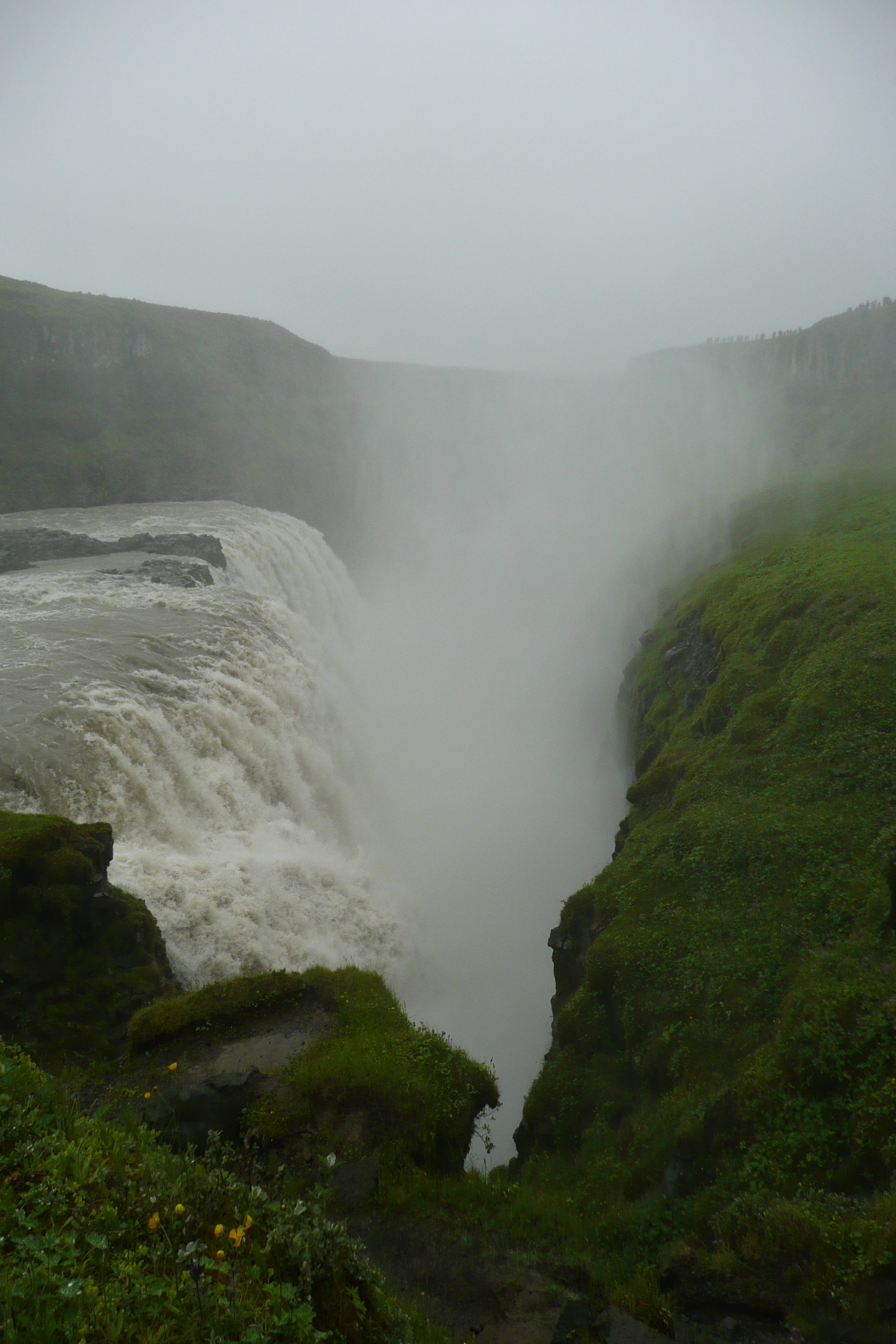
Gulfoss Falls, Iceland
Some gaps are for jumping into. This one isn’t.


A few weeks ago, I went to the cinema with a friend to see one of my favourite films. Specifically, 2001: A Space Odyssey in a 70mm print. Being such an old print, it was scratchy in places, though the glorious visuals more than covered for that. As an old print though, it had another surprise to give: a little over halfway through, the screen went dark and a single word popped up. “Intermission.” Now that was an unfamiliar experience.

Maybe not all that unfamiliar though. Two years ago, a lot of the things that had defined my life had come to an end. The most recent of them was that the company I’d worked for had been bought out and the job I’d been in since college was being made redundant. The first part of my working life was over. Time for an intermission.

My first reaction was the obvious one: start looking for work, start looking for something to fill the yawning gap that had opened up in my life. Obvious, but wrong. I’d been complaining about being in a work rut for years at that point, wondering how I could get out of it. Well, life had delivered a short, sharp answer.

So, I took my severance package, had a quick think about what I really wanted to do, eyed up that yawning gap and jumped. Within a few months, I was travelling around the world, visiting places that I’d wanted to see for years (and, as a direct result, starting up this blog – the earliest posts are all about this trip).

It wasn’t all indulgence though—I was thinking about what sort of working life I wanted on the other side. On my return I secured a few freelance jobs, leveraging my publishing experience, but the two-dimensional nature of my career to date limited my opportunities. Luckily, there was another jump to take.

Not long after my travels, I was at a meeting of publishing folks, where I was told about a course in Trinity (by one of the people taking it), the MSc Interactive Digital Media, which covered a broad array of media forms and the technologies used to manipulate and present them. A pretty good fit for my interests and skills, even if some of them were dusty from years of disuse.

So I applied, to just that one course, and after a certain amount of trepidation on my part, I got in. That was just under 12 months ago. It’s been a year of fascinating education, good company from my new classmates and more pressure to excel and achieve than my job had thrown at me in a decade and more.

This morning, I gave a presentation (together with the rest of my team) on the project that we’ve been working on for the last two-and-a-bit months. You can see our work here, though be aware it’s a hefty download and requires a WebGL-compatible browser (and doesn’t work at all on IE). Tomorrow, we get our results and find out whether we can append that MSc to our names.

So. Intermission over. Time to retake my seat, metaphorically speaking, for the second act. Once again, it has the look of a yawning gap of uncertainty ahead of me. But you know what? Having jumped once, the second time really isn’t all that daunting.

It’s About Time for Zombies

20130822-141527.jpg
Part of the Pirate World in PvZ2

Plants Vs Zombies 2, Popcap, iOS, Free

No game on my iPhone engaged me as long or as deeply as the original Plants Vs Zombies. A tower-defence game blessed with an abundance of humour, impressive cartoon visuals and a catchy score (including the best end credits song since Portal), it also had the benefit of a developer that continued to enhance and upgrade the game for several years after it came out, with new game modes and other add-ons.

Well, the sequel has finally landed, in the form of Plants Vs Zombies 2: It’s About Time, a punning, double-meaning subtitle that reassures fans of the original that the same twisted brains are still in charge. The big change this time around is that PvZ2 is free-to-play. The game itself comes without charge, but players can decided to pay more for extras within the game itself.

Free-to-play is rightly viewed with some suspicion. It’s a new business model for the games industry, and earlier efforts to make it work have resulted in crippled games that frustrate players. Luckily, PvZ2 takes another tack: the game offers an abundance of content, all of which can be accessed for free, but players can spend some coin to make their passage through the game easier or to buy some new plants to improve the variety of the experience.

As far as gameplay goes, the winning formula hasn’t been altered: the player places plants on the left of the screen and zombies attack from the right in waves of increasing intensity. There are some new elements thrown in, such as new plants and new zombies, but if anything the variety is a little bit down compared to the state the first game reached with all its expansions in place.

Tweaks have been added to the gameplay in the form of new special powers. Plant food supercharges plants temporarily and coins can be spent to activate special powers that will squish, electrocute or fling zombies offscreen. For an old-school player, these powers can seem a little like cheating, but the game is balanced so that while plant food is often necessary, the special powers rarely are. However, the in-battle currencies of plant food and coins do add complexity to a game laden with currencies (the familiar sun for buying new plants, stars for completing new levels and keys to unlock new routes).

These routes are the big change in the presentation of the game world. The first game took place in a back yard, by day and night, with a pool and without, and occasionally afflicted by fog. The player progressed from level to level, in a linear fashion. In PvZ2, the game is split into three worlds (Ancient Egypt, Pirates and Wild West, with an upcoming Far Future world having been announced). Each one is completed by following a linear path, but keys gained during battles allow the player to unlock side paths and gain extra plants and abilities thereby.

It’s a slightly more graphically intense game than the old one (only iPhone 4 and above need apply), and the graphics designed for retina displays take a little adjusting to, but everything is in order gameplay-wise. It’s as addictive as the old game—I’ve already completed the first world and made my way through part of the second, at a time when I really shouldn’t be playing games (or writing reviews of them).

The one niggle I’d point out? Although the side routes in each game world do offer different challenges akin to the mini-games of the first game, there’s no way to tell which one is which from the isometric world map. It’s a bit of an odd design decision, and one that I suspect will be fixed in further updates. If nothing else, Popcap’s reputation breeds confidence in the fact that this will be a well-supported game for a long time to come.

Recommending this game is a no-brainer (ahem). For no money at all, you get the same great gameplay of the original PvZ, and you can happily play through it without spending a penny. My only worry is that a lot of people will do just that, and that PvZ2 won’t be the financial success it deserves to be. Because, honestly, we could all do with more games like this.

(A quick reminder to clarify: the Android version of PvZ2 isn’t out yet, but it isn’t likely to differ too much from the above.)

Beauty, not Brains?

20130822-141343.jpg
Hairy arm: model’s own.

Pebble Smartwatch, $150, iOS and Android

As people smarter than myself have already pointed out, taking part in a Kickstarter funding campaign is like buying a present for your future self: by the time it arrives, you’ll have forgotten that you paid for it, and be pleasantly surprised that it showed up at all. That and the feeling of actually participating in a product rather than just buying it are all the reasons you need to know why Kickstarter is still huge.

To date, I’ve participated in five Kickstarter campaigns, mostly for small amounts. In each case, it was clear that I’d be waiting a long time for the results, something I didn’t mind at all. Well, in recent months my currently impoverished self has been reaping the benefits of my affluent former self, in that two of the results have shown up (in one form or another).

My biggest Kickstarter contribution to date was for one of the site’s most famous campaigns: the Pebble ePaper watch. A customisable bluetooth watch for Android and iOS phones, the Pebble raised $10,000,000 through Kickstarter, far above an original funding goal of $100,000. Due to the fact that I opted for a grey watchface rather than black, red or white, mine took a little longer to arrive than it might have otherwise, but a few weeks ago I wrested it from the hands of Irish customs and onto my wrist.

For the first wave in a new breed of smartwatches (Kickstarter is already hosting its more ambitious next-gen brethren), the Pebble has a definite retro, plastic feel to it. Which is not to say it’s not solid: the plastic case keeps it watertight while allowing charging through a USB lead and keeps the body light despite the its bulk.

The ePaper screen is basic but readable, with a motion-activated backlight, and can be modified with a multitude of watchfaces. Figuring out how to do so can be a bit of a chore: the online setup process is straighforward enough, but for more expansive options, you’ll need to use your phone’s web browser and the app that manages the Pebble itself.

In use, the Pebble is a handy accessory. I often don’t hear my phone when it’s in my pocket, but I can feel the Pebble’s vibration on my wrist without a problem, alerting me to calls, texts and mails. I can even read the mails and texts, or at least the first few lines of the mails, on the Pebble’s screen, though this only works in the moment—there’s no way to browse older messages.

At the time of buying the Pebble, my main reason was to have it as a running accessory. I’d just started recording my running with RunKeeper, and the idea of having a watch that would tell me my pace and distance covered sounded pretty good. Well, mission accomplished on that front: the Pebble keeps updated throughout a run

There are only three issues with the Pebble, all of them technology based. The first is that it drops the bluetooth connection occasionally. This is an issue because the Pebble isn’t a smartwatch. It’s a terminal for your smartphone, and lacking the connection, it can tell you the time in various pretty ways but not much else (there are game apps for the Pebble, but the chunky buttons don’t allow for sensitive control).

The second issue is battery life. I’ve averaged around five days so far, which isn’t too bad for a bluetooth device, but the phone software doesn’t do a great job of indicating when you need to recharge, so there have been a couple of times when I’ve looked at my wrist and found a blank screen looking at me. Annoying, but some of those multitude of watchfaces promise to fix that issue.

The last issue is probably the biggest one for Pebble: this is a first-generation device, cute and functional, but staring down the barrel of technological innovation. As stated, Kickstarter is already hosting second-generation devices, and Apple and Samsung look set to enter the space before long, bringing all their engineering know-how to the field. When that happens, Pebble’s retro looks may become all-too apt.

For now though, I’m wearing a watch for the first time in a couple of years, and I’m more than happy with the present my former self bought me. Runkeeper functionality, message and call alerts and a variety of funky watchfaces. It may not be smart, but it sure is handy.

Flying Solo, One Day More

Not a bad sight to wake up to.
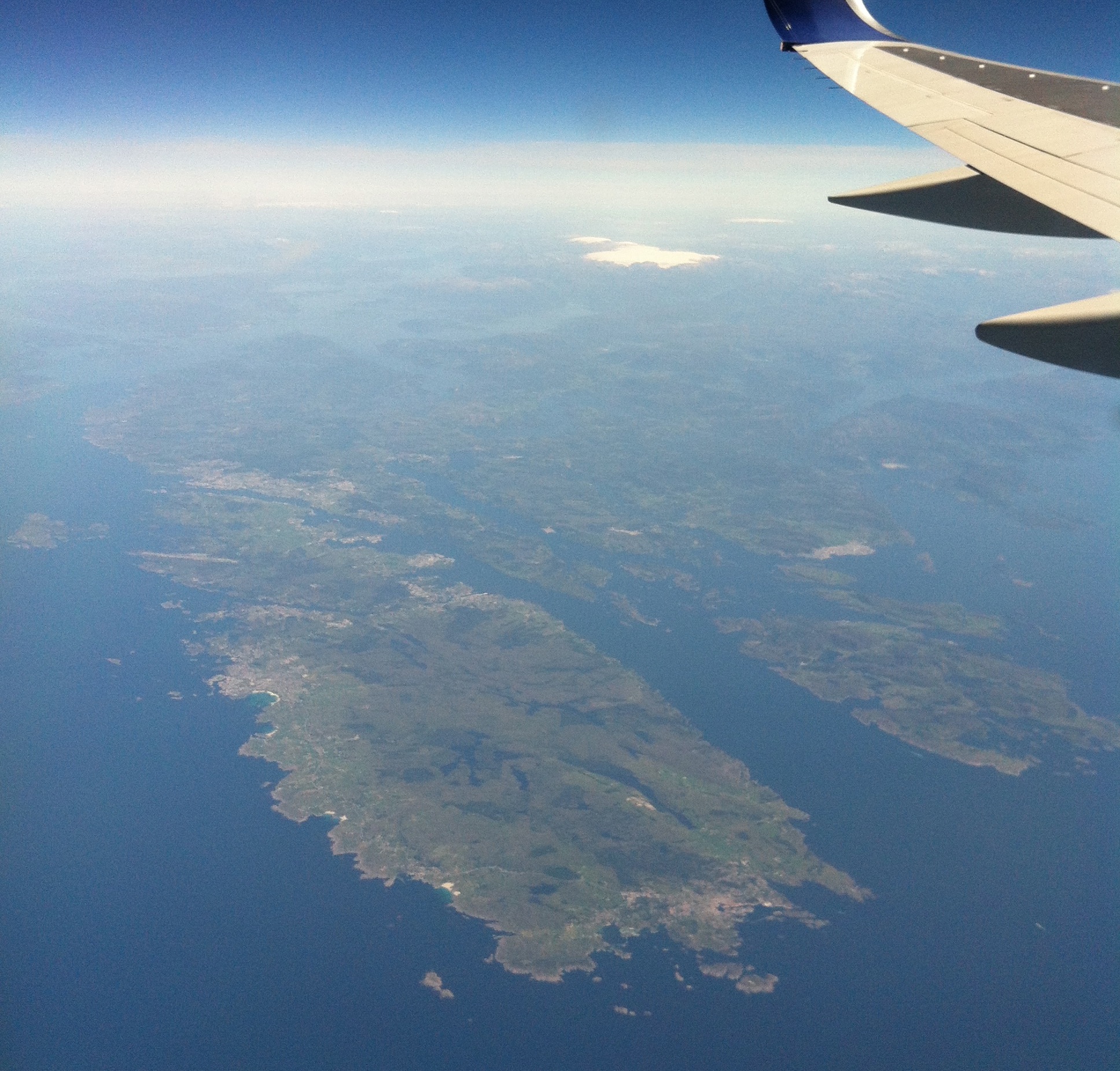
West coast of Norway, complete with glaciers and fjords.

The last day of the holiday is usually the occasion of the shortest report in these records. So it will probably be again, but this holiday was a little unusual. For all that it’s a short break, it’s really three holidays in one: a day trip to Copenhagen to meet some friends, three days in Iceland with another travelling companion, and today: one last solo trip to Copenhagen as I return home. As always seems to be the case when I travel solo, a good portion of the trip involved climbing very tall things.

Dr. P and I would have been up at the crack of dawn in any normal country, but this close to the Arctic Circle in summer, dawn is hard to nail down. The grey clouds had returned overnight though, and sleepy as we were, we had packed and prepared well enough to have time for breakfast before heading down to BSI for the bus to the airport again (the tickets were a promotional gift as part of the previous day’s car hire).

Once again we passed through the lava fields that led to Keflavik, glimpsing the steaming geothermal plant beside the Blue Lagoon, a reminder of where all this had begun. In Keflavik Airport though, there was none of the relaxed vacancy of three mornings previous: the place was jammed. Unsurprising really: Monday morning has the cheapest flights, so everyone was leaving while the price was right.

Having bags to drop, Dr. P joined the queues, whereas I, with my carry-on, browsed the shops and changed my money. We met again before too long—Scandinavian efficiency is the same everywhere—but having already eaten there wasn’t much to do but say our farewells and head to our separate planes. After the briefest period of waiting, I was once more aloft, once more solo and swiftly asleep.

I snoozed for half the flight, timing my waking to coincide with the first view of western Norway. Site of another trip, some years back, this was a view I hadn’t previously enjoyed: the now-clear skies revealed a landscape of deep fjords, rocky mountains and distant glaciers. That and a few episodes of Journey’s End kept me going until we touched down safely in Copenhagen Airport.

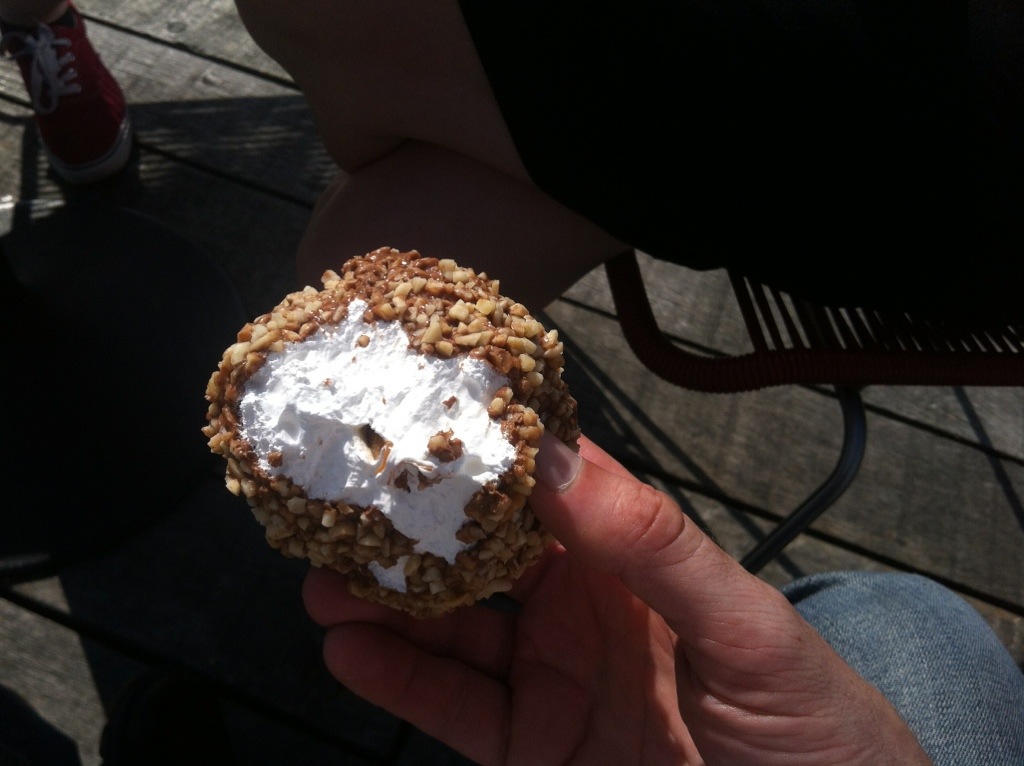
Once again, the plan was to spend my four-hour layover in Copenhagen, so I passed swiftly through the airport, hopped on the Metro and into town. It was, if anything, even warmer than it had been on my previous visit, so I needed a plan. Stage one: return to Norreport station and find myself a pastry shop. One caramel-filled, nut-encrusted fløldebolle later, I was ready to go and still making my plan up as I went along.

Second stop: the round tower that once served as Tycho Brahe’s observatory. Even with my luggage in tow, I had no problem making my way to the top and decided I’d well deserved some ice cream as I lounged on the upper parapet, doing some observing of the city myself. It was only about then that I came up with a finalised plan: make my way south across the river to Christianshavn, using up the remainder of my time in the city in exploration and then jumping on the Metro back to the airport.

It all worked out very well, despite the heat and the efforts of city cobbles to destroy my luggage’s wheels. The palace and the stock exchange with its wonderful dragon steeple passed by on my right, and hordes of cyclists passed me on my left. By the time I got to Christianshavn, I had added one last item to the agenda: the spiral tower of the Church of Our Saviour.

This time, I dropped my luggage at the ticket desk, and just as well. To get to the base of the steeple itself, you have to climb 65 metres up steep and narrow wooden steps, dodging tourists going the other way. All this in stifling, non-air-conditioned heat. It didn’t get any less hot once outside either, just sunnier. The steps that corkscrew around the steeple get narrower and narrower as they ascend, so much so that there was a queue to see the very top. Not that anyone can reach it—in the end, the climb is too narrow for anyone to fit. The view, though, is spectacular.

Having worked off my pastry and ice cream in sweat, I descended briskly, picking up my luggage and heading for the Metro. After that, it was pretty smooth sailing, to the airport, through security and onto the plane, pausing only for a hotdog to keep my spirits up. Then, as always, the very last trip of all, into the air and back to Dublin, another journey at an end.

Iceland’s Golden Circle

20130722-220801.jpg
A panorama of Gullfoss. Doesn’t even come close to capturing the feel of it.

Driving in Iceland is an exercise in concentration. Icelanders have long disdained hard shoulders as a crutch for the careless and the weak, and their absence acts as a form of vehicular natural selection. Allow your attention to waver and you’ll end up in a ditch so deep you’ll have to wait for the next ice age to be dug out. Or, if you’re fortunate enough to survive, you’ll be fined for damaging the delicate local vegetation.

Dr. P and I were up respectably early, all set for the final full day in Iceland and a briefly sketched adventure into the wilderness beyond Reykjavik. Being the only one in possession of a driving licence, it was my job to nurse the car (rented from RE:D in the BSI bus terminal) along the roads the led to the various sites along the Golden Circle. Dr. P, meanwhile, was responsible for navigating our way there. A job which primarily consisted of arguing with the Garmin navigation system we were given.

Luckily, the road to our first destination was one of the good ones, and once the Garmin had been cowed into obedience, we were on our way. Þingvellir is a place of coming together and splitting apart. Coming together in that it’s the traditional site of the Icelandic parliament, inaugurated in 930 C.E. Splitting apart in that it’s a dramatic rift valley marking the spot where the North American and Eurasian continental plates are diverging. We enjoyed the scenery in the company of several busloads of tourists and a horde of midges, taking in the high, narrow valley, the law rock where the law speaker would recite the laws of the land, and our first two waterfalls of the day.

We made a quick pit stop nearby for food and drink but tried to get moving quickly so as to catch a march on the tour buses. Next on our itinerary was the geothermal hotspot known as Geysir. Its eponymous waterspout doesn’t get out of bed for anything less than an earthquake these days, but its younger sibling Strokkur is the exhibitionist of the family, sending jets of superheated water skywards every 4-8 minutes. The entire area is worth a look though, consisting as it does of many bubbling pools, a Mars-scape of red volcanic mud and that eggy smell that accompanies hot Icelandic water everywhere. Even the expensive souvenir shop is the best on the Golden Circle, perhaps unsurprisingly given that this is the lunchtime break for most on the route.

However, we eschewed lunch, heading instead to our next destination and getting a lesson in the perils of trusting too much in technology. The Garmin directed us down a narrow road, where we spent about 16km in the company of a fine selection of Icelandic potholes. Oh, and one single-lane trestle bridge. I was driving a small Hyundai, but right then I wished I was in one of the huge 4x4s that are increasingly prevalent the further from Reykjavik you go.

The early morning signs of sunshine had faded by the time we reached Gullfoss, which would turn out to be the highlight of the day. Gullfoss is a massive waterfall that fills an entire valley, crashing into a narrow rift in two cataracts. The last drop sends a massive wall of spray into the air, creating a microclimate of mist and rain. Key to the experience is the fact that you can get right up close to the water, within arms-length of the torrent and at eye level with the upper stream. A little sunshine might have revealed just why this is called the “Golden Falls”, but we had to content ourselves with a distantly glimpsed herd of Icelandic ponies galloping at the edge of our mist-shrouded vision, like a memory of some ancient stampede.

From Gullfoss, we continued on our erratic route around the Golden Circle, dipping briefly into the back roads once more before getting back on smooth tarmac. Our next destination was another waterfall, but there was no one else in the car park when we got there, and the only comment Dr. P and I could muster from the viewing area was that it was quite nice. Coming directly after Gullfoss though, no waterfall was going to fare well, and I can’t even remember this one’s name.

Still, there was one last attraction to see on the Golden Circle, the crater lake Kerið. Less famous than the rest, this is still worth a visit, as you can circle the top and bottom of the collapsed cone. So we did, searching for interesting lumps of rock amid the black, red and purple scoria and then tossing some of them into the crystal clear waters of the lake below. We even had the pleasure of watching a family of three falcons cavorting around the crater, until some tourists coming too close scared them off.

On the road back to Reykjavik, the grey clouds that had dominated our visit finally broke up, letting through blue skies and sunshine. The landscape, which had a rugged beauty already, now became a thing of wonder. We passed through deep valleys and over high ridges, across geothermal hotspots where power plants steamed away the days and past herds of ponies that were as windblown as the grass they fed on. Dr. P did his best to capture it on camera, whereas I relied on my memory to hold onto as much of it as I could.

Back in Reykjavik, we returned the car after a few hiccups (apparently giving back the keys when you return the car is traditional) and headed home to cook dinner (he cooked, I cleaned again). After a post-prandial nap (Dr. P’s jetlag enjoying its final fling) we headed down to the harbour side and the Kex Hostel. The high headland north of Reykjavik was picked out in perfect detail by the setting sun, and a brief stroll past the Sun Voyager was very much warranted. Also warranted were a couple of beers at the Kex Hostel, site of the previous night’s concert and now a lightly populated and quirky bar, serving tasty summer beer not unlike Hooegarden.

Alas, a couple of beers were all we allowed ourselves: our flights the next morning were unconscionably early, and we were both too old and sensible to drink our last hours in Iceland away. The final bus ride to the airport would have to be our farewell.

Doing the Rounds in Reykjavik

20130721-195644.jpg
It’s not all like this, but quite a bit is.

Reykjavik’s architecture is varied. The dominant material is corrugated iron, often painted a wild array of colours to distract from its utilitarian nature, but there are areas of the city where efforts have clearly been made to ignore the local climatic realities and try to be a bit more adventurous. Hallgrímskirkja, for example, is a massive concrete church, and the concert hall is a honeycombed glass confection on the waterfront.

One other thing to notice about Iceland in general is the water: hot water is easy to get on a volcanic island, but one thing that Iceland has in abundance is sulphur, so that hot water comes with a definite smell of rotten eggs. It doesn’t linger, but it’s hard to miss.

On this Saturday, Reykjavik was slower to wake than I was, possibly because I’d been earlier to bed than most of it. In an effort to save money, I was out gathering breakfast essentials, grateful that despite the grey clouds it wasn’t raining. When we were finally fed, we headed out the door, aiming to climb the steeple of Hallgrímskirkja and get the best view in the city. Unfortunately, we timed our arrival to coincide with a morning concert, so the church was put on the backburner.

Instead, we headed down the hill and across the Tjornin pond to the National Museum, where the next two hours were spent examining the history of Iceland. As Dr. P remarked at an end, the problem with Icelandic history is that the Scandinavians are so reasonable. Once the era of settlement and sagas was over, Icelandic history is mostly bereft of major conflicts, progressing to independence without a huge amount of fuss. (Icelandic readers may not agree, but that’s the impression given.) Still, the museum is well laid out and worth a visit.

From the museum, we followed Suðurgata past the Hòlavallagarður cemetery, which is beautifully overgrown, with trees planted not just beside but in many graves. At the end of this walk, we came to the 871±2 museum, where an entire longhouse is preserved (the name refers to the estimated date in which the house itself was built). Even more so than the National Museum, it’s a fascinating recreation of the earliest days of settlement on the island, though seeing the multimedia recreation of the longhouse blue-screen out on when Dr. P tried to use it raised a smile.

871±2 was just around the corner from the harbour, so once again we took a stroll by the water’s edge, dropping in on the flea market there and checking out the Sun Voyager sculpture (a symbolic viking longship) as we did. Then it was back up the hill to the Hallgrímskirkja, where once again we found our entry plans blocked, this time by a shiny vintage Buick the car of choice for the couple getting married within. Luckily, we had to wait no longer than fifteen minutes to effect an entry.

The view from the steeple of the church is easily the best in the city, and on a clear day you can see for miles. Sadly, the day was grey at best, and fuzzy around the edges. Still, it had been worth the wait to get up there, and on getting back to the bottom in the cramped lift, we found a massive queue, suggesting that our timing hadn’t been as bad as all that.

Iceland’s not a cheap place though, so instead of eating out, we did some shopping. Back in the apartment, we divided up the chores in the kind of equitable fashion that has marked our various travels together: Dr. P did the cooking and I did the cleaning. Afterwards, he got to snooze some more while I once again caught up on this writing and the escapades of the rest of the world. Outside, the rain came down heavy for the first time since we’d arrived, but luckily it was just a brief downpour.

There was one last task for the evening. The Kex Hostel was holding a 12-hour concert of indie performers, from noon to midnight. We’d already heard some of it as we strolled around the city. Now we were going to catch the end of it. After a short stroll down Baronstigur, we could follow the sound of music to the yard behind the hostel, where a crowd was gathered, bouncing along to a white-dreadlocked chanteuse belting out indie pop as though her life depended on it.

For the next couple of hours we enjoyed the scene. The crowd seemed to consist of Iceland’s entire population of hipsters, but perhaps they were enjoying themselves too much to qualify for ironic detachment. The highlight was the last act, a Hawaiian-shirted funk band with a full brass section, a bongo player in a fez and a wooly-hatted bandleader. The best way to describe how they sounded is to direct you to the climactic sequence of this video. Seriously funky stuff, and we barely noticed the return of the rain.

Still, at midnight it all had to wrap up, possibly to the relief of nearby residents. We grabbed a consolation pint in Dillon, but an early start kept us from straying too long. Time for exploration, in the manner of the Viking settlers of old…

First Day in Iceland

20130721-015533.jpg
The Hallgrímskirja and Leif Ericsson, discoverer of America

The takeoff from Copenhagen airport saw more sideways motion than any airplane should indulge in that close to the ground. I’m normally okay with these things, but I couldn’t restrain the urge to grab hold of the seat ahead of me. Luckily that was all the drama that the flight offered (Les Miserables was my choice for inflight entertainment, whereas I should have been watching the wonderful Journey’s End documentary about the Icelandic sagas).

We chased the dawn north west for three hours, above a solid bank of grey cloud, crossing two time zones, making that three zones in one day for a total of −1 on my personal total. For an actual sight of Iceland, I had to wait until the last few moments of the flight, as the clouds were thick and low, and the mist heavy. At around 11.30pm local time, I did what Viking explorers and Celtic missionaries did more than a thousand years ago and set foot on Iceland.

Whereas Copenhagen had been mostly empty when I arrived and left, Keflavik Airport was jammed. I shouldn’t have been surprised. By virtue of its northerly position in the middle of the Atlantic, Kelfavik makes for a great pit stop for long-haul flights crossing the Atlantic. That and the lack of a true sunset this close to the Arctic Circle in summer (I’d never been this far north either) means that even at midnight, the airport is full of people who’ve just landed or are just leaving.

Long story short though: I was tired. So I nipped outside, thankful once more for sticking to cabin baggage only, and found a taxi driver. A few minutes later, I was in the nearby town of Reykjanesbaer, at the A-10 guesthouse. Despite arriving past midnight, I was welcomed without fuss and shown to my small, tidy room. Thin walls couldn’t keep me from sleep for long.

Next morning, I awoke to find a message from my next travelling partner, Dr. P. He was already in Keflavik, so I arranged to meet him there. After a shower and breakfast, the hotel owner gave me a lift back to the airport, providing an swift example of Icelandic friendliness.

Dr. P and I have travelled together several times before: Istanbul, Paris, San Diego and New York. This time though, he was on the homeward leg of an epic journey that took him all the way to the Bering Sea. So once he’d been suitably caffeinated, having flown direct to Keflavik from Anchorage in Alaska, we found a bus that to take us somewhere we can relax: a pit stop at the Blue Lagoon.

As a lump of still-active volcanic rock in the middle of the Atlantic Ocean, Iceland is justly famous for its geothermal spas. The Blue Lagoon is one of the most famous, and being halfway between the airport and the capital, it’s a favourite of tourists. Early in the morning though it was (and Keflavik is far less crammed than it was at midnight) the bus was packed.

Keflavik itself stands at the end of a peninsula extending west into the Atlantic Ocean. It’s a mostly flat expanse of volcanic rock, old lava flows eroded into jagged lumps and covered with moss and a patchy layer of soil and grass. There’s nothing to stop the wind, so there are no trees to be seen, and the houses that we see have a hunched look designed to survive Atlantic storms.

We spotted the steam coming from the Blue Lagoon long before we see the site itself. The cloud turns out to emanate from the geothermal power plant next door (another benefit of living here). The lagoon itself is housed in a low-slung building nestled amid volcanic outcroppings. The pools are a startling milky blue colour, steaming gently in the chill summer air.

It’s not a cheap experience, but I’ll say this for nothing: if time wasn’t so limited in this trip, I’d give serious thought to going back for another go. Dr. P and I were ushered through the changing areas with Icelandic efficiency and spent two hours bobby gently around the pools with the rest of the crowds, enjoying a waterfall shower than delivered an effective head and shoulder massage, a sweat lodge of a steam bath, saunas and a facial scrub made of the silica that coats (and smooths) the volcanic rocks of the pool. We also enjoyed smoothies made from the local delicacy skyr and beers from the poolside bar. (Everything, including lockers, is controlled using your wrist tag, and it’s all paid before you leave.)

Sadly, we couldn’t stay all day, and after a couple of hours we hopped out of the pool and caught one of the buses that leave every hour for Reykjavik. The road from airport to capital was clearly one of the beneficiaries of the now-gone boom times, as it’s new, smooth and swift, and as the bus followed it, the landscape shifted from volcanic semi-wilderness to something a little more hospitable to humanity.

Dropped off at the BSI bus terminal, we found our way to our apartment on Liefsgata in the shadow of the hilltop Hallgrímskirja. For all that Dr. P was starting to feel the effects of jetlag, we didn’t linger longer than it took us to deposit our luggage. (To be fair, I was feeling snoozy too – two hours of quality soakage inclines the body to recumbency.) A tour of Reykjavik was the plan, with food the first goal.

From the outside, Vita Bar looks like a corner shop, but it’s actually a cosy little cafe, and its burgers are among the best in the city. Just the kind of fuel we needed to keep us going as we circled the city centre. We geeked out a little on Baldursgata (if you don’t get why, you probably wouldn’t anyway), then circled around to the main shopping street of Laugavegur. We weren’t looking to shop though, just to check out the sights, and our circle took us past the conference centre and concert hall on the dockside, as well as the nearby statue of Ingólfur Arnarson, first settler of Reykjavik.

Back on Laugavegur, we actually dropped into a few shops, noting the dry, absurd sense of humour that marks Icelanders: one tourist souvenir was a tub of Eyjafjallajokutll ash, with a warning not to use near jet engines. However, at this stage Dr. P was fading fast, so we aimed back for the apartment, where he could have a snooze in an attempt to reset his body clock.

Doing so gave me a chance to catch up on a few things too, and when he arose from the dead, the plan was to round the evening off with a few drinks in town. First a little more food though, so we dropped in on Cafe Loki near Hallgrímskirkja, where we both opted for the descriptively titled “Meat Soup”. Thus fortified, we went in search of a drinking establishment or two.

First up was the Lebowski Bar, which was decorated just as you’d expect and showing E.T. on the big screen. Whether we would have stayed beyond one pint, I can’t be sure, but the arrival of a large stag party suggested to us that moving on was the better part of valour. So we headed down the street a ways and found ourselves in the Dillon whiskey bar, which proved even noisier, but seeing as the noise was in the form of live rock music, it was much more to our tastes.

Also to our tastes were the selections of beer and whiskey, and we whiled away the remainder of the night propping up the bar. The intervention of an aggressively friendly and very drunk young Icelandic Chelsea supporter eventually sent the evening into a tailspin, but by that time we were both well oiled and ready to move on. Past midnight, the locals were only getting started, but these two weary travellers were only going to recharge.

An Afternoon in Copenhagen

20130719-192920.jpg
Still can’t remember the name, other than it sounded like something the Muppets’ Swedish Chef would say.

Further to my mention in the previous post: the reason I had only a quarter of an hour in Copenhagen first time around was due to a mix up on my part with regard to the efficiency of German trains. Specifically, I missed my connection in Cologne because I didn’t realise that German trains can go in several directions at once. Seriously. While I was sleeping, my overnighter train would have split into multiple parts, each heading in a different direction (in my case Copenhagen). Sadly, I missed this momentous event due to my confusion and instead had to doze on an uncomfortable bench seat and get into Copenhagen with just enough time to buy a sandwich before heading on to Stockholm.

Still, it’s an ill wind that blows no good, and my first real experience of Copenhagen had two major advantages over the one I would have had two years ago. First, it was longer, at eight hours instead of two. Second, it was in the company of two of my friends, who were coincidentally at the tail end of a week-long stay in the city and had just enough time to meet me off the train and show me around a bit.

Copenhagen Airport is as sleek and clean as any Scandinavian public service, though the odd choice of mingling arrivals and departures meant that a seemingly empty airport became very crowded where the two streams met. Still, despite not having any Danish and not knowing what I was doing, it wasn’t long before I was in possession of a Metro ticket and speeding my way into the city proper.

First admission: the big child trapped in my even bigger adult frame wasn’t about to do anything other than sit up front on the Metro, where a huge windscreen provided a view of, well, not much really. Copenhagen’s suburbs are neither high rise nor particularly interesting, and one subway tunnel tends to look much like another. Still, I got to sit up front, and that made me (and the other kids who joined me there) happy. Isn’t that what really matters?

Disembarking at Norreport Station, I was swiftly taken under the wing of my friends, who had the advantage of six days of exploring the city and proceeded to regale me with stories, many of which involved dogs or bicycles, and occasionally even dogs on bicycles. Under a sun only slightly less torrid than Dublin’s we headed south east through the main shopping area of the city, pausing only to grab some local delicacies, eventually landing ourselves a cafe table by the Nyhavn, or New Harbour, which is, in true European fashion, the oldest harbour in the city.

As an opening chord to a holiday, that kind of experience is hard to beat, and I wasn’t about to disagree with my friends’ determination to some day return to the city, either for a visit or a longer stay. We cooled ourselves off with cold beverages, then trekked the length of Nyhavn to the waterside theatre, where we sat again, watching the boats, kayaks and water taxis go by. I also broke open the confections we’d bought earlier and helped myself to one. Shamefully, I can’t remember the name, but it was a mass of marshmallow and caramel, heaped on a thin waffle and coated with chocolate and chopped nuts. Utterly delicious, dreadfully unhealthy and very, very sticky on a hot day like that.

My friends had their own flight to catch, earlier than mine, so too soon I was bidding them farewell with as much thanks as I could offer for their hospitality. After that, I hopped in a canal tour boat for a one-hour trip around the canals of the city. Copenhagen may be short on canals compared to Amsterdam and Venice, but it does okay for itself. The Little Mermaid might have been less notable than the crowds surrounding her, but the city had plenty else to offer, with the highlight for me probably being the twisted dragon-tail tower atop the old stock exchange. It looks like something out of a fantasy novel, and it seemed like a good omen for my trip to a land of myths and sagas.

When the tour was over, I was deposited back at Nyhavn and then roamed the city for an hour or so. The shops were closing up, but the summer spirit was keeping everywhere else alive. Food was needed though, and when an al fresco restaurant proved too expensive, I found myself something a little more to my pocket’s taste: Sunset Boulevard, a Danish spin on fast food, offering sandwiches and herby fries. The bread was very tasty, if a little rough on the soft palate of someone who wasn’t brought up chewing shingles, but for the price (Denmark is not cheap in any sense) it was very welcome.

After that, more roaming, before I headed back to the airport. Perhaps earlier than I needed to, but I had the advantage of knowing that I’d be coming back this way in a few days. The airport’s free wifi having been cracked, I at least had the opportunity to see if anyone had missed me (of course not) and check the status of the world while I was gone. Oh, and write this, of course.