All posts by cerandor

An Afternoon in Copenhagen

20130719-192920.jpg
Still can’t remember the name, other than it sounded like something the Muppets’ Swedish Chef would say.

Further to my mention in the previous post: the reason I had only a quarter of an hour in Copenhagen first time around was due to a mix up on my part with regard to the efficiency of German trains. Specifically, I missed my connection in Cologne because I didn’t realise that German trains can go in several directions at once. Seriously. While I was sleeping, my overnighter train would have split into multiple parts, each heading in a different direction (in my case Copenhagen). Sadly, I missed this momentous event due to my confusion and instead had to doze on an uncomfortable bench seat and get into Copenhagen with just enough time to buy a sandwich before heading on to Stockholm.

Still, it’s an ill wind that blows no good, and my first real experience of Copenhagen had two major advantages over the one I would have had two years ago. First, it was longer, at eight hours instead of two. Second, it was in the company of two of my friends, who were coincidentally at the tail end of a week-long stay in the city and had just enough time to meet me off the train and show me around a bit.

Copenhagen Airport is as sleek and clean as any Scandinavian public service, though the odd choice of mingling arrivals and departures meant that a seemingly empty airport became very crowded where the two streams met. Still, despite not having any Danish and not knowing what I was doing, it wasn’t long before I was in possession of a Metro ticket and speeding my way into the city proper.

First admission: the big child trapped in my even bigger adult frame wasn’t about to do anything other than sit up front on the Metro, where a huge windscreen provided a view of, well, not much really. Copenhagen’s suburbs are neither high rise nor particularly interesting, and one subway tunnel tends to look much like another. Still, I got to sit up front, and that made me (and the other kids who joined me there) happy. Isn’t that what really matters?

Disembarking at Norreport Station, I was swiftly taken under the wing of my friends, who had the advantage of six days of exploring the city and proceeded to regale me with stories, many of which involved dogs or bicycles, and occasionally even dogs on bicycles. Under a sun only slightly less torrid than Dublin’s we headed south east through the main shopping area of the city, pausing only to grab some local delicacies, eventually landing ourselves a cafe table by the Nyhavn, or New Harbour, which is, in true European fashion, the oldest harbour in the city.

As an opening chord to a holiday, that kind of experience is hard to beat, and I wasn’t about to disagree with my friends’ determination to some day return to the city, either for a visit or a longer stay. We cooled ourselves off with cold beverages, then trekked the length of Nyhavn to the waterside theatre, where we sat again, watching the boats, kayaks and water taxis go by. I also broke open the confections we’d bought earlier and helped myself to one. Shamefully, I can’t remember the name, but it was a mass of marshmallow and caramel, heaped on a thin waffle and coated with chocolate and chopped nuts. Utterly delicious, dreadfully unhealthy and very, very sticky on a hot day like that.

My friends had their own flight to catch, earlier than mine, so too soon I was bidding them farewell with as much thanks as I could offer for their hospitality. After that, I hopped in a canal tour boat for a one-hour trip around the canals of the city. Copenhagen may be short on canals compared to Amsterdam and Venice, but it does okay for itself. The Little Mermaid might have been less notable than the crowds surrounding her, but the city had plenty else to offer, with the highlight for me probably being the twisted dragon-tail tower atop the old stock exchange. It looks like something out of a fantasy novel, and it seemed like a good omen for my trip to a land of myths and sagas.

When the tour was over, I was deposited back at Nyhavn and then roamed the city for an hour or so. The shops were closing up, but the summer spirit was keeping everywhere else alive. Food was needed though, and when an al fresco restaurant proved too expensive, I found myself something a little more to my pocket’s taste: Sunset Boulevard, a Danish spin on fast food, offering sandwiches and herby fries. The bread was very tasty, if a little rough on the soft palate of someone who wasn’t brought up chewing shingles, but for the price (Denmark is not cheap in any sense) it was very welcome.

After that, more roaming, before I headed back to the airport. Perhaps earlier than I needed to, but I had the advantage of knowing that I’d be coming back this way in a few days. The airport’s free wifi having been cracked, I at least had the opportunity to see if anyone had missed me (of course not) and check the status of the world while I was gone. Oh, and write this, of course.

The Icelandic Saga: Book One

20130718-211719.jpg
A fountain of herons in Copenhagen. I had to fight the urge to use a food photo…

It’s been a while since I’ve written once of these. Getting on for two years, in fact. Recent times have not been kind to my straying feet. Still, the fact is that I’m back on the road, or rather in the air, once more, and not just for a quick hop across to London—my only other overseas destination in all that time.

The opportunity to finally make it to Iceland, a long-desired travel destination, was too good to pass up, and I consequently raided my piggy bank to pay for the cheapest flights I could find.* Which brings me to this point: up in the air, on my way to Copenhagen as stage one of a two-part trip to the land of ice and fire.

These days, the act of travelling doesn’t excite me half so much as the fact of being somewhere new. I have an eight-hour layover in Copenhagen between flights, which is something of a bonus arising from my pursuit of value. On an earlier trip, I had intended to spend a few hours in Copenhagen on my way to Stockholm, but train-related misadventures turned those few hours into around 15 minutes. Barely enough to peek outside the train station (the view consisted mainly of bicycles) before catching the next overnighter on my itinerary.

It’s an odd time to be leaving Dublin too. The sun was baking the airport tarmac as we boarded the plane, granting a Mediterranean feel to a nation more accustomed to rain and climatic misery. I should feel right at home in Iceland, it seems: While Copenhagen is sunny at present, Reykjavik seems to be under a cloud right now. Rain-bearing, that is.

This isn’t entirely a solo trip either, for all of my use of the first-person singular thus far. I have friends to meet in my brief tour around Copenhagen, and while I may be arriving in Iceland on my lonesome, and close to midnight, I’ll be meeting my travelling companion the next day. Hopefully, at least: he’s coming from a lot further away than I am, and his travels have been much, much wilder.


*Not a metaphor. At the tail-end of my second college career, my piggy bank is more fully funded than I am.

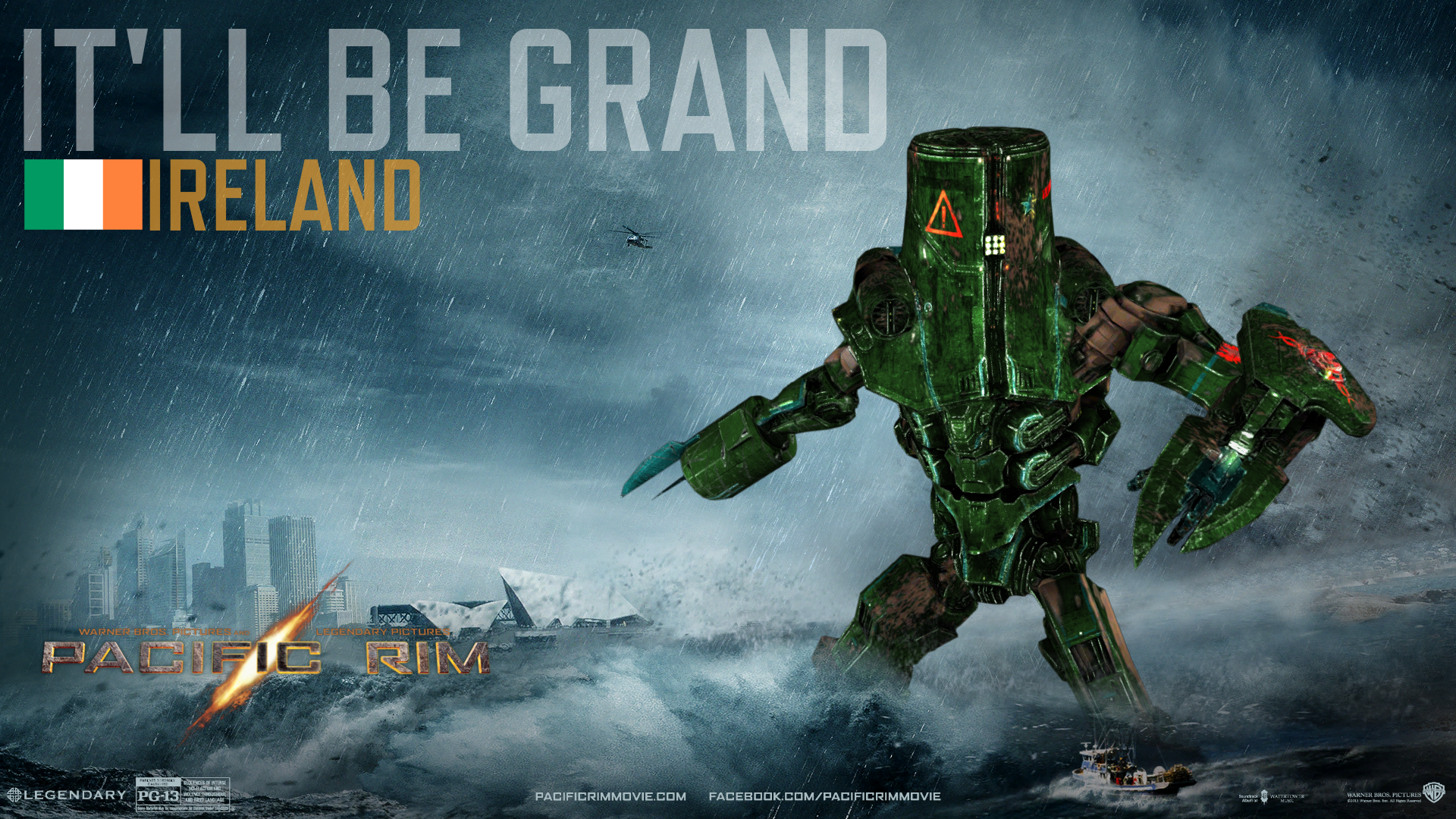
On the Personality of Monsters: Pacific Rim

Ireland's Contribution to the Kaiju War
Collateral damage? What collateral damage?


First things first: Pacific Rim is a movie about 25-storey-tall mechanoids smacking the protoplasm out of genetically engineered, city-destroying monstrosities. It is, therefore, immune to criticism on at least one level. If that’s your kind of thing, you should probably go watch it in the cinema. If it isn’t, you shouldn’t. That said, there’s a difference between criticism and critique.

This isn’t going to be a review, more a pondering of some points of design and storytelling. However, there will be spoilers, so it’s all below the cut.

Continue reading On the Personality of Monsters: Pacific Rim

A Game of Words

20130716-120344.jpg
Early days on the French language tree.

Duolingo (iOS and Android, Free)

My several years of iPhone experience have seen me fall prey to a number of apps. Addiction to horticultural zombie escapades, miniaturised high-rise management and Indiana Jones-style sprinting have all proved fun, but I wouldn’t have called them beneficial. Well, now I may have found an app that is both addictive and good for me.

Duolingo is a language-learning app, based on the web site of the same name. The concept behind the service is a simple one: crowdsourcing humanity’s efforts to learn new languages by getting them to translate web content. Because the learners are providing a service, the learning experience is free.

Of course, having a free service doesn’t mean much if the experience is no good. Luckily, Duolingo’s app doesn’t fall down on that score. It sports a clean, colourful design that’s both welcoming and easy to understand. Each language is presented as a tree of connected lessons that users progress through at their preferred pace, from basic comprehension to complex concepts.

Lessons consist of 20 exercises, each taking no more than a few seconds to complete, with four or more lessons grouped into themed nodes (food, animals, adjectives, etc.) on the learning tree. As a barely competent reader of French, the early lessons in that language were a useful refresher for me, but if I’d wanted to jump ahead, each node offers the chance to “test out” and complete the whole thing in one short lesson.

Gamification elements are put to good use here: users get three hearts per lesson, so they can make three errors before a fourth requires them to start over. Completing a lesson earns a users points and builds their in-app vocabulary, and the number of consecutive days they’ve been playing is recorded. The intelligence behind the app seems well tuned thus far, and will point out certain errors, like misplaced accents, but not penalise users for them.

One of the big problems with learning a language (and maintaining that knowledge) is the issue of practice. Duolingo covers this too. First by offering users the chance to strengthen the skills they’ve already earned and second by providing a leaderboard so they can compare their acheivements with their friends. I can’t speak to the success of the latter as yet, but it’s another example of game mechanics intruding beneficially into the non-game world.

The Duolingo app is comprehensive in its treatment of the five languages it covers (French, German, Spanish, Portuguese and Italian) and demonstrates a wealth of thoughtful touches in its design. One feature I’d love to see is a searchable vocabulary of words in each language, but as a relatively new app, there’s bound to be more to come from this initiative.

Carey Good Comics

20130626-101008.jpg
Take three in the morning and call me in the afternoon.

The Amazon fairy brought me some reading goodness over the past weekend, in the form of a trio of graphic novels from one of my favourite writers: Mike Carey. The first was a reprint of a series I’ve long had in the less-convenient monthly form, Lucifer, the latter two were the sixth and seventh installments of Carey’s current magnum opus, The Unwritten.

Lucifer was one of several spin-off series that DC Comics released in the wake of Neil Gaiman’s Sandman. Of all those spin offs, it came closest to the original in form and longevity, though Carey brought a very distinct tone to it. Whereas Sandman was a tour through mythology and storytelling, revolving around the enigmatic figure of Morpheus, Lucifer skews closer to a traditional quest tale, as the much more forceful title figure overcomes all obstacles as part of his plan to obtain his freedom from all authority and destiny.

Carey’s Lucifer hews closely to the Miltonian ideal of the ultimate rebel and borrows heavily from the “Magnificent Bastard” trope: an unsympathetic figure who’s just so damned (pun intended) impressive that you can’t help but root for him. Carey plays this up by regularly placing his protagonist in positions where he’s powerless and has him come out on top by out-thinking those who set themselves against him.

This beefy collected edition brings together the original Lucifer miniseries and the first 13 issues of the regular series. It’s far from perfect, as Carey seeks to find the right way to tell his tale and deals with changes in artist, but by the end it’s caught the wave that would carry it all the way to the end, the details of which I’m not going to spoil here.

The Unwritten is much more recent vintage Carey, sharing much of the same interest in myth and storytelling, but here using them as a theme rather than as props. Like Lucifer it builds on the work of another author, but here the chosen one is J.K. Rowling. The protagonist is the son of an author of a Harry Potter-like series, and his life is turned upside down when questions are asked about the links between him and his father’s most famous creation.

This isn’t just a Potter pastiche though. Carey’s interest is in how stories affect us and how we in turn affect them, and to explore this he tosses his likeable cast into a labyrinth of literary theories and allusions. Not that he wanders too far into the highbrow either: there are vampires and monsters aplenty to go with the ever-present Potterisms, and a multitude of mysteries to be uncovered.

As the books I received were well into the long-form story, I won’t discuss them here, other than to say that they continue the process of revealing the truth behind Carey’s universe of stories. It’s a journey that I’ve been enjoying ever since I picked up the first book. Carey as a writer has come on in leaps and bounds since Lucifer, and he was already pretty damn good then. Anyone with even a passing interest in myths and stories could do far worse than picking these tales up.

Personally Interested

Star of the show.
Jim Caviezel at ComicCon (via Genevieve719)

This Monday, RTE starts showing crime drama Person of Interest. The CBS show is one of the better recent offerings from a U.S. broadcast television industry that has mostly been left in the dust for quality by cable.

Fitting questions about surveillance, paranoia, vigilantism and computer sentience into its case-of-the-week structure, it’s cleverer than it has any right to be and digs into its themes without losing the qualities that make it appealing right from the off. But as much as I like it for the thought that’s gone into its creation, what really impressed me was its approach to its female characters.

The two leads are both male, fitting into the brain/brawn categories, with plenty of psychological damage in their makeup. There’s a supporting female cop, who follows a fairly standard antagonist-to-support role, well played by Taraji P. Henson. With her as with the rest of the female characters, a simple rule seems to be followed: the women are as capable and intelligent as the men. Moreover, they’re just as likely to be the bad guys as good guys.

It seems like a simple thing, but it’s rare. Our culture is rife with female stereotypes that writers have to work hard to avoid. One in particular, never far away when a female villain is involved, is the femme fatale. Pleasingly, right through its first season, Person of Interest stays well away from that one.

Why is this a good thing? After all, literature and film are full of femme fatales. The problem is that when you have a female villain, it’s too easy an option to reach for. The link between women, sexual allure and power over men is an unbalanced one: no male character is so defined by his ability to manipulate women. James Bond may be a lothario, but he’s much more besides.

That’s why femme fatales, while memorable, are not long-enduring characters. They’re expressions of a trope, one that states that a women who uses her sexual desirability as a weapon is dangerous, even evil. In contrast, culture tends to view men who seduce women as admirable.

I wonder how much of the show’s avoidance of the femme fatale is down to Jim Caviezel (who plays the brawn side of the central equation in an appealingly deadpan manner). Famously religious, he avoided naked scenes with his romantic interest in The Count of Monte Cristo out of respect for his wife. It doesn’t seem like too much of a stretch to think that the show’s avoidance of overt sexual themes is something that might have appealed to him. (There’s plenty of flirtation, but it’s underplayed.)

Of course, it’s possible to go too far the other way and be completely puritan in avoiding sex altogether. Person of Interest doesn’t go that far, and the point to all of this is that its female characters play on the same board as the men: matching wits with them and often winning. It’s good to see.

A Barricade of Bunting

20130113-142324.jpg
Hidden in the dazzle, the early evening protestors and their bunting.

In the end, it was a simple matter of stepping over a thin line of bunting stretched across the road. And then, later, walking through a line of mostly youngish men, hooded and masked. No one commented, or even looked my way. Even so, I felt my stomach knotting.

Why? There was no violence there, early on a wet night in Belfast, or later. (Though things did get hairy elsewhere and the next day.) The flag protests that have rolled across Northern Ireland for the past few weeks have been amply covered in the media, but this was my first direct contact with them. In place of brick and bottle throwing defiance, there was a slightly sullen matter-of-factness about the whole affair. Civil disobedience already turned into habit.

I’m not going to go into the justifications for the protests, which have already been covered elsewhere, except to note that few commentators on either side of the divide have dared to come out in support of violence as a response to putting a flag in a drawer as opposed to on a pole for most of the year. Unfortunately, both sides of the community in Northern Ireland are in the habit of launching the sort of street protest that inevitably leads to stone-throwing and worse. For the young and the hopeless, it’s better than dealing with the everyday grind.

So if I wasn’t facing violence, what was it that caused my stomach to curl in on itself? Some of it, perhaps, was a reminder of what I’d left behind. I’ve been in Dublin for a long time, and even when I lived in Northern Ireland it was in a relatively peaceful corner, where the Troubles mostly came in the form of daily news reports. In the North, old grievances run deep, and fears run along with them. Fear of the Other and what they might do if unchecked.

So the protests were a response to the apparent nationalist victory at getting the Union Jack taken off Belfast City Hall most days of the year. An effort by the loyalist community to throw their weight around, to prove to the police, nationalists and anyone watching that they could do so if they wanted. Swaggering is one word. Intimidation is another.

And it was that intimidation that my stomach was responding to. I’m not a violent person, and my first response to conflict is usually to avoid it. But when gangs decide to block passage along the Ormeau Road, as others did elsewhere that night, avoidance is no longer an option. Meekness works instead, avoiding eye contact and just passing by, hoping that the self-appointed big dogs have bigger fish to fry.

And where was I going that night? To Ravenhill, where an Ulster rugby team that has garnered the support of both sides of the community slogged their way to another victory in the rain. Among the flags there were plenty of Northern Ireland and Ulster banners, the best of which featured the Red Hand grasping a pint of Guinness. But no Union Jacks and no tricolours. We should all be so lucky.

December 2012 Book Reviews

20130107-221906.jpg
Arranged in ascending order of whatever explanation you prefer.

This last collection of book reviews for 2012 is a little late. Not, surprisingly, for reasons of laziness, but rather because I, well, cheated. The last book mentioned below, God’s War was begun and mostly read in December, but I only finished it yesterday. Which means, by the mostly arbitrary rules this blog follows, it should go in the January pile of reviews. However, there isn’t going to be a January pile.

Not that I’m going to stopping writing the reviews: I enjoy them too much. Specifically, I enjoy the challenge of summing up my thoughts on a book in just three readable sentences without resorting to ridiculously long run-on constructions. (And yes, sometimes I have resorted thusly, but I try not to.) However, what with the demands of college, which are only going to increase in the months ahead, there aren’t likely to be enough reviews to make a monthly pace sustainable.

Which is a pity, as it’s been a very handy way to ensure that I post at least once every month.

Anyway, the reviews will return, in some form, whenever I build up enough of them. For now though, enjoy the last of the current batch and I’ll wander off to dream up some new, non-time-consuming theme to ensure regular posting.

The Hobbit, J.R.R. Tolkien: In the run up to the movie, this was a must-read, and it was great to return to it, both for memories of reading it myself and of reading it to my little brother when he was in primary school. It’s not The Lord of the Rings by a long shot, but it remains very much a classic, this story of an unwilling everyman who finds that his unsuspected virtues are just what is needed on a quest to face down a dragon and recover a lost kingdom. Wonderful incidental touches punctuate an otherworldly story in a richly developed world, and one that takes little or no time to dive into and get yourself lost in.

Northlanders: The Icelandic Trilogy, Brian Wood et al.: Wood rounds off his “Viking” series with the story of an Icelandic settler family, from their earliest days on the island to the loss of independence at the hands of Norway. This is nation-building from the viewpoint of a family willing to do anything to build and hold what’s theirs, and it’s gritty and at times unpleasant stuff, as this is a series that has never shied away from the more squalid corners of Viking life. As a signoff for a series cancelled before its time, its suitably downbeat and defiant, and if the art is not going to suit every taste, the writing ably portrays lives as bleak and enduring as the landscape they inhabit with minimal strokes.

God’s War: A New History of the Crusades, Christopher Tyerman: This is a massive and exhaustive tome that examines all aspects of the crusading phenomenon over several centuries in an effort to create a coherent view of the world it sprang from and inflicted itself upon. Tyerman’s approach is to see the crusades not merely as a series of conflicts between the Christian and Muslim worlds, but rather as a way of life and a belief system that infected the European world for centuries. This approach sometimes leads him to jump back and forward in time to tie his points together, but it’s still a very readable account given the amount of detail it employs.

The Hobbit: An Unexpected Curate’s Egg

Image gleaned from Guardian.co.uk
Bilbo surrounded by misadventure

When Fellowship of the Ring came out in 2001, it was something very special. I’d been waiting for it for years, and I watched it with friends who had been waiting just as long, one of whom was only a few hours off a flight from San Francisco to Dublin. Inevitably, the release of The Hobbit wasn’t going to get the same degree of anticipation. But does it deserve the amount of opprobrium being thrown at it? (Including by some of those selfsame friends…)

Continue reading The Hobbit: An Unexpected Curate’s Egg