It’s my hope that the below won’t read like a rant, but it probably will. So, spoilers ahoy!
Continue reading Start Wreckin’: Searching for the Shallow Under the Shiny
It’s my hope that the below won’t read like a rant, but it probably will. So, spoilers ahoy!
Continue reading Start Wreckin’: Searching for the Shallow Under the Shiny

This Monday, RTE starts showing crime drama Person of Interest. The CBS show is one of the better recent offerings from a U.S. broadcast television industry that has mostly been left in the dust for quality by cable.
Fitting questions about surveillance, paranoia, vigilantism and computer sentience into its case-of-the-week structure, it’s cleverer than it has any right to be and digs into its themes without losing the qualities that make it appealing right from the off. But as much as I like it for the thought that’s gone into its creation, what really impressed me was its approach to its female characters.
The two leads are both male, fitting into the brain/brawn categories, with plenty of psychological damage in their makeup. There’s a supporting female cop, who follows a fairly standard antagonist-to-support role, well played by Taraji P. Henson. With her as with the rest of the female characters, a simple rule seems to be followed: the women are as capable and intelligent as the men. Moreover, they’re just as likely to be the bad guys as good guys.
It seems like a simple thing, but it’s rare. Our culture is rife with female stereotypes that writers have to work hard to avoid. One in particular, never far away when a female villain is involved, is the femme fatale. Pleasingly, right through its first season, Person of Interest stays well away from that one.
Why is this a good thing? After all, literature and film are full of femme fatales. The problem is that when you have a female villain, it’s too easy an option to reach for. The link between women, sexual allure and power over men is an unbalanced one: no male character is so defined by his ability to manipulate women. James Bond may be a lothario, but he’s much more besides.
That’s why femme fatales, while memorable, are not long-enduring characters. They’re expressions of a trope, one that states that a women who uses her sexual desirability as a weapon is dangerous, even evil. In contrast, culture tends to view men who seduce women as admirable.
I wonder how much of the show’s avoidance of the femme fatale is down to Jim Caviezel (who plays the brawn side of the central equation in an appealingly deadpan manner). Famously religious, he avoided naked scenes with his romantic interest in The Count of Monte Cristo out of respect for his wife. It doesn’t seem like too much of a stretch to think that the show’s avoidance of overt sexual themes is something that might have appealed to him. (There’s plenty of flirtation, but it’s underplayed.)
Of course, it’s possible to go too far the other way and be completely puritan in avoiding sex altogether. Person of Interest doesn’t go that far, and the point to all of this is that its female characters play on the same board as the men: matching wits with them and often winning. It’s good to see.
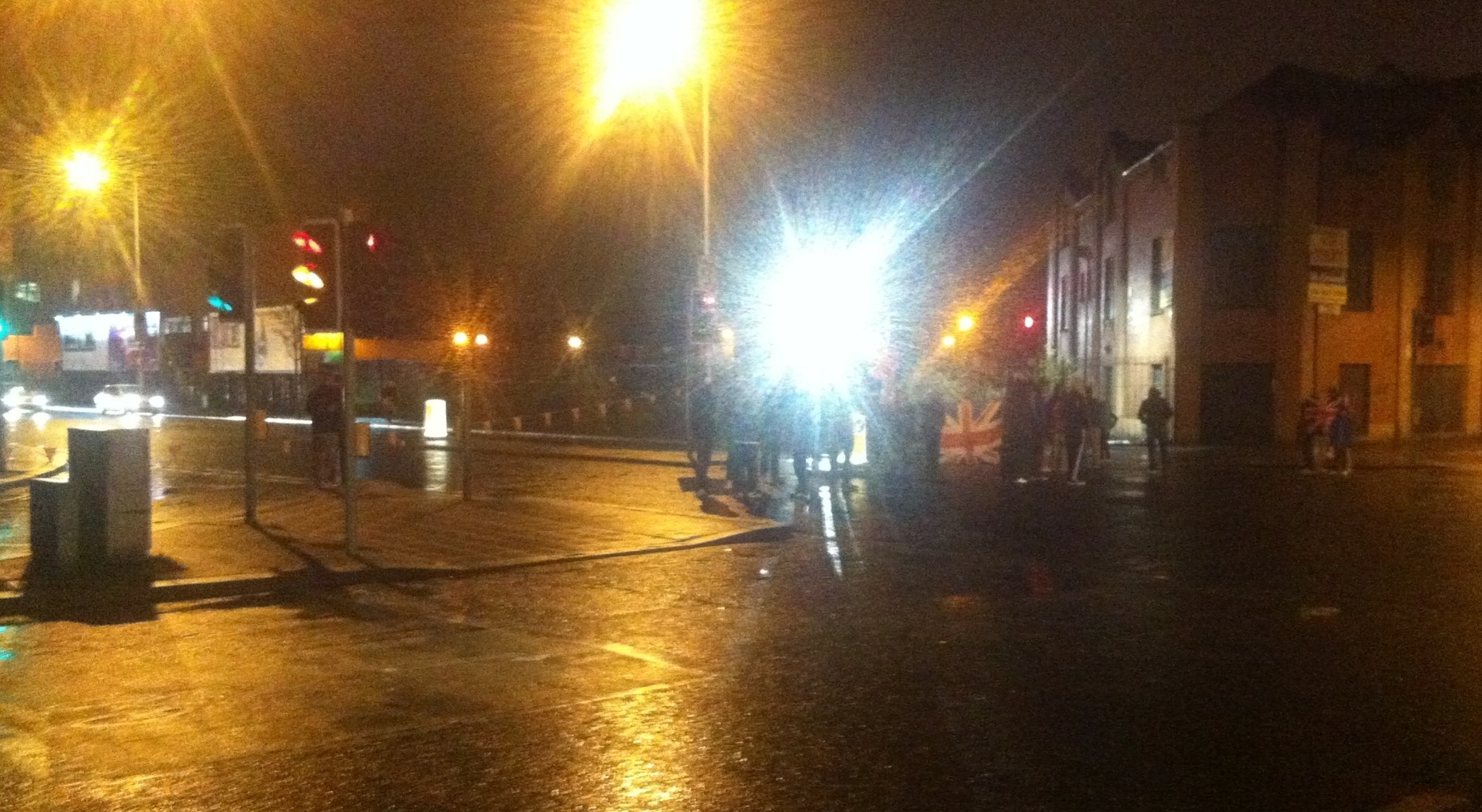
Hidden in the dazzle, the early evening protestors and their bunting.
In the end, it was a simple matter of stepping over a thin line of bunting stretched across the road. And then, later, walking through a line of mostly youngish men, hooded and masked. No one commented, or even looked my way. Even so, I felt my stomach knotting.
Why? There was no violence there, early on a wet night in Belfast, or later. (Though things did get hairy elsewhere and the next day.) The flag protests that have rolled across Northern Ireland for the past few weeks have been amply covered in the media, but this was my first direct contact with them. In place of brick and bottle throwing defiance, there was a slightly sullen matter-of-factness about the whole affair. Civil disobedience already turned into habit.
I’m not going to go into the justifications for the protests, which have already been covered elsewhere, except to note that few commentators on either side of the divide have dared to come out in support of violence as a response to putting a flag in a drawer as opposed to on a pole for most of the year. Unfortunately, both sides of the community in Northern Ireland are in the habit of launching the sort of street protest that inevitably leads to stone-throwing and worse. For the young and the hopeless, it’s better than dealing with the everyday grind.
So if I wasn’t facing violence, what was it that caused my stomach to curl in on itself? Some of it, perhaps, was a reminder of what I’d left behind. I’ve been in Dublin for a long time, and even when I lived in Northern Ireland it was in a relatively peaceful corner, where the Troubles mostly came in the form of daily news reports. In the North, old grievances run deep, and fears run along with them. Fear of the Other and what they might do if unchecked.
So the protests were a response to the apparent nationalist victory at getting the Union Jack taken off Belfast City Hall most days of the year. An effort by the loyalist community to throw their weight around, to prove to the police, nationalists and anyone watching that they could do so if they wanted. Swaggering is one word. Intimidation is another.
And it was that intimidation that my stomach was responding to. I’m not a violent person, and my first response to conflict is usually to avoid it. But when gangs decide to block passage along the Ormeau Road, as others did elsewhere that night, avoidance is no longer an option. Meekness works instead, avoiding eye contact and just passing by, hoping that the self-appointed big dogs have bigger fish to fry.
And where was I going that night? To Ravenhill, where an Ulster rugby team that has garnered the support of both sides of the community slogged their way to another victory in the rain. Among the flags there were plenty of Northern Ireland and Ulster banners, the best of which featured the Red Hand grasping a pint of Guinness. But no Union Jacks and no tricolours. We should all be so lucky.
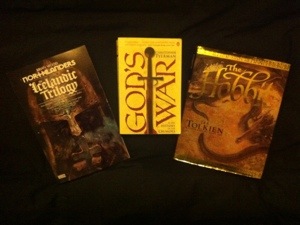
Arranged in ascending order of whatever explanation you prefer.
This last collection of book reviews for 2012 is a little late. Not, surprisingly, for reasons of laziness, but rather because I, well, cheated. The last book mentioned below, God’s War was begun and mostly read in December, but I only finished it yesterday. Which means, by the mostly arbitrary rules this blog follows, it should go in the January pile of reviews. However, there isn’t going to be a January pile.
Not that I’m going to stopping writing the reviews: I enjoy them too much. Specifically, I enjoy the challenge of summing up my thoughts on a book in just three readable sentences without resorting to ridiculously long run-on constructions. (And yes, sometimes I have resorted thusly, but I try not to.) However, what with the demands of college, which are only going to increase in the months ahead, there aren’t likely to be enough reviews to make a monthly pace sustainable.
Which is a pity, as it’s been a very handy way to ensure that I post at least once every month.
Anyway, the reviews will return, in some form, whenever I build up enough of them. For now though, enjoy the last of the current batch and I’ll wander off to dream up some new, non-time-consuming theme to ensure regular posting.
The Hobbit, J.R.R. Tolkien: In the run up to the movie, this was a must-read, and it was great to return to it, both for memories of reading it myself and of reading it to my little brother when he was in primary school. It’s not The Lord of the Rings by a long shot, but it remains very much a classic, this story of an unwilling everyman who finds that his unsuspected virtues are just what is needed on a quest to face down a dragon and recover a lost kingdom. Wonderful incidental touches punctuate an otherworldly story in a richly developed world, and one that takes little or no time to dive into and get yourself lost in.
Northlanders: The Icelandic Trilogy, Brian Wood et al.: Wood rounds off his “Viking” series with the story of an Icelandic settler family, from their earliest days on the island to the loss of independence at the hands of Norway. This is nation-building from the viewpoint of a family willing to do anything to build and hold what’s theirs, and it’s gritty and at times unpleasant stuff, as this is a series that has never shied away from the more squalid corners of Viking life. As a signoff for a series cancelled before its time, its suitably downbeat and defiant, and if the art is not going to suit every taste, the writing ably portrays lives as bleak and enduring as the landscape they inhabit with minimal strokes.
God’s War: A New History of the Crusades, Christopher Tyerman: This is a massive and exhaustive tome that examines all aspects of the crusading phenomenon over several centuries in an effort to create a coherent view of the world it sprang from and inflicted itself upon. Tyerman’s approach is to see the crusades not merely as a series of conflicts between the Christian and Muslim worlds, but rather as a way of life and a belief system that infected the European world for centuries. This approach sometimes leads him to jump back and forward in time to tie his points together, but it’s still a very readable account given the amount of detail it employs.

When Fellowship of the Ring came out in 2001, it was something very special. I’d been waiting for it for years, and I watched it with friends who had been waiting just as long, one of whom was only a few hours off a flight from San Francisco to Dublin. Inevitably, the release of The Hobbit wasn’t going to get the same degree of anticipation. But does it deserve the amount of opprobrium being thrown at it? (Including by some of those selfsame friends…)

So many people looking for books as Christmas presents.
Yes, this is very late. I’ve been busy. College stuff, you know? Of which more, hopefully, anon. More on a lot of things anon, with any luck. The first semester is over, and I may just take a few days to reset my brain before the Christmas break, during which I’ll have more College stuff to do. Of course.
In the meantime though: reviews!
Half-Real: Video Games between Real Rules and Fictional Worlds, Jesper Juul: Exactly what are games, and video games in particular, and how are they defined by the real rules that players interact with and the fictional worlds the games themselves present? Juul takes a systematic approach to both elements of video games, exploring first their presence in games throughout history, then their development in the video game era, then looking at how video games have combined both elements, either successfully or not so successfully. Though laden with examples and thoroughly explained and footnoted, this is a very readable tour through video game history and explanation of a theory of game design and development.
The Visual Display of Quantitative Information, Edward R. Tufte: A classic in the annals of graphic design, this is a survey of the use and abuse of charts and tables, breaking down every technique going and then building up a new methodology to guide anyone seeking to convey data through the intelligent application of ink. Tufte is a laconic host for this process, saying no more than he has to as he praises the best charts and dryly demolishes the foolishness, frippery and plain misleading imagery of the worst. In the end, the reader will at the very least know how to charts better than they did before, and if they make charts regularly, they may just want to own a copy for their reference library.
The Walking Dead Compendium 2, Robert Kirkman and Charlie Adlard: Collecting another fifty or so issues of the indie zombie comic hit, this is a solid slab of post-apocalyptic depression literature in which horrible things happen to good people who have no choice but to become not-so-good so that bad things don’t continue to happen, at least not quite so often. This large chunk of the story allows the reader to get a feel for where Kirkman is going with his series, but sadly despite a more upbeat turn towards the end, there’s still no strong through-line beyond survival and a vague hope for the return of civilisation. As the threat of the walking dead is replaced by that of other humans, Adlard’s art remains as impressive in rendering a bleak, hopeless world as always, but it’s the details of the story that will require the strongest stomach from readers who get no humour and few rays of light to leaven the misery.
Dodger, Terry Pratchett: Not quite fantasy and not quite history, this is a tour through the grimier corners of Victorian London, in the company of another of Terry Pratchett’s sharp operators and an array of supporting characters, both historical and fictional. As he nears the end of his career, Pratchett seems determined to forge happy endings from the most unlikely material, and though as a result there’s little narrative tension here, it’s still a tale delightfully told. A lot of the appeal comes from the historical detail, and while there’s far more warmth than humour, it’s hard to imagine that there are many people who won’t find themselves smiling at least once or twice.

I’ve noted a tendency in myself to be overly mysterious in this blog. It’s the drama ham side of me, which doesn’t get many chances to emerge into the light. So when I said that I would talk a little about the things making my life busy lately, I did mean to. It’s just that I’ve been, well, busy.
About a month and a week ago, I returned to college for the first time in just over 14 years. The initial experience was somewhat akin to taking a point-blank blast in the face from the shotgun of knowledge. In a good way. Trinity’s MSc in Interactive Digital Media is nothing if not comprehensive. Over the course of one year, students are expected to absorb as many elements of media theory and production as their tiny minds can cope with. From the practicality of programming, web authoring or 3D modelling to the theoretical realms of cultural and critical theory or interactive narratives, it’s all covered here, and the result is a 9-to-5 (or more) immersion in all aspects of the modern media world.
At this early stage, I’m pleased to say that it’s been not only fascinating but even fun at times. I had a grounding in some fields from previous educational forays (cultural and critical theory, in particular) and from general interest and reading (game design and development, for example), and my liking for puzzling out solutions has helped me to scramble through the early weeks of courses where I was going in more or less blind (programming and 3D modelling). Of course, it helped that the rest of the students have proven to be not only impressively able but also a very friendly bunch.
Almost as interesting, at least to me, is how the course is structured. Each module stands alone, and even the individual strands within those modules are clearly delineated. Even so, there are names and references that crop up across strands, and it’s not hard to see that somewhere further down the line, all of this is going to start fitting together. Maybe not in time for our individual research papers (due early next year), but certainly in time for the group projects that take the place of our final dissertations.
If I may be allowed another metaphor (and I am, because metaphors are cool now), we’re in the “wax-on, wax-off” stage of the Karate Kid. Learning all the basic moves that we’ll string together into massively impressive multimedia projects somewhere further down the line. That’s my theory as to what the idea behind the course is anyway, and right at the moment I feel rather optimistic about getting there.
For now though, I have a reading week without classes and a long list of assignments to get back to. Which reminds me that I’ve probably spent way too long writing this…
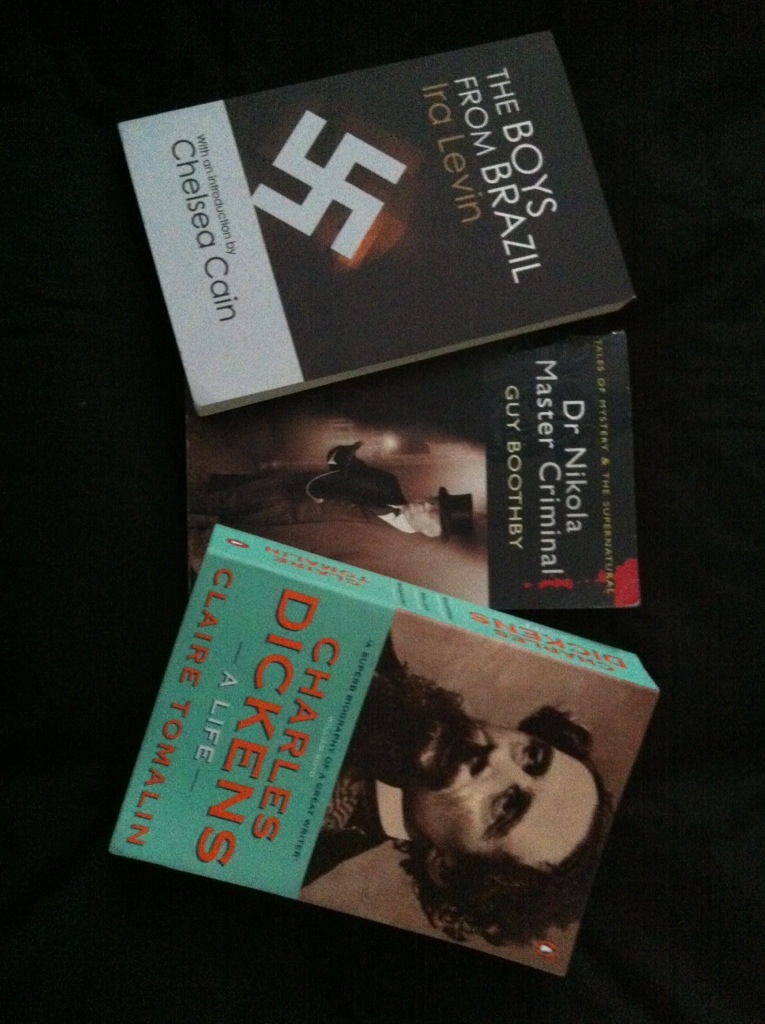
Light, medium and heavy reading.
A quiet month on the book front, due to circumstances about which I’ll be going into more detail anon. The next few months are likely to be just as quiet if not more so on the fiction-reading front, but other things are going to be filling in. So more details on that soon, but for the moment, here are some views on books that came my way last month. (Three of which, by the way, were birthday presents – so thanks John!)
The Boys From Brazil, Ira Levin: A classic of the thriller genre, with the best villains of all – Nazis – pitted against an aging, tired hunter faced with a an unthinkable plot. Levin lays out all the elements of the plot carefully, playing each card at the right time all the way up to the final confrontation. If you’ve seen the movie, then the central twist has already been revealed, but knowing it hardly spoils the book, and in fact the book even explores its ramifications more deeply, though the very last page might be a little too cliched.
Revolution 2.0, Wael Ghonim: A personal memoir of the revolution that toppled Egypt’s government in January and February 2011, told by the Google marketing executive who inspired much of it, this is an eye-opening tale of just what can be achieved through social media. Despite his post at Google, Ghonim’s point of view is a solidly Middle Eastern one, and his revolutionary activities were born out of a love of his country and a desire for justice—two traits that saw him abducted just as the revolution was reaching its height. This is a personal story rather than a blueprint for similar activities elsewhere, and it is unapologetically focused on Egypt, but anyone who is interested in how governments and the Internet are likely to interact in years to come, it’s a must read.
Doctor Nikola, Master Criminal, Guy Boothby: The tales of Doctor Nikola, a gentlemanly criminal mastermind, and his more rough-and-tumble adversaries and compatriots, were exceptionally popular in their time, and two of them are collected here. Boothby’s prose has not dated as well as some, and his action is now too reserved for pulpish excitement and his writing too stilted to get anywhere near the imprimatur of serious literature. However, as a window into British Victorian attitudes and a snapshot of a world where there was still adventure and mystery beyond the horizon, it’s a fascinating diversion.
Charles Dickens: A Life, Claire Tomalin: England’s most representative author gets a thorough going-over from Claire Tomalin, revealing the exceptional talents and the the darker corners of someone who did his best to live up to his own legend. Splitting her attention more or less equally between the man and his works, Tomalin isn’t afraid to point out where Dickens fell short, and indeed she does so with such regularity that you have at times to wince for a man who was protective of his own reputation in his lifetime. Yet with all his flaws and failings, Dickens still manages to come through as someone deserving of his status, and this is an exceptionably readable portrait of a man of genius and the world he inhabited and depicted with unsurpassed skill.

One of Dublin’s better bookshops. Very handy for Trinity students.
A quiet enough month for reading, dominated as it was by preparations for my return to college. Mostly light reading in what I did manage to get into, insofar as weighty fantasy tomes can be described as “light”. I’m not hopeful of getting much more in during the months to come either, so thin slivers of reviews may become the norm for a while.
Accelerando, Charles Stross: In charting the future history of the human race across the 21st century, as seen through the eyes of a very dysfunctional family, Stross flings out so many ideas and theories that the casual reader is likely to drown without some kind of grounding in modern science and science fiction. Moments of genuine human emotion are present, but they surface all too rarely amid the crashing waves of future shock, and as the novel goes on, it gets harder and harder to maintain the pretense of a link between reality and the events being portrayed. It’s an intriguing book, even a fascinating one if the changes occuring now and in the future to humanity are of interest to you, and Stross is a very clever writer, but its focus on humanity as an abstract whole rather than a personal characteristic is its gaping flaw.
Moranthology, Caitlin Moran: A collection of newspaper columns from the career of the author of How to be a Woman, this is by turns hilarious and affecting as it hops across every topic from womens’ rights to personal history to the hotness of Benedict Cumberbatch. Comberbatch is in fact a recurring theme, and Moran is no less effective when she’s gushing over him as she is when she’s interviewing Keith Richards or Paul McCartney. Blessed with a fine turn of phrase and a winning way with wild metaphors (David Cameron as a camp robot made of ham being one such), she’s like a less grumpy Charlie Brooker, and if her enthusiasm for certain subjects does sometimes get the better of her, it’s far from the worst problem for an author to have.
Gardens of the Moon, Steven Erikson: The self-consciously epic “Malazan Book of the Fallen” series starts off with powers both profane and sacred converging on a doomed city and fighting over not just its fate but that of an entire world. This is fantasy as archaeology, with layers of lost races and civilisations and the reader left to consult the voluminous appendices as the author delights in throwing in yet more twists and new players every time they might be getting on top of all the schemes and counter-schemes. This is not a book for the impatient, nor for fantasy virgins, but for those who enjoy grimy, doomed characters struggling to survive in a world of gods and monsters warring over fate itself, it has a lot to recommend it.

Front Square during Freshers Week: Societies a-go-go
The other day, I mentioned to someone in the pub that I graduated from Trinity College Dublin back in 1998. His response? “Wow, I was ten then.”
Now, I quite like the grey in my stubble, and references to my advanced years rarely bother me. However, there was one difference with this comment: the guy I was talking to wasn’t just a stranger in a pub. He was a classmate.
That’s right: after a gap of fourteen years, I’m heading back to college. Specifically back to Trinity. My goal? To study for an MSc in Interactive Digital Media, a one-year, full-time course. It’s been a strange experience so far; nostalgia and novelty in equal measure.
My first four years in Trinity were a time of change. The college was getting wired up to the Internet and making the most of the nascent boom as it fundraised for new buildings. Over the course of my degree, I made lifelong friends, got my first email address, and found myself a new place to live. I settled in Dublin, got myself a job, and have never been away for long since then.
Even so, reentering education has offered up a lot that’s familiar. Freshers Week, with its host of society kiosks in Front Square, is much the same as ever. The Sports Centre is new since I was a student, but seeing as my fees paid for it and I’ve been using it as a graduate, it’s not exactly novel. All the strangeness, in fact, comes from the fact that I’m in a very different position to my former student life.
Let’s not mince words here: in my class, I’m the oldest, by a good few years. Most of the rest of the class are a few years at most from their graduation. They seem like a great crowd though, and there seems to be a common eagerness to develop an esprit de corps. Given that a lot of the work we’ll be doing is team-based, that can only be positive.
So I doubt I’m going to feel like an outsider here. Even so, most of my fellow postgrads still have the habits of education ingrained in their heads. How much of that has survived a decade and more of a working life? I’m about to find out.

