Category Archives: Books

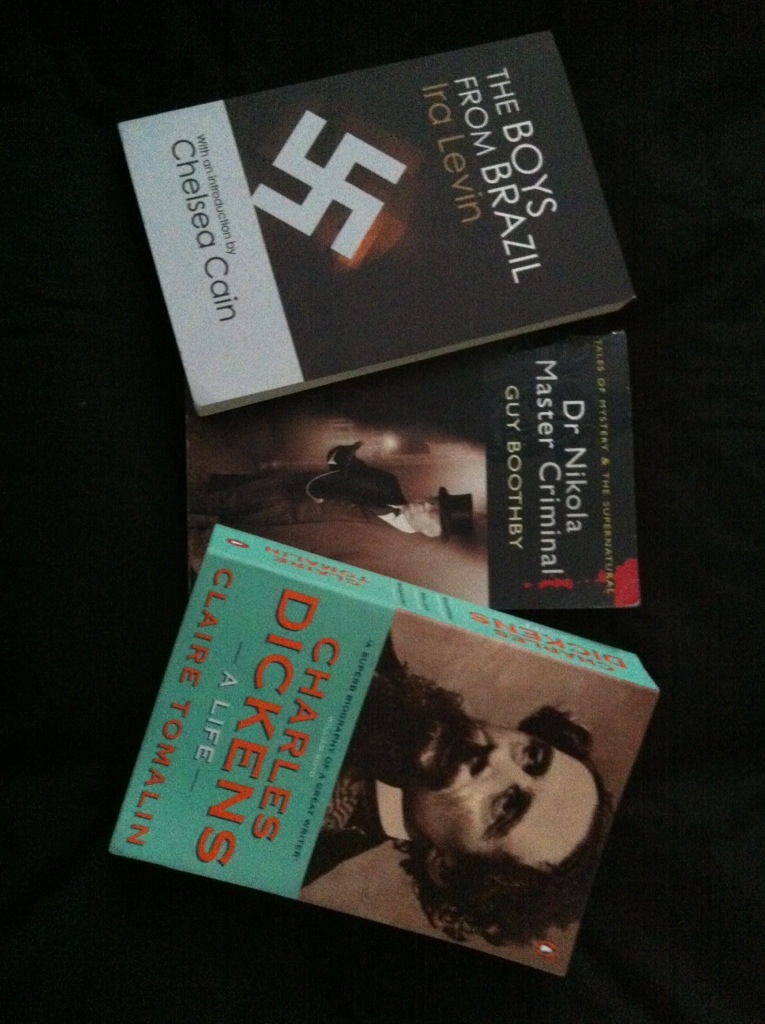
October Book Reviews

20121103-090904.jpg
Light, medium and heavy reading.

A quiet month on the book front, due to circumstances about which I’ll be going into more detail anon. The next few months are likely to be just as quiet if not more so on the fiction-reading front, but other things are going to be filling in. So more details on that soon, but for the moment, here are some views on books that came my way last month. (Three of which, by the way, were birthday presents – so thanks John!)

The Boys From Brazil, Ira Levin: A classic of the thriller genre, with the best villains of all – Nazis – pitted against an aging, tired hunter faced with a an unthinkable plot. Levin lays out all the elements of the plot carefully, playing each card at the right time all the way up to the final confrontation. If you’ve seen the movie, then the central twist has already been revealed, but knowing it hardly spoils the book, and in fact the book even explores its ramifications more deeply, though the very last page might be a little too cliched.

Revolution 2.0, Wael Ghonim: A personal memoir of the revolution that toppled Egypt’s government in January and February 2011, told by the Google marketing executive who inspired much of it, this is an eye-opening tale of just what can be achieved through social media. Despite his post at Google, Ghonim’s point of view is a solidly Middle Eastern one, and his revolutionary activities were born out of a love of his country and a desire for justice—two traits that saw him abducted just as the revolution was reaching its height. This is a personal story rather than a blueprint for similar activities elsewhere, and it is unapologetically focused on Egypt, but anyone who is interested in how governments and the Internet are likely to interact in years to come, it’s a must read.

Doctor Nikola, Master Criminal, Guy Boothby: The tales of Doctor Nikola, a gentlemanly criminal mastermind, and his more rough-and-tumble adversaries and compatriots, were exceptionally popular in their time, and two of them are collected here. Boothby’s prose has not dated as well as some, and his action is now too reserved for pulpish excitement and his writing too stilted to get anywhere near the imprimatur of serious literature. However, as a window into British Victorian attitudes and a snapshot of a world where there was still adventure and mystery beyond the horizon, it’s a fascinating diversion.

Charles Dickens: A Life, Claire Tomalin: England’s most representative author gets a thorough going-over from Claire Tomalin, revealing the exceptional talents and the the darker corners of someone who did his best to live up to his own legend. Splitting her attention more or less equally between the man and his works, Tomalin isn’t afraid to point out where Dickens fell short, and indeed she does so with such regularity that you have at times to wince for a man who was protective of his own reputation in his lifetime. Yet with all his flaws and failings, Dickens still manages to come through as someone deserving of his status, and this is an exceptionably readable portrait of a man of genius and the world he inhabited and depicted with unsurpassed skill.

September Book Reviews

20121007-224640.jpg
One of Dublin’s better bookshops. Very handy for Trinity students.

A quiet enough month for reading, dominated as it was by preparations for my return to college. Mostly light reading in what I did manage to get into, insofar as weighty fantasy tomes can be described as “light”. I’m not hopeful of getting much more in during the months to come either, so thin slivers of reviews may become the norm for a while.

Accelerando, Charles Stross: In charting the future history of the human race across the 21st century, as seen through the eyes of a very dysfunctional family, Stross flings out so many ideas and theories that the casual reader is likely to drown without some kind of grounding in modern science and science fiction. Moments of genuine human emotion are present, but they surface all too rarely amid the crashing waves of future shock, and as the novel goes on, it gets harder and harder to maintain the pretense of a link between reality and the events being portrayed. It’s an intriguing book, even a fascinating one if the changes occuring now and in the future to humanity are of interest to you, and Stross is a very clever writer, but its focus on humanity as an abstract whole rather than a personal characteristic is its gaping flaw.

Moranthology, Caitlin Moran: A collection of newspaper columns from the career of the author of How to be a Woman, this is by turns hilarious and affecting as it hops across every topic from womens’ rights to personal history to the hotness of Benedict Cumberbatch. Comberbatch is in fact a recurring theme, and Moran is no less effective when she’s gushing over him as she is when she’s interviewing Keith Richards or Paul McCartney. Blessed with a fine turn of phrase and a winning way with wild metaphors (David Cameron as a camp robot made of ham being one such), she’s like a less grumpy Charlie Brooker, and if her enthusiasm for certain subjects does sometimes get the better of her, it’s far from the worst problem for an author to have.

Gardens of the Moon, Steven Erikson: The self-consciously epic “Malazan Book of the Fallen” series starts off with powers both profane and sacred converging on a doomed city and fighting over not just its fate but that of an entire world. This is fantasy as archaeology, with layers of lost races and civilisations and the reader left to consult the voluminous appendices as the author delights in throwing in yet more twists and new players every time they might be getting on top of all the schemes and counter-schemes. This is not a book for the impatient, nor for fantasy virgins, but for those who enjoy grimy, doomed characters struggling to survive in a world of gods and monsters warring over fate itself, it has a lot to recommend it.

August Book Reviews

20120901-122337.jpg
Not all of my books are for entertainment. Just most of them…

Not too much fiction this month, but plenty of history, psychology and literary advice. All of which adds up to, well, probably a need to dive into something a little more lightweight in September, what with all the craziness about to be fighting for my brain space.

In the Shadow of the Sword, Tom Holland: Holland has made a career out of examining turning points in history, and this time he dives into one of the most contentious and mystery-shrouded upheavals: the birth of Islam and the world that it overturned. He first delineates the nature of that world, then offers up a strong argument that Islam was not so much a new divine revelation as a new tapestry woven out of the threads of the old world. Covering a vast span of space and time, it remains readable despite the depth of detail, as all of Holland’s books have been, but with few strong and vivid characters, readers might struggle to find an entry point into this strange world of clashing civilisations, religions and desires for domination.

Style: The Art of Writing Well, F.L. Lucas: A classic among books on writing, yet out of print for four decades, Lucas’s book excels in practicing what it preaches: it not only tells one how to write well, but it is also written well. The modern reader will occasionally bump against the author’s viewpoint (that of a scholarly Englishman in the post-World War II world), but his advice is always easy to understand, often funny, and bolstered with examples of the finest writing in many languages. Only one of the eleven chapters delves into technical matters – the rest cover more fundamental issues of style, focusing on how writers can best communicate with readers and providing plenty for both to learn from and enjoy.

Ancient Echoes, Robert Holdstock: Once more delving into the psychological and mythical depths that provided him with the material for Mythago Wood, Holdstock provides a tale that feels more specific and grounded, yet less satisfying at the same time. To a large degree, the meat of the story takes place within the psyche of the protagonist, with the narrative point of view zooming in and out relative to how deep the story is delving, and as he comes face to face with remnants of prehistoric time, buried cities and their need for vengeance, and the threat of marriage and parenthood dissolving. It’s a heady brew to manage, and it never quite comes together, with a heavy expository passage towards the end and a reliance on a rather literal deus ex machina to bring it all to some sort of closure.

I, Claudius, Robert Graves: Fact and fiction form a perfect mix in Graves’ famous pseudo-memoir of the fourth Emperor of Rome. Ever the outsider, Claudius observes the long, tortured decline of his family, from the travails of Augustus to the depravity of Tiberius and insanity of Caligula, not sparing his own foibles and failings as he presents a picture of lethal ambition that is surprisingly fresh and modern. For all the evident depth of research underlying this work, it’s an easy read, with an unassuming narrator who capably manages his sprawling cast.

The Twelve Caesars, Suetonius (translated by Robert Graves): The lives of the rulers of Rome, from Julius Caesar to Domitian, are laid out in cleared-eyed detail in this fine edition of the classic set of biographies. Suetonius pulls no punches when it comes to describing the worst qualities of the Caesars, but nor does he neglect to mention the finer moments of even the worst of them, and the result is an even handed description of the rulers that Rome suffered and gloried in during the first century AD. In the wealth of incidental detail he provides, there’s plenty to be learned about Roman society and morals, and in his determination to stick with the facts he can find, Suetonius is surprisingly modern (apart from a recurring focus on the importance of omens and auguries in the life and death struggles over the rulership of Rome).

The Brain that Changes Itself, Norman Doidge: In a series of eye-opening case studies, Doidge reveals the brain’s ability to change itself to recover from trauma and to continue to change all the way through adulthood and old age. Overturning the notion of the brain as a machine that gets more and more fixed in its ways from childhood onwards, he shows in inspiring fashion that every one of us is capable of gaining new knowledge and behaviours all through our lives. Although it seems on some places too good to be true, if even a portion of its potential is real, this is a book worth owning, not just reading.

Schadenfreude, or The Little Book of Black Delights, Tim Lihoreau: I will happily admit to suffering from “calicurrophilia”, and while I am resistant to the appeal of “tollophilia”, “mecutempophilia” is another matter (though that might be saying entirely too much). Adopting the tone of an upper-class English savant, Lihoreau takes readers on a ride through the spurious offshoots of schadenfreude, in the form of delights in varying shades of grey and black, with titles that twist the scholarly use of Latin far beyond what it was intended to achieve. It’s not a laugh-out-loud book, but there are few who will read it without finding themselves smiling involuntarily when they are reminded of a pleasure that they perhaps should be more than a little ashamed of.

July Book Reviews

20120804-190629.jpg
Nothing to do with books, just a visual representation of my state of mind.

In the absence of anything resembling a summer, it was no hardship to retreat into a few good books (and at least one not so good). Wholly fiction this time out, if with a hint of history in some of the pieces reviewed. Plus, my first review of a graphic novel and a stand-out piece at that.

The Betrayal, Helen Dunmore: In the years after World War II, a Leningrad doctor and his family find themselves caught up in the politics of paranoia and fear, where the desire to be a good human being comes into conflict with the need to protect oneself and those one cares about. Deeply researched, this is a very human story taking place in a world that feels entirely genuine, from the daily lives of those surviving in the last days of Stalin’s reign to the constant fear of the political apparatus that surrounds them and crushes those that come to its notice. It never hits the heights of drama, but that’s not really the point: this is a human story of endurance and patience, one in which the small victory of surviving is enough to overcome the terror of being mangled by the machinery of an oppressive state.

Seven Days in New Crete, Robert Graves: Cast into a future utopia founded on Goddess worship and occult social control, a poet finds himself the catalyst for the introduction of evil as a force for change. Writing in the wake of WWII, from the perspective of a veteran of WWI, Graves is clinical as he cuts into the notion of how ensuring the best of all possible worlds can’t account for the imperfections and the desires of the human heart. His vision of a future grown stagnant in its peaceful compacency is a chilly one, even as it builds towards a frenzied climax, but it’s the voice of the observer who comes to understand the world he finds himself in even as he begins the process of its disintegration that makes this worth reading.

A Visit from the Goon Squad, Jennifer Egan: Charting a spiral course through the lives of an interconnected group of characters, Egan’s novel constucts a web-like frame on which she hangs the struggles of those characters to connect, comprehend and survive everything that life throws at them, as well as their decisions to maintain their masks or reveal their fragile selves. That unusual structure provides much of the life for this novel, which paints its characters in humour and desperation as they strut their brief moments on the stage before stepping into the background of someone else’s tale. It’s an easy book to become attached to, and it’s over all too soon.

Surface Detail, Iain M. Banks: Returning to the Culture, his galactic society of hyper-intelligent AIs and adventurous and occasionally lost humans and aliens, for a tale of war, revenge and heaven and hell, Banks proves himself in fine, if somewhat light, form. The central conceit of artificially constructed hells and a war fought over the moral right to destroy them interweaves with a woman seeking revenge for her own murder, but this is a romp with disturbing overtones rather than an exploration of deeper themes. Tinged with more Adamsian touches than usual, particularly in the form of a warship AI absurdly delighted at the opportunity to exercise his gifts, but this is a fine addition to the series of Culture novels in its own right, albeit one where the whimsy occludes the admittedly heavy subject matter.

Criminal: The Deluxe Edition, Ed Brubaker and Sean Phillips: Brubaker and Phillips are one of the finest writer-artist teams in comics, and this beautifully presented collection of three interwoven tales of betrayal and secrets among the criminal fraternity is a fantastic introduction to their oeuvre. Damned by their own pasts, the protagonists of the three tales may be the most moral of the characters inhabiting their shared world, but that’s a relative term, and the world of the lawless that they inhabit is one where no-one has clean hands and the spark of hope is always at risk of being snuffed out by someone more brutal or better prepared to step beyond the bounds of the unthinkable. Phillips’ scratchy, yet solid, art perfectly matches Brubaker’s terse dialogue and descriptive narration, and together they create a world of dark corners and filthy alleys that’s impossible not to get sucked into.

Mythago Wood, Robert Holdstock: Delving back deeper than Tolkienian fantasy, Holdstock works with the clay of primal mythmaking as he crafts a tale of a family whose encounters with the last vestiges of chilly antiquity change them utterly. Steeped in British folklore and spanning the human imagination from the last ice age to the second world war, this is a story in which the very human emotions of love and loss are rooted in and sometimes overwhelmed by the unconscious need to craft stories out of the world that surrounds us. Deservedly a modern classic of the fantasy genre, it’s a fascinating read, dominated by the stunning creation of the myth-infused world that lies within a single scrap of primeval woodland.

The Bone Hunters, Tom Holland: When one of your leading characters is a “naive but wilful heiress,” you know that you’re in for a traditional romance, for all that the setting is the Bone Wars between palaeontologists in 19th century U.S., amid the blood and recrimination of the Indian Wars. So it proves to be, though that’s a far less important sin for this book than the kludgy language and the choice of the author to mark every encounter and glance between two characters with at least three paragraphs of insight, flashback and emotional resonance. There’s an interesting story here, one with historical resonance and clever use of its setting, but it’s buried very, very deeply by the language and syntax, and I’m still not altogether sure it was worth unearthing it.

June Book Reviews

20120702-102108.jpg
A slice of bookshelf, from Malory to Moore

Another month that seemed to be heading down a quiet path as far as book reading went was turned around by a lazy weekend at the parents’ place, which allowed me to polish off three titles. I guess there’s something to be said for having a few days where you attempt to merge with the couch through osmosis…

;

Night of Knives, Ian C. Esselmont: A stand-alone story set in the world of Steven Erikson’s “Malazan” tales, this is almost as dense in terms of detail as that series, which is to be expected coming from the setting’s co-creator. Set over the course of a single night, it provides a meaningful chunk of backstory to Erikson’s opus, and as a result is probably required reading for diehard fans of the Malazan books. However, it’s not quite as wild and baroque as the series it springs from, and in the course of a single book it cannot explain all the elements of the world that it draws upon, leaving it solely for fans, perhaps.

At Swim Two Birds, Flann O’Brien: Irish myth and folklore twist together with the bluster and verbosity of Irish pub conversation in a surreal, multi-level narrative. Telling multiple stories at various levels, vaguely centered around an author trying to wrangle his recalcitrant creations, it’s filled to the brim with poetically wordy digressions and strange depictions of the wild and the weird of the tiny green island it sprang from. Deeply erudite, constantly playful and Irish in a way that few other books are, even as it launches volley after volley of affectionate digs at the cliches of Irishness, this is a book that demands a lot of the reader but packs more than enough in to reward (if not require) multiple readings.

Girlfriend in a Coma, Douglas Coupland: The title of the book is the kicking-off point for a meditation on the meaning of life, mediated through the experiences of five friends and the few others who come to share their lives as they face the banal apocalypse of adulthood. There’s a vein of weirdness running through the book that comes to overwhelm it towards the end, but the author keeps a careful eye on the point he’s making, and even amid the strangest occurrences the characters remain true to themselves, if not necessarily true to life. Some readers won’t like the overly preachy tone of the last few chapters, but this is a thoughtful book, casting a jaundiced eye over the modern world and comparing its meaningless pursuit of prosperity to a wasted maturity after the promise of childhood.

Last Argument of Kings, Joe Abercrombie: The First Law series of books comes to an end in suitably bloody, ambiguous fashion, with deaths aplenty and destiny revealed to be the inevitable result of choices made by the person affected and those who’ve treated them as pawns. Fittingly, there’s a real sense of returning to where the story began, even as all the secrets and lies laid down before are exposed, leading to results that are all the more satisfying for being unexpected. Joe Abercrombie spots the landing perfectly, even taking the time to have a dig at the fantasy genre and provide plenty of skewed humour amid the blood and gore.

Snuff, Terry Pratchett: At this stage in the author’s career and his long-running Discworld series, there’s a real comfort in revisiting a very familiar setting, but this is Pratchett, and underneath the comfort there’s the steel point of an author who still has things to say. The humour in the newest tale of Sam Vimes, policeman to the bone no matter how high he rises in society, is obvious here, cutting there, but it wouldn’t matter a damn if it weren’t as well-constructed a story as ever, populated by characters who always remain just the right side of caricature. The writing isn’t as sharp as it once was, and the Discworld series has moved far beyond its knockabout roots to warmly told tales of injustice thwarted, but so long as Pratchett keeps issuing invitations to this unique world, I for one will continue to visit.

Dry, Augusten Burroughs: The memoir of an alcoholic trying to go sober in the face of a life that seems to be doing its best to drive him to drink, this is an occasionally hilarious but mostly scouring look into the mind of an addict. An ad exec in New York, Burroughs is at his funniest before he’s forced into rehab, an experience that leads him to confront the reasons for his behaviour and learn whether or not he’s capable of going dry. The degree of self examination can be wearying at times, but there’s no self pity to be found here, just an self awareness that’s at times completely raw.

April and May Book Reviews

20120607-164822.jpg
A small slice of bookshelf…

Two months worth of book reviews in one post – I fell behind in my reading in April and only caught up last month. Still, what I did read I mostly enjoyed.

April

Strip Jack, Ian Rankin: An early tale of Rankin’s dour, dogged detective John Rebus, Strip Jack rings with authenticity as it depicts Rebus’s Edinburgh haunts, but in having its central mystery revolve around the doings of that city’s upper crust, it loses a lot of its weight. The central crime is appropriately twisty, but it never feels quite dark enough, and Rebus’s own troubled personal life has at least as much heft. The sharpness of the writing, especially Rankin’s ear for dialogue and the cutting line, as well as the fully-drawn character of Rebus himself, still make this a more than rewarding read.

A Princess of Mars, Edgar Rice Burroughs: One of the founding texts of the now mostly defunct space romance genre, this is an old-style adventure that barrels along at a furious pace, never afraid to stoop to contrivance or convenience in its efforts to get to the next cliffhanger or climax. John Carter is an able and sympathetic romantic hero, marooned on Mars/Barsoom by a mechanism that amounts to authorial handwaving but swiftly adapting to his new surroundings with a verve that a modern reader might decry as wish-fulfillment if it weren’t all so much fun. You’d have to be hard-hearted indeed not to get caught up in Burroughs’ planetary adventure, with its barbarians, princesses, ancient cultures and strange mysteries, and when you reach the end of the breathless ride, you might just find yourself eager for another.

May

The Black Book, Ian Rankin: Following on from Strip Jack, Detective Inspector John Rebus returns with an altogether darker and more satisfying dive into the grimy criminal underworld of Edinburgh. Not only is Rebus himself at his dogged, incisive best, but his supporting cast stand up well to him and the array of ne’er-do-wells he navigates in chasing down the leads in a long-cold murder case are colourfully drawn. Few characters get out without some blood on their hands, and none of them (with the exception of Rebus himself) come across as being guaranteed to make it to the final page.

Mortal Causes, Ian Rankin: The blood and grim purpose of the conflict in Northern Ireland intrudes into the Edinburgh of John Rebus, further darkening an already bleak depiction of the city. A little of Rebus’s own past is also revealed, suggesting some of the demons that haunt him, and he remains a thoroughly flawed protagonist, yet admirable in his unstated insistence on pursuing the unjust into whatever corners they have chosen to hide. Rebus’s world is further deepened by the use of threads from previous novels, and the cast surrounding him are almost as well written as he himself is.

Winter King, Thomas Penn: The repressive, paranoid reign of the first of the Tudor kings, Henry VII, is depicted in epic detail, from his early years in exile to the chaotic scenes that accompanied his death. As much a portrayal of the kingdom Henry created as of the man himself, it’s a fascinating retelling of his efforts to bind together a kingdom and pass it on to his son in the face of rebellion, conspiracy and personal tragedy. With a cast of hundreds, it can sometimes prove tricky to keep track of all the players in this game of court intrigue, but for anyone with an interest in English history, this is a must.

The History of England Volume 1: Foundation, Peter Ackroyd: Speaking of English history, this is an entry in the “magnum opus” corner of the history section of the library, as Ackroyd attempts to chart the history of the English nation from the earliest settlers onwards. It’s a tale full of digressions, and Ackroyd regularly gives his writerly side free rein to express itself as he picks his way through the bones of England’s past, unearthing odd gems and revealing rarely seen sides of otherwise familiar stories. His habits of passing judgement on everything he sees and ending nearly every section with an enigmatic hint or a witty bon mot get somewhat repetitive, but there’s plenty of information in here to keep a reader fascinated.

March Book Reviews

A decent month of reading in March, mostly populated by fantasy, with a bit of Western in there too. Also the month in which I picked up an iPhone app that allowed me to catalogue my library. Not really a good thing to do to someone who has problems keeping his obsessive-compulsive tendencies at bay at the best of times…

Tongues of Serpents, Naomi Novik: Being an even-numbered offering in Novik’s “Temeraire” series, it shouldn’t be too surprising that this book mostly concerns itself with new lands and interesting cultures, nor that it isn’t quite as gripping as the action-oriented, odd-numbered books. Stuck in Australia, far from the Napoleonic wars, Captain Will Laurence and his dragon Temeraire indulge in some personal conflicts and a long chase across the outback, ending in a brief fracas that does more to set up plot points for later stories than provide a satisfying ending in and of itself. Still eminently readable and interesting as an alternate fantasy-history, this series is in danger of becoming just a little too predictable.

The Blade Itself, Joe Abercrombie: Populated with broken, angry, epically flawed characters, the first book in Abercrombie’s “First Law” trilogy is gritty stuff, with hints of high fantasy and ancient powers interspersed with brutal violence and Machiavellian politics. Although very much the first third of a larger story, there’s enough here for the reader to get their teeth into, even if most of it does come by the way of characters who refuse to be as predictable as they might be in another author’s hands. Whether the rest of the trilogy lives up to this impressive start remains to be seen, but Abercrombie has done all that he needed to encourage readers to pick up book two.

The Sisters Brothers, Patrick DeWitt: A laconic, darkly humorous tale of the dysfunctional relationship between two hired-killer brothers in the Wild West, this is as much as anything a homage to classic Western tales. Narrated by the philosophical, fatalistic Eli Sisters, it’s packed full of incident and strangeness yet always remains within orbiting distance of reality, or at least as close as Gold Rush-era California ever got to reality. Very deserving of its critical acclaim, it retains an oddly gentle and thoughtful tone throughout, even in the face of the high level of violence and death that accompanies its protagonists.

The Broken Sword, Poul Anderson: Some classic fantasy, born from a melding of Norse and Celtic myth and folklore, telling the tale of a doomed hero, his changeling replacement and the woman caught between them. Anderson wastes no words as he sets up a layered world of gods and faerie creatures, all operating parallel to the course of history, and the passions that drive his characters and full-blooded, whether they are dark or heroic. As with any good mythic tale, there’s an undercurrent of tragedy that emerges to dominate as the tale comes to its end, with a sense of a world coming to an end as myths and legends die, but this is a rich enough offering to stand with the best of the myths that have been hallowed by the centuries.

Before They Are Hanged, Joe Abercrombie: As his “First Law” series continues, Abercrombie takes the characters he’d introduced in the first book and throws them into the deep end, whether it’s war, a siege or a journey to the end of the world. Those characters and their multifarious flaws are what gives this series its punch, though as the author opens up the myth-making behind his world, he increases the sense of real consequence to the wars and struggles he presents. If there’s a complaint to be made, it’s that after two books, the story doesn’t feel like it’s two-thirds over: there’s a lot of wrapping up to be done in the pages to come.

February Book Reviews

20120302-140822.jpg
Bookshelves: slightly dusty. My mother would not approve.

A shorter month than the rest but longer than normal. And more reading than I managed to do in January, mostly because I managed to clear away the Banville blockage that was keeping me from the printed page. After that, I had to resort to some lighter and more enjoyable fare…

Eclipse, John Banville: Employing his mastery of the English language to depict an episode in the life of a self-absorbed actor, Banville delivers a piece that is self-consciously a work of art as much as it is a novel. Concerning itself with things occluded and an inability to comprehend the inner workings of the world and the human mind, it allows the reader to marvel at the author’s ability to spin words according to his will, but engagement with the narrator’s life falls by the wayside. A novel so involved with emotions should not perhaps be so cold, but it engages the intellect where it fails to spark the soul, making it an intriguing exercise rather than an absorbing read.

Empire of Ivory, Naomi Novik: For the fourth book in her “Temeraire” series, Novik once again sends Captain Will Laurence and his eponymous dragon on their travels, this time to darkest Africa. It’s a more successfully depicted journey than the second book’s trip to China, due largely to a greater sense of threat and urgency, and Novik continues to fill in the corners of her world, providing yet another slant on the notion of a Napoleonic world with dragons. It’s not wholly successful, as the final third of the book is largely detached from what comes before, but as before it’s the strength of the characters and their utterly believable emotional ties and dilemmas that pulls the whole thing through.

Victory of Eagles, Naomi Novik: The fifth book in the “Temeraire” series would serve as a surprisingly poignant point of closure, if not for the fact that there’s more of this fascinating world to explore, as the final chapters make clear. Ramping up the action right from the start, Novik for the first time makes the dragon Temeraire an equal point of view character with his captain Will Laurence, and it’s a mostly successful move, even if Laurence’s personal history and reactions to the situations he finds himself in remain the core of the book. Some impressive battles and well-thought out strategy and tactics keep the whole thing moving, but surprisingly, a lack of copy editing in the version I read gave an unpleasant feeling that the whole thing was rushed into publication.

Redbreast, Jo Nesbo: A Scandinavian crime thriller that wears its moral message more lightly than Stieg Larsson’s Millennium trilogy, this is an engaging and clever read that only suffers by not being wholly complete in and of itself. Nesbo’s Harry Hole is an appealingly dogged and down-at-heel detective, and the World War II story and aftermath that surrounds his latest case will make it all the more enticing for history buffs. However, the real draw lies in the vivid characters and interesting world that Nesbo has created, as well as the jolts of horrible violence that occasionally intrude on all of them.

January Book Reviews

Going for tenuous relevance to the text here...
A City Under a City: Washington's Metro

January was a busy month: getting settled into a new mode of working and chasing down leads for actual work. Add into that an effort to be sociable, healthy and productive in the middle of winter, and somehow books got left by the wayside. Accordingly, only two reviews this time around. Film reviews, as promised, have been shunted off into the twittersphere, visible to the right, while my thoughts on games are still forthcoming. (Yes, it’s all a grand delay, but work is in progress…)

Born to Run, Christopher McDougall: The somewhat crazy world of ultrarunners, for whom marathons are nothing but a warm up, is the subject of this occasionally hyperbolic but very readable book. McDougall structures his tale around a search for the semi-mythical Tarahumara tribe of Native Americans, who ran their way into obscurity in Mexico, and an attempt to set up the ultimate race between them and the best that the running world has to offer, but a huge chunk of the fun comes from the digressions into the strange characters who populate this world. Occasionally it all seems a bit too weird to be non-fiction, but it’s enough fun that it might even encourage some readers to take up running (if not ultrarunning, admittedly).

The City and the City, China Miéville: On the surface, this is a Kafka- and Orwell-infused detective novel set in two intertwined cities, but at its heart, it’s about the power of the human mind and society to create and bind us to a particular reality. At the outset, language is used as a distancing device, with odd phrasings dragging readers out of their comfort zone, but it seems that the author abandons this device further in, perhaps to give those readers a feeling of acclimatising themselves. Like a lot of Miéville’s work, it’s more interesting than engaging, but if the ideas herein appeal to you and you prefer your reality tinged with weirdness, rather than fantasy, you might find it worth exploring.

December Reviews

20120103-133215.jpg
Nothing to with the reviews; just a nice photo.

I started writing these reviews around the beginning of 2011. At first they were mostly a writing challenge: sum up my reaction to a piece of work in three sentences. All the same, I stuck them up on my old LiveJournal, then brought them here too, as an aid to my own memory and recommendations to my few readers of the things that I enjoy. It’s nice to get a full year in, and this is probably an apt time for a review of the reviews.

The film reviews are fun, but as films don’t last long in the cinema these days, gathering them up in a monthly bundle means they’re mostly out of date by the time they’re released. The solution is to deliver them more quickly, either in longer format, so as to be worthy of a full post, or short enough to fit in a Tweet. I’ll probably go the latter way, unless I come across a film I really like.

The book reviews work best, as they’re not as time-limited as the film reviews. They’ll probably continue as they have been, though I’ll likely tinker with the three-sentence structure.

Game reviews were an occasional feature, and I’ve been thinking about them a fair bit as I’ve been working on working in that area. I hope to have more of those in the future, in a longer format and focused on the role of story in games. Specifically where it works, where it doesn’t, and why. Ambitious, but it’ll be helpful to me if no one else.

Without further ado then, on with the last reviews of 2011.

Books

Throne of Jade, Naomi Novik: With the second book in her “Temeraire” series, Novik slows down her narrative a little but maintains the high degree of plausibility in terms of both character and world-building that marked her debut. Both a sequel and a stand-alone tale, “Throne of Jade” suffers a little from the fact that its central conflict is wrapped in diplomacy and subterfuge, making the ending somewhat abrupt after a long, careful build up. Not that it needs to be saved, so high is the quality of the writing, but the utterly believable, sympathetic and well developed characters of the dragon Temeraire and his captain and companion Will Laurence make this indispensable for anyone who read and enjoyed the first book.

Anno Dracula, Kim Newman: A pseudo-sequel to Stoker’s “Dracula”, based on the idea that Dracula not only survived but succeeded in subjugating Britain, Newman’s book is a gleeful romp through Victorian-era tropes, with every page offering a plethora of in-jokes and references both subtle and obvious for the discerning and informed reader. The central mystery of the identity of a “Jack the Ripper” of vampire victims is revealed right away, making the chase to find the killer more of a vehicle to explore Newman’s vampire-dominated Britain. The weakness of the central plot and a pair of lead characters who are made distant by their experiences and attitudes make the book a little less visceral than it should be, but it’s a very enjoyable experience nonetheless.

The Ship Who Sang, Anne McCaffrey: Old-style science fiction from one of the masters of the genre, this is less interested in the nuts and bolts of a possible future than it is with the predicament of a woman who serves as the mind of a ship and has to deal with emotional entanglements with the fully embodied humans who pass through her life. McCaffrey invests her heroine with a feisty, yearning humanity, and the futuristic background adds colour without serving up too many anachronisms to jolt the modern reader. It’s the humanity of the tale and the journey the heroine goes on that has made this story endure, and it’s still worth a read, slim volume though it might be.

Dragonflight, Anne McCaffrey: The first book in McCaffrey’s “Pern” series, over four decades old now, still stands up well as an imaginative and interesting creation, its telepathic dragons and celestial menace as solid as they were all those years ago. The relationships between the central characters are touched on a little obliquely, and there may be a shortage of detail for readers accustomed to lengthier fantasy and science fiction epics, but there’s a surprising amount of grit under the fingernails of the setting, with various twists and tricks used to resolve the plot. It’s hard not to get invested in wanting to know more about McCaffrey’s creation, with this story just one slice of a greater history, and indeed the lengthy series of books that continued from this one bears that notion out.

Black Powder War, Naomi Novik: Continuing the process of turning the more-or-less standalone first book into a globetrotting adventure series, Novik delivers perhaps the strongest involvement yet, introducing both a credible nemesis for her dragon-and-captain duo and a genuine sense of desperation. As always, the relationship between the two members of that duo forms the emotional heart of the book, and that relationship continues to evolve in realistic ways as they struggle to return home after the adventures in the Far East of the previous book. It proves amazingly successful as part of a series, both satisfying those who want to know more after the previous installment and whetting their appetites for yet more to come.

The Rise and Fall of Ancient Egypt, Toby Wilkinson: Not only does Toby Wilkinson manage to cram more than three millennia of history into an admittedly chunk history book, but he does so in a readable and even gripping form. Given the sources available the main focus is on the pharaohs and demystifying the idea of their Egypt as a glittering golden age but the character of Egypt and its people is well portrayed, even if sometimes there’s a feeling of political bias in the history. Even in as sizable a books as this, the occasional leaps of generations within paragraphs are inevitable, but although Wilkinson’s language dos get a bit casual from time to time, this is a great overview of Egyptian history for anyone interested in getting an idea of how it survived from Narmer to Cleopatra.

Films

Arthur Christmas: Just in time for the festive season comes an Aardman animated offering about succession struggles in the Family Claus and the subjugation of an entire race of elves under the North Pole. Well, not really (sort of): this is a polished kids’ film all about “the true meaning of Christmas” in a commercial, technological age, as we tend to see this time every year, and it successfully tugs the heart strings while providing some amusement for adults in the form of Grandsanta’s un-PC comments. It’s a long way from being the best of Aardman’s offerings, and it sags in the middle, but as an honest piece of Yuletide entertainment with some clever touches and too much in the way of product placement, it’s likely to become a fixture on Christmas TV schedules in years to come.

Take Shelter: Anchored by a powerful central performance by Michael Shannon, this tale of a man afraid that he’s slowly losing his mind is strong when it comes to depicting the effect of his affliction on his relationships but loses its way when it explores elsewhere. Shannon convinces as a man who cannot escape his belief that his apocalyptic visions are real, even in the face of a family history of mental troubles, and he has able support from Jessica Chastain as his loving but suffering wife. If the last five minutes of the film were missing, it would be a perfectly crafted and moving film, but as it is, how you feel on walking out of the cinema will depend on your investment in everythng that’s come before.

Sherlock Holmes: A Game of Shadows: Guy Ritchie continues his steampunk-and-fisticuffs reimagining of the Holmes stories by throwing Moriarty into the mix and dropping everything that gets in the way of the bromance between Holmes and Watson. It’s not as sharp as the first film, and there are parts that feel distinctly ropey, but everything moves at such a pace that viewers will probably have to wait until it’s done to figure out exactly what might have been bothering them. It’s really nothing exceptional, but as an example of mindless, roller-coaster movie entertainment, with Robert Downey Jr. and Jude Law enjoying themselves in the lead roles, it will do nicely.

Missin Impossible – Ghost Protocol: Brad Bird is the latest director to put his own stamp on the MI franchise, adding a dash of humour and humanity to globe-trotting hijinks and gadgetry and delivering perhaps the most diverting of the films in the series so far. Tom Cruise is at his least smug, and there’s plenty of room for the other members of their team to strut their stuff as a plot that begins with an explosion in the Kremlin careens all over the world, eventually landing in the Far East for a few more explosions. It’s not the best film that anyone involved has ever done, but there are no discernable weak points and the whole thing is well worth the price of admission.