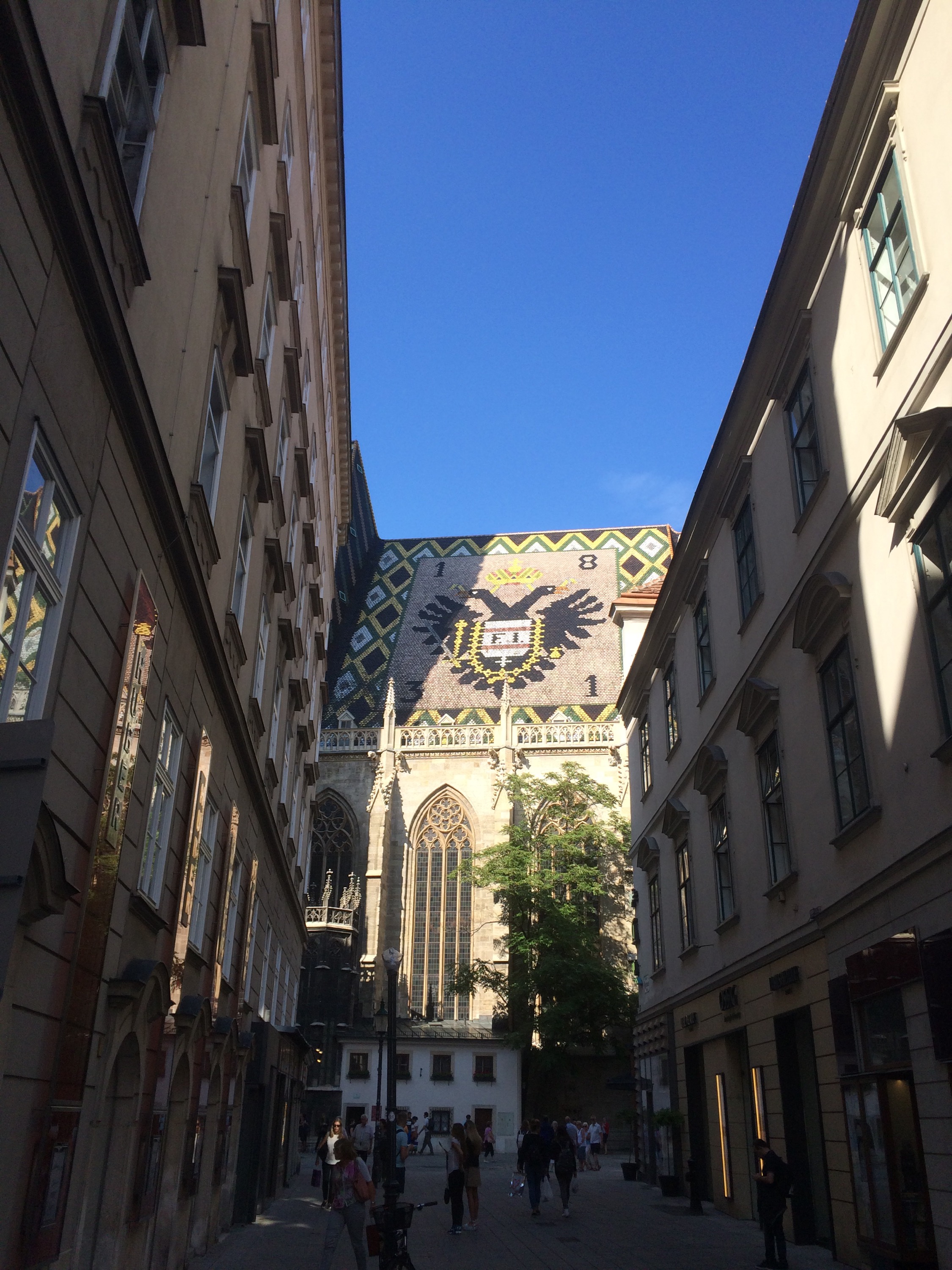
What’s the point of having a cathedral if you can’t stick your emblem on its roof?
It occurred to me as I was wandering around Vienna that I’ve managed to hit most of the imperial capitals of Europe. Rome, obviously, but Istanbul has the unusual claim of being the capital of two empires. As for more modern empires, there’s London, Paris, Berlin and Moscow. Further down the list, Athens counts for the brief era of Athenian power, as does Stockholm from the Swedish short golden age of martial might, pre-Peter the Great of Russia, who moved Russia’s seat of power from Moscow to St. Petersburg. Even Copenhagen squeezes in for the Kallmar Union – am I missing any? (As near as I can tell, I need Madrid and Lisbon to complete the set.)
Unlike Berlin, which had a wonderfully cosmopolitan identity crisis, Vienna knows that it’s an imperial capital. Though as capital of the Holy Roman/Austro-Hungarian Empire, it has a bit of competition: if we go all the way back to Charlemagne, there would probably be more imperial capitals than I would have time to list. Nonetheless, Vienna knows what it is and was, and its architecture practically shouts out “Hey, we used to have all the power in these parts.”
The best example that I saw of this was in the twin Kunsthistoriches Museum and Natural History Museum. Both are suspended halfway between being modern museums and reminding visitors of how they started: as the collection houses of Emperors, designed to show of their patrons’ power and sagacity through the display of works of art and historical and natural curios of every type that could be found.
One of the mineral rooms at the Natural History MuseumEmperors in an Imperial setting.
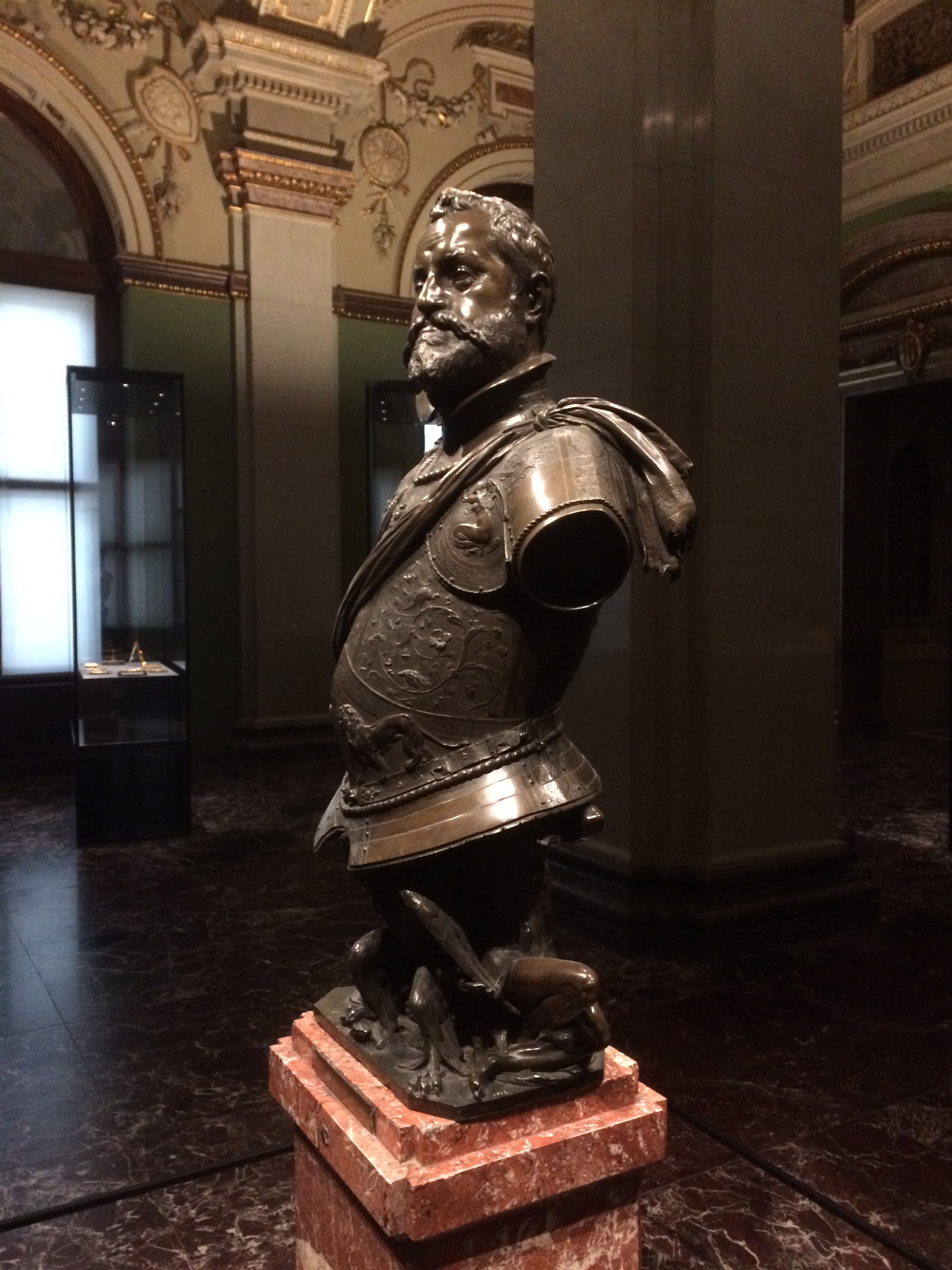
As museums go, they’re a lot of fun to walk around, and while these ones weren’t looted as badly as their counterparts in Berlin, the Natural History Museum in particular suffers from the fact that the Austro-Hungarian Empire was a relatively minor imperial player compared to France and Britain from the Age of the Enlightenment onwards (its array of taxidermy is startling though). As for the Kunsthistoriches Museum, it’s a delight to wander around, as there’s been an effort made to attach the works of art there to the rulers who commissioned or collected them, meaning that they help to tell the strange and twisted story of the Habsburgs and their ever-increasing jawline.
A beard hides all ills in a manly fashion.
The combination of old-fashioned and modern approaches helps these museums to stand out from the crowd. It works for the city as a whole too. Vienna feels relaxed and confident, and very western in a way that might not be the case today if its once-famous, now vanished walls hadn’t been quite so impregnable. History has treated the city pretty gently, and visitors to the city have reason to be grateful for that.
Charles Bridge, somewhere near sunset.
My preferred method of exploring a city is to start walking and only change direction whenever I see something more interesting down another street. Were I to try that in Prague, I would end up walking in spirals, or in an endlessly zig zag pattern. In Prague, there’s always something more interesting around the corner. This is a city that’s as close as any I’ve seen to the clichéd fantasy medieval metropolis.
There are the endlessly winding cobbled streets, with tiled rooftops packed so tightly overhead that guilds of thieves could conduct entire wars up there with no one below being any the wiser, save for the occasional corpse-cobble impact incident. There’s a town hall with an overly ornate astronomical clock, complete with clockwork mannequins. (The story goes that the designer was blinded once he finished so he wouldn’t go on to make a better one.)
Other clocks are available, and probably easier to read.
There are legends and stories galore surrounding the city, from poor old Jan Hus, who put too much trust in princes, to the golem that once stalked the Jewish quarter. Best of all, there’s the Defenestration of Prague, which manages to use one of my favourite words in its title. (Seriously – how much more fun is it to say “defenestration” than “thrown out of a window”?)
There’s a centuries-old bridge lined with statues of saints and divinities, across a river that’s home to an entire flotilla of swans. There’s not one but two hilltop citadels overlooking the city. Prasky Hrad, with its Gormenghast-like scale and complexity, and the over-the-top gothicness of St. Vitus’s Cathedral, gets all the press, but I’m partial to the more ancient Vyšehrad, which is mostly a shell these days, but is lovely to wander through and offers great views of the Vlatva River and Prague itself.
The Vlatva, looking south from Vyšehrad.
There’s even a hill hard by the city that’s swathed in an encroaching forest and hides not only a monastery with an ancient library but also a wizard’s tower that peeks through the treetops and has a labyrinth at its base.
All right, so the tower is a copy of the Eiffel Tower and the labyrinth is a maze of mirrors, but wizards are noted for their lack of originality. I doubt the average medieval inhabitant of Prague would have quibbled over the details before reaching for the nearest pitchfork and joining the local mob.
It’s a city for losing yourself in, then, as I’ve done for the past few days, the high point of which was when I found a store selling replica Viking arms and armour. For a good five minutes, I considered attiring myself in a manner befitting a Norse adventurer and taking ship down the Danube to the Black Sea and seeking service as a Varangian Guard in Miklagard/Constantinople.
Sadly, dreams of adventure and fantastic vistas founder when they hit the hard rocks of reality. Even as I’m enjoying my travels throughout Europe, a group of far more desperate travellers are trying to head in the opposite direction. The “tide” of refugees entering Europe is much in the news at the moment, often to heartbreaking effect, and while I’m currently on my way to Vienna, my plan is to be in Budapest, the current flashpoint of the crisis, in three days.
That may change, but even if it doesn’t, it forces me to think about why I’m travelling – this experience of cities and nations I’ve never been to before. How much worth does my indulgence hold against the desperate need of others, exemplified in the huddled form of a small boy washed up on a lonely beach? Are they comparable? Or even relatable? And what can I do?
I only have the beginnings of answers for any of those questions. I doubt that one traveller can make much of a difference, or learn everything he’d need to in the space of the two weeks I have remaining. The one thing I do know is that if I close my eyes, I’ll learn nothing. So I’ll keep travelling and see what answers I can find.
The beautiful weather added a surreal edge to the experience.
Auschwitz exerts a gravity of its own. You can travel to Kraków without visiting it, but you’ll remain aware of it, the many signs advertising tours tugging at you, reminding you of the black hole of history, lurking just beyond the horizon.
A friend of mine told me, when I mentioned that I intended to visit the concentration camp, that they couldn’t bear to do so. I can understand that. I’m not the most sensitive person, but even I can’t help but feel unease at the incomprehensible nature of what happened there. Still, I wanted to go, to be part of the effort to remember and not forget, and so I did.
(Apologies is some of the below is upsetting.)
That the visit was on the warmest, sunniest day I’d experienced in years was somewhat incongruous. In fact, the whole start of the tour, around the original Auschwitz I camp, felt a little off at first. To sanitised, too carefully restored and preserved, too occupied by tour groups. I was beginning to wonder if I was missing something. Then we reached the room full of human hair.
In one of the restored barracks buildings, fully half of a long room was taken up by a mass of human hair, taken from the scalps of the dead, with traces of Zyklon B still detectable when the Soviets liberated the camp. In further rooms were the dead’s belongings: eyeglasses, coats, suitcases with names written on them, shoes, children’s shoes. As much as anything else, the weight of these objects lay in the fact that they were the only remaining scraps of evidence that the Nazis hadn’t gotten around to destroying or using
We had been meant to see these first – a long queue meant that our guide took us around those more sanitised buildings first. Like some of the concentration camp victims, I was lulled into a false sense of security, feeling that seventy years since the camp was liberated had deprived it of its power to shock. Preserved behind glass though it may be, it still reaches out.
A mile or two down the road from Auschwitz I is Auchwitz-Birkenau. Dreadful as it was, Auschwitz I was in effect a trial run – Auschwitz-Birkenau is an order of magnitude larger and was the place that the Nazis applied industrialised methods and an inhuman level of detachment to their “final solution.” Here, though they tried to burn and demolish the traces of what they’d done, can still be seen the ruins of the crematoria and the shells of the barracks that housed the dying and the doomed.
Auschwitz I retains the indelible image of all that the Nazis took from their victims. Auschwitz-Birkenau demonstrates the scale to which they brought that collective sin. Moreover, it’s the decaying nature of Auschwitz-Birkenau that lends a final reminder of reality: this is not a preserved exhibit in a museum. This is a place where more than a million people were murdered. It needs to be remembered and I’m glad I visited, though that visit will stay with me.
If there was one thing that I missed, it was some sense of why this happened. Auschwitz preserved the “how,” but it makes less effort at showing how a nation can slide so irrevocably into horror. How centuries of looking down on Jews and other “others” curdled into contempt and hatred. How political leaders could take that hatred and bind it to a “solution” that led step by step to Auschwitz-Birkenau.
At a time when Europe and the U.S. are convulsed with fear of immigrants, and when our politicians are advocating ever more draconian measures to deal with this problem, we need to remember where that path leads. We already have them in camps, after all. We are hearing calls for them to work for their keep, to earn the right to live among their betters. It’s a reasonable proposal, isn’t it? It always is, at the start.
Follow the Lime Green Railroad to the Wonderful Wizard of Uncertain Destinations…
So, I’m doing it again. One year after Greece, four years after the Trans-Siberian and six years after Norway, I’m once more taking an August-September travelling holiday, hitting a bunch of new (to me) locations. Once again, rail is the medium for my peregrinations, and this time the locale is as much of the former Soviet Bloc as I can fit into three weeks. (No, I’m not visiting Belarus as part of this trip, and as much as I’d like to drop in on Ukraine, it might be better to leave that for later too.)
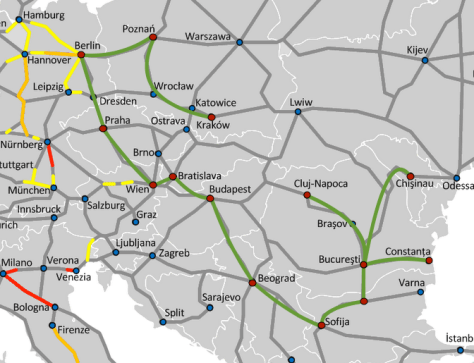
That map above gives the general outline of the trip: Krakow, Poznan (briefly), Berlin, Prague, Vienna, Bratislava (briefly), Budapest, Belgrade, Sofia, Veliko Tarnovo, Bucharest, and then … options. This is one of those trips where the early stages have been nailed down and booked, whereas the latter ones are more reliant on train availability and everything that goes before. Which, even though it might rub my obsessive compulsive tendencies the wrong way, is still appealing. Not knowing exactly where I’m going to wind up probably won’t do my mother’s blood pressure any favours, but I’m happy enough to keep a loose leash on the days ahead.
One of the nicest of things about this trip is that I’ve never been to most of the countries I’ll be visiting—the only ones I’ll be returning to are Germany and Austria, and even there, Berlin or Vienna will be entirely new. In fact, once this trip is over, the only European nations remaining unchecked will be fall into three groups: the Russian fringe (Finland, Latvia, Lithuania, Belarus, Ukraine, and maybe Moldova), the Balkans (Slovenia, Croatia, Montenegro, Bosnia and Herzegovina, Albania, Kosovo, and Macedonia), and a scattering of others (Switzerland, Portugal and most of the microstates—Andorra, Liechtenstein, Luxembourg, San Marino, and Monaco). Which brings me close enough to a complete collection to prompt a few more holiday ideas at least.
For now though, an Eastern European Odyssey is the order of the day. Preparations have been made, maps have been consulted, and tickets have been booked where possible. And as many considerations as I can consider have been considered.
Rail Travel: As mentioned, rail is the way to go here, and the resource worth relying on is The Man in Seat 61. It’s served me well in the past and it did here too, though booking tickets beyond Vienna has proved less useful than just showing up at the station in person. Sleeper services will be taken of wherever possible, and there might be a brief river trip between Vienna and Bratislava if the Danube isn’t too drought-stricken. When I get to Bulgaria and Romania though, my timetable will be at its most flexible. It’s just a pleasant coincidence that my options will be opening up as Europe reaches its most alluring.
Accommodation: The open nature of the latter end of my travels means that I can’t book too far ahead, but even if I could, I’m going to be taking a leaf out of my Greek odyssey: stick to booking a day or two ahead of time, using the Booking.com and AirB&B apps on my phone. Sleeper services are to be preferred, but hostels and B&Bs are just as valuable, mostly for their showers and laundry facilities. If I’m travelling light, cleaning my clothes will be a necessity at some stage.
Flights: Normally, the two things I’d book first would be my flights there and back. Well, I’m flying into Kraków to kick things off, but where I’ll be flying back from? That’s still undecided. I’d like to visit Moldova (because why not, when you have the chance?) but flights back from there are at least twice as expensive as from neighbouring Romania. So we’ll see. I have a ticket tracker running using the Kayak app, and the sudden availability of a cheap option may well determine how and where my journey ends.
Technology: Technology-light is the rule of the day. As in Greece, nothing more than my phone is to be brought. Even my new Pebble Time is getting dropped in favour of a Timex Weekender with a battery that lasts five years instead of five days. This will make it a little tricky to update the Travel section of this site as I go, but I’ll do my best. Those long train journeys will definitely give me time, at the very least. Still, my poor old iPhone 5S is suffering from geriatric battery syndrome these days, so one more piece of tech is needed. I’ve bought myself an Anker Astro E7 external battery, and having tested it for the past week, I’ve deemed it good. At the cost of a little extra weight to my backpack, I should be able to keep my loyal iPhone, and more importantly its camera and booking capabilities, running for as long as I need them.
Reading Material: This is an issue. Travelling light rules out carrying more than two books, and with one of those slots taken up by a Lonely Planet guidebook, that leaves little wiggle room. A friend has loaned me an ageing Sony eReader, but that runs up against both the low-tech rule and my personal preferences. I might rely on second-hand bookstores instead, or just read on my iPhone. (The latter option might seem a poor one, but I’ve read the Bible and War and Peace on my phone before, so it is an option. Maybe Moby Dick this time…)
Writing Material: Of course, without reading to take up my travelling time, and assuming that staring out the window can only occupy one for so long, writing will have the field to itself. So pens, some ink refills, and a notepad or two will be packed. How much I’ll get to write (beyond the requisite journal of my travels) remains uncertain, but the idea of letting my brain wander on the Danube plain is a huge draw. Even when I’m not strolling the city streets, there’s be imaginative highways and byways to explore.
Missing: What will I be missing while I’m gone? Well, not a huge amount. As the next category shows, the timing of this trip has worked out rather well. The start of the Pro12 rugby season and a few pre-World Cup friendlies is about the height of my sporting interests. Missing the Irish Craft Beer Festival stings a bit though. As for work, it’s been packed away for the next few weeks, and when it comes to keeping an eye on the state of the Internet, that’s something I could do with less of.
Returning: On the other hand, within a week of my return, I’ll have the return of Doctor Who, the start of the Rugby World Cup, a new niece to be a godfather to, and one of those birthdays with a “0” at the end of it. So I’d better be well rested when I take off from somewhere near the Black Sea (presumably). Because I’ll be hitting the ground running.
It’s an eclectic city, but if you catch it at the right moment, it’s a beautiful one too.
When I first started up this blog, it was with the purpose of keeping a record of a months-long trip around the world. Since then, it’s drifted away from that towards reviews of games and movies, punctuated by the odd political or cultural rant. This drift shouldn’t be all that surprising – it’s not like I can afford to go on holiday every month.
Still, when I do go on holiday, even when it’s only for a few days, it’s fun to keep a diary, one that can be illustrated with photos. Sharing experiences isn’t just for Facebook, though Facebook is the obvious gateway through which to usher people to these pages.
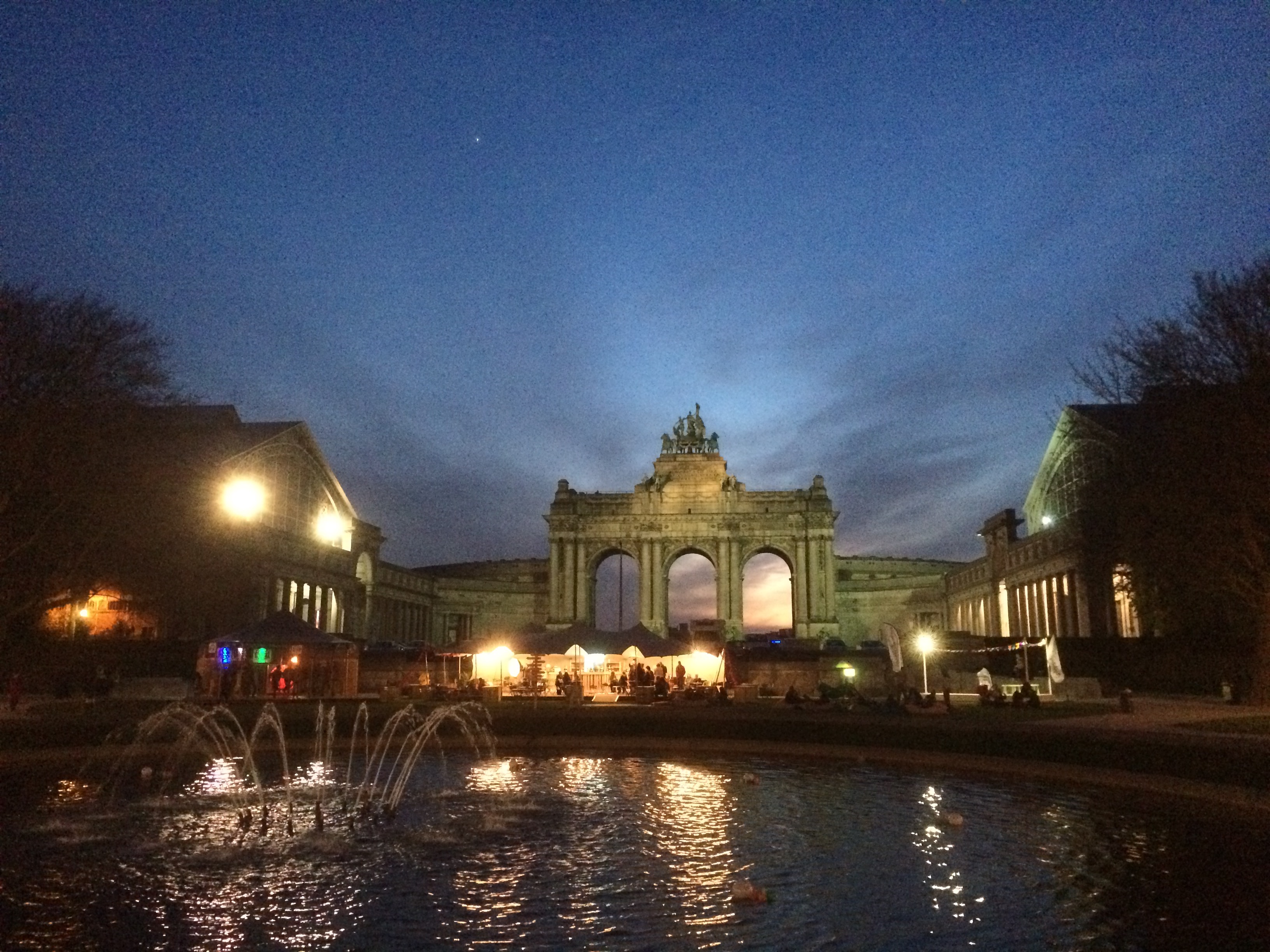
In short, I’ve added another entry to the Travel menu above, courtesy of my just-ended five days in Brussels. Five days of sunshine and late nights, during which I made strenuous efforts to balance out my intake of beer, frites and waffles with some industrial grade walking. By the end of it all, I felt like I’d gotten a pretty good feel for the city, and I’m looking forward to getting the chance to go back some day. For some small clue as to why I enjoyed it all so much click here.
(And apologies in advance if the prose is a bit clunky. I’ve fallen out of the habit of writing these articles, and it’s not always easy to jump right in again.)
This one is a bit delayed. A bit more than a month delayed, in fact. Apologies for that—I don’t like leaving things unfinished, and just because my Greek odyssey ended in quiet fashion was no reason to leave my audience (you’re out there, right? Is this thing even on?) hanging.
Chania, in the west of Crete, was a quietly pleasant way to wrap up my travels. Founded as Kydonia long ago in the Minoan age, it passed through the hands of multiple powers, both foreign and domestic, over the intervening centuries, all of which left their mark. No massive museums to rival those in Athens or Thessaloniki, or fortresses like those of Nafplio or Mycenae. Yet with a cafe tucked into a narrow alleyway, twisting streets filled with craft shops, the relics of Venetian fortifications, and an old church turned into a museum, with relics of the Ottoman occupation in the garden, there was more than enough to see.
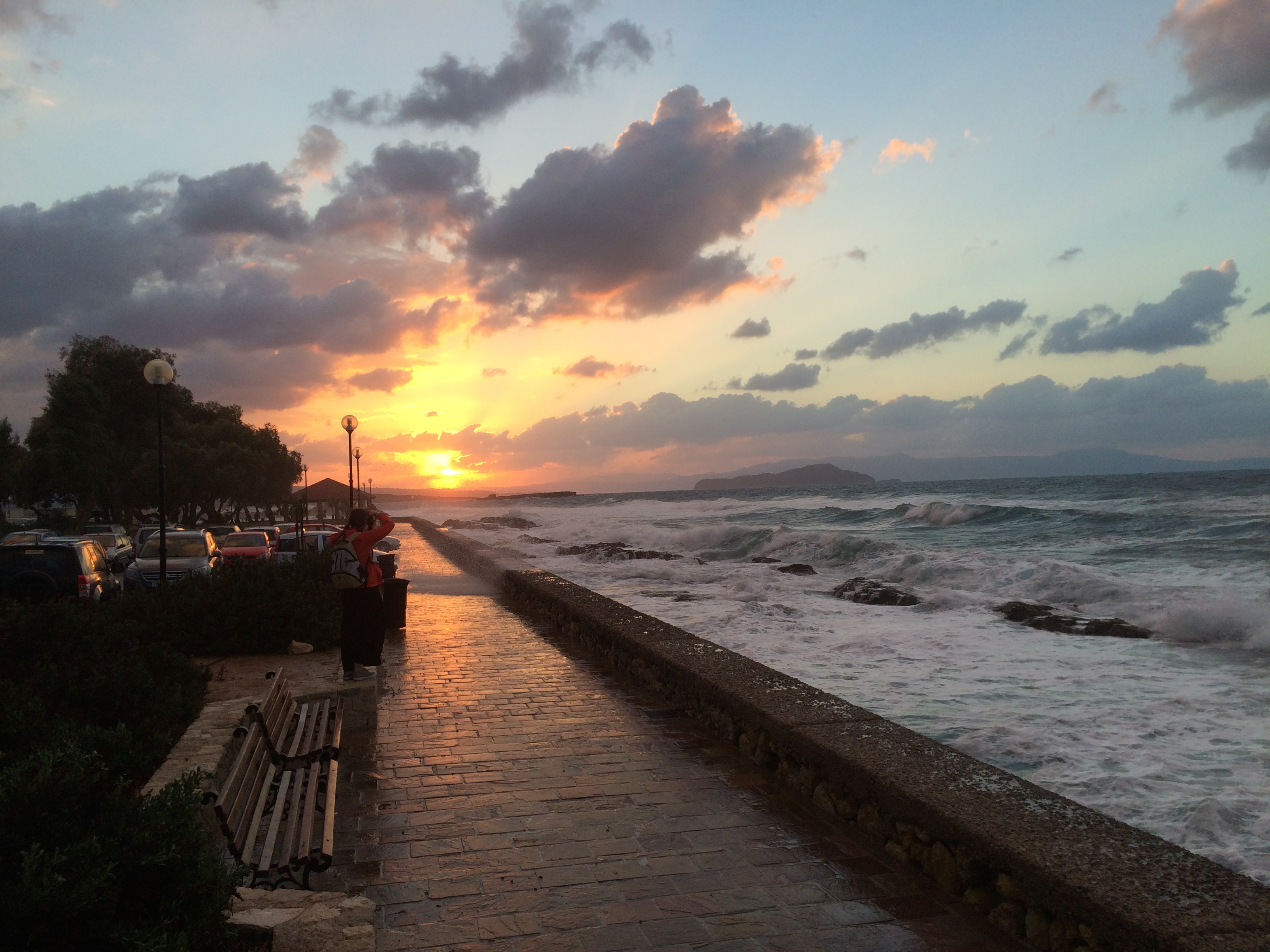
It would perhaps have been nice to spend an hour or so on the beach (or preferably in the sea), but wild weather and the first hints of autumn in the air put paid to that. I got plenty of the sea in my face just by strolling along the promenade, and the main adventure of my time in Chania was had the first night, making my way all along the long, crumbling breakwater to the old lighthouse, joining a French couple in climbing over the locked gates to do a little light trespassing for the sake of a good photo.
So Chania was a place for resting and relaxing, either collecting my thoughts and resting tired limbs after more than a week of walking to and around new experiences, or steeling myself for the inevitability of a five-hour Ryanair flight and the cattle drive of the airport that preceded it. With that in mind, as well as the long gap between getting home and writing this, here are a few collected thoughts.
Greece is utterly worth the effort. I’d waited for years to go there, and while I didn’t get to see everything I wanted (who could, in only ten days?), I saw wonders.
It’s a country of two parts. The Isthmus of Corinth has divided the Greek world for millennia, and it still does. To the north and east are the two main cities of Athens and Thessaloniki, connected by the country’s main railway. To the south and west is the Peloponnese, with smaller towns and cities, truly ancient ruins and wild hills, and no working railway.
It’s a straight travel choice. Either travel by bus, of which there are plenty, or by car and risk Greece’s occasionally tricky roads and drivers. The risks of the latter are probably a little overstated, but then I didn’t have to deal with them. Being bus-bound wasn’t a major problem for me, but if you want to get off the beaten path, you’ll need a car.
Get there early. Tour buses and the hordes they disgorge are the enemy. In Delphi and Mycenae, I got there before the worst of the crowds, and in Delphi in particular the result was magical. In Knossos I didn’t, and I ended up dodging the crowds and queueing up to see some of the best bits.
Alternatively, get there late. The Greeks had a tendency, not uncommon in the ancient world, to build their most imposing monuments on hilltops. If you’re going there in September/October, you’ll be able to catch sunset before they close. There’s not much that improves a sunset more than ruins two thousand years old…
Get comfortable with waiting. Service in Greece isn’t bad, it’s just not hurried. At all. Which should give you plenty of time to chill out, enjoy the ouzo or raki, and contemplate the meaning of life.
Travelling with one bag? Not that I’m the first person to figure this out, but it’s perfectly doable, even when travelling for more than a week. Just make sure that you know where to find a laundrette, and be aware that bringing presents home is going to be limited, size-wise.
Ditching the electronics… This is the second trip I’ve had where I limited my electronics to my phone alone. Given that I prefer to write freehand when I can, and that my iPhone is pretty capable, it wasn’t much of a sacrifice. The only issue is battery life—next time I’d bring a battery case.
…but using the ones you have… I was flying by the seat of my pants with regard to a lot of my travel planning. Beyond my flight in and my flight out, plus my first two nights in Thessaloniki, everything was booked the day before, using Booking.com and/or Tripadvisor. It all worked pretty smoothly, but…
…paying attention to the details. My one big error on the trip was not realising that there would be so few ferries from Athens to Iraklio per day. I made the best of it in the end, getting to watch the close of the Ryder Cup in a Sports Bar, but the overnight trip was something I could have been better prepared for. Lesson learned—next time I’m not going to assume that everything will be convenient.
Travelling to Crete is like taking the lever that controls the Greek history time machine and pushing it as far back as it will go without breaking. Modern political divisions notwithstanding, this is a very different country, and there’s no better place to see this than in Knossos, heart of the Minoan civilisation of Crete and fabled palace of the mostly legendary King Minos, his daughter Ariadne and her half-brother the Minotaur. (Look it up – it’s a little icky.)
Even for the Mycenean Greeks who supplanted them, the Minoans must have appeared to be something alien and ancient. In the court of the Pharaohs of Egypt, the men of “Keftiu” were regular visits and the acknowledged masters of the wide green sea. The first maritime kings of the Mediterranean, they bequeathed some but not all of their practices to the Myceneans when disaster and strife somehow brought down their power. (The role of the Thera eruption in that downfall is yet another fascinating possibility.)
Looking at the art of the Minoans, it’s still easy to note the gulf that separates them from the later, more realistic depictions of the Greeks. In religion, the Minoans were goddess worshippers, and while they did venerate male deities too, the shift that placed Zeus (born and raised in a cave on Mount Ida on Crete as the tale goes) at the head of the pantheon of Olympian deities came after their time.
This shift in culture, art and language is a fascinating one to try and follow. There are Greek scripts that seem to depict the ancient Minoan tongue. The Linear B text seems of Minoan origin but is used to depict Greek language. The Minoans rose and fell several times over the centuries, coexisting with the Myceneans for several of them until their uniqueness was eclipsed.
The Iraklio Archaeological Museum does an excellent job of putting this tale in its proper context. (Any flaws in my understanding of it all, I’ll have to put down to my sleep-deprived brain – and while I’m at it, I’ll blame any typos on that too.) It seems that the more the Cretans were plugged into the trading networks and political systems of other Mediterranean powers, the less distinctive they became. Eventually, the people who had built and decorated the palace at Knossos so gloriously (though not necessarily as it now appears, depending on your opinion of Arthur Evans) became just another territory. An appendage and territory of other powers, whether Greek, Roman, Byzantine, Ottoman, or Venetian.
It seems a shame, but we have the memories in myth and legend of those times and the relics recovered from the concealing earth and painstakingly restored. For me, I’ve enjoyed all that and more. My travels have taken me from Thessaloniki in the north of Greece, with its Byzantine and Ottoman influences, all the way to Crete, going ever deeper into history as I’ve continued south. This seems as good a place as any to stop. Maybe tomorrow, before I fly home, I’ll just lie on the beach for a while instead…
The lighthouse at Chania in western Crete. On a stormy night like this, there’s no place better to be.
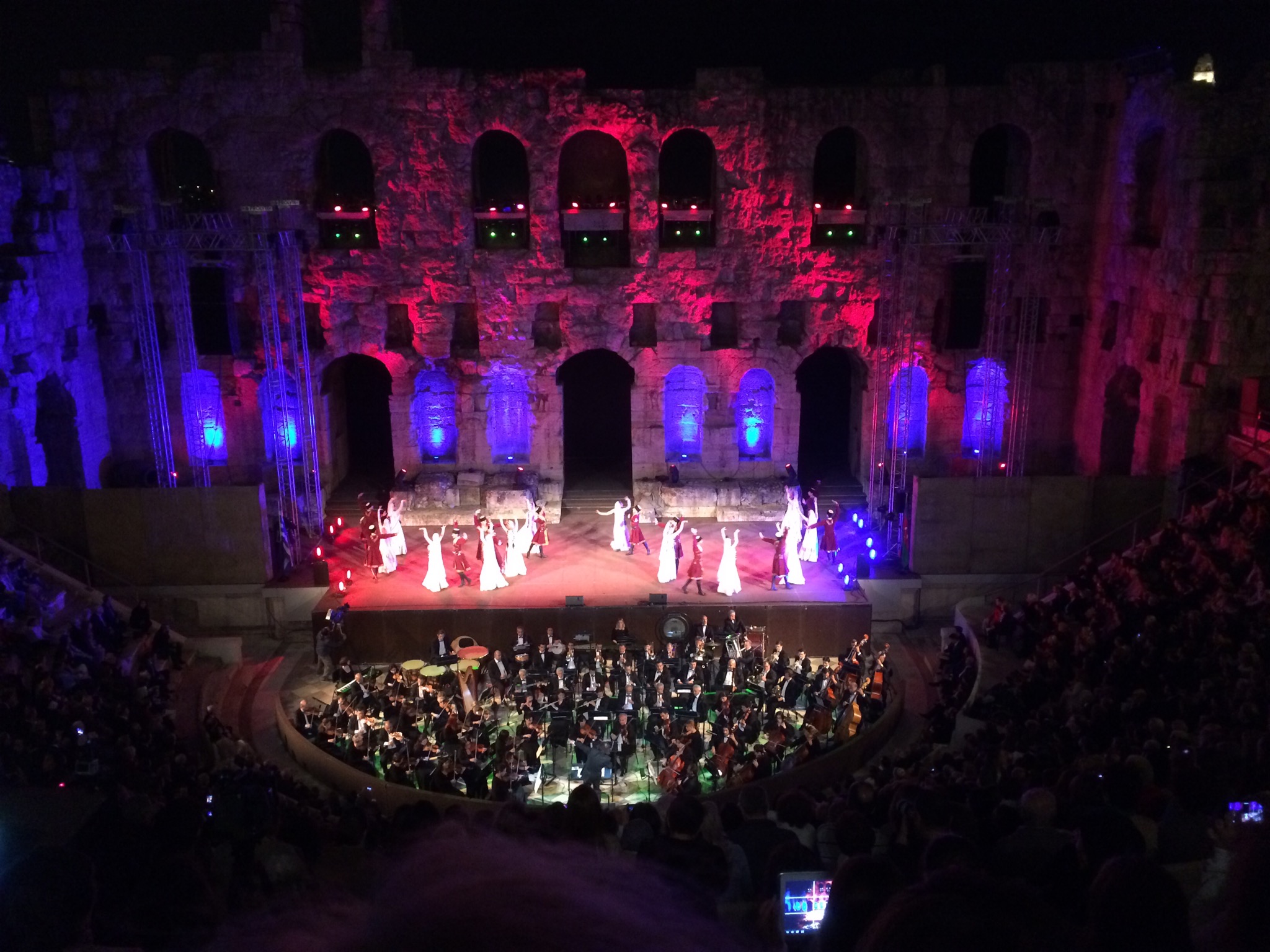
When one is given a chance to attend a full orchestral performance in a theatre some 1,900 years old, one doesn’t turn it down. Thus it was that I found myself buying a €5 ticket to gain access to the Odeon of Herodes Atticus, in the shadow of the Acropolis, there to watch a performance by the Azerbaijan National Orchestra and several other Azerbaijani performers, notable among them a troupe of dancers.
Whether or not the ticket seller was offering a dramatic flourish of his own when he said that I had bought the very last ticket, I can’t honestly say, but the Odeon was probably as full as it could be while still being safe. Likewise, I’m not exactly sure what the cultural links between Greece and Azerbaijan are – perhaps my attention wandered during the introductory speeches that took up a fair chunk of the evening. Still, there’s no arguing with the fact that the orchestra’s performance was very warmly received, whether they were accompanying other acts (including, incongruously, a tenor offering up his take on “Nessun Dorma”). The dancers turned out to be the stars of the night though, their kinetic leaping, whirling and shouting inspiring the audience to clap in time to every flourish as light and sound illuminated the inside of those ancient stones.
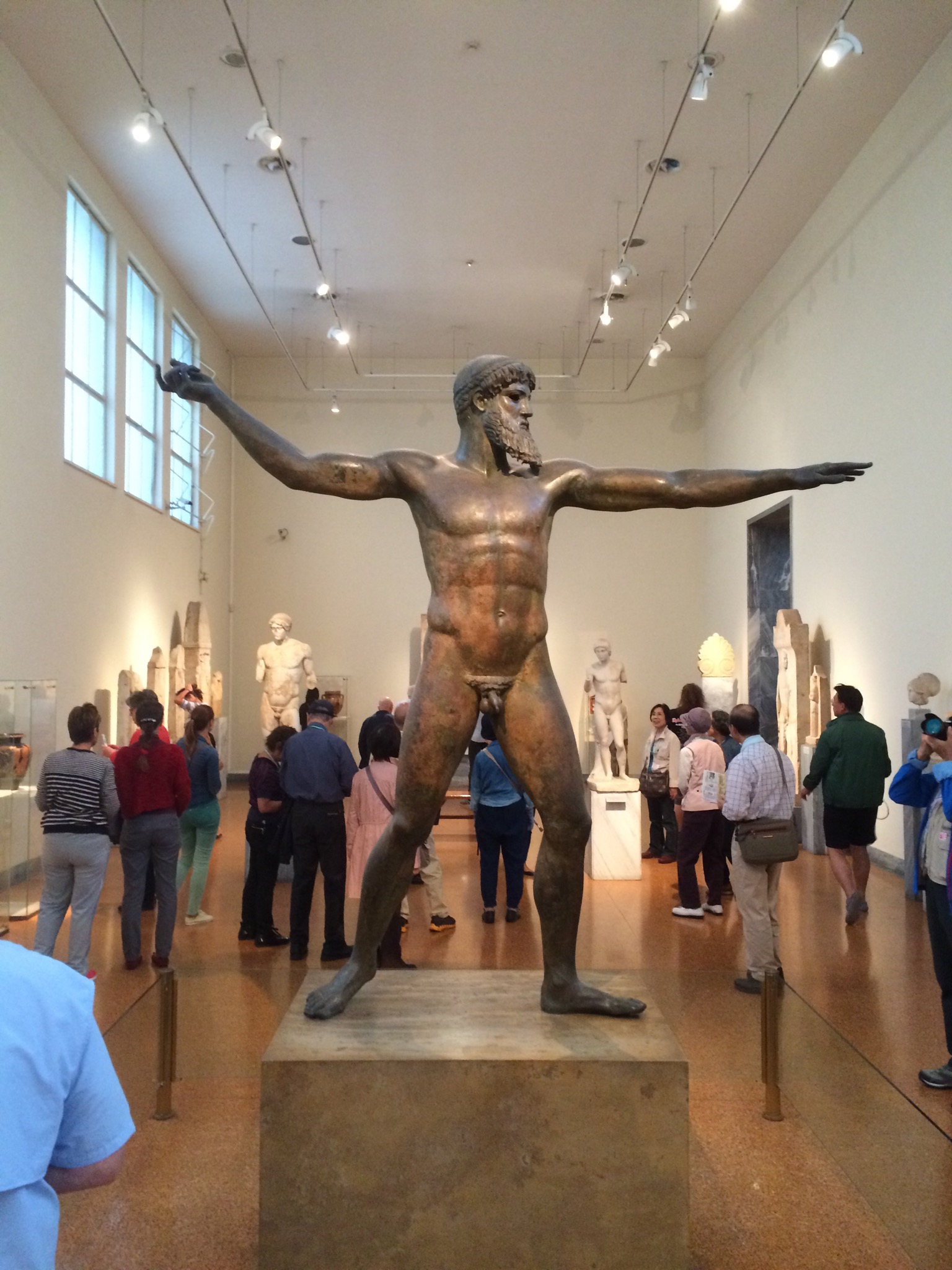
Sublime history of another kind was the order of the day the next morning, as I made my way to the National Museum of Archaeology. With such a resource as the history of Greece to draw on, this could hardly fail to be spectacular, and as much as I may have seen more statues in the past two days than in the course of my life to date, I haven’t tired of them yet. The museum contains the Death Mask of Agamemnon (so called by Schliemann), several rare and exquisite bronze statues (far fewer of these survive from ancient times than their marble equivalents), and items both unspeakably ancient and of such quality of manufacture and art that you can’t help but linger over them.
Perhaps the most fascinating piece that the museum now holds is a relatively recent acquisition. In an ancient shipwreck off the tiny island of Antikythera were found not only a collection of sculptures (probably looted and on their way to imperial Rome) but a nondescript lump of fused bronze. That lump, carefully studied over decades, now has an exhibition all to itself and is known as the Antikythera Mechanism. An intricate clockwork device, seemingly constructed to track and predict the motions of celestial bodies, it’s a glimpse into the little guessed complexity of ancient craftsmanship, forgotten for centuries afterwards.
So much for the sublimity: whence comes the ridiculous of this article’s title? Well, I’ve supplied most of that myself as I’ve come to the last few days of this trip. For example, on my way to the museum, I managed to get completely turned around and found myself wandering through a mostly deserted park until I figured things out.
The main ridiculousness though has more to do with where I am as I write this. I’d always planned to head to Crete for the last two days of the trip, but following my thus-far successful plan of booking things at short notice has caused me a few problems this time around. First off, I went ahead and booked accommodation without checking ferry times. Bad idea – the only ferries from Piraeus, Athens’ ancient and modern port, are overnighters. Still, I get in early enough that I might be able to use breakfast and a shower before I have to check out. As a final insult, trying to book a ferry ticket online resulted in a lost connection somewhere between the agency and the ferry company. And then it turns out that I could and should have bought the ticket at a booth at the port for half the price! Sigh. Lesson learned for now. Time to try to get some sleep while hoping that the boat doesn’t sink and that the guy behind me stops snoring at some stage…
I’m in ur background, bombing ur photoz.
There’s a trope in film and television of using familiar landmarks to create a sense of place. If a scene is meant to be in Paris, the odds are that the Eiffel Tower will be lurking in the background. If it’s London, Big Ben and Tower Bridge serve the same purpose. If it’s Dublin, well, a pub will probably do fine.
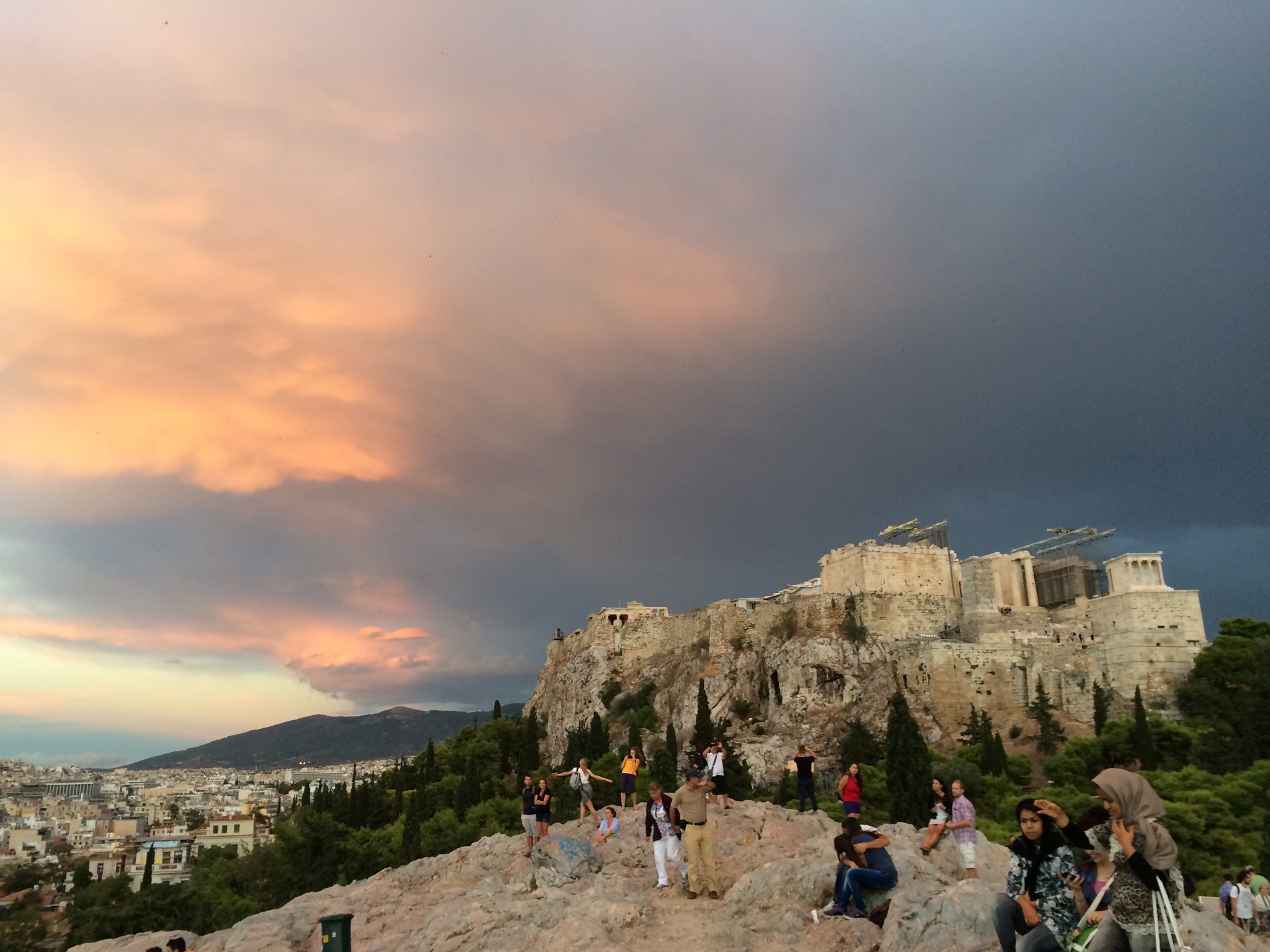
For Athens, the Acropolis and the Parthenon are the more than obvious choices as identifying landmarks. The difference being that when you’re in Athens, the Parthenon and Acropolis actually are in the background most of the time. It’d be a surprise if they weren’t, give that they’re built on a whacking great mountain in the middle of the city.
For all that modern Athens now sprawls all across the Attic plain, its ancient past remains evident at its heart. The Acropolis stands out of course: there are Mycenean stones at its base, as in so many other places that I’ve visited, but habitation here goes back at least to the Neolithic. But it’s hard to go anywhere in the centre of the city and not come across reminders of the past. Plenty of the museum pieces that I’ve seen over the past two days have had notes attached saying that they were found in some construction project or other.
It must make urban planning a nightmare here, perhaps more so than anywhere else on Earth. All around the city you can see building sites that have turned into archaeological digs, though how much of that is due to the economic downturn I couldn’t say. Even the Acropolis Museum has a glass ground floor, the better to show the craftsmen’s district uncovered during its construction.
Tear your eyes away from the Pantheon and take a walk around Athens though and you’ll be well rewarded. In the shadow of the Acropolis alone, you have the Areopagus hill, where high crimes were judged. You have the Pnyx, where Athens’ ruling body of the people met. There’s the largely intact temple to Hephaestus and the mostly ruined but massive Temple of Olympian Zeus. In the ancient agora, you can see the prison where Socrates took his fatal draught of hemlock, and down the hill you can see the uncovered Kerameikos district, where he strove to open minds among Athens’ ordinary citizens, questioning their every assumption.
Once again, it’s all about being close to history. Not just the history of a place like the Acropolis, a sacred precinct for the gods, but the history of the Kerameikos, where the common folk of Athens went about their daily business. Where they lived and died and were buried, for the Kerameikos was a cemetery too. Where you can see the roads that led out through Athens’ walls and the homes where meals were prepared and eaten. In a place like that, where centuries of dirt have been scoured away, you can walk in their footsteps. It’s as close as you’ll ever get to walking beside them.
The path of grave markers that led from the Kerameikos.
Emerging from the Secret Cistern in Mycenae. It’s bloody dark down there.
I mentioned before that only a scrap of mythic Mycenae remained in Nafplio. Specifically, that scrap exists in the foundations of the Akronafplio, the old Acropolis of the city. In fact, for a long time the acropolis was the city, until the Venetians came along and created the lower city. As with the Palamidi fortress, nearly everything that’s there now is Venetian, and though there are odd chambers and hidden passages still visible amid the foundations, it’s hard to explore them far among all the restoration work.
In contrast, half an hour away by bus, the citadel of Mycenae is almost pure myth. This is Homer’s Mycenae, the city of Agamemnon, founded by Perseus, the son of Zeus. Although it was never forgotten during the dark ages between its height and the rise of Athens and Sparta, what history it had faded into folktales. The stones of the walls and gateways were so massive that it was thought that Perseus had called on the cyclopes to help him build the city.
Through painstaking excavation and the decipherment of scraps of Linear B script from the site, we know a lot more than the Greeks did about how Mycenae operated: its rule by a “Wanaka” and the trade links that stretched all across the Mediterranean and even as far as the British Isles and the Baltic Sea. There are records among the Hittites, Egyptians and other ancient civilisations of contacts with the “Ahhiyawa”, and there we can even glimpse a few names, though their exact provenance is hard to determine. In general, we know no more of the personages themselves – the kings and queens, heroes and villains – than Homer did when he spoke of “gold-rich Mycenae” and its king.
This kind of thing fascinates me and always has: the point in time where history fails us and the only point of reference we have is half-remembered stories of great events and turning points. Be they ever so twisted for dramatic effect or to provide a moral point, they’re as much truth as we have. It still happens too: think of the tales of George Washington and the cherry tree or Abraham Lincoln and his log cabin. Closer to Ireland, was there ever a Cuchulain, or was he just a recasting of an older tale or a folk hero with no basis in fact?
Stories have their own gravity, and myths are just those stories that have been around long enough to solidify into a bedrock for other tales. The Iliad and Odyssey dragged in heroes from other stories, just as King Arthur and Cuchulain became the dominant stories of a nation and more: stealing the narratives from other tales and recasting them as their own. What then happens to those stolen stories?
In some cases, their fate is to be buried, as with the Akronafplio. Larissa Fortress near Argos, another famed ancient city, has Mycenean stones among its foundations too, but the rest of the edifice is of much newer make. Argos had the good fortune though of being celebrated through its heroes, both in Homeric fashion and into historic times. Other sites have not been so lucky.
One such can be seen closer to Nafplio. The citadel of Tiryns is, if anything, even larger than Mycenae. However, it’s in poorer repair and sits on a less imposing outcrop. More importantly, it features in few stories now. The people of Tiryns left behind a monument in stone, but the age that they lived in is the one we now call the Mycenean Age. A tribute as much to Homer and his skills as it is to the greatness of that city and its peoples, whom we remember now only through his tales.
Tiryns, sadly, also makes for an unimpressive photo opportunity.









 cerandor.com