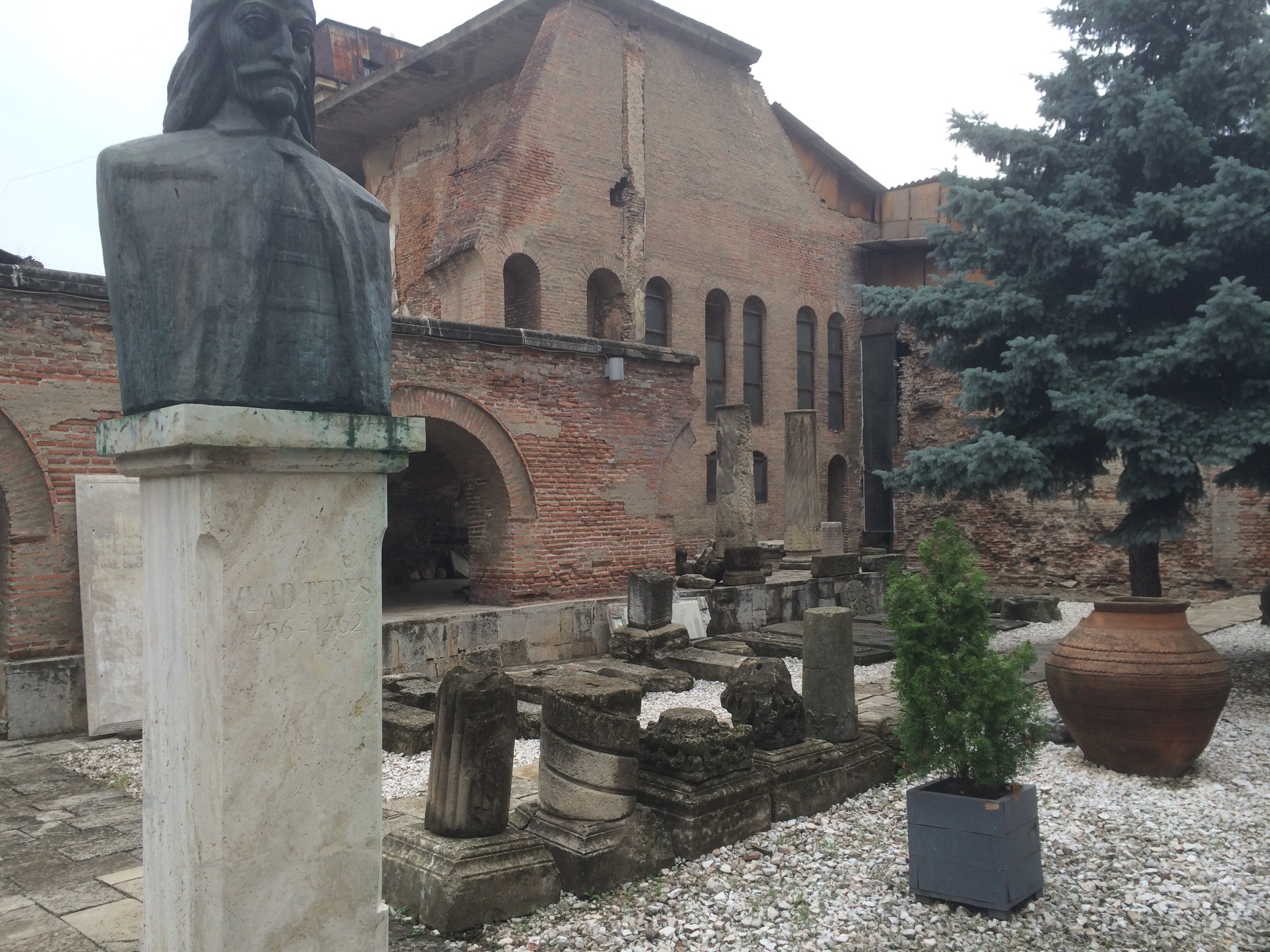
The obvious suspect: Vlad Tepes and his palace.
Romania feels like something of an outlier. In the midst of countries with Slavic languages, written in Cyrillic script, its Romance language owes more to French and uses the Latin alphabet. This oddness is a little difficult to explain, even at a historical stretch: the province of Dacia, lying beyond the Danube, was one of the longest-lasting conquests of Trajan, Rome’s greatest military emperor, and for some reason that association has stuck, for all that Rome and its successor states vanished long ago.
What is immediately obvious as you walk around Bucharest is that the Soviet era was a dreadful wrong turn for the city. There are many examples of absolutely gorgeous architecture – western styles given native Romanian twists – that have spent the decades since World War II, when the Romanians were on the side of the Axis, elegantly crumbling. As they crumbled, massive Soviet edifices sprang up, some of them featureless and uninspiring, others blank copies of Parisian grandeur, such as the monumental Parliamentary Palace, the second-largest administrative building in the world after the Pentagon.
Photos can’t capture just how huge and out of place this is.
Nicolae Ceacescu’s dictatorship attempted to turn Bucharest into a metropolis and only managed to gather far too many people together, turning a city that had shown signs of becoming the Paris of Eastern Europe into a sprawling space that you could spend all day trekking around. There’s so much to see here and so much to fall for, but the omnipresent feeling that it’s still trying to recover from Ceaucescu and the economic turmoil that followed his ouster and execution.
Escaping isn’t all that hard though, and it proves well worth it. Less than two hours on the train brings you to the foothills of the Carpathians and the town of Sinaia, where the Romanian king Carol I once held court at Peles Castle. Navigate through the tour groups that cram every corridor and you’ll find a mix of German, Italian and Romanian decor to enjoy, as well as rooms as richly appointed as any to be found in Europe. Though given the amount of love lavished on this one building created for the benefit of a single family, the extravagances of royalty become a little harder to support.
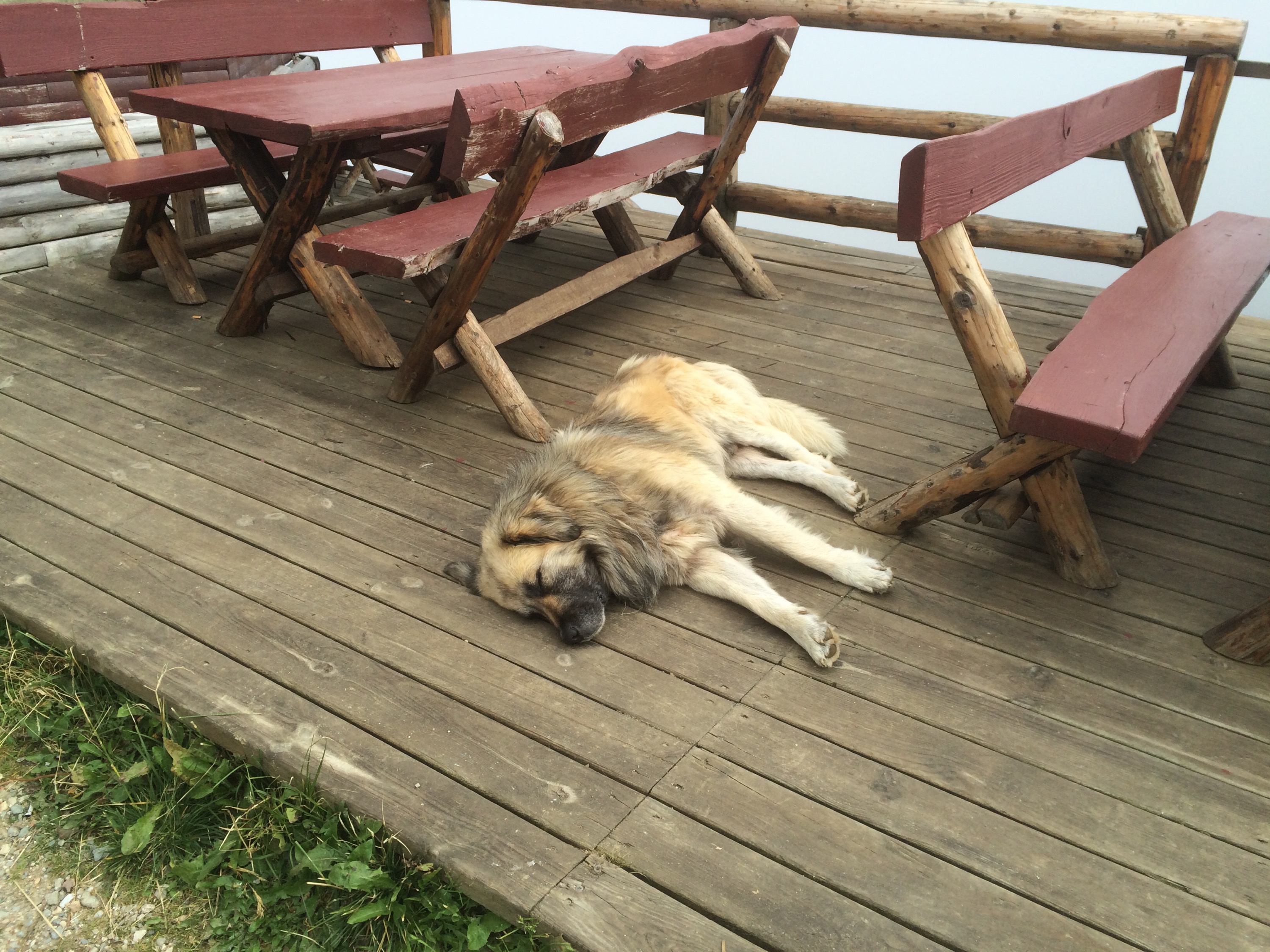
Huge fuzzy dogs – much needed on mountains.
Thankfully, Sinaia offers one of the best ways to escape: a cable car gondola to 2,000m up in the mountains above. There, if the cloud cover is kind, you’ll be able to view the valley below and others as well, and get an idea of how it all fits together. And if the cloud cover isn’t kind, you’ll at least have massive dozing mastiffs and sheepskin wraps to keep you warm while you sip your hot chocolate.
But Bucharest on the Danube plain remains the draw and the hope of the nation. Crumbling that old architecture may be (and the city’s Old Town is tacky enough to outdo Dublin’s Temple Bar), but there are signs aplenty of a desire to preserve just what made the city special and to incorporate it into the new spaces springing up as those Soviet monuments crumble in their turn. Should the future be kind to Romania, and it navigate the space between Russia and the EU with care, there could yet be a golden age here, and this lovely city be even more worth visiting than it already is.
There’s a lot of flat ground in Veliko Tarnovo: most of it vertical.
I had planned to spend more time in Bulgaria, but things didn’t work out that way. A combination of a delayed train from Belgrade, some awful weather and a miscalculation on my part meant that I had to miss out Sofia entirely. Instead, courtesy of an overly helpful train station attendant, I ended up jumping on a bus that took me straight to the ancient Bulgarian capital of Veliko Tărnovo, through mist-shrouded mountains and broad valleys to an ancient place of power. I’d rather have taken the train, but given that I found out next day that the local train station was kaput, this was clearly a good idea.
Not that things got any easier once I got to Veliko Tărnovo. If it reminds me of anywhere, it’s Delphi in Greece. Both towns are packed tightly onto a mountainside, using steps as much as streets to facilitate movement. Yet whereas Delphi was meant as a destination, a special place that pilgrims had to trek to reach, Veliko Tărnovo was meant as a defensive bastion, an impregnable fortress, defended by walls, rivers and high cliffs.
The old royal palace at Veliko Tarnovo
As culmination of my fortress-hopping on this trip go, I couldn’t have asked for more than Tsarevets Fortress. Occupying an entire bend of the local river and accessible only via a narrow bridge that still hosts a gatehouse with an impressively spiky portcullis, it’s a commanding sight, even if most of it has now decayed and crumbled. The parts of it that have been restored – the church on the highest peak and several of the outer towers – show just how imposing it must have been. It helps that one of the towers has been left stocked with (nailed down) arms and armour, so you can see how the Bulgar guards in medieval times would have been able to do their duty.
I don’t really have too much to say about the Bulgarian people, sadly, due to my limited time here, other than that they seem as friendly as any I’ve come across. Though something that is notable about Veliko Tărnovo is its cats. They’re everywhere and they’re tiny – I thought the first one I saw was a kitten, but no, they were all that size, and when I sat down to dinner that evening, there were a host of them in attendance, first yowling for scraps and later just sitting under my chair, making themselves comfortable.
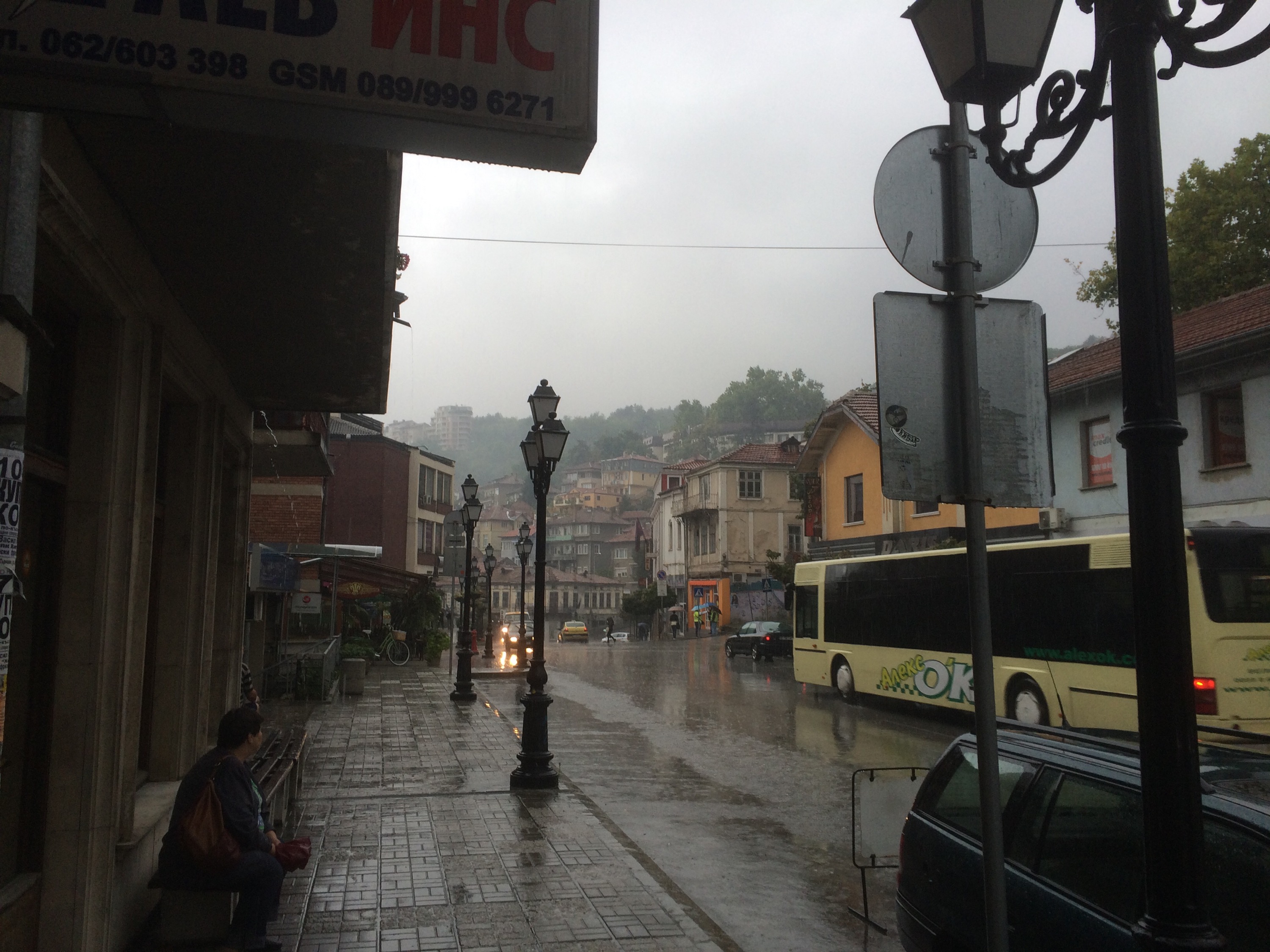
I left town along with several thousand gallons of water.
I suppose that a place like Veliko Tărnovo, where the ground is as much vertical as it is horizontal, is better suited to cats than to humans. Whereas we trudge up and down or get into cars barely small enough to navigate narrow and winding streets, they can scamper this way and that, find places in the sun to rest, and disappear out of sight whenever they choose. They certainly seemed to have the run of the place – the few dogs that I saw were a cowed and defeated lot.
However, the cats couldn’t have been any happier than I was with the weather on the morning of my last day. It was pouring in a way I hadn’t seen at all on this trip, and it didn’t look inclined to let up. I was even driven so far as to have to purchase an umbrella. The rain certainly accented the Soviet tinges of the town – the gloomy ticket office where I got a train ticket for the connection at Gorno and the Gallery where I spent half an hour in the half-light perusing some weird and evocative Bulgarian art. (Eventually someone remembered to turn on the lights, which came to life with a sound like a flock of birds taking off.) Eventually though, I was washed downhill to the closed-for-repairs train station, where I was able to get a bus to Gorno. And as I write this, I’m on a train to Bucharest, awaiting the Danube and my next nation: Romania.
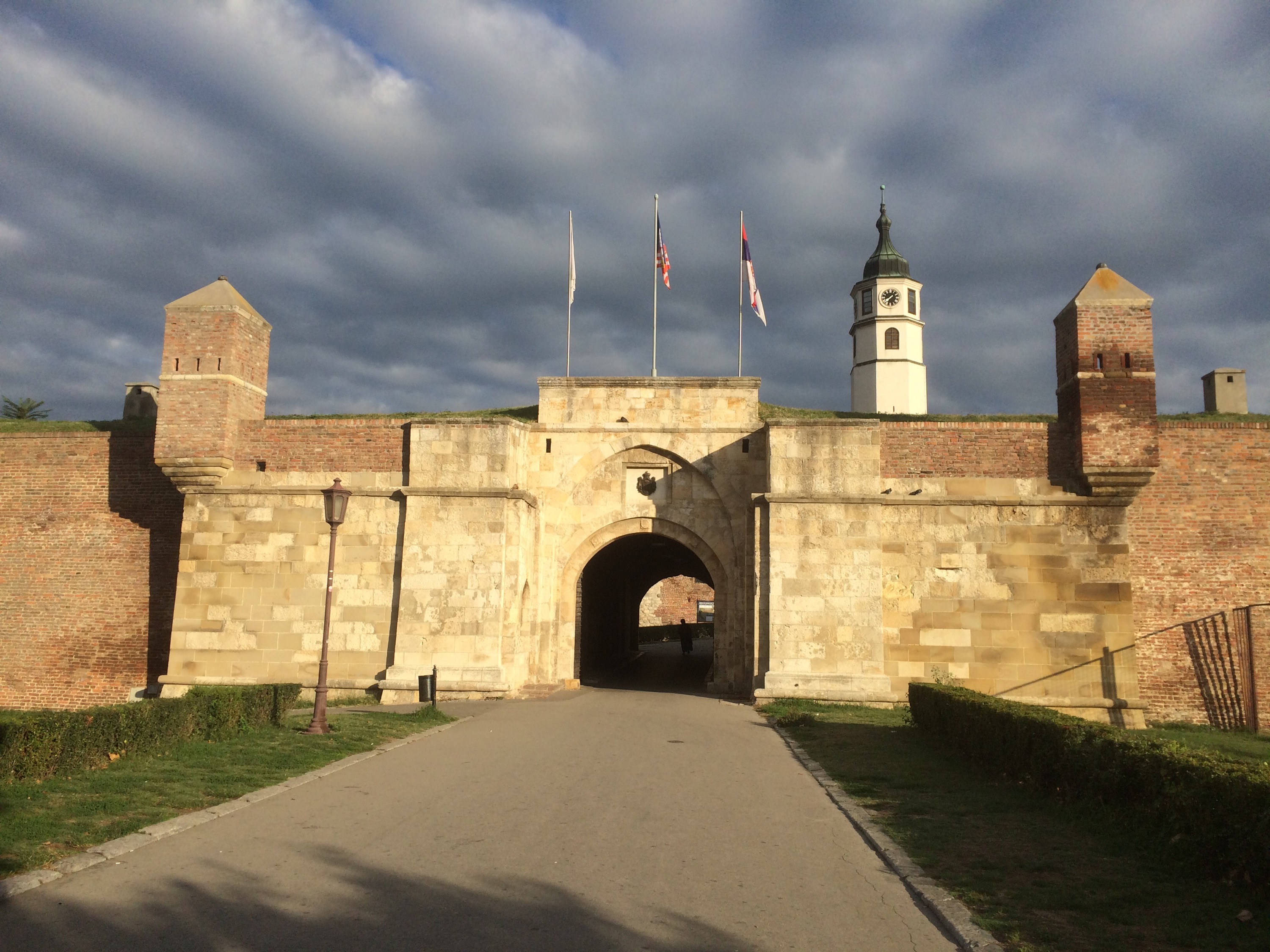
The Stamboul Gate at Kalemegdan
There’s something a touch wild about Belgrade. The mighty Kalemegdan Fortress perches on a rock overlooking the place where the Danube meets the Sava River. Much occupied and much conquered, it has seen Celts, Thracians, Illyrians, Romans, Avars, Byzantines, Slavs and Ottmans come and go over the years. In all of Europe there may be places more fought-over, but none so recent: the Ministry of Defence building still stands ruined, destroyed by NATO bombs in the 1990s.
Kalemegdan is just the most visible sign of this frontier mentality. For Romans, the Danube was the dividing line between the civilised world and the barbarian sphere, from whence strange tribes would occasionally emerge to threaten and then perhaps join with Rome. With nomadism as a way of life now mostly disappeared, that doesn’t seem to happen as much any more, but there are still forces that will lead people to travel vast distances: I saw more refugees in Belgrade than I did in Budapest, clustered around the train and bus stations. The Danube as seen from Smederevo’s Corner Tower
When the Danube was both frontier and highway, controlling it was vital. Kalemegdan played a part in that, but the even larger (if less well preserved) Smederevo Fortress a few miles down the road served the same purpose. It’s unusual among the fortifications that I’ve seen in this part of the world in that it’s not built on a hill but instead on the banks of the Danube itself. This lack of a solid rock foundation may explain why some of its walls and towers tilt alarmingly far from the vertical – the forces of time and tide tear down everything that is built sooner or later.
Back in Kalemegdan though, the Museum of Military History offers a fine collection of tanks and artillery outside (packed into the fort’s defensive ditches alongside tennis and basketball courts) and a potted history of Serbia’s story told through war. Very little of what is told is set out in English, but the multiple maps of the area with arrows heading this way and that make it quite clear: armies have been marching hither and thither across Serbia for as long as records have been kept. Not every frontier in Serbia is war-related. Fun and games at the Tesla Museum.
Upstairs in the museum, things get more interesting, as the story turns to World War II, Yugoslavia and Tito. Serbia, of course, was once at the heart of Yugoslavia, back when the map of Eastern Europe looked a lot simpler than it does now. As with the rest of Eastern Europe, Yugoslavia fell under the Soviet Sphere of influence, but it forged a path of its own under the guidance of Josep Broz Tito.
I don’t know enough about the man to judge him, but he’s obviously still revered in these parts, and what I do know is fascinating. Famously, after he’d fallen out with Stalin, he endured several assassination attempts before sending a tetchy message: “Stop sending assassins. I’ve already caught three. If you don’t stop, I’ll send one myself and I won’t have to send another.” True or not, it’s become part of the national folklore, and the museum, especially in the latter half, builds to the reveal of a shrine to Tito.
There’s an addendum, of course. Those NATO airstrikes still rankle, and the museum makes clear whom it thinks the aggressors were, mapping the countries to blame right beside the fragments of an F-117 stealth fighter-bomber shot down over Serbia. Wars become history just as quickly here as they do anywhere else.
Okay, so it’s a misleading title. But I can’t resist the occasional bit of wordplay. Travel broadens the mind, after all, and many different kinds of whimsy can creep in there.
Budpaest is an old city – or at least parts of it are. Most famously, it’s the combination of two cities, lying on either side of the Danube: sleepy Buda and buzzing Pest. So when my train finally pulled into Budapest-Keleti train station, it should come as no surprise that I opted to head to neither, instead aiming for the even older Obuda, north of Buda, built around the old Roman settlement of Aquincum.
So there you have ruins, along with the roamin’/Roman to justify the headline. For Aquincum is well worth a visit to anyone with an interest in Eternal Rome. It may not offer the snapshot of life as it was that Pompeii does, but a lot of effort has been made to depict the way of life in this Roman frontier town, just across the Danube from the seemingly endless stream of “barbarian” peoples whom Rome first absorbed and then gave way to.
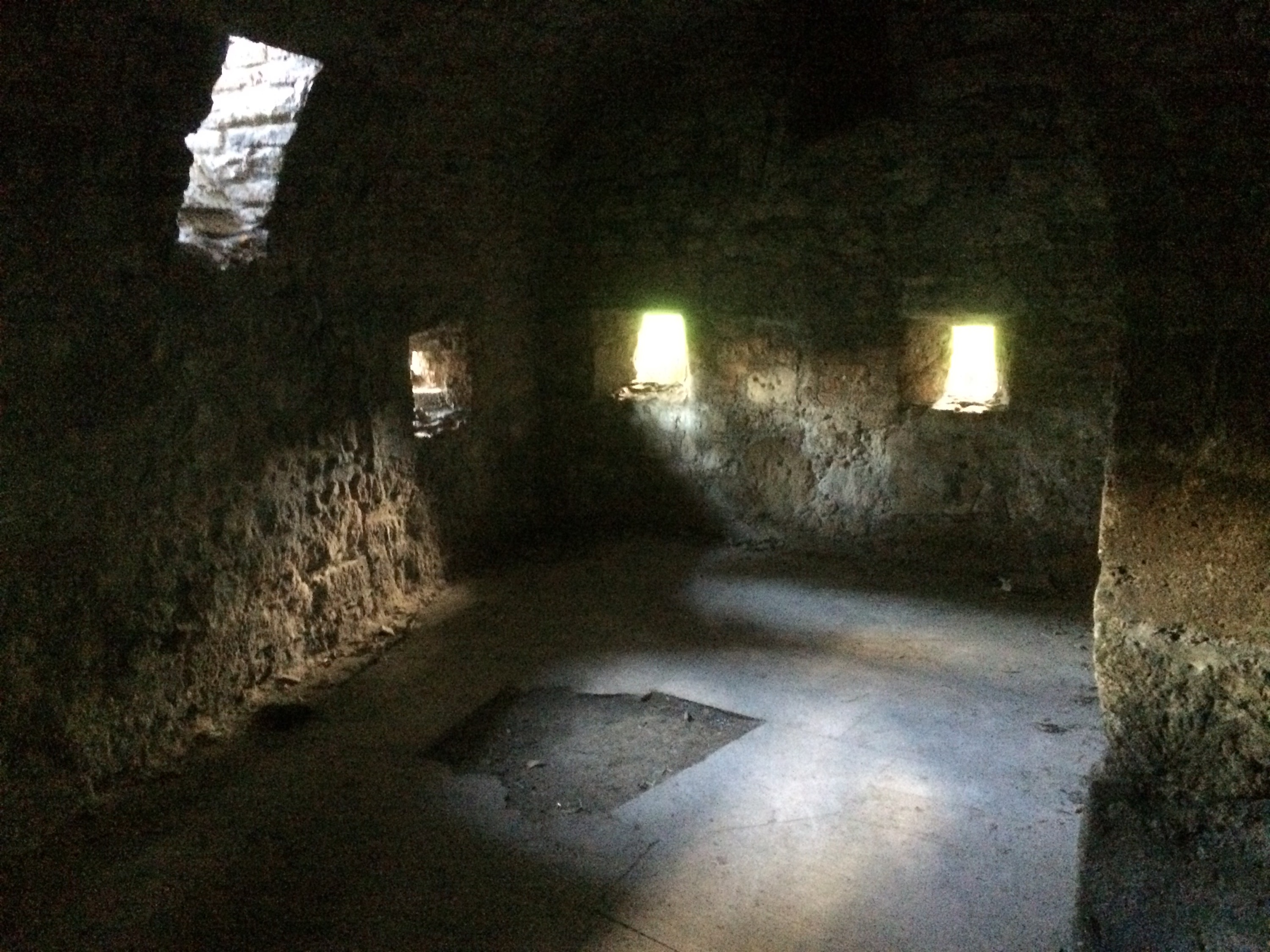
Dank, unlit and smelling strongly of wee.
Buda has its own sights, of course, though I wouldn’t call either of the two main ones ruins. Castle Hill, occupied by Budapest Castle and the Matthias Church (named after the original Raven King) is worth exploring, though in the latter case at least, heavy reconstruction and redecoration work has left the place looking a little too fresh and tourist friendly. As always, it pays to poke around and explore every corner, to turn up surprised like an unlit corridor leading to a seemingly forgotten chamber beneath the earth.
South of Castle Hill stands Gellert Hill, a steeper and more taxing climb, albeit very much still worth it. For atop the hill stands the Citadella, an Austro-Hungarian fortification that was obsolete before it was finished, and the Liberty Monument, which stands as it did in Soviet times, albeit with all specific references to the Soviets removed. Brutally putting down rebellions wins few friends. The Citadella was closed by the time I got there, but that wasn’t much of a loss – the hill commands a view of the entire sweep of the Danube, laying all of Buda and Pest out before you.
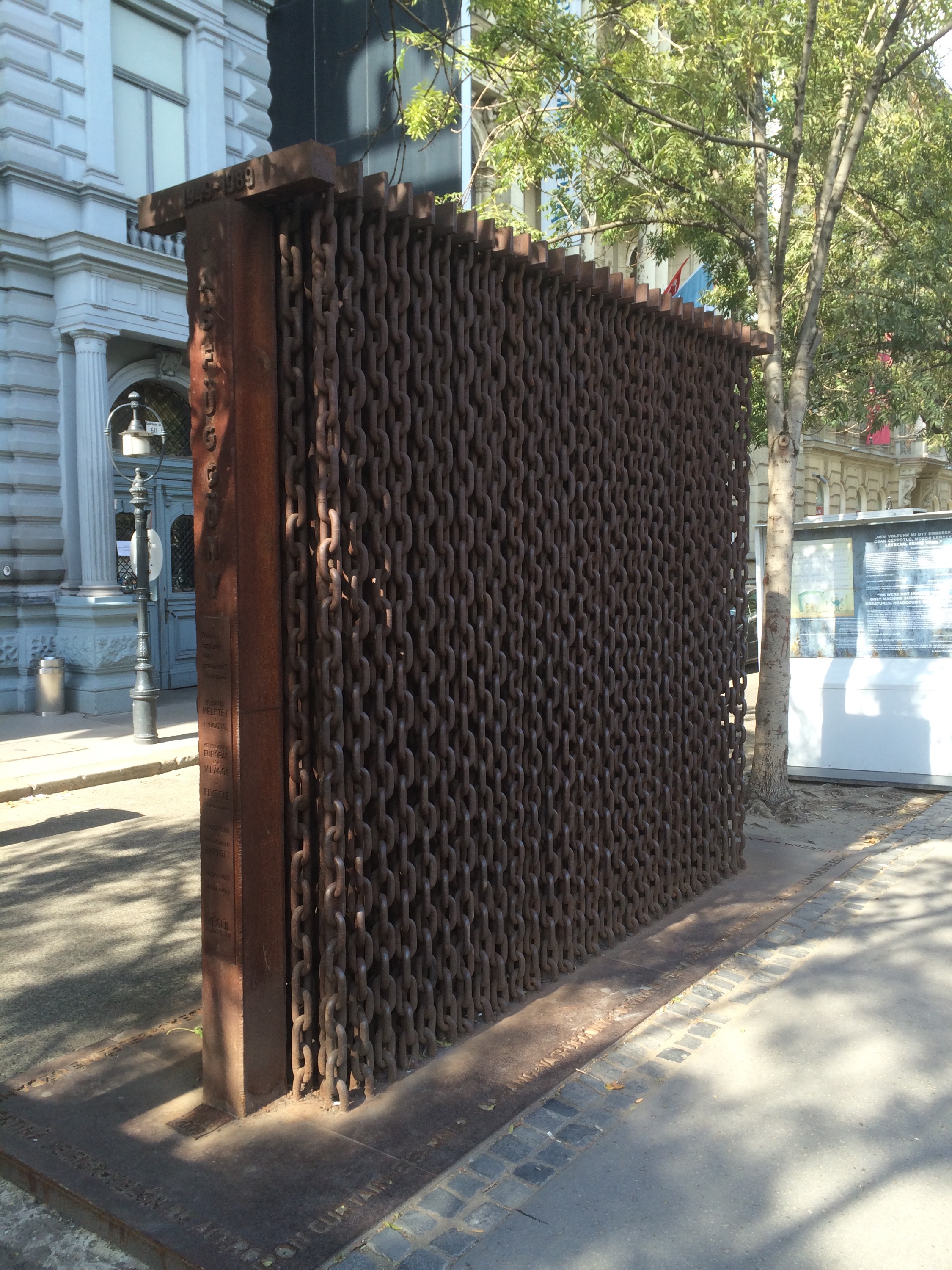
An Iron Curtain. Metaphors are for wusses.
If Buda and Obuda have laid claim to most of the history, Pest is left with the lion’s share of the life. History here is of the more recent type, and the life that’s to be found is of the natural-, human- and night- types. Natural life in the various parks and green spaces in Pest and neighbouring Margaret Island, human life on every street and especially in the huge Szechenyi Thermal Baths, which weren’t short of both tourist and local bodies on an otherwise quiet Monday. As for night life, I was usually too tired to check, but the activity around my hostel suggested there was plenty of it.
For all its divisions, Budapest seems to be a pretty unified city. It’s interesting to compare it to Vienna and Bratislava on the theme of identity: in comparison to the former’s comfort and the latter’s questing, Budapest was stuffed with reminders of a shared Magyar heritage, separate from influences both East and West. It felt a little like an effort from above to set the cultural narrative, which is always a tricky thing to do. And, as could be seen in the refugee tents still visible at Budapest-Keleti, of little benefit to anyone not fortunate enough to fall into the cultural group in question.
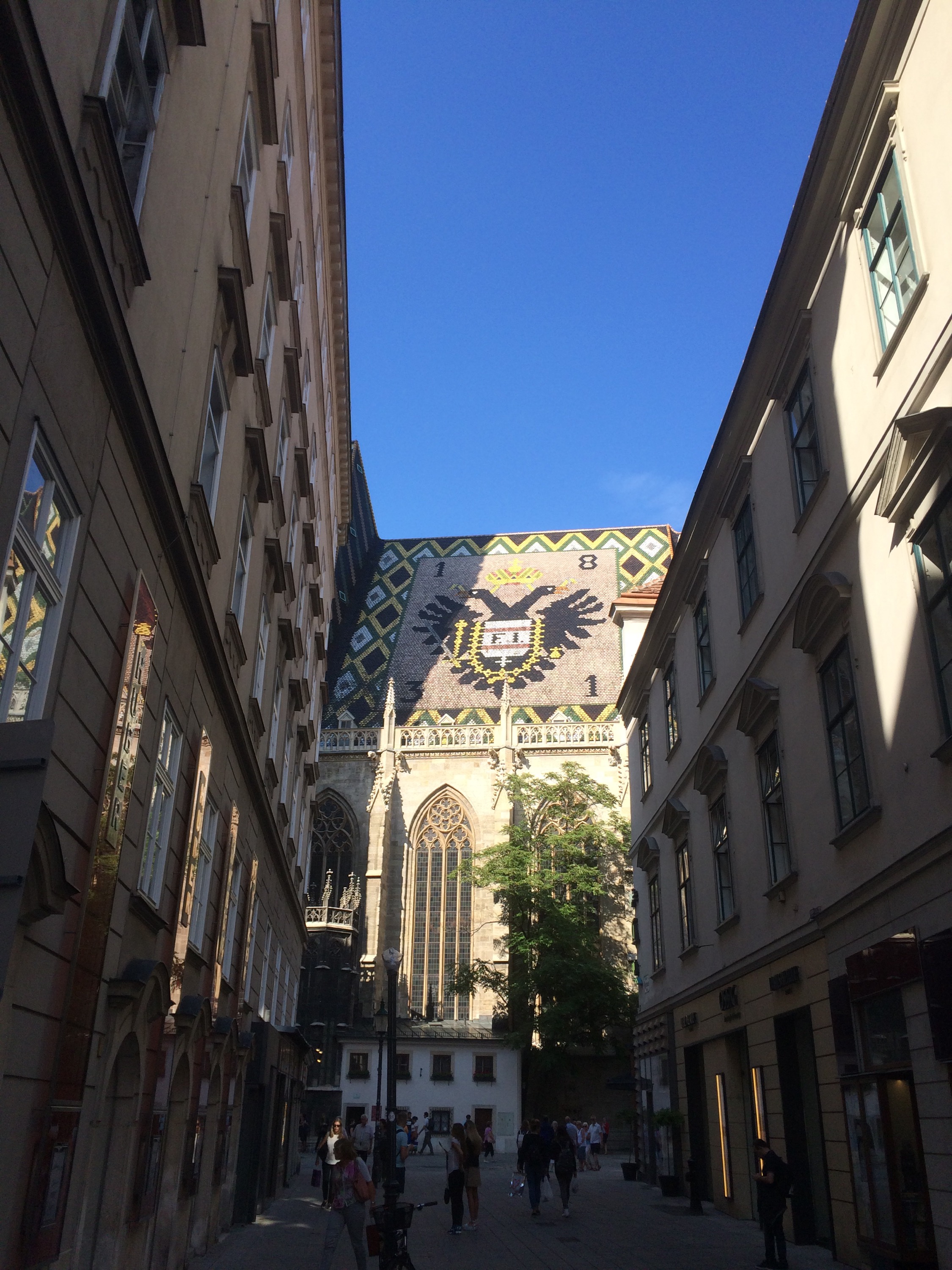
What’s the point of having a cathedral if you can’t stick your emblem on its roof?
It occurred to me as I was wandering around Vienna that I’ve managed to hit most of the imperial capitals of Europe. Rome, obviously, but Istanbul has the unusual claim of being the capital of two empires. As for more modern empires, there’s London, Paris, Berlin and Moscow. Further down the list, Athens counts for the brief era of Athenian power, as does Stockholm from the Swedish short golden age of martial might, pre-Peter the Great of Russia, who moved Russia’s seat of power from Moscow to St. Petersburg. Even Copenhagen squeezes in for the Kallmar Union – am I missing any? (As near as I can tell, I need Madrid and Lisbon to complete the set.)
Unlike Berlin, which had a wonderfully cosmopolitan identity crisis, Vienna knows that it’s an imperial capital. Though as capital of the Holy Roman/Austro-Hungarian Empire, it has a bit of competition: if we go all the way back to Charlemagne, there would probably be more imperial capitals than I would have time to list. Nonetheless, Vienna knows what it is and was, and its architecture practically shouts out “Hey, we used to have all the power in these parts.”
The best example that I saw of this was in the twin Kunsthistoriches Museum and Natural History Museum. Both are suspended halfway between being modern museums and reminding visitors of how they started: as the collection houses of Emperors, designed to show of their patrons’ power and sagacity through the display of works of art and historical and natural curios of every type that could be found.
One of the mineral rooms at the Natural History MuseumEmperors in an Imperial setting.
As museums go, they’re a lot of fun to walk around, and while these ones weren’t looted as badly as their counterparts in Berlin, the Natural History Museum in particular suffers from the fact that the Austro-Hungarian Empire was a relatively minor imperial player compared to France and Britain from the Age of the Enlightenment onwards (its array of taxidermy is startling though). As for the Kunsthistoriches Museum, it’s a delight to wander around, as there’s been an effort made to attach the works of art there to the rulers who commissioned or collected them, meaning that they help to tell the strange and twisted story of the Habsburgs and their ever-increasing jawline.
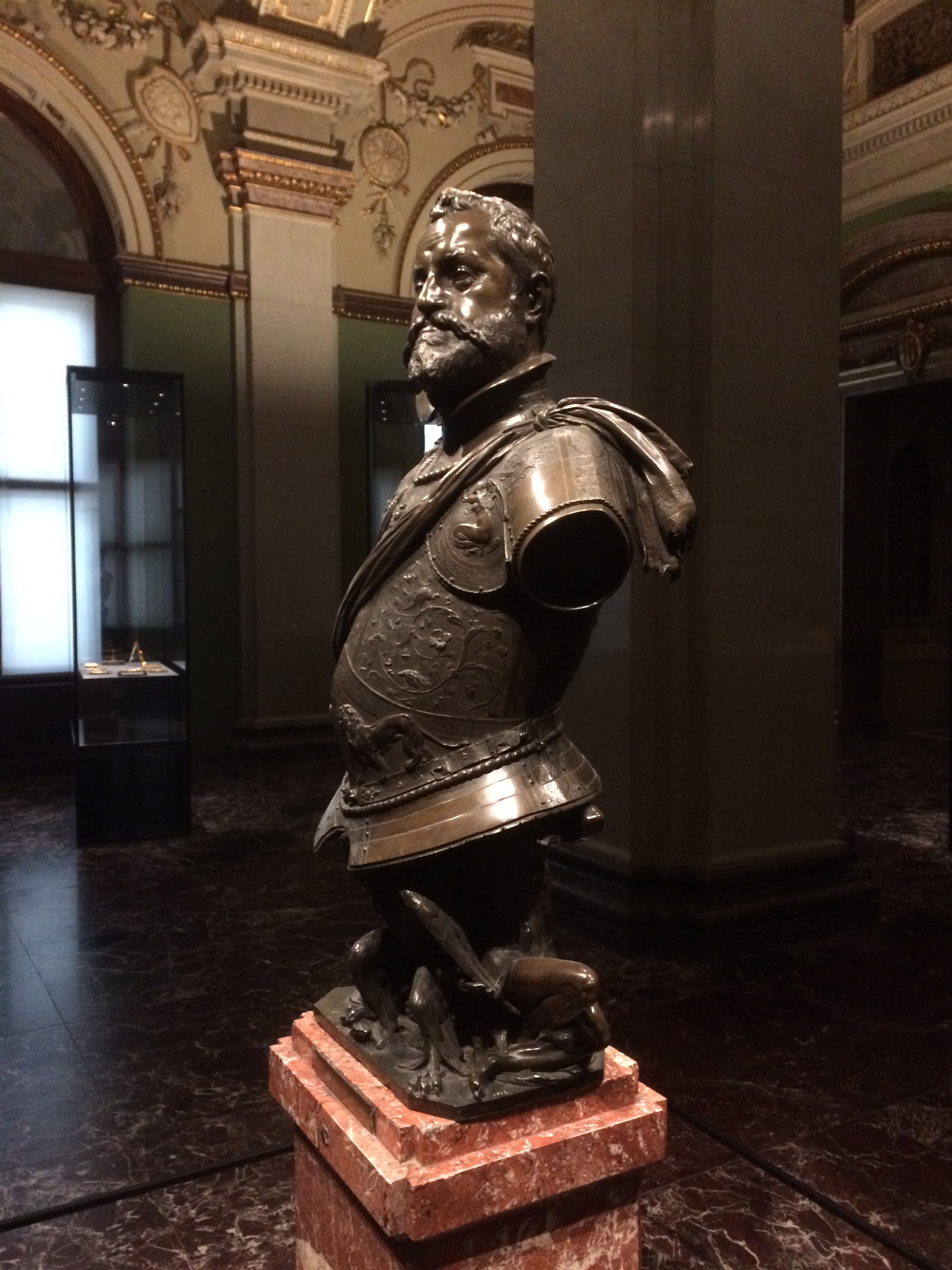
A beard hides all ills in a manly fashion.
The combination of old-fashioned and modern approaches helps these museums to stand out from the crowd. It works for the city as a whole too. Vienna feels relaxed and confident, and very western in a way that might not be the case today if its once-famous, now vanished walls hadn’t been quite so impregnable. History has treated the city pretty gently, and visitors to the city have reason to be grateful for that.
Charles Bridge, somewhere near sunset.
My preferred method of exploring a city is to start walking and only change direction whenever I see something more interesting down another street. Were I to try that in Prague, I would end up walking in spirals, or in an endlessly zig zag pattern. In Prague, there’s always something more interesting around the corner. This is a city that’s as close as any I’ve seen to the clichéd fantasy medieval metropolis.
There are the endlessly winding cobbled streets, with tiled rooftops packed so tightly overhead that guilds of thieves could conduct entire wars up there with no one below being any the wiser, save for the occasional corpse-cobble impact incident. There’s a town hall with an overly ornate astronomical clock, complete with clockwork mannequins. (The story goes that the designer was blinded once he finished so he wouldn’t go on to make a better one.)
Other clocks are available, and probably easier to read.
There are legends and stories galore surrounding the city, from poor old Jan Hus, who put too much trust in princes, to the golem that once stalked the Jewish quarter. Best of all, there’s the Defenestration of Prague, which manages to use one of my favourite words in its title. (Seriously – how much more fun is it to say “defenestration” than “thrown out of a window”?)
There’s a centuries-old bridge lined with statues of saints and divinities, across a river that’s home to an entire flotilla of swans. There’s not one but two hilltop citadels overlooking the city. Prasky Hrad, with its Gormenghast-like scale and complexity, and the over-the-top gothicness of St. Vitus’s Cathedral, gets all the press, but I’m partial to the more ancient Vyšehrad, which is mostly a shell these days, but is lovely to wander through and offers great views of the Vlatva River and Prague itself.
The Vlatva, looking south from Vyšehrad.
There’s even a hill hard by the city that’s swathed in an encroaching forest and hides not only a monastery with an ancient library but also a wizard’s tower that peeks through the treetops and has a labyrinth at its base.
All right, so the tower is a copy of the Eiffel Tower and the labyrinth is a maze of mirrors, but wizards are noted for their lack of originality. I doubt the average medieval inhabitant of Prague would have quibbled over the details before reaching for the nearest pitchfork and joining the local mob.
It’s a city for losing yourself in, then, as I’ve done for the past few days, the high point of which was when I found a store selling replica Viking arms and armour. For a good five minutes, I considered attiring myself in a manner befitting a Norse adventurer and taking ship down the Danube to the Black Sea and seeking service as a Varangian Guard in Miklagard/Constantinople.
Sadly, dreams of adventure and fantastic vistas founder when they hit the hard rocks of reality. Even as I’m enjoying my travels throughout Europe, a group of far more desperate travellers are trying to head in the opposite direction. The “tide” of refugees entering Europe is much in the news at the moment, often to heartbreaking effect, and while I’m currently on my way to Vienna, my plan is to be in Budapest, the current flashpoint of the crisis, in three days.
That may change, but even if it doesn’t, it forces me to think about why I’m travelling – this experience of cities and nations I’ve never been to before. How much worth does my indulgence hold against the desperate need of others, exemplified in the huddled form of a small boy washed up on a lonely beach? Are they comparable? Or even relatable? And what can I do?
I only have the beginnings of answers for any of those questions. I doubt that one traveller can make much of a difference, or learn everything he’d need to in the space of the two weeks I have remaining. The one thing I do know is that if I close my eyes, I’ll learn nothing. So I’ll keep travelling and see what answers I can find.
Follow the Lime Green Railroad to the Wonderful Wizard of Uncertain Destinations…
So, I’m doing it again. One year after Greece, four years after the Trans-Siberian and six years after Norway, I’m once more taking an August-September travelling holiday, hitting a bunch of new (to me) locations. Once again, rail is the medium for my peregrinations, and this time the locale is as much of the former Soviet Bloc as I can fit into three weeks. (No, I’m not visiting Belarus as part of this trip, and as much as I’d like to drop in on Ukraine, it might be better to leave that for later too.)
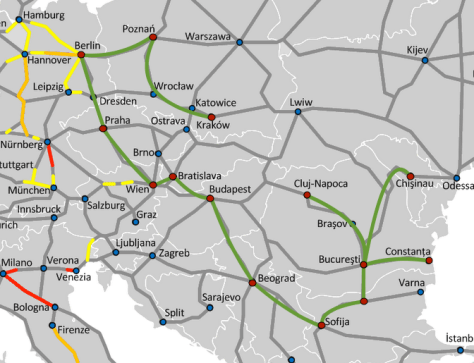
That map above gives the general outline of the trip: Krakow, Poznan (briefly), Berlin, Prague, Vienna, Bratislava (briefly), Budapest, Belgrade, Sofia, Veliko Tarnovo, Bucharest, and then … options. This is one of those trips where the early stages have been nailed down and booked, whereas the latter ones are more reliant on train availability and everything that goes before. Which, even though it might rub my obsessive compulsive tendencies the wrong way, is still appealing. Not knowing exactly where I’m going to wind up probably won’t do my mother’s blood pressure any favours, but I’m happy enough to keep a loose leash on the days ahead.
One of the nicest of things about this trip is that I’ve never been to most of the countries I’ll be visiting—the only ones I’ll be returning to are Germany and Austria, and even there, Berlin or Vienna will be entirely new. In fact, once this trip is over, the only European nations remaining unchecked will be fall into three groups: the Russian fringe (Finland, Latvia, Lithuania, Belarus, Ukraine, and maybe Moldova), the Balkans (Slovenia, Croatia, Montenegro, Bosnia and Herzegovina, Albania, Kosovo, and Macedonia), and a scattering of others (Switzerland, Portugal and most of the microstates—Andorra, Liechtenstein, Luxembourg, San Marino, and Monaco). Which brings me close enough to a complete collection to prompt a few more holiday ideas at least.
For now though, an Eastern European Odyssey is the order of the day. Preparations have been made, maps have been consulted, and tickets have been booked where possible. And as many considerations as I can consider have been considered.
Rail Travel: As mentioned, rail is the way to go here, and the resource worth relying on is The Man in Seat 61. It’s served me well in the past and it did here too, though booking tickets beyond Vienna has proved less useful than just showing up at the station in person. Sleeper services will be taken of wherever possible, and there might be a brief river trip between Vienna and Bratislava if the Danube isn’t too drought-stricken. When I get to Bulgaria and Romania though, my timetable will be at its most flexible. It’s just a pleasant coincidence that my options will be opening up as Europe reaches its most alluring.
Accommodation: The open nature of the latter end of my travels means that I can’t book too far ahead, but even if I could, I’m going to be taking a leaf out of my Greek odyssey: stick to booking a day or two ahead of time, using the Booking.com and AirB&B apps on my phone. Sleeper services are to be preferred, but hostels and B&Bs are just as valuable, mostly for their showers and laundry facilities. If I’m travelling light, cleaning my clothes will be a necessity at some stage.
Flights: Normally, the two things I’d book first would be my flights there and back. Well, I’m flying into Kraków to kick things off, but where I’ll be flying back from? That’s still undecided. I’d like to visit Moldova (because why not, when you have the chance?) but flights back from there are at least twice as expensive as from neighbouring Romania. So we’ll see. I have a ticket tracker running using the Kayak app, and the sudden availability of a cheap option may well determine how and where my journey ends.
Technology: Technology-light is the rule of the day. As in Greece, nothing more than my phone is to be brought. Even my new Pebble Time is getting dropped in favour of a Timex Weekender with a battery that lasts five years instead of five days. This will make it a little tricky to update the Travel section of this site as I go, but I’ll do my best. Those long train journeys will definitely give me time, at the very least. Still, my poor old iPhone 5S is suffering from geriatric battery syndrome these days, so one more piece of tech is needed. I’ve bought myself an Anker Astro E7 external battery, and having tested it for the past week, I’ve deemed it good. At the cost of a little extra weight to my backpack, I should be able to keep my loyal iPhone, and more importantly its camera and booking capabilities, running for as long as I need them.
Reading Material: This is an issue. Travelling light rules out carrying more than two books, and with one of those slots taken up by a Lonely Planet guidebook, that leaves little wiggle room. A friend has loaned me an ageing Sony eReader, but that runs up against both the low-tech rule and my personal preferences. I might rely on second-hand bookstores instead, or just read on my iPhone. (The latter option might seem a poor one, but I’ve read the Bible and War and Peace on my phone before, so it is an option. Maybe Moby Dick this time…)
Writing Material: Of course, without reading to take up my travelling time, and assuming that staring out the window can only occupy one for so long, writing will have the field to itself. So pens, some ink refills, and a notepad or two will be packed. How much I’ll get to write (beyond the requisite journal of my travels) remains uncertain, but the idea of letting my brain wander on the Danube plain is a huge draw. Even when I’m not strolling the city streets, there’s be imaginative highways and byways to explore.
Missing: What will I be missing while I’m gone? Well, not a huge amount. As the next category shows, the timing of this trip has worked out rather well. The start of the Pro12 rugby season and a few pre-World Cup friendlies is about the height of my sporting interests. Missing the Irish Craft Beer Festival stings a bit though. As for work, it’s been packed away for the next few weeks, and when it comes to keeping an eye on the state of the Internet, that’s something I could do with less of.
Returning: On the other hand, within a week of my return, I’ll have the return of Doctor Who, the start of the Rugby World Cup, a new niece to be a godfather to, and one of those birthdays with a “0” at the end of it. So I’d better be well rested when I take off from somewhere near the Black Sea (presumably). Because I’ll be hitting the ground running.
It’s an eclectic city, but if you catch it at the right moment, it’s a beautiful one too.
When I first started up this blog, it was with the purpose of keeping a record of a months-long trip around the world. Since then, it’s drifted away from that towards reviews of games and movies, punctuated by the odd political or cultural rant. This drift shouldn’t be all that surprising – it’s not like I can afford to go on holiday every month.
Still, when I do go on holiday, even when it’s only for a few days, it’s fun to keep a diary, one that can be illustrated with photos. Sharing experiences isn’t just for Facebook, though Facebook is the obvious gateway through which to usher people to these pages.
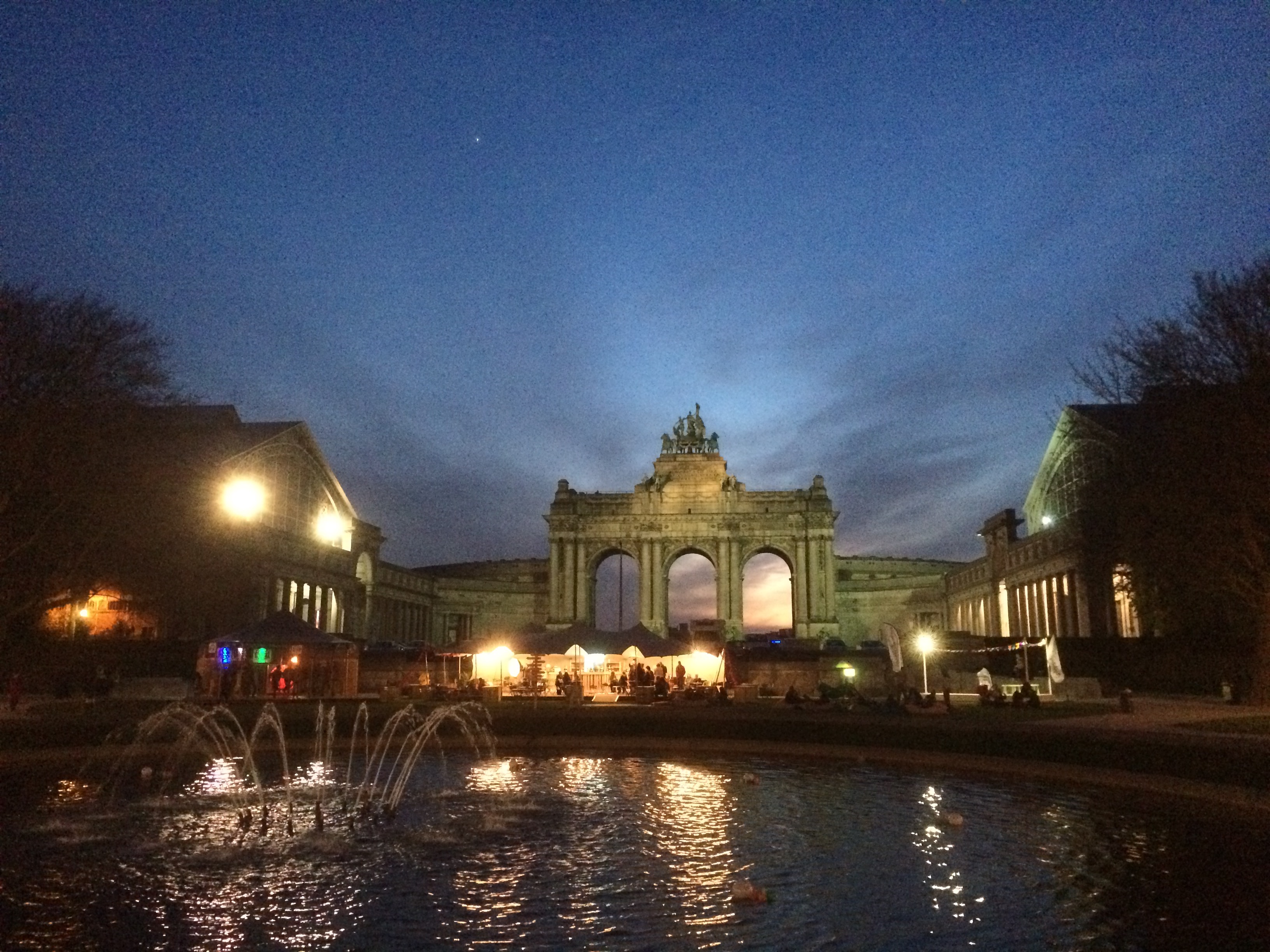
In short, I’ve added another entry to the Travel menu above, courtesy of my just-ended five days in Brussels. Five days of sunshine and late nights, during which I made strenuous efforts to balance out my intake of beer, frites and waffles with some industrial grade walking. By the end of it all, I felt like I’d gotten a pretty good feel for the city, and I’m looking forward to getting the chance to go back some day. For some small clue as to why I enjoyed it all so much click here.
(And apologies in advance if the prose is a bit clunky. I’ve fallen out of the habit of writing these articles, and it’s not always easy to jump right in again.)
Travelling to Crete is like taking the lever that controls the Greek history time machine and pushing it as far back as it will go without breaking. Modern political divisions notwithstanding, this is a very different country, and there’s no better place to see this than in Knossos, heart of the Minoan civilisation of Crete and fabled palace of the mostly legendary King Minos, his daughter Ariadne and her half-brother the Minotaur. (Look it up – it’s a little icky.)
Even for the Mycenean Greeks who supplanted them, the Minoans must have appeared to be something alien and ancient. In the court of the Pharaohs of Egypt, the men of “Keftiu” were regular visits and the acknowledged masters of the wide green sea. The first maritime kings of the Mediterranean, they bequeathed some but not all of their practices to the Myceneans when disaster and strife somehow brought down their power. (The role of the Thera eruption in that downfall is yet another fascinating possibility.)
Looking at the art of the Minoans, it’s still easy to note the gulf that separates them from the later, more realistic depictions of the Greeks. In religion, the Minoans were goddess worshippers, and while they did venerate male deities too, the shift that placed Zeus (born and raised in a cave on Mount Ida on Crete as the tale goes) at the head of the pantheon of Olympian deities came after their time.
This shift in culture, art and language is a fascinating one to try and follow. There are Greek scripts that seem to depict the ancient Minoan tongue. The Linear B text seems of Minoan origin but is used to depict Greek language. The Minoans rose and fell several times over the centuries, coexisting with the Myceneans for several of them until their uniqueness was eclipsed.
The Iraklio Archaeological Museum does an excellent job of putting this tale in its proper context. (Any flaws in my understanding of it all, I’ll have to put down to my sleep-deprived brain – and while I’m at it, I’ll blame any typos on that too.) It seems that the more the Cretans were plugged into the trading networks and political systems of other Mediterranean powers, the less distinctive they became. Eventually, the people who had built and decorated the palace at Knossos so gloriously (though not necessarily as it now appears, depending on your opinion of Arthur Evans) became just another territory. An appendage and territory of other powers, whether Greek, Roman, Byzantine, Ottoman, or Venetian.
It seems a shame, but we have the memories in myth and legend of those times and the relics recovered from the concealing earth and painstakingly restored. For me, I’ve enjoyed all that and more. My travels have taken me from Thessaloniki in the north of Greece, with its Byzantine and Ottoman influences, all the way to Crete, going ever deeper into history as I’ve continued south. This seems as good a place as any to stop. Maybe tomorrow, before I fly home, I’ll just lie on the beach for a while instead…
The lighthouse at Chania in western Crete. On a stormy night like this, there’s no place better to be.
I’m in ur background, bombing ur photoz.
There’s a trope in film and television of using familiar landmarks to create a sense of place. If a scene is meant to be in Paris, the odds are that the Eiffel Tower will be lurking in the background. If it’s London, Big Ben and Tower Bridge serve the same purpose. If it’s Dublin, well, a pub will probably do fine.
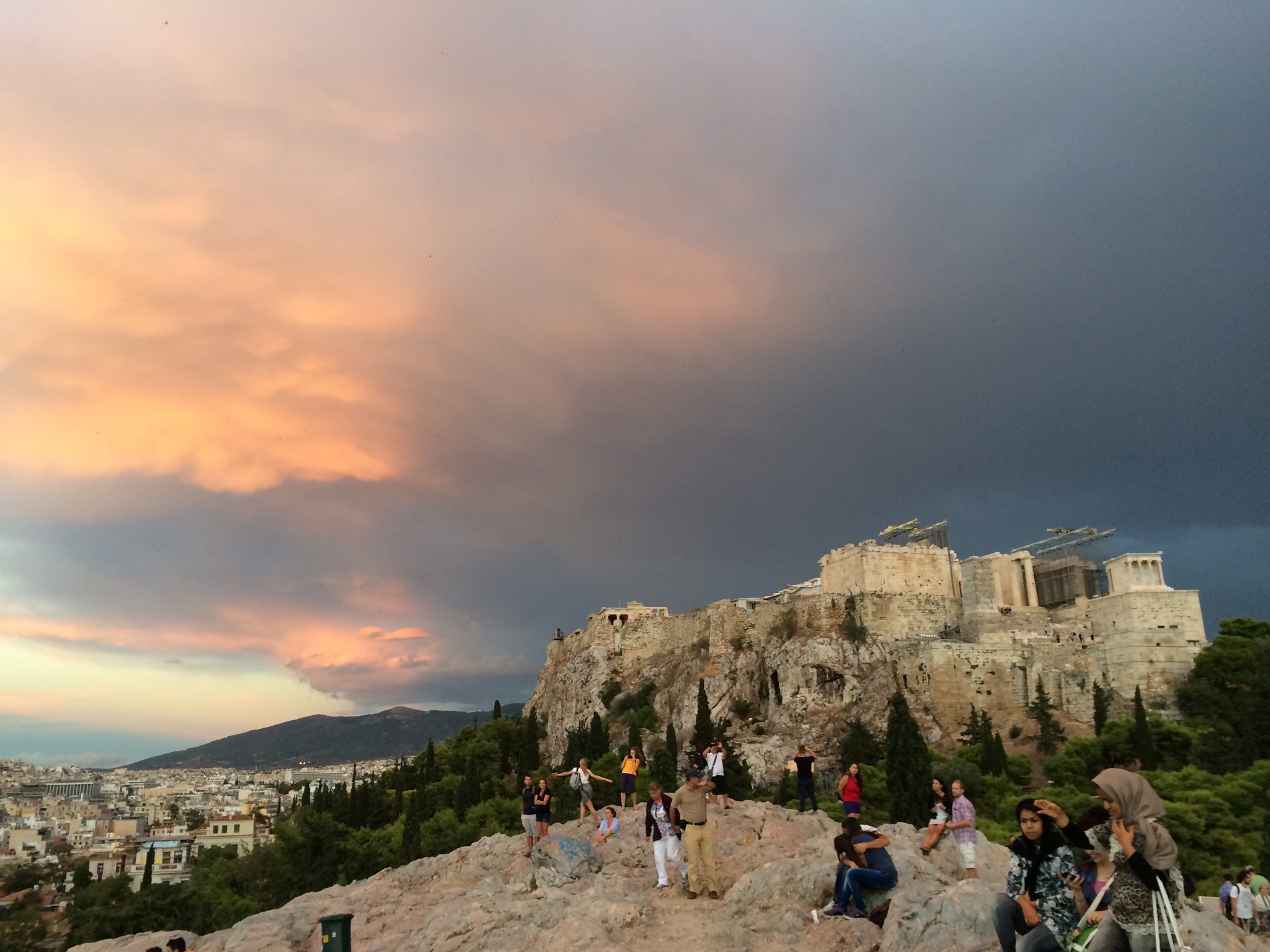
For Athens, the Acropolis and the Parthenon are the more than obvious choices as identifying landmarks. The difference being that when you’re in Athens, the Parthenon and Acropolis actually are in the background most of the time. It’d be a surprise if they weren’t, give that they’re built on a whacking great mountain in the middle of the city.
For all that modern Athens now sprawls all across the Attic plain, its ancient past remains evident at its heart. The Acropolis stands out of course: there are Mycenean stones at its base, as in so many other places that I’ve visited, but habitation here goes back at least to the Neolithic. But it’s hard to go anywhere in the centre of the city and not come across reminders of the past. Plenty of the museum pieces that I’ve seen over the past two days have had notes attached saying that they were found in some construction project or other.
It must make urban planning a nightmare here, perhaps more so than anywhere else on Earth. All around the city you can see building sites that have turned into archaeological digs, though how much of that is due to the economic downturn I couldn’t say. Even the Acropolis Museum has a glass ground floor, the better to show the craftsmen’s district uncovered during its construction.
Tear your eyes away from the Pantheon and take a walk around Athens though and you’ll be well rewarded. In the shadow of the Acropolis alone, you have the Areopagus hill, where high crimes were judged. You have the Pnyx, where Athens’ ruling body of the people met. There’s the largely intact temple to Hephaestus and the mostly ruined but massive Temple of Olympian Zeus. In the ancient agora, you can see the prison where Socrates took his fatal draught of hemlock, and down the hill you can see the uncovered Kerameikos district, where he strove to open minds among Athens’ ordinary citizens, questioning their every assumption.
Once again, it’s all about being close to history. Not just the history of a place like the Acropolis, a sacred precinct for the gods, but the history of the Kerameikos, where the common folk of Athens went about their daily business. Where they lived and died and were buried, for the Kerameikos was a cemetery too. Where you can see the roads that led out through Athens’ walls and the homes where meals were prepared and eaten. In a place like that, where centuries of dirt have been scoured away, you can walk in their footsteps. It’s as close as you’ll ever get to walking beside them.
The path of grave markers that led from the Kerameikos.












 cerandor.com