Tag Archives: travel

Focus and Inspiration

20111028-002915.jpg
Iron and Weeds

I’m counting down the hours to my return at the moment.* One last long transit will take me back to Ireland, via Heathrow. Hopefully the place will have dried out a bit by the time I get there. Should I be worried about my ground floor apartment?

I’ve been in New York for the last few days, stomping out familiar territory as I prepare to return. Although I’ve been here several times in the past, this time around I’ve tried to concentrate on doing things that I’ve never done before. Some are a little obvious, such as going to the top of the Empire State Building. Some are reminders of home, such as cosy pints in the Gingerman Pub. And some are things that I wasn’t even aware of last time I was here, such as walking the High Line.

An elevated railway converted to a linear wildflower garden that offers a unique vantage point over southwestern Manhattan, the High Line is an example of a community project that took a crumbling eyesore and turned it into something that’s not only an asset to the local communities but also a tourist attraction, luring in people who might not otherwise be inclined to visit these parts of New York. I first read about it in a National Geographic article, and that was enough to make me determined to see it and to walk it as I passed through the city.

The High Line is an example of community activism that has had a positive outcome far beyond what the threatened demolition of the line would have provided. Up in the air for the moment is the outcome of a rather more well known outburst of activism: the Occupy Wall Street movement. I’ve been coming across the offshoots of this movement as I’ve passed through the U.S., and I’ve been hearing about its spread across the wider world, but even here in New York it’s hard to say exactly what it’s achieved, or will achieve, beyond attracting attention to itself and drawing the occasional incident of police brutality.

There are a lot of theories in the media about the Occupy Wall Street movement at the moment. Many of them tend to focus on the fact that beyond protesting about the state of things, there’s little sense among the activists of a clear view of what needs to be done. It’s a fair criticism, but also inevitable: this isn’t a protest about something as simple as ending a war or preventing job losses. Ultimately, it’s about changing the way a small but very influential sector of our society works, and societal engineering is a difficult thing to plan, let alone to carry out.

I’ll be interested to see what comes of the Occupy Wall Street movement. Any number of commentators will tell you that something needs to be done if our notions of liberty and justice in society are going to be preserved in the face of an unbalanced distribution of wealth and influence, especially when those with all the money and the weight to throw around are fighting to retain what they have and perhaps gather more as the system creaks beneath them.

Occupy Wall Street may not have the answers. They’re unlikely to ever have as much focus as those who created the High Line. But they are at least asking questions and drawing attention to the need for someone in a position of power to take a longer-term view of where we’re heading. If nothing else, what they’ve done so far has reminded those with a knowledge of history that inequality tends to lead inexorably to unrest and revolution if not dealt with in a serious manner.

*Well, I was when I started this. I’m safely home now, and this is being posted late due to the habit of JFK and Heathrow airports of not avoiding gouging their customers for Internet access if they can possibly avoid it.

The Backward Track

20111023-110803.jpg
Walden Pond: where crowds come to get away from it all.

Scientific impossibility though it may be (apart from for the occasional stray neutrino), time travel has always been a dream of mine. Not so much to see the future, which happens so fast these days that all we have to do is live through it, as to explore the past. Well, my journey from west to east across the U.S. is probably as close as I’m ever going to get to travelling back in time.

I started off in Los Angeles, which was the cultural heart of the world for much of the 20th century and still bears the traces of its 80s heyday, before that hegemony started to splinter. Further north still, I spent time in the palace of one of the barons of early Hollywood, W.R. Hearst, who partied with Flynn and Chaplin and was the thinly disguised subject of Orson Welles’ Citizen Kane.

I dropped in on Steinbeck’s Cannery Row on the way to San Francisco, which still has the antique feel of the late 19th century around various districts, perhaps a reminder of the days when people from all nations travelled there in search of gold and opportunity.

Across the mountains to the east lay two pioneer cities, born from rather different origins: Salt Lake City, built around a core of Mormon settlers escaping persecution/the rule of law (take your pick), and Denver, another gold rush city, proud of its status as the “Mile High City” and its cowboy heritage.

I skipped through Chicago and landed in Washington, D.C., smoothing my path through time a bit. Born in the aftermath of the American Revolution, Washington has the look of a designed city: glance down any of those long boulevards and the chances are that you’ll see some imposing edifice framed at the end of it. Celebrating American Independence, it sets aside a large part of its heart to memorialising the figures who played notable parts in the nation’s history.

Another skip through New York landed me in Boston, keeping that retrograde progress smooth. From this point, I was in the land where the nation was born: the original thirteen colonies that became states in the War of Independence. Washington may enshrine that memory, but these are the places where the action happened.

One side trip brought me face to face with another person who sought to retreat to a simpler time. Henry David Thoreau, whose book Walden recounts his efforts to live simply and at peace with nature by the pond of that name. His legacy attracts plenty of crowds to Walden now, but it’s not hard to walk the path along the water’s edge and suddenly find yourself alone for a moment or two, with just the trees and the water for company.

Of course, you can’t live in the past forever. I’m on my way to New York now, and even if it’s a long-settled city, once the Dutch port of New Amsterdam, there’s probably no more modern place in the U.S. Washington may be the nation’s capital, but it’s New York that the world thinks of as the exemplar of the American city, or perhaps even the nation as a whole. A fitting place to wrap up this trip, perhaps.

Mile High Club Sandwich

20111017-000921.jpg
A Denver breakfast. There is actually fruit in there, under the English muffin…

Sadly, no matter how hard I looked, I couldn’t find a sandwich joint in Denver that used this particular play on words. Not that I would have eaten said sandwich—I just wanted some proof that there are people out there who are as easily pleased by cheap humour as I am. I’m still looking…

Of all the U.S. cities that I’ve been to so far, Denver feels closest to a place I’d want to live in. It’s wide open without trying as hard to impress as Salt Lake City does or being as pedestrian-unfriendly as Los Angeles. It’s also laid back without being as touristy as San Francisco. One thing that I would miss is the sea. Or, more broadly, moisture in general. I don’t know whether it was the altitude or the sunny weather or some combination of the two, but I spent most of my 24 hours there gasping for a drink.

As much as I might wish to have had a little more time in Denver, my whistle-stop tour of the U.S. is working out well so far. After lurking around LA for a few days, I’ve spent no more than a night in any place since then, confining myself to 24 hours each in Denver and Salt Lake City, 20 hours in San Francisco, and a mere hour and a half in Chicago. I’d originally planned for a whole day there, but with accommodation being scarce and expensive this weekend and myself having visited there a mere six months ago, it was easier just to skip it and head for Washington, D.C.

So I’m getting ever closer to home in time and space. When I hit D.C., I won’t be far from the Atlantic Ocean, and there are only twelve days left before I have to catch my flight from JFK. These blogs entries have only really scratched the surface of all that I’ve seen and done over the past month and a bit; the places I’ve seen, things I’ve done and people I’ve met. I’ll have plenty of time to reflect and write some notes when I return, but for the moment I’ll keep on exploring.

Oh, and for those of you viewing this on Facebook rather than the main site, I’ve updated my Flickr account with some new photos. They should be visible in the sidebar to the right.

Moving On

20111011-055931.jpg
More comfortable on the inside.

My 20 or so hours in San Francisco marked the first time on this trip since London that I’ve crossed paths with a former journey. Seven and a half years ago I was there with a friend, visiting a friend of ours and his then relatively new girlfriend. They’re now married and living in London, and it was their house I crashed in on the first night of this odyssey. The very first digital photos I ever took were on that trip, and they’re still on my laptop, which is filling up with the photos from this one. Everything circles around eventually.

San Francisco hasn’t changed much, thankfully. I liked it then and I like it now: a city that seems determined to keep the pressures of the everyday world at arm’s length whenever possible. I had as much fun walking around the piers, up Telegraph Hill, through Chinatown and out to Haight-Ashbury as I have on any of my more exotic walking tours on this trip. Plus, the longer I’m in the U.S., the stronger the mental and emotional ties become that will bring me back home in a few weeks. It’s a nice way to be eased into the end of a journey like this.

If there’s any source of melancholy here, it lies in the seven-and-a-half year gap to my former visit: it was a different time and a different journey, and I was a very different person, still in my twenties and with a lot of things to learn. Yet given just how much has happened in all that time – how much has even happened in the past year – I can’t help but be optimistic when I consider just what I might be reminiscing about in another seven-and-a-half years time. I haven’t got the least clue what that might be, but if it’s this trip, then I’ll be smiling when I think of it.

Relics of Empire

20111007-104006.jpg
I kept stopping the car every five minutes to take shots like this.

Back near the start of this journey, I spent a day in the Hermitage, the former Winter Palace of the Romanov Tsars, now a treasure house dedicated to the packrat tendencies of those imperial rulers. Two trends were pretty clear: the desire to build as imposing a dwelling place as possible and the need to fill it with art and ornamentation of the very finest quality. After all, those who rule have to awe those who lack the resources to live in similar splendour.

Yesterday, I spent a few hours in the palace of a latter-day emperor: media mogul William Randolph Hearst. His castle at San Simeon is similarly awe-inspiring, perched on a hill overlooking the California coast and strewn with treasures and artworks of the very finest quality. And yet, it was hard not to notice that all of those artworks and treasures were either antiques at least several centuries old or copies in antique style. Whatever their failings, the Romanovs followed the tradition among the powerful and rich of acting as patrons to the artists of their day. I don’t know if Hearst did the same, but there was little that was new about the Castle at San Simeon, apart from the earthquake-proof reinforced concrete structure.

All very different from my experience at the Los Angeles County Art Museum a couple of days before. Whatever your feelings about modern art trends, there’s something admirable about the desire to try new things and see what works, and LACMA is a fine showcase for some fascinating modern pieces.

However, there’s art and then there’s nature, and not much has captivated me on this trip as much as the vistas on the Pacific Coast Highway between San Simeon and Carmel. The drive would have been much shorter had it not been for the constant desire to get out and admire the view every few minutes.

That’s why there’s a photo of the view from the road above rather than of Hearst’s Castle at San Simeon. Well, that and the fact that they have to give written permission before you can publish photos and I forgot to ask.

The Warmest of Welcomes

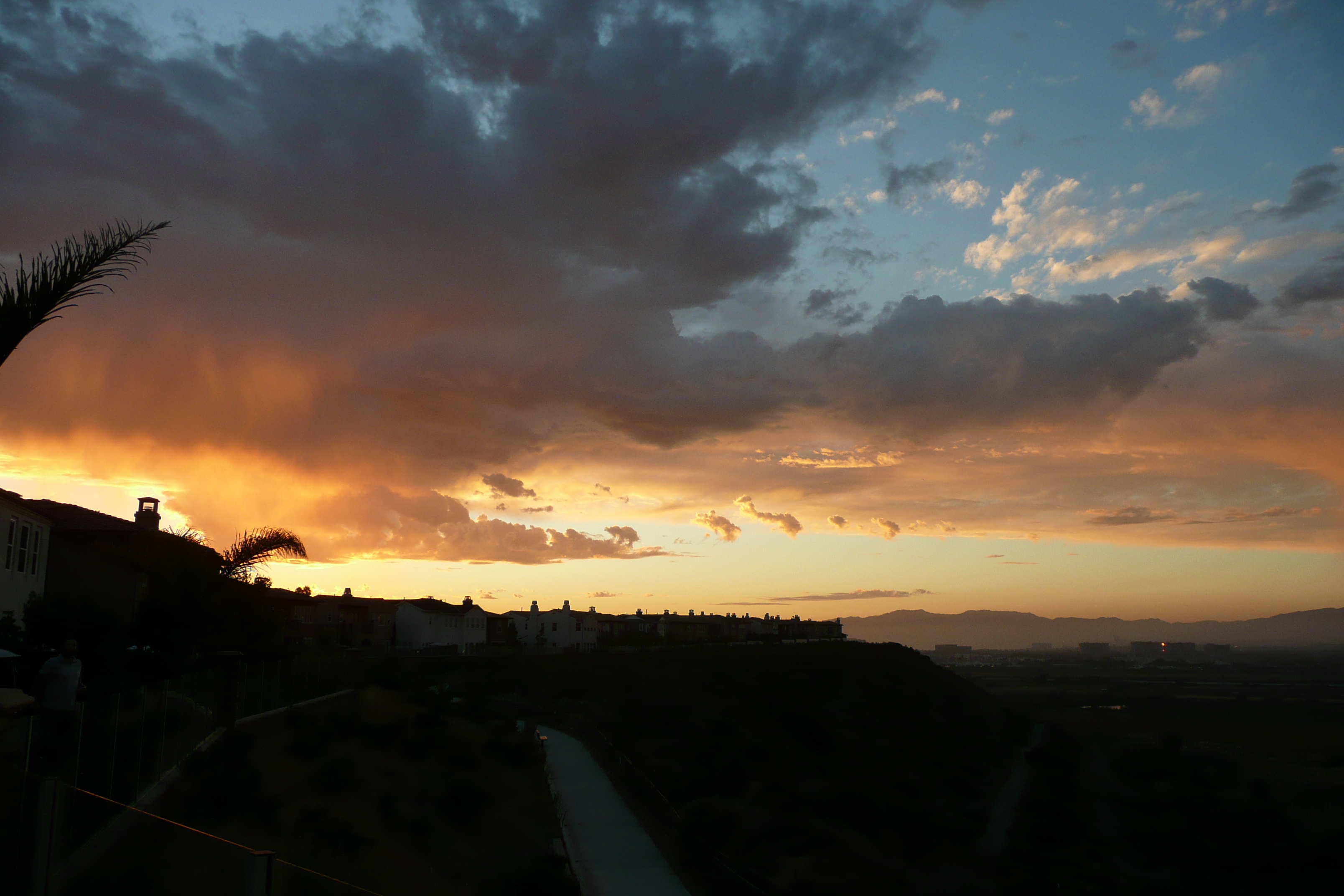
My very first night in LA and I get this welcome.

LA arranged this sunset just for me. Plus a rainbow on the other side of the sky. Nice.

Americans get a bad rap sometimes, with the stereotype of them being loud, obnoxious and culturally insensitive. Sure, I’ve met some Americans who fit that bill, but I’ve also met plenty of Irish who do too, and a fair scattering among other nationalities. In terms of ratios, I suspect that not too much changes wherever you go: there are always assholes. The vast majority of Americans that I’ve known have been some of the warmest, friendliest people it’s been my pleasure to encounter.

Los Angeles provides a case in point. This is the first time on my tour since I left London that I’ve been in the company of a friend, and she and her family couldn’t have been more welcoming to a weary, time zone-addled traveller. Getting to see Los Angeles laid out in front of me at sunset from the rear of their house was a pretty special experience too.

Los Angeles itself is a city I’ve never been to before, though I’ve bracketed it with visits to San Diego and San Francisco. There’s an odd feeling of familiarity about it that comes from place names that show up regularly on television and film: Mulholland Drive, Venice Beach, Rodeo Drive and, of course, Sunset Boulevard. I haven’t visited them all and I probably won’t before I leave, but I have ventured across the city by car and lived to tell the tale. So at least some of my navigational abilities remain intact.

Next up, a trip along the coast, northwards towards San Francisco by way of the Pacific Coast Highway. It’s all rather unplanned from here on in, save a few stops along the way to see friends, but after the scheduled mania of the trip so far, it’s nice to just take it as it comes.

End of the Road (sort of)

Tastier than expectedI’m not the world’s biggest sushi fan, but I couldn’t leave Tokyo without trying some. It was probably the best sushi I’ve ever had though, again, that’s not saying a huge amount. Great ambience though.

There’s around eleven hours left to me before the land and sea odyssey that has brought me from London to Tokyo comes to an end and I take to the air, crossing the Pacific from Narita Airport to LAX. From one continent to another, an eleven-hour flight that crosses purposes with the sixteen-hour time difference between where I take off and where I land. For Phileas Fogg, unaware of what he was doing, it was all about earning an extra day to win his wager. For me, I suspect it will feel an awful lot like theft: an entire night foreshortened and left orphaned, forcing me to deal with Friday afternoon all over again.

Then again, one Friday afternoon in Tokyo, the next (or the same one again) in California. Not so bad, really.

Japan has been quite incredible, and I did no more than cut a path across its heart, from the temple-strewn Kyoto and Nara to the hypermodern Tokyo, where touches of old Japan are preserved but mostly kept away from the hustle and bustle of everyday life. There’s a lot more to the country than that, from chilly Hokkaido in the north, with the last remnants of the indigenous Ainu people and some fine skiing country, to the subtropical islands of the south, where you really can get away from it all. In one week, I saw some cities and glimpsed the countryside, and what it has done is give me a taste for more. I will be back some day.

For now though, a last few hours to swing around some museums and shops, to see a few things I didn’t want to miss before I went. Neon glamour and fascinating side streets; time to put them in the past for now.


I’ve Got Walking Feet

20110928-180052.jpg
No, I don’t know what that is either.

I had thought that the sprawling megalopolis of Tokyo would defeat my tendency to walk everywhere rather than be sensible and use public transport. I reckoned without the power of a sunny day and a liberal sprinkling of useful streetside maps. Though it did take me a while to get used to the fact that the maps aren’t oriented north=up but rather according to the direction the reader is facing. Makes a surprising amount of sense, really.

I did take the JR Yamanote line in the morning, down to Shinbashi Station, but having strolled around the Hama-Rikyū gardens, it only made sense to check out the Tsukiji Fish Market (sadly closed) on foot, then to wander through Ginza, up to the Imperial Palace Gardens. Okay, so the walk from there through Roppongi to the famous Shibuya crossing was maybe a little excessive, but heading north from there, through Yoyogi Park and past the beautiful Meiji Shrine was actually quite relaxing. And once there, it was only a brief stroll to Shinjuku and the free observatory on the 45th floor of the Metropolitan Government offices. Sadly, despite the blue skies, the distant Mt Fuji was lost in the haze.

You’d think, after all that, I’d be crazy to try and walk back to the hotel. And you’d be right – I hopped on a JR train to Ueno, getting back just before sunset. Seriously – this is why it might be better for me to travel solo every so often. As much as I enjoy perambulating around a new city, I’d feel guilty dragging someone else all that way.

Tokyo marks the eastward terminus of this journey by land and sea – in a couple of days, I take to the skies for a flight to LA, landing several hours before I arrive. I don’t know how many times one has to cross the International Date Line before it ceases to be fun, but I suspect it’s quite a few in my case.

One more full day here and most of the next. Having done my strolling, perhaps some museums and the like are in order? First though, another stroll, this time out to see the neon of Akihabara by night.

Catching Up

There's reality, and then there's "reality".Explanation to follow.

Time for me to do a bit of housecleaning. I’m in Nara, Japan, at the moment, having spent most of the last three days on my feet from dawn to dusk (it being slightly after dusk here at the moment), making the most of simply being in Japan and exploring the temples, forests and back streets of Kyoto, Uji and Nara. However, with Tokyo looming and the possibility that I might not have much time for, well, anything in the near future, I’m taking an hour or two out to put certain things in order. The first thing being my photos, which are rapidly becoming a massive, unedited collection, relatively useless until I sort through them.

The second thing being my monthly reviews, which are, oh, just a little bit delayed at present. So, without further ado, and compressed into a single post, here’s August’s reviews.

Cinema Reviews

Fright Night: A glossy 3D remake of a 1980s teen horror film, this skimps on the subtlety and heads straight for the gore, with gushes of blood and large pointy things regularly heading out of the screen and towards the audience. The cast throw themselves into the spirit of the thing, especially David Tennant as a sleazy Vegas magician and Colin Farrell as the even sleazier predatory vampire neighbour. It’s paper-thin, lacking any reason to exist other than to entertain, and on that level it serves pretty well – but only see it in 3D if you like having things pointed at you, as the rest of the film is too murky otherwise.

Drive: Nicholas Winding Refn delivers a detached and dream-like film, saturated in ’80s style, portraying a Hollywood stunt driver who moonlights as a wheelman, seeking to live a normal life even as he deals with monsters. Ryan Gosling is almost mute in the role of the unnamed driver, who only reveals who he is when trapped by an attempt to do the right thing that goes terribly wrong. At times the long pauses and silences can seem pretentious, but there is substance under all the style and some fine performances from a notable cast.

Conan: Okay, I’ll admit that I saw this in Russian, without subtitles, and may have missed out on some subtleties of plot and character, but then Conan has never been a character who’s traded in subtlety. For all the extra gore, dirt, nudity and CGI, this isn’t too far away from the Arnie original, and its design work does a good job of portraying a world of terrible antiquity, even though the whole thing does tip over into cheesiness every so often. Jason Momoa offers an imposing physical presence in the lead role, even though he’s more pantherish compared to Arnie’s beefcake, but it’s questionable whether he or the film have made the character unique enough to earn a second run at a cinematic outing.

Book Reviews

Mockingjay, Suzanne Collins: The “Hunger Games” trilogy comes to an end with a war waged as much through public relations as violence, but one that is no less shattering for its participants for all that. Collins does not stint in depicting the brutal impact, both physical and mental, of being at the centre of this conflict on her protagonist, Katniss Everdeen, as she learns the difference between those who wage war because they have to and those who wage war because it is expedient. Genuinely heartwrenching at times, it refuses to offer easy answers, and even its potentially cliched love triangle is played out in a believable and affecting manner.

Ghost Train to the Eastern Star, Paul Theroux: Replicating a journey he took three decades earlier, the author travels around Asia, revisiting old haunts as a curmudgeonly ghost, alternately enthralled and appalled at the changes and the things that have remained the same. Leavening his sometimes dyspeptic gaze is the fact that he’s willing to fall in love with a scene or a face at a moment’s notice. Ultimately, this is a book about travel, not tourism, and it’s far from being a guidebook of any kind, but it will be hard for anyone to read it and not wish to follow at least part of the way in the author’s footsteps.

The Year of the Flood, Margaret Atwood: Not so much a sequel to Oryx and Crake as a companion piece to it, telling of the end of humanity from a new perspective, this is the story of those whom that apocalypse was inflicted upon, even as they dealt with their own crumbling lives. Atwood takes a light touch in dealing with the eco-cult who dominate the structure of the book, leaving the reader uncertain as to exactly who is being laughed at, with the inevitable answer being everyone, at one time or another. Dark where it needs to be, humorous where it can be and human everywhere, this doesn’t have the impact of its predecessor, but apart from its overuse of coincidence, it’s a fine addition to the story.

Carter Beats the Devil, Glen David Gold: The jazz-age era of stage magicians is evoked with well-researched detail in this twisty thriller, focusing on the career of “Carter the Great” and its links to the foremost developments of the age. Carter is a suitably complex character for this well-crafted story, and although his personal issues are intertwined with the greater developments in the plot and the world at large, he always remains on the right side of self-indulgence. There’s plenty of detail for the reader to get their teeth into, but ultimately this is a satisfyingly straightforward tale of revenge, lost love and secrets.

In all likelihood, there will be very few September reviews. I’ve seen no movies and read only two books, but at least I have an excuse. I’ll make up for it when I get the chance.

Oh, and the third thing, related to that picture above? Martin McGuinness’s plans to run for president of Ireland, which is a news story that broke while I was somewhere in Russia, I think. Now, my viewpoint on Sinn Fein is somewhat biased by the fact that they aided and abetted a bunch of murderous bastards who kept the population of Northern Ireland (all of them, not just half of them) terrorised for three decades. If he’s willing to work to undo some of what Sinn Fein caused over the years, fair enough. But until and unless the party as a whole and he in particular can accept responsibility for what they did, I have no interest in seeing him become the personal representative of the nation that I’ve made my home in for half my life, and which is more than willing to claim me as a citizen.

All right, rant over. Japan is great in many, many ways, some of which I’ll be sharing soon, I hope. Heading to Tokyo tomorrow for yet more adventures, and then the grand tour of the U.S. to wrap it up. It’s been a long, strange trip already, and I’m only about halfway through.

From the Setting to the Rising Sun

20110923-100356.jpg
The land of the Rising Sun indeed.

How do you arrange a perfect morning? There are plenty of recipes, but this one worked well for me.

First, head to bed early, due to a rolling sea that tires you out and kills your appetite. This allows you to wake up at 3.30am, unable to sleep. As a result, you go out on deck and lie on a bench, looking up at the stars, enjoying the balmy and breezy night more or less on your own.

After that, you can return to bed and snooze for a while, only to reemerge at about 5.30am, just as the eastern sky is starting to lighten. Then spend about an hour just sitting there, watching as the sun comes up over the land of the Rising Sun, listening to the soundtrack to Halo, redolent of an encounter with things ancient, technologically advanced and wondrous.

After breakfast, you can watch Japan’s rugged and lush coastline pass by as the ferry pulls into Sakaiminato harbour, one side of which is industrial, the other the aforementioned lushness. You can listen to Ludovico Einaudi’s soaring Divenire too. Tears? Nah, just the wind in my eyes.

At this stage, customs will hold no fear for you, even if they are a bit put out at your lack of accommodation planning.

A very fine way to start a birthday, I tell you.

P.S. I wrote the above while going through customs in Sakaiminato. Right now, several hours and three train journeys (the last on the “Nozomi” Super Express Shinkansen, which officially travels at Ludicrous Speed), I’m in Kyoto’s shopping district, having gone wandering from my ryokan and finally found a usable wifi network. Still, all the above still holds. And Japan is delightful thus far.