Category Archives: Travel

First Day in Iceland

20130721-015533.jpg
The Hallgrímskirja and Leif Ericsson, discoverer of America

The takeoff from Copenhagen airport saw more sideways motion than any airplane should indulge in that close to the ground. I’m normally okay with these things, but I couldn’t restrain the urge to grab hold of the seat ahead of me. Luckily that was all the drama that the flight offered (Les Miserables was my choice for inflight entertainment, whereas I should have been watching the wonderful Journey’s End documentary about the Icelandic sagas).

We chased the dawn north west for three hours, above a solid bank of grey cloud, crossing two time zones, making that three zones in one day for a total of −1 on my personal total. For an actual sight of Iceland, I had to wait until the last few moments of the flight, as the clouds were thick and low, and the mist heavy. At around 11.30pm local time, I did what Viking explorers and Celtic missionaries did more than a thousand years ago and set foot on Iceland.

Whereas Copenhagen had been mostly empty when I arrived and left, Keflavik Airport was jammed. I shouldn’t have been surprised. By virtue of its northerly position in the middle of the Atlantic, Kelfavik makes for a great pit stop for long-haul flights crossing the Atlantic. That and the lack of a true sunset this close to the Arctic Circle in summer (I’d never been this far north either) means that even at midnight, the airport is full of people who’ve just landed or are just leaving.

Long story short though: I was tired. So I nipped outside, thankful once more for sticking to cabin baggage only, and found a taxi driver. A few minutes later, I was in the nearby town of Reykjanesbaer, at the A-10 guesthouse. Despite arriving past midnight, I was welcomed without fuss and shown to my small, tidy room. Thin walls couldn’t keep me from sleep for long.

Next morning, I awoke to find a message from my next travelling partner, Dr. P. He was already in Keflavik, so I arranged to meet him there. After a shower and breakfast, the hotel owner gave me a lift back to the airport, providing an swift example of Icelandic friendliness.

Dr. P and I have travelled together several times before: Istanbul, Paris, San Diego and New York. This time though, he was on the homeward leg of an epic journey that took him all the way to the Bering Sea. So once he’d been suitably caffeinated, having flown direct to Keflavik from Anchorage in Alaska, we found a bus that to take us somewhere we can relax: a pit stop at the Blue Lagoon.

As a lump of still-active volcanic rock in the middle of the Atlantic Ocean, Iceland is justly famous for its geothermal spas. The Blue Lagoon is one of the most famous, and being halfway between the airport and the capital, it’s a favourite of tourists. Early in the morning though it was (and Keflavik is far less crammed than it was at midnight) the bus was packed.

Keflavik itself stands at the end of a peninsula extending west into the Atlantic Ocean. It’s a mostly flat expanse of volcanic rock, old lava flows eroded into jagged lumps and covered with moss and a patchy layer of soil and grass. There’s nothing to stop the wind, so there are no trees to be seen, and the houses that we see have a hunched look designed to survive Atlantic storms.

We spotted the steam coming from the Blue Lagoon long before we see the site itself. The cloud turns out to emanate from the geothermal power plant next door (another benefit of living here). The lagoon itself is housed in a low-slung building nestled amid volcanic outcroppings. The pools are a startling milky blue colour, steaming gently in the chill summer air.

It’s not a cheap experience, but I’ll say this for nothing: if time wasn’t so limited in this trip, I’d give serious thought to going back for another go. Dr. P and I were ushered through the changing areas with Icelandic efficiency and spent two hours bobby gently around the pools with the rest of the crowds, enjoying a waterfall shower than delivered an effective head and shoulder massage, a sweat lodge of a steam bath, saunas and a facial scrub made of the silica that coats (and smooths) the volcanic rocks of the pool. We also enjoyed smoothies made from the local delicacy skyr and beers from the poolside bar. (Everything, including lockers, is controlled using your wrist tag, and it’s all paid before you leave.)

Sadly, we couldn’t stay all day, and after a couple of hours we hopped out of the pool and caught one of the buses that leave every hour for Reykjavik. The road from airport to capital was clearly one of the beneficiaries of the now-gone boom times, as it’s new, smooth and swift, and as the bus followed it, the landscape shifted from volcanic semi-wilderness to something a little more hospitable to humanity.

Dropped off at the BSI bus terminal, we found our way to our apartment on Liefsgata in the shadow of the hilltop Hallgrímskirja. For all that Dr. P was starting to feel the effects of jetlag, we didn’t linger longer than it took us to deposit our luggage. (To be fair, I was feeling snoozy too – two hours of quality soakage inclines the body to recumbency.) A tour of Reykjavik was the plan, with food the first goal.

From the outside, Vita Bar looks like a corner shop, but it’s actually a cosy little cafe, and its burgers are among the best in the city. Just the kind of fuel we needed to keep us going as we circled the city centre. We geeked out a little on Baldursgata (if you don’t get why, you probably wouldn’t anyway), then circled around to the main shopping street of Laugavegur. We weren’t looking to shop though, just to check out the sights, and our circle took us past the conference centre and concert hall on the dockside, as well as the nearby statue of Ingólfur Arnarson, first settler of Reykjavik.

Back on Laugavegur, we actually dropped into a few shops, noting the dry, absurd sense of humour that marks Icelanders: one tourist souvenir was a tub of Eyjafjallajokutll ash, with a warning not to use near jet engines. However, at this stage Dr. P was fading fast, so we aimed back for the apartment, where he could have a snooze in an attempt to reset his body clock.

Doing so gave me a chance to catch up on a few things too, and when he arose from the dead, the plan was to round the evening off with a few drinks in town. First a little more food though, so we dropped in on Cafe Loki near Hallgrímskirkja, where we both opted for the descriptively titled “Meat Soup”. Thus fortified, we went in search of a drinking establishment or two.

First up was the Lebowski Bar, which was decorated just as you’d expect and showing E.T. on the big screen. Whether we would have stayed beyond one pint, I can’t be sure, but the arrival of a large stag party suggested to us that moving on was the better part of valour. So we headed down the street a ways and found ourselves in the Dillon whiskey bar, which proved even noisier, but seeing as the noise was in the form of live rock music, it was much more to our tastes.

Also to our tastes were the selections of beer and whiskey, and we whiled away the remainder of the night propping up the bar. The intervention of an aggressively friendly and very drunk young Icelandic Chelsea supporter eventually sent the evening into a tailspin, but by that time we were both well oiled and ready to move on. Past midnight, the locals were only getting started, but these two weary travellers were only going to recharge.
An Afternoon in Copenhagen

20130719-192920.jpg
Still can’t remember the name, other than it sounded like something the Muppets’ Swedish Chef would say.

Further to my mention in the previous post: the reason I had only a quarter of an hour in Copenhagen first time around was due to a mix up on my part with regard to the efficiency of German trains. Specifically, I missed my connection in Cologne because I didn’t realise that German trains can go in several directions at once. Seriously. While I was sleeping, my overnighter train would have split into multiple parts, each heading in a different direction (in my case Copenhagen). Sadly, I missed this momentous event due to my confusion and instead had to doze on an uncomfortable bench seat and get into Copenhagen with just enough time to buy a sandwich before heading on to Stockholm.

Still, it’s an ill wind that blows no good, and my first real experience of Copenhagen had two major advantages over the one I would have had two years ago. First, it was longer, at eight hours instead of two. Second, it was in the company of two of my friends, who were coincidentally at the tail end of a week-long stay in the city and had just enough time to meet me off the train and show me around a bit.

Copenhagen Airport is as sleek and clean as any Scandinavian public service, though the odd choice of mingling arrivals and departures meant that a seemingly empty airport became very crowded where the two streams met. Still, despite not having any Danish and not knowing what I was doing, it wasn’t long before I was in possession of a Metro ticket and speeding my way into the city proper.

First admission: the big child trapped in my even bigger adult frame wasn’t about to do anything other than sit up front on the Metro, where a huge windscreen provided a view of, well, not much really. Copenhagen’s suburbs are neither high rise nor particularly interesting, and one subway tunnel tends to look much like another. Still, I got to sit up front, and that made me (and the other kids who joined me there) happy. Isn’t that what really matters?

Disembarking at Norreport Station, I was swiftly taken under the wing of my friends, who had the advantage of six days of exploring the city and proceeded to regale me with stories, many of which involved dogs or bicycles, and occasionally even dogs on bicycles. Under a sun only slightly less torrid than Dublin’s we headed south east through the main shopping area of the city, pausing only to grab some local delicacies, eventually landing ourselves a cafe table by the Nyhavn, or New Harbour, which is, in true European fashion, the oldest harbour in the city.

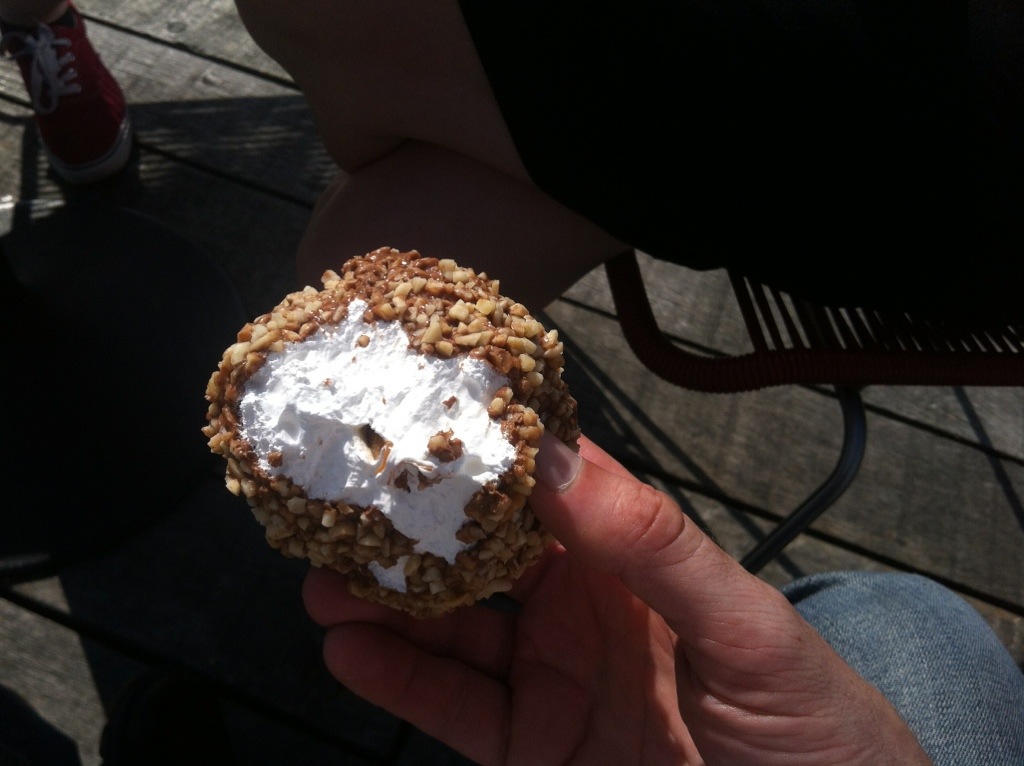
As an opening chord to a holiday, that kind of experience is hard to beat, and I wasn’t about to disagree with my friends’ determination to some day return to the city, either for a visit or a longer stay. We cooled ourselves off with cold beverages, then trekked the length of Nyhavn to the waterside theatre, where we sat again, watching the boats, kayaks and water taxis go by. I also broke open the confections we’d bought earlier and helped myself to one. Shamefully, I can’t remember the name, but it was a mass of marshmallow and caramel, heaped on a thin waffle and coated with chocolate and chopped nuts. Utterly delicious, dreadfully unhealthy and very, very sticky on a hot day like that.

My friends had their own flight to catch, earlier than mine, so too soon I was bidding them farewell with as much thanks as I could offer for their hospitality. After that, I hopped in a canal tour boat for a one-hour trip around the canals of the city. Copenhagen may be short on canals compared to Amsterdam and Venice, but it does okay for itself. The Little Mermaid might have been less notable than the crowds surrounding her, but the city had plenty else to offer, with the highlight for me probably being the twisted dragon-tail tower atop the old stock exchange. It looks like something out of a fantasy novel, and it seemed like a good omen for my trip to a land of myths and sagas.

When the tour was over, I was deposited back at Nyhavn and then roamed the city for an hour or so. The shops were closing up, but the summer spirit was keeping everywhere else alive. Food was needed though, and when an al fresco restaurant proved too expensive, I found myself something a little more to my pocket’s taste: Sunset Boulevard, a Danish spin on fast food, offering sandwiches and herby fries. The bread was very tasty, if a little rough on the soft palate of someone who wasn’t brought up chewing shingles, but for the price (Denmark is not cheap in any sense) it was very welcome.

After that, more roaming, before I headed back to the airport. Perhaps earlier than I needed to, but I had the advantage of knowing that I’d be coming back this way in a few days. The airport’s free wifi having been cracked, I at least had the opportunity to see if anyone had missed me (of course not) and check the status of the world while I was gone. Oh, and write this, of course.

The Icelandic Saga: Book One

20130718-211719.jpg
A fountain of herons in Copenhagen. I had to fight the urge to use a food photo…

It’s been a while since I’ve written once of these. Getting on for two years, in fact. Recent times have not been kind to my straying feet. Still, the fact is that I’m back on the road, or rather in the air, once more, and not just for a quick hop across to London—my only other overseas destination in all that time.

The opportunity to finally make it to Iceland, a long-desired travel destination, was too good to pass up, and I consequently raided my piggy bank to pay for the cheapest flights I could find.* Which brings me to this point: up in the air, on my way to Copenhagen as stage one of a two-part trip to the land of ice and fire.

These days, the act of travelling doesn’t excite me half so much as the fact of being somewhere new. I have an eight-hour layover in Copenhagen between flights, which is something of a bonus arising from my pursuit of value. On an earlier trip, I had intended to spend a few hours in Copenhagen on my way to Stockholm, but train-related misadventures turned those few hours into around 15 minutes. Barely enough to peek outside the train station (the view consisted mainly of bicycles) before catching the next overnighter on my itinerary.

It’s an odd time to be leaving Dublin too. The sun was baking the airport tarmac as we boarded the plane, granting a Mediterranean feel to a nation more accustomed to rain and climatic misery. I should feel right at home in Iceland, it seems: While Copenhagen is sunny at present, Reykjavik seems to be under a cloud right now. Rain-bearing, that is.

This isn’t entirely a solo trip either, for all of my use of the first-person singular thus far. I have friends to meet in my brief tour around Copenhagen, and while I may be arriving in Iceland on my lonesome, and close to midnight, I’ll be meeting my travelling companion the next day. Hopefully, at least: he’s coming from a lot further away than I am, and his travels have been much, much wilder.


*Not a metaphor. At the tail-end of my second college career, my piggy bank is more fully funded than I am.

Bags of Memories

20120622-110856.jpg
Shattered in Salt Lake City: Near the end of its journey…

On my travels around the Northern Hemisphere last autumn, I had the benefit of three faithful companions: three bags that between them carried all my gear. They were on their last legs even then – their ratty appearance, I suspect, had something to do with the fact that I didn’t once face anyone trying to steal from me – and now the last of them has been replaced. Seems like a good time to reflect on them.

The biggest of them, pictured above, was a mid-sized rucksack. It was also the oldest, originally purchased for a skiing trip when I was around sixteen, meaning that it was with me for something close to twenty years. Too unwieldy for short trips, it accompanied me whenever I was going somewhere for a week or more, meaning that it was with me on my most memorable journeys. Its waterproof inner coating was already coming off in sheets at the start of my round-the-world trip, and by the end one of its shoulder straps was hanging on by a thread. However, it went out in a blaze of glory, from Irkutsk to Vladivostok and on to Walden Pond.

My sports/shoulder bag, a black Nike sack, wasn’t quite as old – I bought it around the time I started college – but it was a far more regular companion, seeing use day in and day out for much more than a decade. Quite how it survived all the wear and tear, I don’t know, but it wore down slowly rather than gave way suddenly, and I used it long after it had ceased to look respectable. A hole in a side pocket led to a few lost coins and the right shoulder strap was more of a string by the end, but it was still useful right up until the end. Much less of a traveller than the rucksack, it proved a much more convenient store for everything I didn’t like letting out of arm’s reach as I headed in search of the rising sun.

The smallest of the three bags was a washbag. When I got it, I don’t remember, but I do remember how: it had lain unused in my parents’ house and I nabbed it for a trip somewhere. Ever since then, it accompanied me on every journey, long or short, full of all the toiletries that kids don’t seem to need but adults do. Nothing more than a pouch with a zip and some internal pockets, it was replaced yesterday by a bigger, fussier-looking alternative, which currently sits half-empty in a bigger bag, ready for a trip home.

Three bags, long-used and redolent with memories. All gone now. That’s the way of things. We can hang onto items longer than we should, spurning better alternatives because of the memories that they accrue over years of use. Not the best of ideas. I’m a partial fan of the idea of a de-cluttered life, but my main argument in favour of letting things go is that separating the memories from the things is a good step. Learning to let go of things takes you halfway to allowing your memories to release their hold on you.

The Mammy Principle

20111114-220400.jpg
Even Lenin listened to his mammy.

This modest proposal has been brewing in my brain for a while. Pretty much since St. Petersburg, and that was several months ago now. It might not seem that way, but it was.

If you spend any length of time in a museum or art gallery in Russia, you’ll note a common feature to almost every room: the presence of a middle-aged to elderly lady sitting in the corner. Her purpose? To watch over the unwashed hordes who troop through her fief every day and threaten to do unspeakable things to the wonderful things that have been collected for their perusal. Her only defence against this dark threat: a stare that could reduce a hardened Red Army veteran to a sobbing wreck in only a few seconds.

I have to admit my admiration for the genius of this use of an underutilised resource. Who in Ireland does not know the power of a mammy’s disapproval? Even worse when she has risen to the exalted heights of grandmotherhood and can express her disdain over several generations at once. I shall not even speak of greatgrandmothers, lest I inadvertently draw the attention of one.

Such is the threat that these women wield that they rarely have to employ their glare: being in the same room as one, no matter how large or imposing the room, is enough to remind you of all the times when, as a child, you contemplated raiding the biscuit tin, only to turn and find yourself face to face with someone who knew what you were thinking before you did. I suspect that they only leave their seats to have a natter with one another just to reinforce the connections in their victims’ minds between those childhood guardians and the wardens of Russia’s treasures.

Perhaps, in this time of economic distress, we should seek to make similar use of the deeply-felt power of the mammy. I don’t speak of situating them in our museums, or even our banks or shops, where they would surely make any would-be thief pause in his criminality and slink away, shamefaced. No, the places where we need to situate our mammies are boardrooms and parliamentary chambers. No sooner would a captain of industry contemplate an ethically questionable shortcut to profit or an elected official dream up a scheme to enrich those who aided their rise to power than their inner guilt would kick in, they would look over to the corner to find a pair of steady eyes staring back at them over a copy of Ireland’s Own, and they would then return to find some more difficult yet more virtuous means of attaining their goals.

The price for all of this would be small: an increase in general stress levels among the powerful of the land, a few extra chairs and cushions here and there and a constant stream of tea and biscuits on demand. The rewards, I’m certain, would be many.

Focus and Inspiration

20111028-002915.jpg
Iron and Weeds

I’m counting down the hours to my return at the moment.* One last long transit will take me back to Ireland, via Heathrow. Hopefully the place will have dried out a bit by the time I get there. Should I be worried about my ground floor apartment?

I’ve been in New York for the last few days, stomping out familiar territory as I prepare to return. Although I’ve been here several times in the past, this time around I’ve tried to concentrate on doing things that I’ve never done before. Some are a little obvious, such as going to the top of the Empire State Building. Some are reminders of home, such as cosy pints in the Gingerman Pub. And some are things that I wasn’t even aware of last time I was here, such as walking the High Line.

An elevated railway converted to a linear wildflower garden that offers a unique vantage point over southwestern Manhattan, the High Line is an example of a community project that took a crumbling eyesore and turned it into something that’s not only an asset to the local communities but also a tourist attraction, luring in people who might not otherwise be inclined to visit these parts of New York. I first read about it in a National Geographic article, and that was enough to make me determined to see it and to walk it as I passed through the city.

The High Line is an example of community activism that has had a positive outcome far beyond what the threatened demolition of the line would have provided. Up in the air for the moment is the outcome of a rather more well known outburst of activism: the Occupy Wall Street movement. I’ve been coming across the offshoots of this movement as I’ve passed through the U.S., and I’ve been hearing about its spread across the wider world, but even here in New York it’s hard to say exactly what it’s achieved, or will achieve, beyond attracting attention to itself and drawing the occasional incident of police brutality.

There are a lot of theories in the media about the Occupy Wall Street movement at the moment. Many of them tend to focus on the fact that beyond protesting about the state of things, there’s little sense among the activists of a clear view of what needs to be done. It’s a fair criticism, but also inevitable: this isn’t a protest about something as simple as ending a war or preventing job losses. Ultimately, it’s about changing the way a small but very influential sector of our society works, and societal engineering is a difficult thing to plan, let alone to carry out.

I’ll be interested to see what comes of the Occupy Wall Street movement. Any number of commentators will tell you that something needs to be done if our notions of liberty and justice in society are going to be preserved in the face of an unbalanced distribution of wealth and influence, especially when those with all the money and the weight to throw around are fighting to retain what they have and perhaps gather more as the system creaks beneath them.

Occupy Wall Street may not have the answers. They’re unlikely to ever have as much focus as those who created the High Line. But they are at least asking questions and drawing attention to the need for someone in a position of power to take a longer-term view of where we’re heading. If nothing else, what they’ve done so far has reminded those with a knowledge of history that inequality tends to lead inexorably to unrest and revolution if not dealt with in a serious manner.

*Well, I was when I started this. I’m safely home now, and this is being posted late due to the habit of JFK and Heathrow airports of not avoiding gouging their customers for Internet access if they can possibly avoid it.

The Backward Track

20111023-110803.jpg
Walden Pond: where crowds come to get away from it all.

Scientific impossibility though it may be (apart from for the occasional stray neutrino), time travel has always been a dream of mine. Not so much to see the future, which happens so fast these days that all we have to do is live through it, as to explore the past. Well, my journey from west to east across the U.S. is probably as close as I’m ever going to get to travelling back in time.

I started off in Los Angeles, which was the cultural heart of the world for much of the 20th century and still bears the traces of its 80s heyday, before that hegemony started to splinter. Further north still, I spent time in the palace of one of the barons of early Hollywood, W.R. Hearst, who partied with Flynn and Chaplin and was the thinly disguised subject of Orson Welles’ Citizen Kane.

I dropped in on Steinbeck’s Cannery Row on the way to San Francisco, which still has the antique feel of the late 19th century around various districts, perhaps a reminder of the days when people from all nations travelled there in search of gold and opportunity.

Across the mountains to the east lay two pioneer cities, born from rather different origins: Salt Lake City, built around a core of Mormon settlers escaping persecution/the rule of law (take your pick), and Denver, another gold rush city, proud of its status as the “Mile High City” and its cowboy heritage.

I skipped through Chicago and landed in Washington, D.C., smoothing my path through time a bit. Born in the aftermath of the American Revolution, Washington has the look of a designed city: glance down any of those long boulevards and the chances are that you’ll see some imposing edifice framed at the end of it. Celebrating American Independence, it sets aside a large part of its heart to memorialising the figures who played notable parts in the nation’s history.

Another skip through New York landed me in Boston, keeping that retrograde progress smooth. From this point, I was in the land where the nation was born: the original thirteen colonies that became states in the War of Independence. Washington may enshrine that memory, but these are the places where the action happened.

One side trip brought me face to face with another person who sought to retreat to a simpler time. Henry David Thoreau, whose book Walden recounts his efforts to live simply and at peace with nature by the pond of that name. His legacy attracts plenty of crowds to Walden now, but it’s not hard to walk the path along the water’s edge and suddenly find yourself alone for a moment or two, with just the trees and the water for company.

Of course, you can’t live in the past forever. I’m on my way to New York now, and even if it’s a long-settled city, once the Dutch port of New Amsterdam, there’s probably no more modern place in the U.S. Washington may be the nation’s capital, but it’s New York that the world thinks of as the exemplar of the American city, or perhaps even the nation as a whole. A fitting place to wrap up this trip, perhaps.

Mile High Club Sandwich

20111017-000921.jpg
A Denver breakfast. There is actually fruit in there, under the English muffin…

Sadly, no matter how hard I looked, I couldn’t find a sandwich joint in Denver that used this particular play on words. Not that I would have eaten said sandwich—I just wanted some proof that there are people out there who are as easily pleased by cheap humour as I am. I’m still looking…

Of all the U.S. cities that I’ve been to so far, Denver feels closest to a place I’d want to live in. It’s wide open without trying as hard to impress as Salt Lake City does or being as pedestrian-unfriendly as Los Angeles. It’s also laid back without being as touristy as San Francisco. One thing that I would miss is the sea. Or, more broadly, moisture in general. I don’t know whether it was the altitude or the sunny weather or some combination of the two, but I spent most of my 24 hours there gasping for a drink.

As much as I might wish to have had a little more time in Denver, my whistle-stop tour of the U.S. is working out well so far. After lurking around LA for a few days, I’ve spent no more than a night in any place since then, confining myself to 24 hours each in Denver and Salt Lake City, 20 hours in San Francisco, and a mere hour and a half in Chicago. I’d originally planned for a whole day there, but with accommodation being scarce and expensive this weekend and myself having visited there a mere six months ago, it was easier just to skip it and head for Washington, D.C.

So I’m getting ever closer to home in time and space. When I hit D.C., I won’t be far from the Atlantic Ocean, and there are only twelve days left before I have to catch my flight from JFK. These blogs entries have only really scratched the surface of all that I’ve seen and done over the past month and a bit; the places I’ve seen, things I’ve done and people I’ve met. I’ll have plenty of time to reflect and write some notes when I return, but for the moment I’ll keep on exploring.

Oh, and for those of you viewing this on Facebook rather than the main site, I’ve updated my Flickr account with some new photos. They should be visible in the sidebar to the right.

Justified and Ancient

20111012-231203.jpg
Not actually made out of Lego.

On the train to Salt Lake City, I had my first Mormon experience a little ahead of schedule, when an elderly gentleman sitting nearby started chatting and soon began to try and persuade myself and another passenger (he’d mistaken us for a couple) that the Church of Jesus Christ of the Latter Day Saints was the be all and end all of the Christian experience. Intent as I was on enjoying the train ride, I limited my responses to nods and making a few historical points, but when he claimed that the temple in Salt Lake City was the most beautiful building in the world, it at least gave me something to add to my sightseeing list.

Well, I’ve seen it (that’s it up above, as seen from the tower-block church headquarters next door). Seen it in the darkness, after my train got in at 3am and I decided to wander around; seen it in the sun, though without being let in, as it’s sacred even among the church members themselves; and seen it at sunset, which was pretty damn magnificent (the sunset, that is), viewed from the State Capitol on the hill above. And, well, it’s . . . nice. Solidly built out of granite, with hints of both Disney and Gothic styles in there. But that’s as far as it goes. Even when judged against other religious edifices, it’s no Hagia Sophia and no Pantheon. It doesn’t even hold a candle to St. Peter’s Basilica, which lacks the purity of form of the first two.

The fact that it was built over the course of 40 years by pioneers carting granite from a quarry a few miles away is impressive, though that point falters a bit when one realizes that most of the building happened after the railroad arrived, allowing rather faster stone deliveries. Ultimately, it’s a solid building with a plain facade, a golden statue on top and an unfortunate resemblance to a build-it-yourself Lego kit. To call it the most beautiful building in the world requires the speaker to invest it with qualities that exist outside its physical proportions.

This is not to knock the Mormons too much (I’m not going to type out the full church name every time, which they seem to prefer). Each and every one of them whom I met was polite, friendly and happy to chat to a visitor from abroad. Then again, I could count on the fingers of one hand the number of people who’ve been out-and-out rude to me over the course of the past two months or so. I just struggled at times to cope with the blurring of the lines between “belief” and “truth”, and eventually I escaped to the pub and then a cinema to see the excellent Ides of March, which is all about how politics and the real world destroy idealism.

Hmm. Maybe blind faith isn’t so bad after all. Where did I put that pamphlet?

(Hopefully some of the above is coherent – I’m in Denver now, and by my reckoning, I’ve had about six hours of sleep in the last 48. Time for the head to hit the pillow at last.)

Moving On

20111011-055931.jpg
More comfortable on the inside.

My 20 or so hours in San Francisco marked the first time on this trip since London that I’ve crossed paths with a former journey. Seven and a half years ago I was there with a friend, visiting a friend of ours and his then relatively new girlfriend. They’re now married and living in London, and it was their house I crashed in on the first night of this odyssey. The very first digital photos I ever took were on that trip, and they’re still on my laptop, which is filling up with the photos from this one. Everything circles around eventually.

San Francisco hasn’t changed much, thankfully. I liked it then and I like it now: a city that seems determined to keep the pressures of the everyday world at arm’s length whenever possible. I had as much fun walking around the piers, up Telegraph Hill, through Chinatown and out to Haight-Ashbury as I have on any of my more exotic walking tours on this trip. Plus, the longer I’m in the U.S., the stronger the mental and emotional ties become that will bring me back home in a few weeks. It’s a nice way to be eased into the end of a journey like this.

If there’s any source of melancholy here, it lies in the seven-and-a-half year gap to my former visit: it was a different time and a different journey, and I was a very different person, still in my twenties and with a lot of things to learn. Yet given just how much has happened in all that time – how much has even happened in the past year – I can’t help but be optimistic when I consider just what I might be reminiscing about in another seven-and-a-half years time. I haven’t got the least clue what that might be, but if it’s this trip, then I’ll be smiling when I think of it.