All posts by cerandor

So. Ch-ch-changes…

Trinity Front Gate in the sunshine.
Trinity in the sunshine. Not all that common, sadly.

I’ve noted a tendency in myself to be overly mysterious in this blog. It’s the drama ham side of me, which doesn’t get many chances to emerge into the light. So when I said that I would talk a little about the things making my life busy lately, I did mean to. It’s just that I’ve been, well, busy.

About a month and a week ago, I returned to college for the first time in just over 14 years. The initial experience was somewhat akin to taking a point-blank blast in the face from the shotgun of knowledge. In a good way. Trinity’s MSc in Interactive Digital Media is nothing if not comprehensive. Over the course of one year, students are expected to absorb as many elements of media theory and production as their tiny minds can cope with. From the practicality of programming, web authoring or 3D modelling to the theoretical realms of cultural and critical theory or interactive narratives, it’s all covered here, and the result is a 9-to-5 (or more) immersion in all aspects of the modern media world.

At this early stage, I’m pleased to say that it’s been not only fascinating but even fun at times. I had a grounding in some fields from previous educational forays (cultural and critical theory, in particular) and from general interest and reading (game design and development, for example), and my liking for puzzling out solutions has helped me to scramble through the early weeks of courses where I was going in more or less blind (programming and 3D modelling). Of course, it helped that the rest of the students have proven to be not only impressively able but also a very friendly bunch.

Almost as interesting, at least to me, is how the course is structured. Each module stands alone, and even the individual strands within those modules are clearly delineated. Even so, there are names and references that crop up across strands, and it’s not hard to see that somewhere further down the line, all of this is going to start fitting together. Maybe not in time for our individual research papers (due early next year), but certainly in time for the group projects that take the place of our final dissertations.

If I may be allowed another metaphor (and I am, because metaphors are cool now), we’re in the “wax-on, wax-off” stage of the Karate Kid. Learning all the basic moves that we’ll string together into massively impressive multimedia projects somewhere further down the line. That’s my theory as to what the idea behind the course is anyway, and right at the moment I feel rather optimistic about getting there.

For now though, I have a reading week without classes and a long list of assignments to get back to. Which reminds me that I’ve probably spent way too long writing this…

October Book Reviews

20121103-090904.jpg
Light, medium and heavy reading.

A quiet month on the book front, due to circumstances about which I’ll be going into more detail anon. The next few months are likely to be just as quiet if not more so on the fiction-reading front, but other things are going to be filling in. So more details on that soon, but for the moment, here are some views on books that came my way last month. (Three of which, by the way, were birthday presents – so thanks John!)

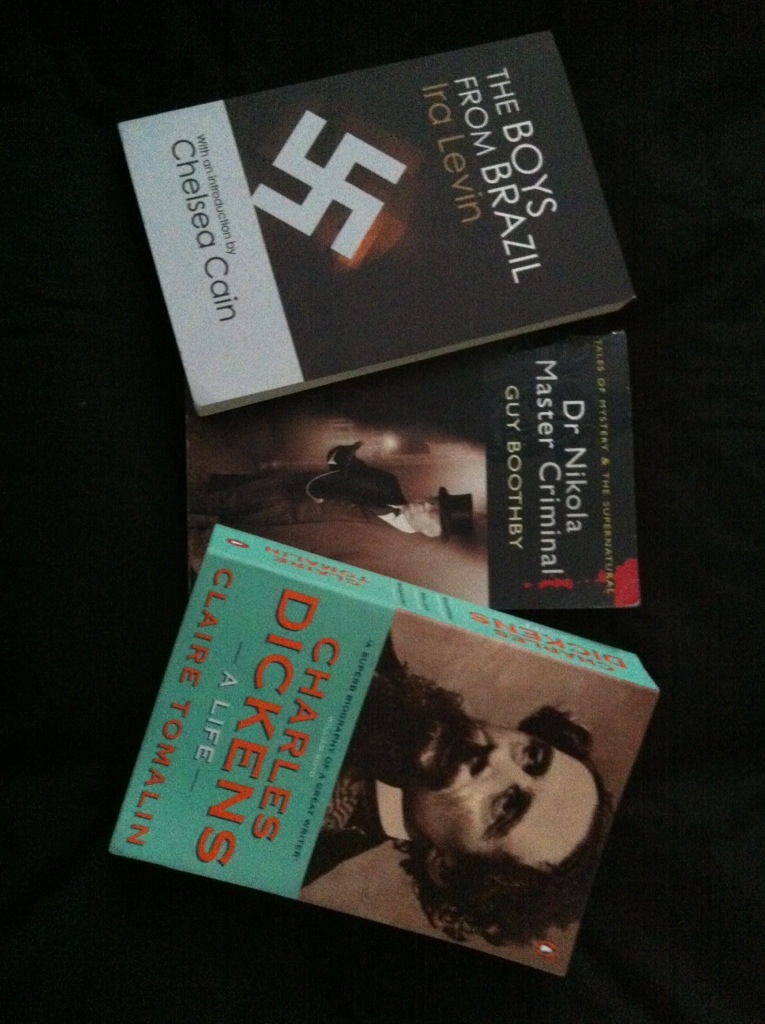
The Boys From Brazil, Ira Levin: A classic of the thriller genre, with the best villains of all – Nazis – pitted against an aging, tired hunter faced with a an unthinkable plot. Levin lays out all the elements of the plot carefully, playing each card at the right time all the way up to the final confrontation. If you’ve seen the movie, then the central twist has already been revealed, but knowing it hardly spoils the book, and in fact the book even explores its ramifications more deeply, though the very last page might be a little too cliched.

Revolution 2.0, Wael Ghonim: A personal memoir of the revolution that toppled Egypt’s government in January and February 2011, told by the Google marketing executive who inspired much of it, this is an eye-opening tale of just what can be achieved through social media. Despite his post at Google, Ghonim’s point of view is a solidly Middle Eastern one, and his revolutionary activities were born out of a love of his country and a desire for justice—two traits that saw him abducted just as the revolution was reaching its height. This is a personal story rather than a blueprint for similar activities elsewhere, and it is unapologetically focused on Egypt, but anyone who is interested in how governments and the Internet are likely to interact in years to come, it’s a must read.

Doctor Nikola, Master Criminal, Guy Boothby: The tales of Doctor Nikola, a gentlemanly criminal mastermind, and his more rough-and-tumble adversaries and compatriots, were exceptionally popular in their time, and two of them are collected here. Boothby’s prose has not dated as well as some, and his action is now too reserved for pulpish excitement and his writing too stilted to get anywhere near the imprimatur of serious literature. However, as a window into British Victorian attitudes and a snapshot of a world where there was still adventure and mystery beyond the horizon, it’s a fascinating diversion.

Charles Dickens: A Life, Claire Tomalin: England’s most representative author gets a thorough going-over from Claire Tomalin, revealing the exceptional talents and the the darker corners of someone who did his best to live up to his own legend. Splitting her attention more or less equally between the man and his works, Tomalin isn’t afraid to point out where Dickens fell short, and indeed she does so with such regularity that you have at times to wince for a man who was protective of his own reputation in his lifetime. Yet with all his flaws and failings, Dickens still manages to come through as someone deserving of his status, and this is an exceptionably readable portrait of a man of genius and the world he inhabited and depicted with unsurpassed skill.

September Book Reviews

20121007-224640.jpg
One of Dublin’s better bookshops. Very handy for Trinity students.

A quiet enough month for reading, dominated as it was by preparations for my return to college. Mostly light reading in what I did manage to get into, insofar as weighty fantasy tomes can be described as “light”. I’m not hopeful of getting much more in during the months to come either, so thin slivers of reviews may become the norm for a while.

Accelerando, Charles Stross: In charting the future history of the human race across the 21st century, as seen through the eyes of a very dysfunctional family, Stross flings out so many ideas and theories that the casual reader is likely to drown without some kind of grounding in modern science and science fiction. Moments of genuine human emotion are present, but they surface all too rarely amid the crashing waves of future shock, and as the novel goes on, it gets harder and harder to maintain the pretense of a link between reality and the events being portrayed. It’s an intriguing book, even a fascinating one if the changes occuring now and in the future to humanity are of interest to you, and Stross is a very clever writer, but its focus on humanity as an abstract whole rather than a personal characteristic is its gaping flaw.

Moranthology, Caitlin Moran: A collection of newspaper columns from the career of the author of How to be a Woman, this is by turns hilarious and affecting as it hops across every topic from womens’ rights to personal history to the hotness of Benedict Cumberbatch. Comberbatch is in fact a recurring theme, and Moran is no less effective when she’s gushing over him as she is when she’s interviewing Keith Richards or Paul McCartney. Blessed with a fine turn of phrase and a winning way with wild metaphors (David Cameron as a camp robot made of ham being one such), she’s like a less grumpy Charlie Brooker, and if her enthusiasm for certain subjects does sometimes get the better of her, it’s far from the worst problem for an author to have.

Gardens of the Moon, Steven Erikson: The self-consciously epic “Malazan Book of the Fallen” series starts off with powers both profane and sacred converging on a doomed city and fighting over not just its fate but that of an entire world. This is fantasy as archaeology, with layers of lost races and civilisations and the reader left to consult the voluminous appendices as the author delights in throwing in yet more twists and new players every time they might be getting on top of all the schemes and counter-schemes. This is not a book for the impatient, nor for fantasy virgins, but for those who enjoy grimy, doomed characters struggling to survive in a world of gods and monsters warring over fate itself, it has a lot to recommend it.

Back to Where I Once Belonged

20120923-112501.jpg
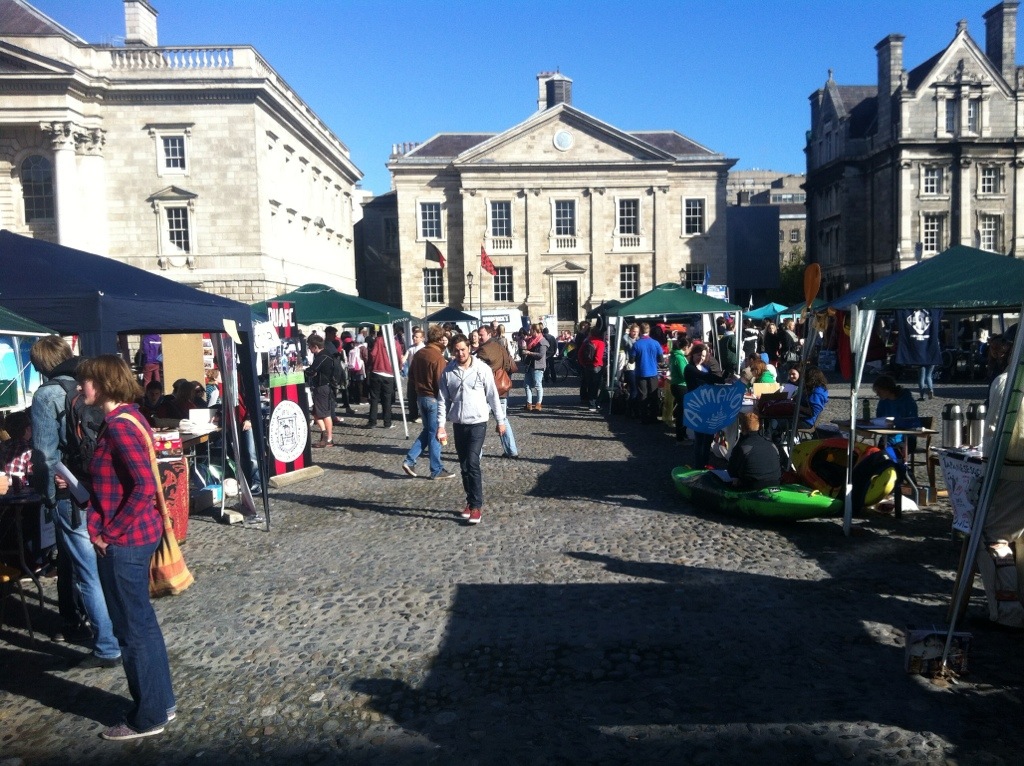
Front Square during Freshers Week: Societies a-go-go

The other day, I mentioned to someone in the pub that I graduated from Trinity College Dublin back in 1998. His response? “Wow, I was ten then.”

Now, I quite like the grey in my stubble, and references to my advanced years rarely bother me. However, there was one difference with this comment: the guy I was talking to wasn’t just a stranger in a pub. He was a classmate.

That’s right: after a gap of fourteen years, I’m heading back to college. Specifically back to Trinity. My goal? To study for an MSc in Interactive Digital Media, a one-year, full-time course. It’s been a strange experience so far; nostalgia and novelty in equal measure.

My first four years in Trinity were a time of change. The college was getting wired up to the Internet and making the most of the nascent boom as it fundraised for new buildings. Over the course of my degree, I made lifelong friends, got my first email address, and found myself a new place to live. I settled in Dublin, got myself a job, and have never been away for long since then.

Even so, reentering education has offered up a lot that’s familiar. Freshers Week, with its host of society kiosks in Front Square, is much the same as ever. The Sports Centre is new since I was a student, but seeing as my fees paid for it and I’ve been using it as a graduate, it’s not exactly novel. All the strangeness, in fact, comes from the fact that I’m in a very different position to my former student life.

Let’s not mince words here: in my class, I’m the oldest, by a good few years. Most of the rest of the class are a few years at most from their graduation. They seem like a great crowd though, and there seems to be a common eagerness to develop an esprit de corps. Given that a lot of the work we’ll be doing is team-based, that can only be positive.

So I doubt I’m going to feel like an outsider here. Even so, most of my fellow postgrads still have the habits of education ingrained in their heads. How much of that has survived a decade and more of a working life? I’m about to find out.

Puzzle Craft – Slim but Beautifully Made

20120902-200317.jpg
A fully-loaded settlement – a far cry from what you start off with.

The recipe for making a game that profits through microtransactions is ostensibly a simple one: provide an enjoyable activity for players and then throw in a few difficulties that they can ease through small purchases. The trick lies in finding the balance between fun and hardship. Too easy and there’s no reason for anyone to reach for the microtransaction button; too hard and players will feel that they’re being gouged.

Right from the start, the iOS game Puzzle Craft (€0.79) from Chillingo gets two things very right. First the name: puzzle games are perfect for smartphones and tablets, and the “craft” suffix has worked for some major properties (World of Warcraft and Minecraft most obviously). Second the art, which is a luscious spin on the Euro boardgames style, with tiny, characterful workers and cartoonish buildings. However, when it comes to gameplay, it errs (perhaps understandably) on the easy side of the microtransaction equation.

The goal of the game is straightforward: collect resources to build your settlement up into a city, complete with castle. The resources are collected by dragging your finger to link up groups of tiles on two 6×6 grids, representing a farm and a mine. Both cash and resources can be used to hire workers, craft tools and construct buildings, introducing higher-level resources and easing the process of building up their stockpiles. The game is generous with its handouts, and the core mechanic of linking resources will stick in your brain when you put the game away for a while.

The problem (apart from some serous bugs that have supposedly been squashed in the latest update) is that there just isn’t a huge amount to do at the moment. The only current element to the game, the “campaign mode”, in which you build up your settlement to a city complete with castle, isn’t going to last for more than a week. Worse, there isn’t much challenge to be had along the way. The lack of a need to reach for microtransactions isn’t wholly a bad thing: this isn’t a free game, after all, and €0.79 for a week’s worth of fun is a decent deal.

Further content is promised, though exactly what that might be isn’t clear yet. Hopefully, it will provide a little more challenge and add some replayability and a social aspect. For the moment though, picking up this game will deliver a gentle, slick and appealing city-building game that you’ll come back to again and again as long as it lasts.

August Book Reviews

20120901-122337.jpg
Not all of my books are for entertainment. Just most of them…

Not too much fiction this month, but plenty of history, psychology and literary advice. All of which adds up to, well, probably a need to dive into something a little more lightweight in September, what with all the craziness about to be fighting for my brain space.

In the Shadow of the Sword, Tom Holland: Holland has made a career out of examining turning points in history, and this time he dives into one of the most contentious and mystery-shrouded upheavals: the birth of Islam and the world that it overturned. He first delineates the nature of that world, then offers up a strong argument that Islam was not so much a new divine revelation as a new tapestry woven out of the threads of the old world. Covering a vast span of space and time, it remains readable despite the depth of detail, as all of Holland’s books have been, but with few strong and vivid characters, readers might struggle to find an entry point into this strange world of clashing civilisations, religions and desires for domination.

Style: The Art of Writing Well, F.L. Lucas: A classic among books on writing, yet out of print for four decades, Lucas’s book excels in practicing what it preaches: it not only tells one how to write well, but it is also written well. The modern reader will occasionally bump against the author’s viewpoint (that of a scholarly Englishman in the post-World War II world), but his advice is always easy to understand, often funny, and bolstered with examples of the finest writing in many languages. Only one of the eleven chapters delves into technical matters – the rest cover more fundamental issues of style, focusing on how writers can best communicate with readers and providing plenty for both to learn from and enjoy.

Ancient Echoes, Robert Holdstock: Once more delving into the psychological and mythical depths that provided him with the material for Mythago Wood, Holdstock provides a tale that feels more specific and grounded, yet less satisfying at the same time. To a large degree, the meat of the story takes place within the psyche of the protagonist, with the narrative point of view zooming in and out relative to how deep the story is delving, and as he comes face to face with remnants of prehistoric time, buried cities and their need for vengeance, and the threat of marriage and parenthood dissolving. It’s a heady brew to manage, and it never quite comes together, with a heavy expository passage towards the end and a reliance on a rather literal deus ex machina to bring it all to some sort of closure.

I, Claudius, Robert Graves: Fact and fiction form a perfect mix in Graves’ famous pseudo-memoir of the fourth Emperor of Rome. Ever the outsider, Claudius observes the long, tortured decline of his family, from the travails of Augustus to the depravity of Tiberius and insanity of Caligula, not sparing his own foibles and failings as he presents a picture of lethal ambition that is surprisingly fresh and modern. For all the evident depth of research underlying this work, it’s an easy read, with an unassuming narrator who capably manages his sprawling cast.

The Twelve Caesars, Suetonius (translated by Robert Graves): The lives of the rulers of Rome, from Julius Caesar to Domitian, are laid out in cleared-eyed detail in this fine edition of the classic set of biographies. Suetonius pulls no punches when it comes to describing the worst qualities of the Caesars, but nor does he neglect to mention the finer moments of even the worst of them, and the result is an even handed description of the rulers that Rome suffered and gloried in during the first century AD. In the wealth of incidental detail he provides, there’s plenty to be learned about Roman society and morals, and in his determination to stick with the facts he can find, Suetonius is surprisingly modern (apart from a recurring focus on the importance of omens and auguries in the life and death struggles over the rulership of Rome).

The Brain that Changes Itself, Norman Doidge: In a series of eye-opening case studies, Doidge reveals the brain’s ability to change itself to recover from trauma and to continue to change all the way through adulthood and old age. Overturning the notion of the brain as a machine that gets more and more fixed in its ways from childhood onwards, he shows in inspiring fashion that every one of us is capable of gaining new knowledge and behaviours all through our lives. Although it seems on some places too good to be true, if even a portion of its potential is real, this is a book worth owning, not just reading.

Schadenfreude, or The Little Book of Black Delights, Tim Lihoreau: I will happily admit to suffering from “calicurrophilia”, and while I am resistant to the appeal of “tollophilia”, “mecutempophilia” is another matter (though that might be saying entirely too much). Adopting the tone of an upper-class English savant, Lihoreau takes readers on a ride through the spurious offshoots of schadenfreude, in the form of delights in varying shades of grey and black, with titles that twist the scholarly use of Latin far beyond what it was intended to achieve. It’s not a laugh-out-loud book, but there are few who will read it without finding themselves smiling involuntarily when they are reminded of a pleasure that they perhaps should be more than a little ashamed of.

Running Into (and Out Of) the Darkness

20120812-162933.jpg
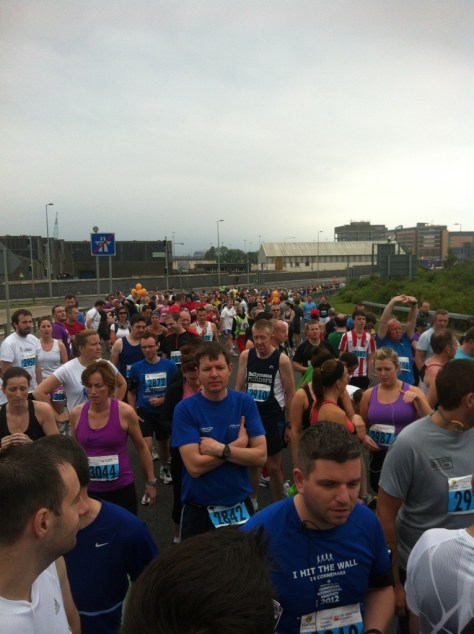
The runners await the off. Grey but not raining at this point.

A little over a year ago, spurred into challenging myself by a combination of boredom and the marathon-running example of my younger brother, I signed up for the Focus Ireland Triathlon. Not having done any serious exercise in years, I was pretty happy to finish the event, let alone do so in the middle of the field. A longer-lasting effect of this success was that I decided to make an effort to maintain my fitness and maybe enter the odd event or two.

That was how I ended up at the Point Village this morning, waiting with a few thousand others to begin the Focus Ireland Tunnel Run, a 10k race through the twin bores of the Port Tunnel that links Dublin’s docklands to the north of the city. Sunday morning may not be the best time for exertion, but it’s a habit of mine to run and swim on a Sunday, so it wasn’t a complete shock to the system. My preparations could have been more professional though: Saturday night drinks with friends and only five hours of sleep, most of which were pretty restless and dominated by dreams of giant spiders – interpret as you will.

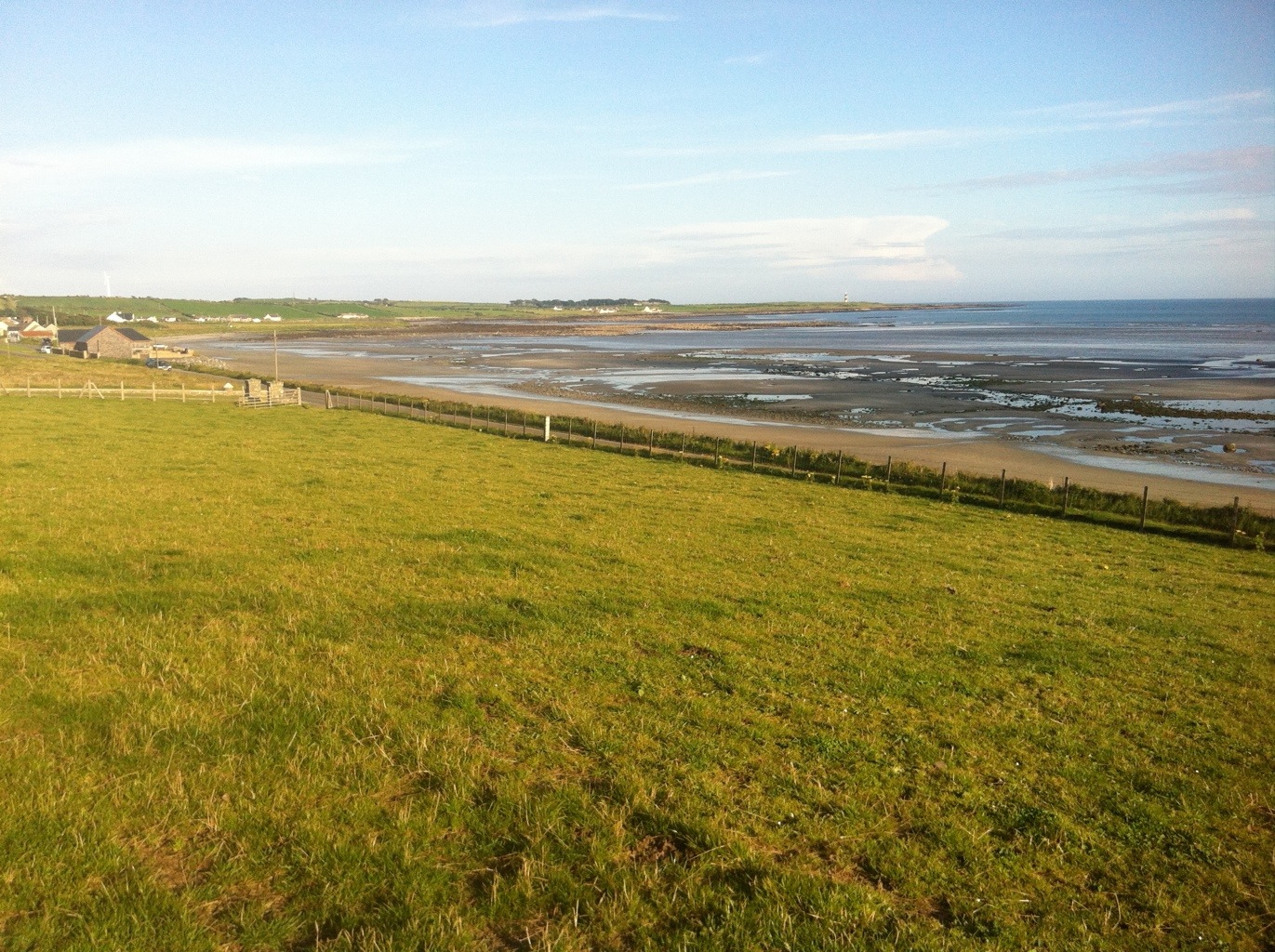
My goal for the run was to finish in 45 minutes or less. Although this was only my third 10k run in the year since the triathlon, I’d managed 46 minutes on the Samsung Night Run, despite pouring rain, an overcrowded course, a futile attempt at shoelace-tying, and the decision to wear my rain jacket all the way through. The other 10k run had taken place the week before the Focus Ireland event, a more leisurely solo run along the coast near home in Northern Ireland.

This was the first time that the Port Tunnel had been closed for runners. A previous 10k event had taken place just before its grand opening, but Focus Ireland had managed to secure it for three hours, hopefully not inconveniencing the Dublin traffic system too much. Organisationally, it all went pretty smoothly, apart from a few glitches, like the Bootcamp Ireland warm up music drowning out the official announcer just before the start.

What the announcer was trying to tell us about was a last-minute change in the plans for the start. Initially, the idea had been for the runners to start in waves, fastest first, presumably to prevent crowding in the two-lane tunnels. Instead, were all released together, shuffling towards the start and then pushing hard for position as we escaped the starter lane. Whatever the reason for the change in starting protocol, crowding proved an illusory problem. The wide toll plaza gave everyone room to run at their own pace before they hit the first tunnel, sorting out the strollers from the runners.

During the much more crowded Samsung Night Run, I’d found myself stuck well back down the order at the start, meaning that when I had the chance to run at pace, I was able to target runners ahead of myself and overhaul them. Being nearer the start, I had few slow runners ahead of me and was overtaken as often as I overtook. Still, running as part of a pack makes it easier to pace yourself, and I felt pretty comfortable after any initial stiffness faded away.

Running through the tunnels proved a strange experience: long, sweeping curves; gentle slopes that were difficult to gauge due to the lack of a horizon; and absolutely no wind. The air didn’t get as stuffy as I’d feared, but it might have been worse for those further behind. There was plenty of space too, and there was more and more as the race went on. Adding some amusement to the run was the fact that the lightboards used to deliver warnings to traffic were instead filled with messages of encouragement for runners, presumably tunnel staff or their family members.

The first tunnel was the tougher of the two, with a long uphill stretch towards the end, and it was a relief to see daylight and the water station at the halfway (actually just over halfway) mark. Quick sips solved any dehydration problem that had lingered from the night before, and the long, gentle downhill slope that began the second tunnel allowed me to push harder as I began the run for home. Other runners must have had a similar idea, as I was overtaken more than I overtook once again, but as soon as I hit the flat, that changed. I had targets in front of me again, and I knew I was closing on the finish line.

The appearance of daylight at the far end of the tunnel was cruelly deceptive, bouncing as it did off several curving walls that marked the end of the hardest uphill stretch of the whole run. Still, the announcement that there were only 500 metres helped me to summon up what energy I had left and head for the line as fast as my tiring legs could take me.

Not quite fast enough, as it turned out. My own timekeeping marked me at 45 minutes and 3 seconds, which the official results would later amend to 45 minutes and 21 seconds. Even so, that was a personal best, placing me 161st fastest among the runners on the day, and far better than I would have considered myself capable of a year ago. I barely noticed the rain as I trudged back to the Point Village to collect my bags. Though to be fair, the rain may well have been steaming off my overheated shoulders as I recovered my breath.

Although it wasn’t quite an Olympian endeavour on my part, it’s hard to be unhappy. A year ago, I hadn’t run in almost 20 years, hadn’t cycled in almost as long, and was at best an indifferent swimmer. The changes since then have contributed a lot to a year that’s been all about rebuilding and expanding my horizons. The simple satisfaction of being in shape and being able to challenge myself and come out on top is a well I plan to keep going back to.

The Olympics Gap

20120809-110418.jpg
Watching the Olympics outdoors in Belfast on a sunny day. Something of a surreal experience.

Much to my surprise, I’ve found myself really enjoying the London Olympics. Having been mired in British cynicism ever since London won the bid many years ago, I guessed that this would be, at best, a mediocre games. Well, I’m glad to say that I was wrong. From the torch run that visited Ireland on the way to criss-crossing the U.K. to Danny Boyle’s spectacular, whimsical and multicultural opening ceremony, the build-up was pitch perfect: positive without being pompous or pretentious. Amazingly, the games themselves took that solid start and ran with it, converting even the most ardent sceptics.

The success that British Olympians have enjoyed in the past two weeks has helped a lot. I’ve been flicking between BBC and RTE for my coverage, and while the former’s constant mood of celebration has occasioned eye-rolling at times, there have been some spectacular moments at times, and the flood of golds have undoubtedly added to the party mood in London. Having considered going last year, I decided against it. A bad move, it seems. Every report I’ve heard has suggested that there’s been no better place to be this summer.

RTE has had a tougher time with its coverage – not having the resources of the BBC, it has more or less devoted one of its channels and much of its Internet resources to covering the massive array of events. The start of the games wasn’t easy for RTE either, with one Irish Olympian after another seeing their hopes of a medal slipping away before the final moments of their events. Thankfully, things seem to have come good at last, with the boxing team, led by the amazing Katie Taylor, now on course to take home a fistful of medals, together with a surprise bronze in the individual showjumping.

Those early struggles though, combined with British success, may have given rise to some suspicions that the Irish media has been deliberately avoiding giving much prominence to the British gold rush. Partly this might be down to the fact that anyone in Ireland who wants to know how the British team is doing can quickly find out by switching (as I’ve been doing) to the BBC. There’s always a small section of the population in Ireland though who’ll reject anything with the taint of Britishness. Whether that extends to the media, I can’t be sure, but I’m glad to say that I’ve only heard of a few examples of it. (About as many as I have of the British media trying to claim our more successful athletes.)

As for myself, despite the fact that I sit at two removes from any sense of Britishness (growing up in a Catholic, nationalist family in Northern Ireland, and living the most recent half of my life in Dublin), I love the fact that this Olympics is so close to home. The BBC has a lot to do with that: it was responsible for at least half of my cultural education, and I tend to prefer watching the Olympics on the BBC rather than RTE, for at least two reasons: no advertisments and a multiplicity of channels, meaning I can watch what I want, when I want.

I can live with the BBC presenters’ over-the-top praise of their athletes as they get swept up in Olympic fever, but when the time comes for coverage of Irish athletes, I’ll turn to RTE for all the details. If nothing else, there are gems in the RTE coverage too. Such as the wildly enthusiastic commentary on the basketball and Jimmy Magee dissolving into raptures every time an Irish boxer lands a punch or two. And when Katie Taylor and the rest of those who have trained for all of their lives for this moment get their just rewards, it won’t matter where my own heritage comes from: I’ll be cheering along with the rest.

Well, that was tense: Curiosity spots the landing

Even as the London Olympics strive to inspire a generation towards physical perfection through washboard abs, world records and tales of Olympian sexual shenanigans in the athletes’ village, inspiration of another kind was taking place several hundred million miles away. Human ingenuity, engineering and scientific skills combined to hurl an SUV-sized vehicle across the void of space and land it within a few hundred metres of its target on the red planet.

NASA has had plenty of practice at flinging scientific instruments at Mars, but this was still no small feat. Missions to Mars have failed before completing their missions around two in every three times. Moreover, the Curiosity rover, part of the Mars Science Laboratory mission, is far larger and more sophisticated than anything landed on Mars before, requiring a Heath Robinson-esque method of getting it safely to the planet’s surface, involving a parachute and a flying sky crane. Since I’m currently sitting here watching some of the first photos from Curiosity, it’s fair to say that the whole thing worked pretty well.

I’m far from alone in getting up early on a bank holiday Monday to catch a glimpse of humanity’s latest adventure on another planet. NASA’s dedicated TV channel lasted long enough to broadcast the euphoric celebrations in the control room before it crashed under the load of viewers from around the world. That kind of enthusiasm, allied to the sheer joy of the crew who have worked for years to bring Curiosity safely to the point where it could begin its mission to survey Mars for signs that it could have supported life at some stage in its past, is simply inspiring.

There will be plenty of news about this, and more science and pictures in the days to come. But for now, it’s great to be reminded of just what we can achieve as a species.

July Book Reviews

20120804-190629.jpg
Nothing to do with books, just a visual representation of my state of mind.

In the absence of anything resembling a summer, it was no hardship to retreat into a few good books (and at least one not so good). Wholly fiction this time out, if with a hint of history in some of the pieces reviewed. Plus, my first review of a graphic novel and a stand-out piece at that.

The Betrayal, Helen Dunmore: In the years after World War II, a Leningrad doctor and his family find themselves caught up in the politics of paranoia and fear, where the desire to be a good human being comes into conflict with the need to protect oneself and those one cares about. Deeply researched, this is a very human story taking place in a world that feels entirely genuine, from the daily lives of those surviving in the last days of Stalin’s reign to the constant fear of the political apparatus that surrounds them and crushes those that come to its notice. It never hits the heights of drama, but that’s not really the point: this is a human story of endurance and patience, one in which the small victory of surviving is enough to overcome the terror of being mangled by the machinery of an oppressive state.

Seven Days in New Crete, Robert Graves: Cast into a future utopia founded on Goddess worship and occult social control, a poet finds himself the catalyst for the introduction of evil as a force for change. Writing in the wake of WWII, from the perspective of a veteran of WWI, Graves is clinical as he cuts into the notion of how ensuring the best of all possible worlds can’t account for the imperfections and the desires of the human heart. His vision of a future grown stagnant in its peaceful compacency is a chilly one, even as it builds towards a frenzied climax, but it’s the voice of the observer who comes to understand the world he finds himself in even as he begins the process of its disintegration that makes this worth reading.

A Visit from the Goon Squad, Jennifer Egan: Charting a spiral course through the lives of an interconnected group of characters, Egan’s novel constucts a web-like frame on which she hangs the struggles of those characters to connect, comprehend and survive everything that life throws at them, as well as their decisions to maintain their masks or reveal their fragile selves. That unusual structure provides much of the life for this novel, which paints its characters in humour and desperation as they strut their brief moments on the stage before stepping into the background of someone else’s tale. It’s an easy book to become attached to, and it’s over all too soon.

Surface Detail, Iain M. Banks: Returning to the Culture, his galactic society of hyper-intelligent AIs and adventurous and occasionally lost humans and aliens, for a tale of war, revenge and heaven and hell, Banks proves himself in fine, if somewhat light, form. The central conceit of artificially constructed hells and a war fought over the moral right to destroy them interweaves with a woman seeking revenge for her own murder, but this is a romp with disturbing overtones rather than an exploration of deeper themes. Tinged with more Adamsian touches than usual, particularly in the form of a warship AI absurdly delighted at the opportunity to exercise his gifts, but this is a fine addition to the series of Culture novels in its own right, albeit one where the whimsy occludes the admittedly heavy subject matter.

Criminal: The Deluxe Edition, Ed Brubaker and Sean Phillips: Brubaker and Phillips are one of the finest writer-artist teams in comics, and this beautifully presented collection of three interwoven tales of betrayal and secrets among the criminal fraternity is a fantastic introduction to their oeuvre. Damned by their own pasts, the protagonists of the three tales may be the most moral of the characters inhabiting their shared world, but that’s a relative term, and the world of the lawless that they inhabit is one where no-one has clean hands and the spark of hope is always at risk of being snuffed out by someone more brutal or better prepared to step beyond the bounds of the unthinkable. Phillips’ scratchy, yet solid, art perfectly matches Brubaker’s terse dialogue and descriptive narration, and together they create a world of dark corners and filthy alleys that’s impossible not to get sucked into.

Mythago Wood, Robert Holdstock: Delving back deeper than Tolkienian fantasy, Holdstock works with the clay of primal mythmaking as he crafts a tale of a family whose encounters with the last vestiges of chilly antiquity change them utterly. Steeped in British folklore and spanning the human imagination from the last ice age to the second world war, this is a story in which the very human emotions of love and loss are rooted in and sometimes overwhelmed by the unconscious need to craft stories out of the world that surrounds us. Deservedly a modern classic of the fantasy genre, it’s a fascinating read, dominated by the stunning creation of the myth-infused world that lies within a single scrap of primeval woodland.

The Bone Hunters, Tom Holland: When one of your leading characters is a “naive but wilful heiress,” you know that you’re in for a traditional romance, for all that the setting is the Bone Wars between palaeontologists in 19th century U.S., amid the blood and recrimination of the Indian Wars. So it proves to be, though that’s a far less important sin for this book than the kludgy language and the choice of the author to mark every encounter and glance between two characters with at least three paragraphs of insight, flashback and emotional resonance. There’s an interesting story here, one with historical resonance and clever use of its setting, but it’s buried very, very deeply by the language and syntax, and I’m still not altogether sure it was worth unearthing it.